Chaga and Diabetes
300 mg/kg LIOP
Low molecular weight chaga polysaccharide at 300 mg/kg for 8 weeks reduced urinary albumin-creatinine ratio, restored glomerular capsule integrity, and suppressed NF-κB/TGF-β1 signaling in diabetic nephropathy mice.
Chou et al., International Journal of Molecular Sciences, 2016
Paradox
same species that protects diabetic kidneys in mice has caused oxalate nephropathy in humans
3 Independent Studies
converge on kidney protection via NF-κB/TGF-β1 suppression
0 Eye Trials
no published study tests chaga directly against diabetic retinopathy
Chou et al., International Journal of Molecular Sciences, 2016
 View as image ↗
Diabetes damages small blood vessels. Over years, that damage concentrates in two organs with dense microvasculature: the kidneys (diabetic nephropathy) and the eyes (diabetic retinopathy). Preclinical researchers have tested chaga (Inonotus obliquus) against diabetic kidney disease in multiple rodent models with consistent protective effects. They have not tested it directly against diabetic retinopathy, though related mechanisms (advanced glycation end-product inhibition, oxidative stress reduction) apply in both tissues. The strange part of this article is the central paradox: the same mushroom that protects mouse kidneys from diabetic injury has also been linked in humans to oxalate-induced kidney failure. Both things are in the published record. Both deserve attention. For the mechanistic underpinnings, see our chaga and AMPK activation and chaga and blood sugar articles.
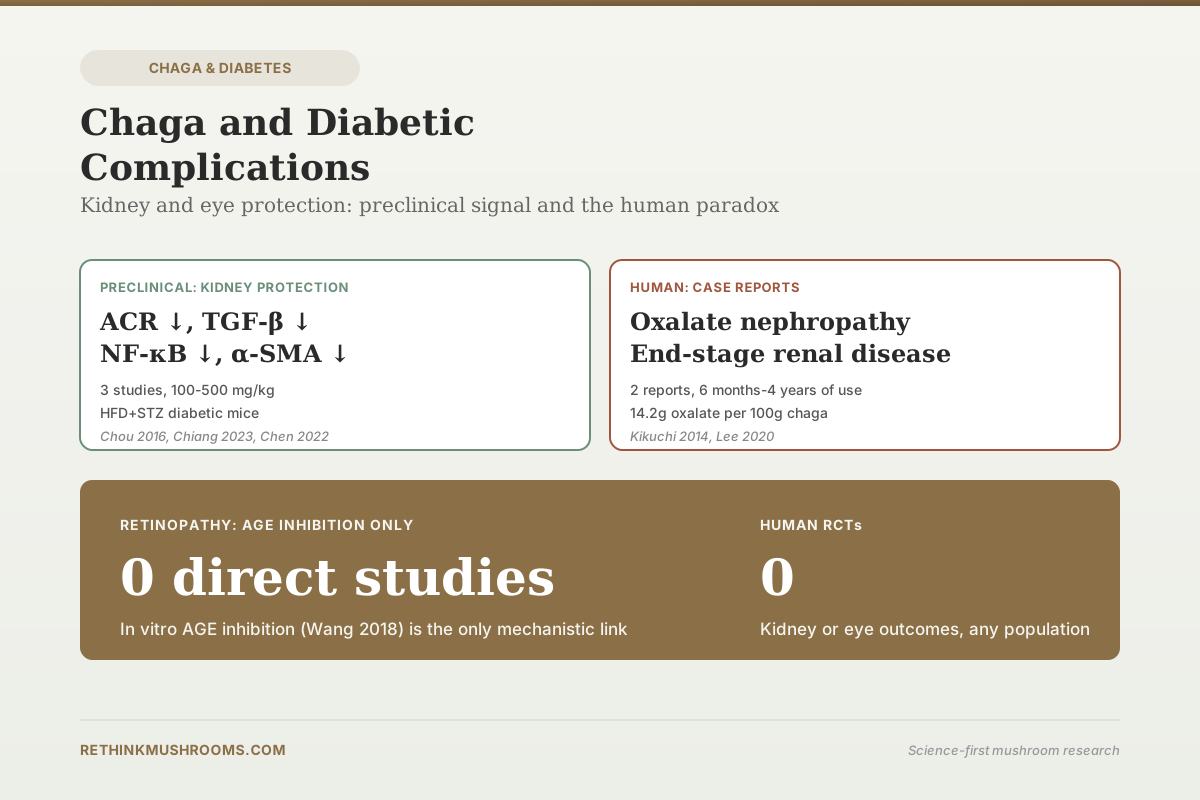
The short version: chaga polysaccharides reduce diabetic kidney disease markers across at least three independent rodent studies at 100-500 mg/kg, via NF-κB and TGF-β1 suppression. At high chronic doses in humans, chaga has produced oxalate nephropathy and end-stage renal disease. The dose at which benefit appears in rodents and the exposure at which human injury has appeared occupy overlapping territory. No chaga eye trial exists.
Key Takeaways
- Chaga ethanol-ethyl acetate extract (EtCE-EA) at 100-500 mg/kg improved blood glucose, albumin-creatinine ratio, serum creatinine, and BUN in streptozotocin-plus-unilateral-nephrectomy diabetic nephropathy mice, with dose-dependent reduction of TGF-β and α-SMA (Chiang et al., IJMS, 2023)
- Low molecular weight chaga polysaccharide (LIOP) at 300 mg/kg for 8 weeks reduced urinary ACR, restored glomerular capsule integrity, and decreased NF-κB and TGF-β expression in HFD+STZ diabetic nephropathy mice (Chou et al., IJMS, 2016)
- Chaga extract at 150 mg/kg for 5 weeks reduced blood glucose and restored pancreatic β-cell numbers while reducing liver, kidney, and pancreas tissue damage in HFD+STZ diabetic mice (Chen et al., Nutrición Hospitalaria, 2022)
- Chaga polysaccharides inhibited all three phases of advanced glycation end-product formation and blocked α-amylase and α-glucosidase activity in vitro, relevant to the mechanism driving both diabetic nephropathy and retinopathy (Wang et al., Food and Chemical Toxicology, 2018)
- Two human case reports linked chronic chaga powder use to oxalate nephropathy requiring hemodialysis (6 months of 4-5 teaspoons daily) and end-stage renal disease (4 years of use), with measured chaga oxalate content at 14.2g per 100g (Kikuchi et al., Clinical Nephrology, 2014; Lee et al., Journal of Korean Medical Science, 2020)
- Zero published studies have directly tested chaga against diabetic retinopathy, cataract formation, or any other ocular diabetic complication
Why Kidneys and Eyes Fail in Diabetes
Chronic hyperglycemia damages tissues through three main routes, all especially active in small blood vessels.
First, excess glucose reacts non-enzymatically with proteins and lipids to form advanced glycation end-products (AGEs). AGEs accumulate in tissues with slow protein turnover (basement membranes, collagen, lens proteins) and progressively stiffen and dysregulate them. AGE binding to the RAGE receptor drives inflammation and oxidative stress.
Second, elevated intracellular glucose shunts through the polyol pathway, depleting NADPH (needed for glutathione regeneration) and building up sorbitol, which is osmotically active and draws water into cells.
Third, hyperglycemia activates protein kinase C isoforms that increase vascular permeability, reduce nitric oxide availability, and promote inflammatory signaling.
The kidney concentrates these effects in glomeruli, where the filtration barrier (podocytes, glomerular basement membrane, endothelial cells) must maintain size and charge selectivity under pressure. Damage manifests as albuminuria (protein leak), rising creatinine, and eventually glomerular sclerosis and tubular fibrosis. Histologically, thickened basement membranes and foot process effacement are the early signs.
The eye concentrates these effects in the retinal microvasculature. Damage manifests as microaneurysms, hemorrhages, exudates, macular edema, and in proliferative stages, neovascularization that can cause vision loss. AGE accumulation in the lens contributes to cataract formation earlier than in non-diabetic individuals.
Any intervention that reduces AGE formation, suppresses NF-κB-driven inflammation, activates the Nrf2 antioxidant response, or dampens TGF-β-driven fibrosis has a plausible theoretical basis for protecting both organ systems. The chaga preclinical literature hits all of these targets.
Chou 2016: The Kidney Benchmark
Chou and colleagues published the first detailed kidney protection study of chaga polysaccharide in diabetic nephropathy in 2016.[1] They isolated a low molecular weight polysaccharide fraction (LIOP, 10-100 kDa) from chaga fruiting bodies and tested it at 300 mg/kg in high-fat-diet-plus-STZ type 2 diabetic nephropathy C57BL/6 mice for 8 weeks.
Findings compared to untreated diabetic controls:
- Progressive improvement in glucose sensitivity (less insulin tolerance)
- Reduced triglyceride levels
- Elevated HDL/LDL ratio
- Reduced urinary albumin/creatinine ratio (ACR), the standard early marker of diabetic nephropathy
- Pathology: restored glomerular capsule integrity, increased glomerular mesangial cells
- Immunohistochemistry: decreased TGF-β expression in the renal cortex
In parallel in vitro work, LIOP at 100 μg/mL protected renal tubular cells (LLC-PK1) against combined STZ and AGE glucotoxicity. NF-κB and TGF-β expression decreased dose-dependently.
NF-κB drives inflammatory cytokine production. TGF-β1 drives tubular-interstitial fibrosis, the scarring process that converts early diabetic nephropathy into irreversible chronic kidney disease. Chaga hitting both of these targets downstream of glucose exposure is mechanistically coherent with the broader preclinical story.
Chiang 2023: A More Severe Model, Same Protection
Chiang and colleagues used a harsher nephropathy model in 2023.[2] Rather than diet-plus-STZ, they combined unilateral nephrectomy (surgically removing one kidney to accelerate chronic renal failure) with STZ. The remaining kidney has to handle all the filtration load while also coping with diabetes. This produces a faster, more severe nephropathy than either insult alone.
Chaga ethanol-ethyl acetate extract (EtCE-EA) was tested at 100, 300, and 500 mg/kg. Outcomes compared to untreated diabetic surgical controls:
- Reduced blood glucose
- Reduced albumin-creatinine ratio
- Reduced serum creatinine
- Reduced BUN (blood urea nitrogen)
- Improved renal histology
- Dose-dependent reduction of TGF-β and α-SMA (α-smooth muscle actin, a myofibroblast marker indicating renal fibrosis)
The 300 mg/kg dose produced notable improvement; the 500 mg/kg dose produced additional incremental benefit. TGF-β and α-SMA reductions indicate the active mechanism includes suppression of the fibrosis program that drives irreversible kidney scarring. This matches Chou's earlier finding on the same signaling axis, now replicated in a more severe injury model with a different extract (ethanol-ethyl acetate rather than water polysaccharide).
Chen 2022: Lower Dose, Shorter Duration, Same Direction
Chen and colleagues used 150 mg/kg chaga extract for 5 weeks in HFD+STZ diabetic mice.[3] Despite the lower dose and shorter duration, the study found:
- Reduced blood glucose
- Restored body weight
- Enhanced insulin sensitivity and tolerance
- Improved glucose tolerance
- Reduced LDL and triglycerides
- Pancreatic section: increased numbers of normal islet β cells
- Liver section: reduced focal necrosis
- Kidney section: reversed HFD+STZ-induced injury
The study's histological evaluation of liver, kidney, and pancreas together supports the idea that chaga's diabetic complication protection is multi-organ rather than kidney-specific. Wang and colleagues in 2017 reached a similar conclusion from a different angle, noting that their 900 mg/kg IOPS treatment alleviated STZ-lesioned liver, kidney, and pancreas tissue in the same diabetic mouse model.[4]
AGE Inhibition and the Retinopathy Bridge
No study has tested chaga directly against diabetic retinopathy. What exists is mechanistic evidence that chaga blocks the chemistry that drives retinopathy.
Wang and colleagues in 2018 tested chaga polysaccharides and their chromium (III) complex against AGE formation, α-amylase activity, α-glucosidase activity, and H2O2-induced oxidative damage in hepatic L02 cells.[5] Key findings:
- All three phases of AGE formation were inhibited (early, intermediate, and late-stage glycation products)
- α-amylase and α-glucosidase were inhibited, reducing postprandial hyperglycemia
- H2O2-induced oxidative damage was reduced
AGE formation is the primary chemical driver of diabetic retinopathy and cataract. The lens is particularly vulnerable because lens crystallins have extremely slow protein turnover, so AGE modifications accumulate over years. An AGE inhibitor, in principle, could slow this process. In practice, no chaga trial in any eye model has been published, and the jump from hepatic cell H2O2 protection to retinal outcome is a large one. For the network pharmacology picture on how chaga's anti-diabetic compounds map to multiple complication pathways, see our chaga AMPK article which summarizes the Randeni 2025 analysis.
The Paradox: Chaga Protects Diabetic Kidneys in Mice and Has Damaged Human Kidneys
This is where the article gets complicated. Two case reports in the published human medical literature have linked chaga powder to kidney injury.
Kikuchi and colleagues described a 72-year-old Japanese woman who consumed 4-5 teaspoons of chaga powder daily for 6 months.[6] She developed oxalate nephropathy requiring hemodialysis. Renal biopsy showed diffuse tubular atrophy, interstitial fibrosis, and oxalate crystals in the tubular lumina. Chaga, the authors documented, contains extremely high oxalate concentrations.
Lee and colleagues described a 49-year-old Korean man who used chaga powder for atopic dermatitis for four years.[7] He developed end-stage renal disease. Biopsy showed chronic tubulointerstitial nephritis with oxalate crystal deposits. The specific chaga powder was measured at 14.2g oxalate per 100g. Estimated daily oxalate intake was 2-5 times normal dietary baseline.
How do we reconcile "chaga protects diabetic kidneys in mice" with "chaga has caused kidney failure in humans"? Several honest observations:
The preparations differ. The mouse studies used aqueous polysaccharide extracts, ethanol-ethyl acetate fractions, or defined polysaccharide molecular weight ranges. The human cases involved raw chaga powder. Oxalate content varies with preparation; ethanolic extracts contain less oxalate than water extracts of the same source material. Most commercial chaga products do not report oxalate content.
The doses overlap. Chou's 300 mg/kg in mice scales to roughly 1.7g daily for a 70 kg adult. Lee's patient consumed chaga powder sufficient to produce oxalate intake 2-5 times normal dietary baseline, which, given chaga's 14.2g oxalate per 100g, corresponds to chaga intake in the gram range daily. The therapeutic and toxic dose territories are not cleanly separated.
The populations differ. Mouse studies used previously healthy animals rendered diabetic acutely. Human cases involved chronic use (6 months to 4 years), and one patient had prior liver surgery. People with diabetes have a higher baseline risk of kidney disease and reduced renal reserve.
Acute protection and chronic toxicity are not mutually exclusive. Chaga polysaccharides could plausibly reduce diabetic kidney injury via NF-κB/TGF-β1 suppression in the short term while chaga's oxalate load drives progressive renal crystal deposition in the long term. Both effects could be real.
The practical implication is that chaga's diabetic complication protection evidence sits under a constraint: the population that might benefit (people with early diabetic kidney disease) is the same population with the most vulnerability to chaga's kidney safety signal. For related safety context, see our articles on taking chaga long-term and the safety of combining multiple mushroom supplements.
What Would Change This
A meaningful human trial of chaga for diabetic nephropathy would need: standardized extract with documented low oxalate content (achievable with ethanolic extraction but not with powder); a defined dose based on the animal data and human scaling; careful kidney function monitoring (eGFR, ACR, urine microscopy for crystals) given the oxalate signal; duration of at least 6 months for meaningful nephropathy progression endpoints; and prior oxalate load assessment in participants. Such a trial has not been registered or published.
A chaga trial for diabetic retinopathy faces an even larger gap, since no prior chaga eye study exists to establish dosing or endpoint expectations. The AGE-inhibition mechanism is a reasonable hypothesis but remains untested in any eye tissue model.
The Bottom Line
Preclinical studies in three independent rodent diabetic nephropathy models show that chaga polysaccharides and ethanolic extracts reduce albuminuria, serum creatinine, and BUN while suppressing NF-κB and TGF-β1 signaling and restoring glomerular histology. The effects are dose-dependent and multi-organ. No human clinical trial of chaga for diabetic nephropathy has been published. Two human case reports link chronic chaga powder use to oxalate nephropathy and end-stage renal disease. The populations most likely to benefit from chaga's preclinical renoprotection overlap with those most vulnerable to its oxalate kidney safety signal. No study has tested chaga directly against diabetic retinopathy, though its AGE-inhibition mechanism is theoretically relevant.
Frequently Asked Questions
Sources & References
- 1RTHM-00423·Chou, Yen-Jung et al. (2016). “Renal Protective Effects of Low Molecular Weight of Inonotus obliquus Polysaccharide (LIOP) on HFD/STZ-Induced Nephropathy in Mice..” International journal of molecular sciences.Study breakdown →PubMed →↩
- 2RTHM-00819·Chiang, Kuang-Hsing et al. (2023). “Renoprotective Impacts of Inonotus obliquus Ethanol-Ethyl Acetate Extract on Combined Streptozotocin and Unilateral Nephrectomy-Induced Diabetic Nephropathy in Mice..” International journal of molecular sciences.Study breakdown →PubMed →↩
- 3RTHM-00750·Chen, Shanshan et al. (2022). “Anti-diabetic effects of Inonotus obliquus extract in high fat diet combined streptozotocin-induced type 2 diabetic mice..” Nutricion hospitalaria.Study breakdown →PubMed →↩
- 4RTHM-00495·Wang, Jia et al. (2017). “Anti-diabetic effects of Inonotus obliquus polysaccharides in streptozotocin-induced type 2 diabetic mice and potential mechanism via PI3K-Akt signal pathway..” Biomedicine & pharmacotherapy = Biomedecine & pharmacotherapie.Study breakdown →PubMed →↩
- 5RTHM-00533·Wang, Cong et al. (2018). “Effects of polysaccharides from Inonotus obliquus and its chromium (III) complex on advanced glycation end-products formation, α-amylase, α-glucosidase activity and H2O2-induced oxidative damage in hepatic L02 cells..” Food and chemical toxicology : an international journal published for the British Industrial Biological Research Association.Study breakdown →PubMed →↩
- 6RTHM-00329·Kikuchi, Yuko et al. (2014). “Chaga mushroom-induced oxalate nephropathy..” Clinical nephrology.Study breakdown →PubMed →↩
- 7RTHM-00630·Lee, Sua et al. (2020). “Development of End Stage Renal Disease after Long-Term Ingestion of Chaga Mushroom: Case Report and Review of Literature..” Journal of Korean medical science.Study breakdown →PubMed →↩