Chaga and Diabetes
α-Amylase + α-Glucosidase Both Inhibited
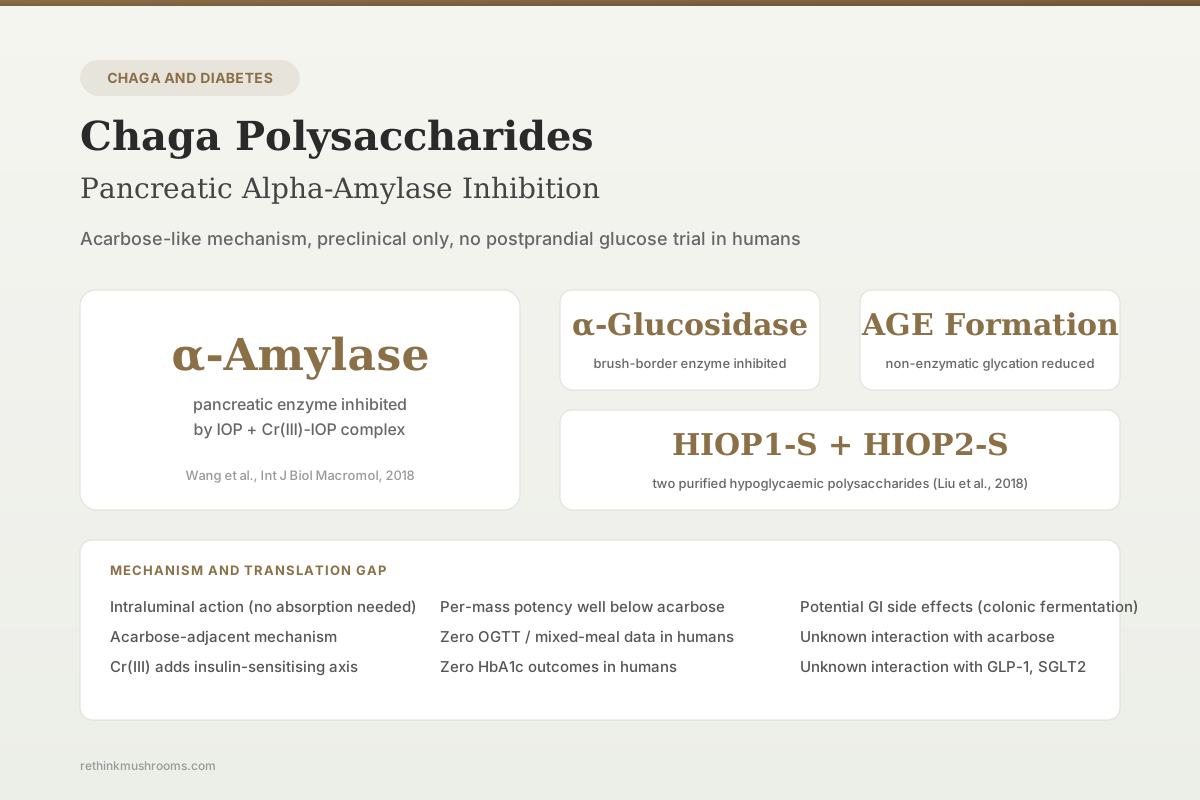
Chaga polysaccharides and their chromium (III) complex inhibit pancreatic α-amylase and intestinal α-glucosidase in vitro, slowing the stepwise hydrolysis of dietary starch to glucose. This is the same mechanism that underpins acarbose, a first-line antidiabetic drug. The translation gap is the absence of any clinical trial testing chaga's postprandial glucose effect in humans.
Wang et al., Int J Biol Macromol, 2018
Cr(III) complex
chromium-complexed chaga polysaccharide adds insulin-sensitising activity alongside enzyme inhibition (Wang et al., 2018)
HIOP1-S + HIOP2-S
two purified chaga polysaccharides with documented hypoglycaemic activity and structural characterisation (Liu et al., 2018)
0 human trials
no RCT has tested chaga for postprandial glucose excursion, oral glucose tolerance test response, or HbA1c in people
Wang et al., Int J Biol Macromol, 2018
 View as image ↗
Postprandial glucose excursions are a central driver of type 2 diabetes complications and vascular risk, independent of fasting glucose. After a meal, salivary and pancreatic α-amylase hydrolyse dietary starch into maltose and shorter oligosaccharides; intestinal brush-border α-glucosidase (including maltase, sucrase, and isomaltase activities) then releases free glucose for absorption. Inhibiting either step slows glucose delivery to the bloodstream, blunting postprandial peaks. Acarbose, a pharmaceutical α-glucosidase inhibitor, exploits this mechanism with decades of clinical trial data in type 2 diabetes. Chaga polysaccharides and their chromium (III) complex replicate both α-amylase and α-glucosidase inhibition in vitro, adding enzyme-inhibitor mechanism to chaga's broader antidiabetic preclinical portfolio.[1][2] For the broader diabetes context, see chaga for type 2 diabetes: evidence and mechanisms and chaga and blood sugar: hypoglycemic research.
Key Takeaways
- Wang et al. (2018) characterised chaga polysaccharides and their chromium (III) complex as inhibitors of α-amylase, α-glucosidase, and advanced glycation end-product (AGE) formation in vitro
- Liu et al. (2018) isolated and structurally characterised two hypoglycaemic polysaccharides from I. obliquus (HIOP1-S and HIOP2-S), linking specific polysaccharide structures to α-glucosidase inhibition and in vivo blood glucose reduction
- The mechanism of carbohydrate-digesting enzyme inhibition mirrors the mechanism of acarbose, a clinically validated α-glucosidase inhibitor with decades of type 2 diabetes outcomes data
- Chaga polysaccharides act alongside insulin-sensitising mechanisms (PI3K/Akt engagement documented by Wang et al., 2017) and AMPK/ACC activation (Zhang et al., 2021), producing a multi-mechanism preclinical antidiabetic profile
- Chromium (III) complexation adds a second insulin-sensitising dimension; Cr(III) alone has some human T2D clinical evidence, and combining it with chaga polysaccharide produces a single agent with multiple plausible glycemic mechanisms
- No randomised clinical trial has tested chaga for postprandial glucose response, oral glucose tolerance test outcomes, HbA1c, or insulin sensitivity in humans, despite the preclinical enzyme inhibition signal
The Enzymes and Why They Matter
Dietary starch is a polymer of α-1,4 and α-1,6 glucose linkages. Digestion proceeds in two stages. In the mouth and small intestine, α-amylase (salivary and pancreatic isoforms) hydrolyses internal α-1,4 linkages in starch, releasing maltose, maltotriose, and short α-limit dextrins. Pancreatic α-amylase is secreted into the duodenum and reaches peak activity in the proximal small intestine. At the brush border of the small intestinal epithelium, α-glucosidase (including maltase, sucrase, isomaltase, and glucoamylase activities) cleaves these oligosaccharides into glucose monomers, which are then absorbed by SGLT1 and GLUT2 transporters.
Inhibiting either enzyme slows glucose delivery to the bloodstream, producing a flatter postprandial glucose curve. Lower postprandial glucose peaks reduce the glycemic load imposed on pancreatic β-cells for insulin secretion, reduce postprandial hyperinsulinemia, and reduce endothelial exposure to transient hyperglycemia that drives vascular damage in long-standing diabetes.
Acarbose, the prototype pharmaceutical α-glucosidase inhibitor, has demonstrated efficacy in type 2 diabetes (reducing HbA1c by 0.5–0.8% in randomised trials) and in prediabetes (reducing progression to diabetes in the STOP-NIDDM trial). Miglitol and voglibose are related α-glucosidase inhibitors. The class is associated with gastrointestinal side effects (flatulence, diarrhoea, abdominal discomfort) from unabsorbed carbohydrate fermentation by colonic bacteria.
The Wang 2018 Study: Chaga Polysaccharide + Cr(III) + Three Targets
Wang et al. (2018) tested I. obliquus polysaccharide (IOP) and its chromium (III) complex against three interlinked type 2 diabetes targets: α-amylase activity, α-glucosidase activity, and AGE formation.[1] The multi-target design reflects a specific clinical logic: slowing carbohydrate digestion (α-amylase, α-glucosidase) reduces postprandial glucose peaks, while AGE inhibition addresses the accumulated consequences of persistent hyperglycemia by blocking non-enzymatic glycation of long-lived proteins.
The chromium (III) complex matters because Cr(III) is an insulin-sensitising micronutrient with its own type 2 diabetes clinical evidence base. Chromium picolinate has shown modest HbA1c reductions in some T2D RCTs, though meta-analyses are mixed. Complexing chromium to chaga polysaccharide produces a single molecular entity with both chaga-polysaccharide enzyme inhibition and chromium-mediated insulin sensitisation. Whether this combination offers value over the sum of its parts was not directly tested in a split-factor experiment.
The Liu 2018 Study: Structural Characterisation of Two Hypoglycaemic Polysaccharides
Liu et al. (2018) purified two polysaccharides from I. obliquus with documented hypoglycaemic activity: HIOP1-S and HIOP2-S.[2] Both were structurally characterised by sugar composition analysis, glycosidic linkage determination, and molecular weight estimation. Both showed α-glucosidase inhibitory activity in vitro and hypoglycaemic activity in mouse models.
The structure-activity relationship matters because chaga polysaccharide is not a single defined molecule. Different extraction methods and different chaga sources yield polysaccharide fractions with different molecular weights, sugar compositions, and branching patterns. Liu 2018 establishes that specific structural features correlate with enzyme inhibition potency, which is essential for eventual standardisation of a clinically testable chaga polysaccharide product.
How Chaga Polysaccharides Inhibit These Enzymes
The mechanism of polysaccharide inhibition of α-amylase and α-glucosidase is not primarily competitive substrate binding (polysaccharides are not small-molecule analogues of maltose or starch segments). Instead, the likely mechanism is either non-competitive allosteric binding to the enzyme (altering active-site geometry), binding to the substrate (starch or oligosaccharide) and steric hindrance of enzyme access, or binding to mucosal surfaces and slowing the physical encounter between enzyme and substrate.
In vitro kinetic characterisation of chaga polysaccharide inhibition across the published studies has not been sufficient to definitively assign a single mechanism class. The biological effect (reduced glucose release from starch hydrolysis) is robust across studies regardless of the precise kinetic mode.
Comparison with acarbose: acarbose is a competitive inhibitor binding the α-glucosidase active site with an IC50 in the nM range. Chaga polysaccharide potency in the same assays is typically in the μg/mL range, making it orders of magnitude less potent per unit mass than the pharmaceutical inhibitor. Whether this translates to clinically meaningful inhibition at typical chaga consumption levels depends on the luminal polysaccharide concentration achieved during carbohydrate digestion, which has not been measured in humans.
Why Polysaccharides Are Plausible Intraluminal Agents
Unlike small-molecule polyphenols that require systemic absorption for most of their action, polysaccharides can act locally in the gut lumen without requiring absorption. Chaga polysaccharides consumed orally remain in the intestine, where they can directly encounter pancreatic α-amylase (secreted into the duodenum) and brush-border α-glucosidase. This intraluminal site of action makes the in vitro IC50 values more translatable: whatever concentration of polysaccharide is achievable in intestinal lumen after oral intake is the concentration available for enzyme inhibition.
The intraluminal mechanism also explains why chaga polysaccharide effects on gut microbiota (bifidogenic effect documented by Burmasova 2019 for melanin, and microbiome shifts documented by Zhang 2023 for DSS colitis) can coexist with enzyme inhibition: all three effects operate from the luminal side without requiring systemic distribution.
Network Pharmacology Integration
Randeni et al. (2025) applied LC-MS chemical characterisation combined with network pharmacology, molecular docking, and bioinformatics to integrate chaga's antidiabetic compound-target landscape.[3] The approach identified specific chaga compounds (polysaccharides alongside triterpenoids and phenolics) with predicted binding to α-amylase, α-glucosidase, and other T2D-relevant proteins.
Network pharmacology predictions are hypothesis-generating rather than definitive. The convergence between docking-predicted α-glucosidase binding and experimentally documented α-glucosidase inhibition (Wang 2018; Liu 2018) strengthens the overall mechanistic case and suggests additional compound classes worth experimentally testing.
The Missing Postprandial Glucose Trial
For a preparation with well-characterised in vitro α-amylase and α-glucosidase inhibition, the absence of an oral glucose tolerance test (OGTT) or mixed-meal test in humans is notable. The relevant experiment would be simple: randomise healthy volunteers or people with prediabetes to placebo or standardised chaga polysaccharide (dose extrapolated from preclinical studies) given before a standardised meal, then measure postprandial glucose and insulin curves. Outcomes would include peak glucose, area under the glucose curve (AUC), and corresponding insulin measures.
No such trial has been registered or published. Structural barriers include the variable composition of chaga products, the difficulty of masking chaga in a placebo (the flavour and colour are distinctive), and the absence of commercial sponsors for a preparation that cannot easily be patented. Academic investigator-initiated trials could overcome these, but have not been reported.
Fordjour et al. (2023), Ern et al. (2024), and Szychowski et al. (2021) all flag this gap.[4][5][6]
What the Evidence Supports and What It Does Not
| Question | Evidence | Confidence |
|---|---|---|
| Do chaga polysaccharides inhibit α-amylase in vitro? | Yes (Wang et al., 2018) | Moderate |
| Do chaga polysaccharides inhibit α-glucosidase in vitro? | Yes (Wang 2018; Liu 2018) | Moderate |
| Do chaga polysaccharides reduce AGE formation? | Yes with Cr(III) complex (Wang et al., 2018) | Moderate |
| Is the enzyme inhibition potency comparable to acarbose? | No: orders of magnitude less potent per unit mass | N/A |
| Does chaga reduce postprandial glucose in humans? | Not tested; no OGTT or mixed-meal study | None |
| Does chaga affect HbA1c in humans with T2D? | Not tested; no RCT | None |
Safety Considerations Specific to Enzyme Inhibition
If chaga polysaccharides do inhibit intestinal carbohydrate digestion at the doses people actually consume, some considerations from the acarbose experience apply:
Gastrointestinal side effects: Unabsorbed carbohydrate reaching the colon is fermented by bacteria, producing gas and sometimes diarrhoea. Acarbose users commonly experience flatulence, abdominal discomfort, and loose stools. Chaga consumers who report digestive effects may be experiencing a similar fermentation pattern, though this has not been formally documented for chaga.
Bioflora interaction: The bifidogenic effect of chaga melanin (Burmasova 2019) could interact with the substrate-shift effects of enzyme inhibition, producing complex microbiome changes that have not been characterised over long-term use.
Concurrent T2D medication: Patients on acarbose, miglitol, or voglibose face potential additive carbohydrate-digesting enzyme inhibition from chaga. No clinical study has characterised this. Patients on SGLT2 inhibitors, GLP-1 agonists, or DPP-4 inhibitors have different mechanisms and lower theoretical interaction risk, but no data confirm safety.
General chaga safety: The three oxalate nephropathy case reports (Kikuchi 2014; Kwon 2020; Lee 2022) and chaga's antiplatelet activity apply independent of the enzyme-inhibition mechanism and warrant attention in any diabetic population being considered for chaga adjunct use.
The Bottom Line
Chaga polysaccharides inhibit pancreatic α-amylase and intestinal α-glucosidase in vitro. Wang et al. (2018) documented this for I. obliquus polysaccharide and its chromium (III) complex alongside AGE formation inhibition. Liu et al. (2018) structurally characterised two hypoglycaemic chaga polysaccharides (HIOP1-S, HIOP2-S) with α-glucosidase inhibitory activity and in vivo blood glucose reduction in mice. The mechanism mirrors acarbose, though at substantially lower per-mass potency. Chaga polysaccharides act alongside insulin-sensitising mechanisms (PI3K/Akt via Wang et al., 2017; AMPK/ACC via Zhang et al., 2021) to produce a multi-mechanism preclinical antidiabetic profile. Network pharmacology (Randeni et al., 2025) confirms convergent compound-target mapping. No randomised clinical trial has tested chaga for postprandial glucose response, OGTT outcomes, or HbA1c in humans, despite the mechanism being directly testable in a simple postprandial study design.
Frequently Asked Questions
Sources & References
- 1RTHM-00533·Wang, Cong et al. (2018). “Effects of polysaccharides from Inonotus obliquus and its chromium (III) complex on advanced glycation end-products formation, α-amylase, α-glucosidase activity and H2O2-induced oxidative damage in hepatic L02 cells..” Food and chemical toxicology : an international journal published for the British Industrial Biological Research Association.Study breakdown →PubMed →↩
- 2RTHM-00520·Liu, Ping et al. (2018). “Structure Characterization and Hypoglycaemic Activities of Two Polysaccharides from Inonotus obliquus..” Molecules (Basel.Study breakdown →PubMed →↩
- 3RTHM-00948·Randeni, Nidesha et al. (2025). “Elucidating the Anti-Diabetic Mechanisms of Mushroom Chaga (Inonotus obliquus) by Integrating LC-MS, Network Pharmacology, Molecular Docking, and Bioinformatics..” International journal of molecular sciences.Study breakdown →PubMed →↩
- 4RTHM-01694·Fordjour, Eric et al. (2023). “Chaga mushroom: a super-fungus with countless facets and untapped potential..” Frontiers in pharmacology.Study breakdown →PubMed →↩
- 5RTHM-01886·Ern, Phoebe Tee Yon et al. (2024). “Chaga Therapeutic Properties: What This 2024 Review Actually Shows.” Mycology.Study breakdown →PubMed →↩
- 6RTHM-00722·Szychowski, Konrad A et al. (2021). “Inonotus obliquus - from folk medicine to clinical use..” Journal of traditional and complementary medicine.Study breakdown →PubMed →↩