Button Mushroom Health
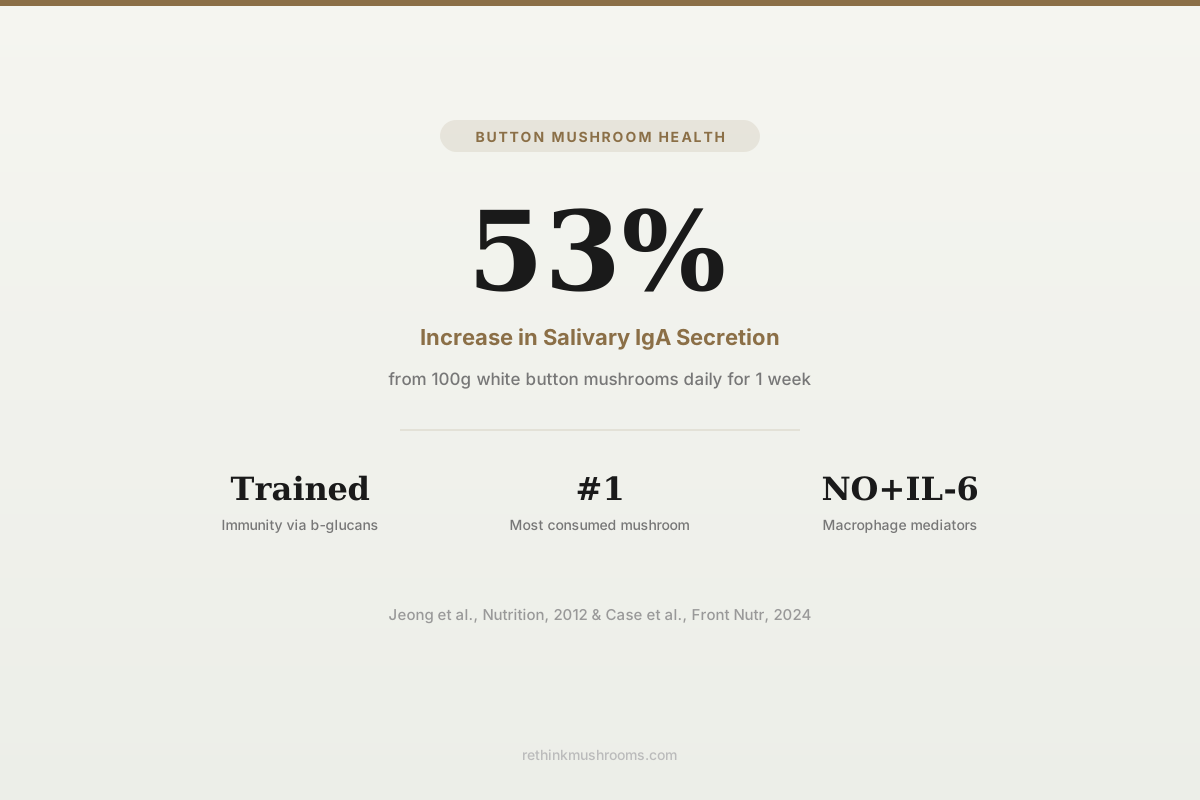
53% sIgA increase
Healthy volunteers eating 100g of white button mushrooms daily for one week showed a 53% increase in salivary immunoglobulin A secretion rate, a frontline mucosal immune marker.
Jeong et al., Nutrition, 2012
Trained Immunity
beta-glucans reprogram macrophage responses
#1 Consumed
most-eaten mushroom species worldwide
NO + TNF-a + IL-6
macrophage mediators stimulated
Jeong et al., Nutrition, 2012
 View as image ↗
Agaricus bisporus, the common white button mushroom, accounts for roughly 45% of global mushroom production. It is the mushroom people eat without thinking of it as medicine. Sold as white button, cremini, or portobello (all the same species at different growth stages), it appears in salads, pizzas, stir-fries, and soups worldwide. The assumption that this ubiquitous food mushroom lacks the bioactive punch of specialized medicinal species like reishi or lion's mane has been challenged by research showing that A. bisporus polysaccharides activate macrophages, drive trained immunity, and increase mucosal antibody production in humans. For a comparison of how maturity stage affects bioactive content, see White vs. cremini vs. portobello: same species, different benefits?.
Key Takeaways
- Healthy volunteers eating 100g of blanched white button mushrooms daily for one week showed a 53% increase in salivary IgA secretion rate, which persisted at 56% in week 2 before returning to baseline by week 3 (Jeong et al., Nutrition, 2012)
- Beta-glucans from Agaricus bisporus drove trained immunity in mouse macrophages: cells pre-exposed to mushroom powder showed enhanced responses to subsequent immune challenges, particularly through TLR-2 stimulation (Case et al., Frontiers in Nutrition, 2024)
- A. bisporus polysaccharide fractions stimulated macrophage production of nitric oxide, interleukin-6, and tumor necrosis factor-alpha, with the water-extracted fraction showing the strongest immunomodulatory activity (Jeong et al., J Med Food, 2012)
- Polysaccharides from A. bisporus and A. brasiliensis (blazei) showed similar macrophage activation profiles, suggesting the common button mushroom provides immune effects comparable to its medicinal relative (Smiderle et al., 2011)
- In immunosuppressed mice, A. bisporus polysaccharides from both fruiting body and cultured mycelium restored immune parameters, with fruiting body polysaccharides showing stronger effects (Liu et al., 2019)
- A single 16g serving of A. bisporus produced measurable plasma ergothioneine increases within hours, with acute effects on antioxidant capacity (Weigand-Heller et al., 2012)
Trained Immunity: Reprogramming the Innate Immune System
The most significant recent finding on button mushroom immunology comes from Case et al. (2024), who demonstrated that beta-glucans from A. bisporus can drive "trained immunity," a concept that has reshaped how immunologists think about the innate immune system.[1]
Classical immunology taught that only the adaptive immune system (T cells, B cells, antibodies) has memory. The innate immune system (macrophages, natural killer cells, neutrophils) was considered reactive but amnesic: responding to each threat as if encountering it for the first time. Trained immunity upends this view. It describes a process by which innate immune cells, particularly macrophages, are epigenetically reprogrammed by initial exposure to certain microbial compounds. After this "training," the cells respond more vigorously to subsequent unrelated immune challenges.
Case et al. found that mouse macrophages pre-treated with white button mushroom powder displayed enhanced responses when restimulated with Toll-like receptor (TLR) ligands. The cells were particularly sensitive to TLR-2 stimulation. Chemical analysis confirmed the presence of alpha-glucose, beta-glucose, and beta-(1-6)-linked glucans in the mushroom powder, along with galactose, fucose, xylose, and mannose side chains.[1]
The trained immunity response from button mushroom beta-glucans was modest compared to training induced by purified yeast-derived beta-glucans (the standard reference compound in trained immunity research). This difference likely reflects concentration: whole mushroom powder contains beta-glucans diluted within a complex food matrix of protein, chitin, and other carbohydrates, while purified yeast beta-glucan is concentrated active compound. The biological significance is that even at food-matrix concentrations, button mushroom beta-glucans can initiate innate immune reprogramming.
The Human IgA Study
Jeong et al. (2012) conducted the only human trial specifically measuring button mushroom effects on immune function. Twelve healthy volunteers consumed 100g of blanched white button mushrooms daily with their normal diet for one week, while 12 control subjects ate their normal diet without mushrooms.[2]
Salivary immunoglobulin A (sIgA) secretion rate increased by 53% at week 1 and 56% at week 2 in the mushroom group, then returned to baseline by week 3 (one week after mushroom consumption ended). The control group showed no significant changes across the same timeframe.
sIgA is the primary antibody defending mucosal surfaces: the lining of the respiratory tract, gut, and urogenital tract. It represents the body's first-contact immune defense against pathogens entering through these surfaces. A 53% increase in secretion rate from a single week of dietary mushroom intake is a substantial effect for a common food.
The study has clear limitations. The sample size (12 per group) is small. The control group was not blinded (they knew they were not eating mushrooms). The sIgA increase reversed after mushroom consumption stopped, indicating the effect requires ongoing intake. Whether this sIgA increase translates to reduced infection rates was not tested. But the magnitude of the effect and the simplicity of the intervention (100g of a common, inexpensive mushroom) make it one of the more practically relevant findings in mushroom immunology.
Macrophage Activation: The Cellular Mechanism
Jeong et al. (2012, separate study) provided the mechanistic foundation by isolating polysaccharide fractions from A. bisporus and testing their effects on murine macrophages. The polysaccharides stimulated macrophage production of nitric oxide (NO), interleukin-6 (IL-6), and tumor necrosis factor-alpha (TNF-alpha), three key mediators of innate immune activation.[3]
Different extraction methods yielded fractions with different immunomodulatory potencies. The water-extracted fraction showed the strongest macrophage-activating effects, followed by alkali-extracted and acid-extracted fractions. This extraction-dependent variation means that how button mushrooms are prepared affects their immune potential. Cooking in water (soups, stews, blanching) may release more immunoactive polysaccharides than dry-heat methods.
The same polysaccharide fractions also showed antitumor activity in mouse models, though the antitumor mechanism appeared to operate through immune activation (stimulating the immune system to recognize and attack tumor cells) rather than direct cytotoxicity. For related research on this mechanism in a close relative, see Agaricus blazei: the most immunostimulating mushroom?.
Button Mushroom vs. Medicinal Mushroom Relatives
A persistent assumption in the mushroom supplement industry is that common culinary mushrooms are nutritionally valuable but immunologically inferior to dedicated medicinal species. Smiderle et al. (2011) challenged this by directly comparing polysaccharides from A. bisporus (button mushroom) and A. brasiliensis (also known as A. blazei, the celebrated medicinal species).[4]
The two species showed similar macrophage activation profiles. Both produced polysaccharides that stimulated nitric oxide and cytokine production through similar pathways. The structural analysis revealed comparable glucan architectures, though with species-specific differences in branching patterns and side-chain composition.
This finding does not mean button mushrooms are interchangeable with A. blazei for all applications. A. blazei contains additional bioactive compounds (blazein, agaritine-derived metabolites) that A. bisporus may lack or produce in different quantities. But for the specific question of polysaccharide-mediated macrophage activation, the common button mushroom provides effects in the same range as its expensive medicinal cousin.
Fruiting Body vs. Mycelium: Which Delivers More
Liu et al. (2019) tested polysaccharides from both the fruiting body and cultured mycelium of A. bisporus in healthy and immunosuppressed mice. Both sources activated immune cells and produced measurable immunomodulatory effects, but the fruiting body polysaccharides showed stronger activity than mycelium-derived polysaccharides across most parameters.[5]
In immunosuppressed mice (treated with cyclophosphamide to reduce immune function), both polysaccharide sources helped restore immune parameters toward normal levels. This suggests button mushroom polysaccharides may be relevant not only for immune enhancement in healthy individuals but also for immune recovery in compromised states, though this has not been tested in humans.
The fruiting body advantage has practical implications. The mushrooms sold in grocery stores are fruiting bodies. Eating whole button mushrooms delivers the more immunoactive polysaccharide fraction directly, without requiring extraction or supplementation.
Beyond Polysaccharides: Ergothioneine
Button mushrooms also provide ergothioneine, a sulfur-containing amino acid antioxidant. Weigand-Heller et al. (2012) demonstrated that a single 16g serving of A. bisporus produced measurable increases in plasma ergothioneine within hours, with acute effects on antioxidant capacity and inflammatory biomarkers.[6]
Ergothioneine's immune relevance is indirect: it accumulates in immune cells (particularly erythrocytes and bone marrow) through the SLC22A4 transporter and may protect these cells from the oxidative stress generated during immune activation. When macrophages produce reactive oxygen species to kill pathogens, ergothioneine helps prevent collateral damage to the macrophages themselves and surrounding tissue. For a full review of ergothioneine's role in health, see Blood ergothioneine levels and all-cause mortality risk.
Dietary Context: What 100g of Button Mushrooms Contains
A 100g serving of raw white button mushrooms (roughly one cup sliced) provides approximately 22 calories, 3.1g of protein, 3.3g of total carbohydrates (including the immunoactive polysaccharides), 1g of fiber, and meaningful amounts of selenium (9.3 mcg), riboflavin (0.4 mg), niacin (3.6 mg), and copper (0.3 mg). The caloric and nutritional cost of the immune-boosting dose used in the Jeong et al. study is minimal.
The beta-glucan content of A. bisporus is estimated at 3-8% of dry weight, though this varies with growing conditions, strain, and maturity stage. At the 100g fresh weight used in the human study (approximately 7-8g dry weight given button mushrooms' ~92% water content), this translates to roughly 200-600 mg of beta-glucans per serving. For comparison, typical beta-glucan supplement capsules provide 250-500 mg per dose. Eating a cup of mushrooms delivers a supplement-equivalent dose of beta-glucans embedded in a food matrix with additional bioactive compounds.
The food-matrix context may matter for bioavailability. Beta-glucans in whole mushrooms are bound within cell walls composed of chitin, a polymer that human digestive enzymes cannot break down. Cooking disrupts chitin structure and releases more polysaccharides. The blanching used in the human study represents moderate cell wall disruption. More extensive cooking (prolonged simmering in soups) may release more beta-glucans, while minimal cooking (brief sauteing) may release less. For related research on the aromatase inhibition properties of button mushrooms, see Button mushroom and breast cancer: the aromatase inhibition discovery.
Limitations and Open Questions
The button mushroom immune research has several gaps. Only one human trial (Jeong 2012, sIgA) has been published, with just 12 subjects per group and no blinding. No human study has measured whether eating button mushrooms reduces actual infection rates, duration, or severity. The trained immunity findings (Case 2024) are in mouse macrophages, not in human cells or clinical settings.
The dose-response relationship is undefined. The human study used 100g daily (roughly one cup of sliced mushrooms). Whether smaller dietary amounts produce proportionally smaller immune effects, or whether there is a threshold below which no effect occurs, is unknown.
Cooking method effects are underexplored. The human study used blanched mushrooms. Whether raw, sauteed, grilled, or soup-cooked mushrooms produce equivalent immune effects depends on how different cooking methods affect beta-glucan availability and polysaccharide structure. Water-based cooking may extract more immunoactive polysaccharides into the cooking liquid, which matters if the liquid is consumed (soups) versus discarded (blanching water).
For a broader view of button mushroom health properties beyond immunity, see Button mushroom health benefits: more than just a salad topping. For related research on vitamin D production in UV-treated button mushrooms, see Button mushroom and vitamin D: UV-exposed varieties.
The Bottom Line
Agaricus bisporus, the common white button mushroom, has demonstrated immune-modulating activity through three mechanisms: trained immunity in macrophages via beta-glucans, increased mucosal IgA secretion in a human trial, and macrophage activation with cytokine production in cell models. Its immunomodulatory profile is comparable to its medicinal relative A. blazei for polysaccharide-mediated effects. Only one human immune trial exists, with 12 subjects and no blinding, leaving the clinical significance of button mushroom immune effects unestablished.
Frequently Asked Questions
Sources & References
- 1RTHM-00867·Case, Sarah et al. (2024). “β-glucans from Agaricus bisporus mushroom products drive Trained Immunity..” Frontiers in nutrition.Study breakdown →PubMed →↩
- 2RTHM-00251·Jeong, Sang Chul et al. (2012). “Dietary intake of Agaricus bisporus white button mushroom accelerates salivary immunoglobulin A secretion in healthy volunteers..” Nutrition (Burbank.Study breakdown →PubMed →↩
- 3RTHM-00250·Jeong, Sang Chul et al. (2012). “Macrophage immunomodulating and antitumor activities of polysaccharides isolated from Agaricus bisporus white button mushrooms..” Journal of medicinal food.Study breakdown →PubMed →↩
- 4RTHM-00234·Smiderle, Fhernanda R et al. (2011). “Polysaccharides from Agaricus bisporus and Agaricus brasiliensis show similarities in their structures and their immunomodulatory effects on human monocytic THP-1 cells..” BMC complementary and alternative medicine.Study breakdown →PubMed →↩
- 5RTHM-00576·Liu, Yang et al. (2019). “Immunomodulatory Activities of Polysaccharides from White Button Mushroom, Agaricus bisporus (Agaricomycetes), Fruiting Bodies and Cultured Mycelia in Healthy and Immunosuppressed Mice..” International journal of medicinal mushrooms.Study breakdown →PubMed →↩
- 6RTHM-00270·Weigand-Heller, AuBrei J et al. (2012). “The bioavailability of ergothioneine from mushrooms (Agaricus bisporus) and the acute effects on antioxidant capacity and biomarkers of inflammation..” Preventive medicine.Study breakdown →PubMed →↩