Mushrooms & Cancer
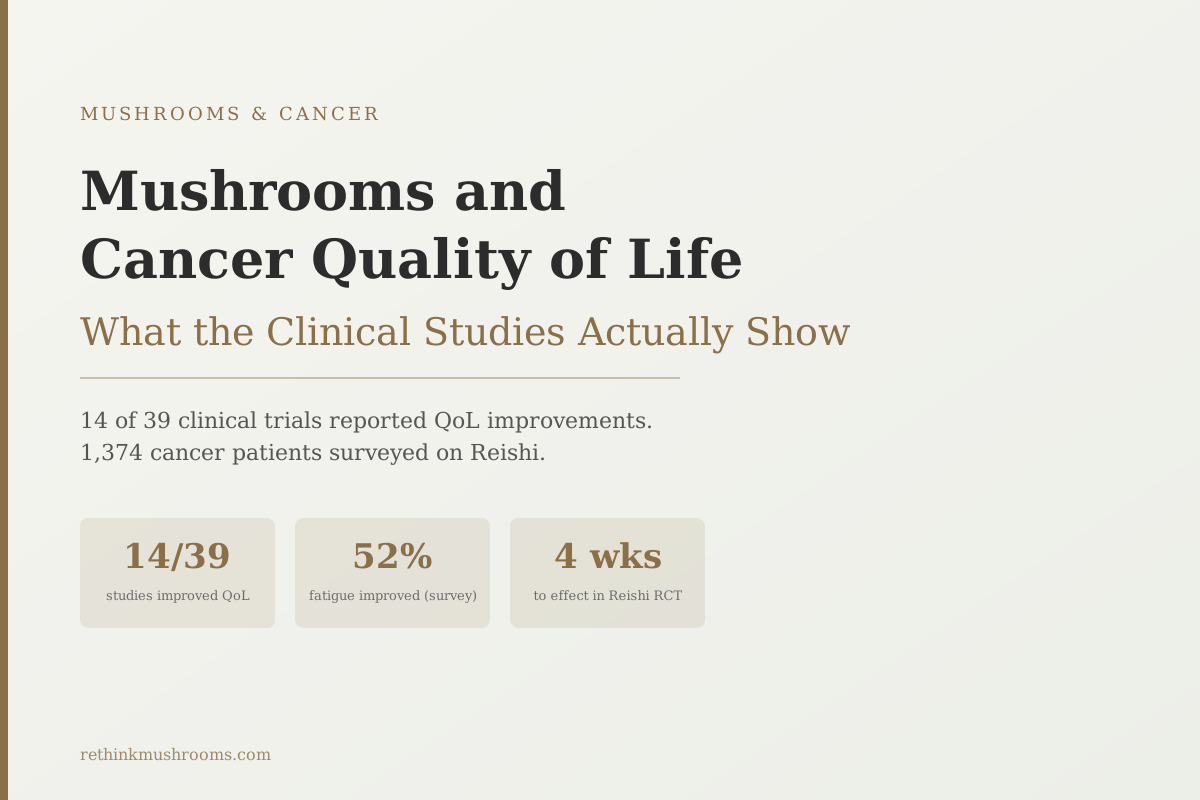
14 of 39 studies
A 2023 systematic review found quality-of-life improvements in 14 of 39 clinical mushroom trials in cancer patients — across 12 different mushroom preparations.
Narayanan et al., Current Oncology Reports, 2023
1,374 patients
surveyed on Reishi for cancer: 52% reported fatigue improved, 55% nausea improved, 51% appetite improved
4 weeks
timeframe in which Reishi spore powder improved fatigue, sleep, and appetite vs. placebo in a 2012 pilot RCT
Grade 2 or lower
severity of most reported adverse effects in clinical mushroom trials in cancer, per the 2023 systematic review
Narayanan et al., Current Oncology Reports, 2023
 View as image ↗
A 2023 systematic review in Current Oncology Reports evaluated the clinical evidence for mushrooms and cancer quality of life by screening 136 studies and finding 39 that met rigorous inclusion criteria. Of those 39, covering 12 different mushroom preparations, quality-of-life improvements or reduced symptom burden were reported in 14 studies.[1]
That figure — 14 of 39 — appears nowhere in consumer-facing cancer health content. Neither does the 2012 randomized controlled trial in which Reishi spore powder significantly improved fatigue, sleep disturbance, and appetite in breast cancer patients within 4 weeks. Nor the 2024 survey of 1,374 cancer patients using Reishi, where more than half reported meaningful improvements across multiple symptoms.
For a comprehensive overview of medicinal mushrooms in oncology research, see the complete guide to medicinal mushrooms and cancer treatment. What follows covers specifically what the research says about quality of life during and after treatment.
Key Takeaways
- A 2023 systematic review (Narayanan et al.) of 39 clinical mushroom trials in cancer patients found quality-of-life improvements in 14 studies across 12 different mushroom preparations — the most comprehensive clinical overview on record
- A 2019 meta-analysis (Zhong et al.) of RCTs found that Coriolus versicolor (turkey tail) and Ganoderma lucidum (Reishi) as cancer adjuncts significantly improved quality-of-life scores and immune parameters compared to conventional treatment alone
- Zhao et al. (2012) — a pilot RCT in 48 breast cancer patients — found Reishi spore powder significantly improved fatigue, physical function, sleep disturbance, appetite, and global quality of life versus placebo after just 4 weeks
- Li et al. (2024), a cross-sectional survey of 1,374 cancer patients using Reishi, found 55% reported nausea improved, 52% fatigue improved, 51% appetite improved, and 50% depression improved
- Agaricus blazei extract improved both NK cell activity (measurable immune function) and quality-of-life scores in gynecological cancer patients undergoing chemotherapy (Ahn et al., 2004)
- Adverse effects in clinical trials were generally mild: the Li 2024 survey found 9.1% of Reishi users reported adverse effects, primarily dry mouth, constipation, and insomnia
What the Evidence on Mushrooms and Cancer Quality of Life Actually Shows
Clinical studies of medicinal mushrooms as cancer adjuncts — particularly Ganoderma lucidum (Reishi) and Trametes versicolor (turkey tail) — report improvements in fatigue, appetite, sleep, and overall quality of life scores in cancer patients undergoing or recovering from conventional treatment. The evidence base is primarily small trials and observational studies, with a growing number of randomized controlled trials and systematic reviews.[1]
The 2023 Narayanan systematic review is the most thorough overview of where this research currently stands. It screened 136 clinical studies, included 39, and found the most commonly studied preparations were Ganoderma lucidum, Trametes versicolor, and Agaricus blazei. Most adverse effects across all included studies were grade 2 or lower, meaning mild to moderate and not requiring treatment discontinuation.
A 2019 meta-analysis by Zhong et al. in Frontiers in Pharmacology specifically analyzed randomized controlled trials of Coriolus versicolor and Ganoderma lucidum as cancer adjuncts.[2] The pooled analysis found statistically significant improvements in quality-of-life scores and immune parameters in the mushroom groups compared to conventional treatment alone. This meta-level finding is supported by a 2023 scoping review by Dan et al. in Cureus, which included nine RCTs and clinical trials on mushrooms in gastric, breast, and colorectal cancers — and found all nine reported benefits including QoL improvements and improved immune function.[10]
A 2020 narrative review by Jeitler et al. in Frontiers in Pharmacology examined 8 RCTs and 1 controlled clinical trial of medicinal mushrooms in cancer patients.[9] The authors reported improvements in QoL, reduced chemotherapy side effects, improved blood cell parameters, and immune modulation, and explicitly recommended integration of medicinal mushrooms into standard oncology care with physician oversight.
For a broader review of the adjunct evidence across cancer types, see the evidence for mushroom-based cancer adjuncts.
Evidence Hierarchy
Mushrooms & Cancer Quality of Life — A Consistent Signal Across Every Tier
The same symptoms — fatigue, appetite, sleep — keep improving whether the evidence comes from pooled RCTs or an uncontrolled survey. But the most rigorous QoL-specific endpoints sit in small pilot trials, while the largest dataset is the one that cannot prove cause. Bar width reflects how much methodological weight each tier carries, not effect size.
Meta-analyses & systematic reviews of RCTs
evidenceZhong 2019 · Narayanan 2023 · Dan 2023 · Jeitler 2020
Pooled RCT evidence: Zhong found significant QoL-score and immune improvements across 23 trials; Narayanan reported QoL improvement or reduced symptom burden in 14 of 39 studies; Dan and Jeitler concur across cancer types
Randomized & controlled trials — QoL endpoints
evidenceZhao 2012 · Ahn 2004
The Zhao pilot RCT improved fatigue, sleep, appetite, physical function, and global QoL versus placebo in 4 weeks; Ahn paired higher NK-cell activity with improved QoL under chemotherapy
Clinical trials — safety & survival
evidenceTorkelson 2012 · Ina 2011
Torkelson established Phase 1 safety and dose-related CD8+ T-cell increases (a foundation for QoL trials, not efficacy); Ina found significantly longer median survival with lentinan added to S-1 chemotherapy
Observational studies & real-world survey
uncontrolledOhno 2013 · Li 2024
Largest reach, least control: Ohno saw QoL gains in remission with no control group, and the 1,374-patient Li survey found >50% reporting improved nausea, fatigue, appetite, and depression — but cannot establish causation
How to read it: convergence is the point. A blinded pilot RCT and a 1,374-patient survey — designs that fail in opposite ways — flag the same responsive symptoms. That agreement is what makes the QoL signal credible. What it is not yet is proof from a large, controlled trial with a QoL primary endpoint, which is the tier the field still needs.
Sources: Narayanan 2023 [1]; Zhong 2019 [2]; Zhao 2012 [3]; Li 2024 [4]; Ahn 2004 [5]; Torkelson 2012 [6]; Ina 2011 [7]; Ohno 2013 [8]; Jeitler 2020 [9]; Dan 2023 [10]. Bar widths are illustrative of methodological weight per tier, not quantitative effect sizes.
The Reishi RCT That Most Cancer Patients Never Hear About
In 2012, Zhao and colleagues published a pilot RCT that has become one of the most cited studies in cancer mushroom research, yet remains almost completely absent from patient-facing information sources.[3]
The trial enrolled 48 women with breast cancer undergoing endocrine therapy — hormone treatment following primary cancer treatment. Participants were randomized to receive Reishi spore powder or placebo for 4 weeks. Quality of life was measured using the EORTC QLQ-C30, the European Organization for Research and Treatment of Cancer's standardized questionnaire, which scores symptoms across multiple domains.
The Reishi group showed statistically significant improvements versus placebo across five separate domains:
Fatigue improved significantly. Cancer-related fatigue is a persistent, debilitating exhaustion distinct from ordinary tiredness; it doesn't resolve with rest and affects 70-100% of people undergoing chemotherapy. Improvement on this endpoint carries substantial clinical weight.
Sleep disturbance improved significantly. Sleep dysfunction is highly prevalent in cancer patients and has bidirectional effects: poor sleep worsens fatigue, pain sensitivity, and immune function. For the mechanisms behind Reishi's effect on sleep specifically, see how Reishi improves sleep quality.
Appetite improved significantly. Appetite loss during chemotherapy contributes to malnutrition, reduced treatment tolerance, and poorer outcomes. Measurable improvement on this endpoint has both QoL and clinical relevance.
Physical function improved significantly — patients reported being better able to perform daily activities.
Global quality of life improved significantly across all domains combined.
This was a pilot trial with a small sample (48 patients), and its results need replication in larger trials. But the directional consistency across five QoL endpoints in a blinded, placebo-controlled design makes it the most rigorous single study on this question. For an in-depth look at the fatigue evidence specifically, see mushrooms for cancer-related fatigue. For the appetite data, see mushrooms and appetite during cancer treatment.
The 2024 Survey: 1,374 Patients on Reishi
The Zhao RCT asked a narrow question in a small, specific group of patients. Li et al. (2024) in Integrative Cancer Therapies asked a much broader one: what do cancer patients who use Reishi actually experience?[4]
The cross-sectional survey included 1,374 cancer patients using Reishi as part of their care. This is a survey, not a clinical trial, so it can't establish causation. But the scale provides something the RCT cannot: a picture of real-world patient experience across different cancer types, stages, and treatment contexts.
Among respondents:
- 55% reported nausea improved quite a bit or very much
- 52% reported fatigue improved quite a bit or very much
- 51% reported poor appetite improved quite a bit or very much
- 50% reported depression improved quite a bit or very much
9.1% reported adverse effects, with dry mouth, constipation, and insomnia as the most common. These are generally mild and reversible.
The convergence between the Zhao RCT endpoints (fatigue, appetite, sleep, overall well-being) and the Li survey results (fatigue, appetite, depression, nausea) across two very different study designs strengthens the overall picture. The same symptoms keep appearing as responsive in both controlled and real-world settings.
For a comprehensive look at fatigue, sleep, and emotional well-being data across species, see mushrooms and cancer quality of life data.
Three More Mushrooms with Quality-of-Life Evidence
Reishi dominates the cancer QoL literature, but three other mushrooms have their own clinical evidence:
Agaricus blazei in gynecological cancer. Ahn et al. (2004) enrolled gynecological cancer patients undergoing chemotherapy and compared those taking an Agaricus blazei extract (Agaricus blazei Murill Kyowa) to controls.[5] The treatment group had significantly higher NK cell activity — NK cells are natural killer cells, part of the immune system's first-response mechanism against cancer cells — and significantly higher quality of life scores, including improvements in physical function and emotional well-being. The study connects two tracks of benefit that are usually measured separately: an immune improvement that is objectively measurable in the lab alongside a subjective quality-of-life improvement on questionnaires. Both appeared together in the treatment group.
Turkey tail in breast cancer. Torkelson et al. (2012) conducted a Phase 1 clinical trial of Trametes versicolor (turkey tail) in women with breast cancer who had recently completed standard primary treatment (chemotherapy and radiotherapy).[6] The primary goal was safety assessment, and the results confirmed that turkey tail was safe and well-tolerated at doses up to 9 grams per day. Immunological improvements were also observed, including dose-related increases in CD8+ T-cell counts — the immune cells that play a central role in recognizing and killing cancer cells. Phase 1 trials establish safety rather than efficacy; but this study establishes the safety foundation for larger QoL-focused trials. For a comparison of Reishi and turkey tail in oncology, see Ganoderma lucidum as a cancer adjunct.
Lentinan in gastric cancer. Ina et al. (2011) studied lentinan, the beta-glucan polysaccharide extracted from shiitake, in gastric cancer patients receiving S-1 chemotherapy (a standard oral chemotherapy regimen).[7] Patients who received lentinan alongside chemotherapy had significantly longer median survival than chemotherapy alone (689 versus 565 days), and also maintained a healthier granulocyte-to-lymphocyte ratio — a marker of preserved immune balance under chemotherapy. The study did not measure quality-of-life questionnaires directly, but the survival and immune-balance findings are relevant to well-being: patients who can tolerate treatment at the prescribed dose, and whose immune function is less suppressed, generally maintain better day-to-day function than those who need dose reductions or breaks. For more on lentinan's unique status in oncology, see lentinan: the shiitake compound approved for cancer treatment in Japan.
Does the Benefit Continue After Active Treatment?
Most cancer QoL research focuses on the treatment period — chemotherapy, radiation, surgery. Ohno et al. (2013) in Complementary Therapies in Medicine asked a different question: do patients in cancer remission benefit from continued Agaricus blazei consumption?[8]
The observational study found that remission patients consuming Agaricus blazei extract reported significant improvements in physical function, social function, and overall quality of life on standardized measures. This is lower-quality evidence (observational, no control group) than the RCT data above, but the finding suggests a potential maintenance role for medicinal mushrooms in the post-treatment phase — where immune support and adaptogenic effects may remain relevant to recovery and ongoing surveillance.
Jeitler et al. (2020) contextualize this within their broader review: they note that the immunomodulatory and adaptogenic effects of mushroom preparations don't necessarily turn off when chemotherapy ends.[9] The physiological disruption of cancer treatment extends into recovery, and the mechanisms by which mushrooms appear to modulate fatigue and immune function are potentially as relevant in remission as during active treatment.
For the mechanisms by which mushroom supplements improve well-being — including how beta-glucans restore NK cell activity and normalize the inflammatory cytokines that drive cancer-related fatigue — see how mushroom supplements improve well-being for cancer patients.
What Clinical Studies Report About Safety
Safety is a legitimate consideration for any supplement taken alongside cancer treatment. Here is what the studies actually report:
Adverse effects in the Li 2024 survey of 1,374 Reishi users were reported by 9.1% of respondents, with dry mouth, constipation, and insomnia as the most common.[4] These are mild and reversible.
Grade 2 or lower adverse effects were the norm across the 39 studies in the Narayanan 2023 systematic review.[1] Grade 2 means moderate — requiring no major intervention and generally not causing treatment discontinuation.
Interaction data between mushroom supplements and specific chemotherapy agents is not fully characterized in the published literature. This is why Jeitler et al. recommend physician oversight for medicinal mushroom use alongside conventional treatment: not because the risk is established, but because the data to characterize the risk is incomplete.[9]
Standardization is a separate issue. The clinical studies use specific standardized preparations — defined extract ratios, beta-glucan content, or pharmaceutical-grade preparations. What's in a commercial supplement product may differ substantially from what was tested in any given trial. The clinical evidence speaks to tested preparations, not the category as a whole.
This article summarizes published research and is not medical advice. Medicinal mushrooms are not a treatment for cancer and are not a substitute for conventional oncology care. If you are undergoing or recovering from cancer treatment, talk with your oncology team before adding any mushroom supplement — some may interact with chemotherapy, and your care team is best placed to weigh the evidence against your specific situation.
The Bottom Line
Clinical evidence for mushrooms and cancer quality of life has grown substantially over the past decade. A 2023 systematic review found QoL improvements in 14 of 39 clinical trials; a 2019 meta-analysis of RCTs found statistically significant improvements for Coriolus and Ganoderma; and the 2012 Zhao RCT showed Reishi spore powder improving five QoL domains versus placebo in just 4 weeks. The 2024 survey of 1,374 Reishi users adds real-world scale. Evidence is strongest for Reishi; adverse effects in studies are generally mild.
Frequently Asked Questions
Sources & References
- 1RTHM-01760·Narayanan, Santhosshi et al. (2023). “Medicinal Mushroom Supplements in Cancer: A Systematic Review of Clinical Studies..” Current oncology reports.Study breakdown →PubMed →↩
- 2RTHM-01155·Zhong, Linda et al. (2019). “Coriolus Versicolor and Ganoderma Lucidum Related Natural Products as an Adjunct Therapy for Cancers: A Systematic Review and Meta-Analysis of Randomized Controlled Trials..” Frontiers in pharmacology.Study breakdown →PubMed →↩
- 3RTHM-00276·Zhao, Hong et al. (2012). “Spore Powder of Ganoderma lucidum Improves Cancer-Related Fatigue in Breast Cancer Patients Undergoing Endocrine Therapy: A Pilot Clinical Trial..” Evidence-based complementary and alternative medicine : eCAM.Study breakdown →PubMed →↩
- 4RTHM-01931·Li, Xiaotong et al. (2024). “Symptom improvements and adverse effects with Reishi mushroom use: A Cross-Sectional survey of cancer patients..” Integrative medicine research.Study breakdown →PubMed →↩
- 5RTHM-00066·Ahn, W-S et al. (2004). “Natural killer cell activity and quality of life were improved by consumption of a mushroom extract, Agaricus blazei Murill Kyowa, in gynecological cancer patients undergoing chemotherapy..” International journal of gynecological cancer : official journal of the International Gynecological Cancer Society.Study breakdown →PubMed →↩
- 6RTHM-00267·Torkelson, Carolyn J et al. (2012). “Phase 1 Clinical Trial of Trametes versicolor in Women with Breast Cancer..” ISRN oncology.Study breakdown →PubMed →↩
- 7RTHM-00404·Ina, Kenji et al. (2011). “Lentinan prolonged survival in patients with gastric cancer receiving S-1-based chemotherapy..” World journal of clinical oncology.Study breakdown →PubMed →↩
- 8RTHM-00299·Ohno, Satoshi et al. (2013). “Quality of life improvements among cancer patients in remission following the consumption of Agaricus blazei Murill mushroom extract..” Complementary therapies in medicine.Study breakdown →PubMed →↩
- 9RTHM-00622·Jeitler, Michael et al. (2020). “Significance of Medicinal Mushrooms in Integrative Oncology: A Narrative Review..” Frontiers in pharmacology.Study breakdown →PubMed →↩
- 10RTHM-01682·Dan, Amit et al. (2023). “Therapeutic Effects of Medicinal Mushrooms on Gastric, Breast, and Colorectal Cancer: A Scoping Review..” Cureus.Study breakdown →PubMed →↩