Mushrooms & Cancer
1,374 cancer patients
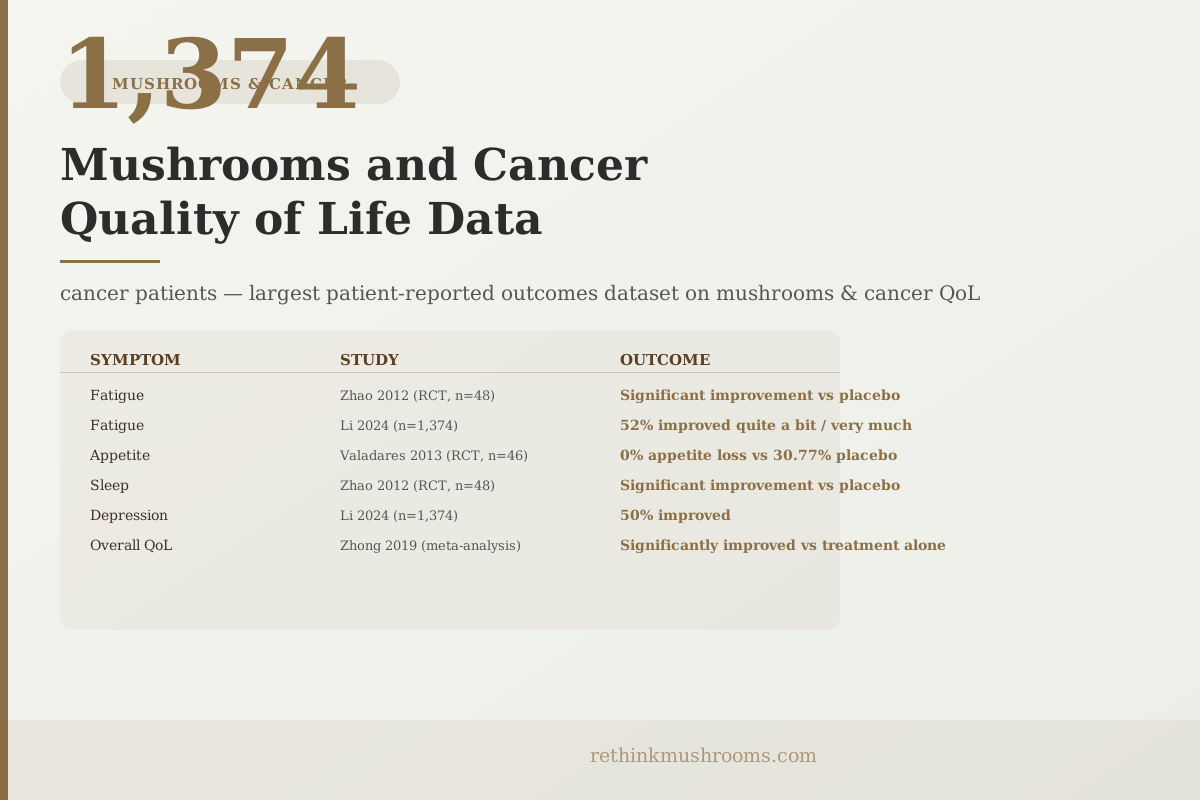
The largest patient-reported outcomes dataset on mushrooms in cancer found 52% reported fatigue improved, 51% appetite improved, and 50% depression improved with Reishi use.
Li et al., Integrative Cancer Therapies, 2024
52%
of 1,374 Reishi users with cancer reported fatigue improved quite a bit or very much
0% vs 31%
appetite loss in Agaricus sylvaticus vs placebo at 3 months of chemotherapy
14 of 39
clinical studies reporting QoL improvements in the 2023 systematic review
Li et al., Integrative Cancer Therapies, 2024
 View as image ↗
Cancer treatment takes a serious toll on everyday life. Fatigue, poor appetite, disrupted sleep, and emotional distress are among the most common complaints from patients on chemotherapy and other standard treatments. Most patients want support for these symptoms, and the research literature contains more useful data than most consumer-facing sources communicate.
This article presents the mushrooms cancer quality of life data in one place: fatigue, sleep, appetite, and emotional well-being endpoints from actual clinical trials, with the actual numbers. For the complete clinical overview of medicinal mushrooms in cancer treatment, see the complete guide to medicinal mushrooms in cancer treatment.
Key Takeaways
- Zhao et al. (2012 RCT, 48 breast cancer patients): Reishi spore powder significantly improved fatigue, physical function, global quality of life, sleep disturbance, and appetite versus placebo in 4 weeks of treatment.
- Li et al. (2024, 1,374 cancer patients using Reishi): 52% reported fatigue improved quite a bit or very much; 51% reported appetite improved; 50% reported depression improved; 55% reported nausea improved.
- Valadares et al. (2013 RCT, 46 breast cancer patients during chemotherapy): 0% appetite loss in the Agaricus sylvaticus group versus 30.77% in the placebo group at 3 months.
- A 2019 meta-analysis of RCTs found Coriolus versicolor and Ganoderma lucidum as cancer adjuncts significantly improved quality-of-life scores and immune parameters versus conventional treatment alone (Zhong et al.).
- Narayanan et al. (2023 systematic review, 39 clinical studies, 12 mushroom preparations): quality-of-life improvement reported in 14 of the 39 studies included.
- Psilocybin, a clinically-investigated mushroom compound distinct from dietary supplements, significantly reduced existential distress and anxiety in advanced cancer patients in a 2024 clinical trial, with effects sustained at 6 weeks (Goodwin et al.).
The Clinical Evidence at a Glance: What Five Trials Actually Found
The table below consolidates the key clinical outcome data. Each number comes from a published study referenced in the sections that follow.
| Symptom | Study | Design | n | Outcome |
|---|---|---|---|---|
| Fatigue | Zhao et al., 2012 | RCT, 4 wks | 48 | Significant improvement vs placebo (EORTC QLQ-C30) |
| Fatigue | Li et al., 2024 | Survey | 1,374 | 52% improved quite a bit / very much |
| Appetite | Valadares et al., 2013 | RCT, 3 mo | 46 | 0% loss vs 30.77% placebo |
| Appetite | Li et al., 2024 | Survey | 1,374 | 51% improved |
| Sleep | Zhao et al., 2012 | RCT, 4 wks | 48 | Significant improvement vs placebo |
| Depression | Li et al., 2024 | Survey | 1,374 | 50% improved |
| Nausea | Li et al., 2024 | Survey | 1,374 | 55% improved quite a bit / very much |
| Overall QoL | Zhong et al., 2019 | Meta-analysis | Multiple | Significantly improved vs treatment alone |
This table is the honest landscape. No number comes from marketing copy; every row points back to a specific study with a specific design and a specific sample size. The evidence levels vary: an RCT and a large self-selected survey tell you different things, and the sections below explain the difference.[1][2][3][4]
Fatigue: The Most Consistently Improved Symptom
Cancer-related fatigue is the most common and often the most debilitating side effect of cancer treatment. It differs from normal tiredness in that it doesn't resolve with rest, can persist for months after treatment ends, and conventional medicine has limited tools to address it.
The most important single study for fatigue is Zhao et al. (2012), a pilot randomized controlled trial in 48 breast cancer patients undergoing endocrine therapy.[2] Patients received either Reishi spore powder or placebo for 4 weeks. The primary outcome was the EORTC QLQ-C30, a validated quality-of-life questionnaire widely used in cancer research. The Reishi group showed statistically significant improvements versus placebo on five separate endpoints: fatigue, physical function, global quality of life, sleep disturbance, and appetite. Five different domains, all moving in the right direction, in a blinded trial.
The scale argument comes from Li et al. (2024), a cross-sectional survey of 1,374 cancer patients already using Reishi mushroom.[1] Among those surveyed: 52% reported fatigue improved quite a bit or very much. This is self-reported data, not a controlled experiment. People who seek out Reishi and agree to be surveyed about it likely expect it to help them, which introduces selection bias. What the Li survey does is tell you what patients who use this preparation actually experience at scale. A 48-patient RCT cannot answer that question.
Narayanan et al. (2023) conducted a systematic review of 39 clinical studies across 12 mushroom preparations and found that quality-of-life improvements, including fatigue reduction, were reported in 14 of those studies.[5] Dan et al. (2023) screened a more targeted set of trials in gastric, breast, and colorectal cancer and found that all nine eligible trials reported benefits including QoL improvements.[6]
For the full deep-dive on this endpoint, see Mushrooms for Cancer-Related Fatigue: Evidence Review.
Sleep: The Finding Most Coverage Misses
The Zhao 2012 RCT is routinely cited for its fatigue data. What rarely gets mentioned is that sleep disturbance was a separately measured endpoint, and it also improved significantly with Reishi versus placebo.[2]
Cancer-related sleep disruption is distinct from fatigue, though they frequently coexist. The mechanisms are different: poor sleep in cancer patients is driven by cytokine imbalances, cortisol dysregulation, anxiety, and physical discomfort, rather than primarily by the energetic depletion that drives fatigue. A treatment that addresses sleep may not address fatigue through the same pathway, which is why measuring them separately matters.
Van Steenwijk et al. (2021), in a systematic review of beta-glucan adjuvants in cancer, identified immune modulation through Dectin-1 and toll-like receptor pathways as the mechanistic basis for reduced inflammatory symptoms, including those that disrupt sleep.[7] Reishi triterpenoids have also been separately investigated for sleep-promoting properties through effects on GABA-related pathways, though that research is largely in non-cancer contexts. The sleep mechanism research is covered in depth in How Reishi Improves Sleep Quality Without Sedation.
Honest note: no clinical trial has been designed specifically around sleep as the primary endpoint for a mushroom preparation in cancer patients. The Zhao finding is a signal from a small pilot trial, not a definitive answer.
Appetite: A 30-Point Difference Almost No One Has Reported
The appetite data may be the most striking single data point in this literature, and it comes not from Reishi but from Agaricus sylvaticus, a mushroom species related to the common button mushroom.
Valadares et al. (2013) ran a randomized, placebo-controlled, double-blind clinical trial in 46 breast cancer patients (stages II and III) undergoing chemotherapy.[3] At 3 months: 0% of the Agaricus sylvaticus group reported appetite loss, versus 30.77% of the placebo group. By 6 months, 80% of the placebo group had developed appetite loss. That's a 30-point difference at 3 months, growing to an 80-point difference at 6 months, in a double-blinded trial.
This study appears in essentially no consumer-facing coverage of mushrooms and cancer quality of life. Context matters: 46 patients, one chemotherapy protocol, one mushroom species, and no subsequent confirmatory trial. It cannot be generalized to all mushroom preparations or all cancer types. But as existence proof that mushroom supplementation can produce a large, measurable, and statistically significant effect on one of the most disruptive side effects of chemotherapy, the Valadares finding is worth knowing.
Li et al. (2024) adds breadth: 51% of 1,374 Reishi users with cancer reported appetite improved.[1] Jeitler et al. (2020) reviewed 8 RCTs and noted appetite preservation among the documented benefits across multiple preparations.[8]
For the full appetite evidence including the mechanism, see Mushrooms and Appetite During Cancer Treatment.
Emotional Well-Being: From NK Cells to the Most Striking Result in the Dataset
The emotional and psychological dimensions of cancer quality of life appear in two separate parts of the mushroom research literature, and they tell very different stories.
The first involves NK cell activity and emotional well-being. Ahn et al. (2004) studied gynecological cancer patients on chemotherapy receiving Agaricus blazei Murill extract.[9] The treatment group had significantly higher NK cell activity and significantly higher quality-of-life scores, including emotional well-being measures, compared to controls. The study doesn't establish a causal chain between NK cell activity and subjective well-being; both improved together. But the correlation is consistent with how immune activation and mood relate: chronic inflammation suppresses energy and mood, and immune restoration moves both in a positive direction.
The second story involves psilocybin, a compound found in certain mushrooms that is under clinical investigation for its effects on psychological distress in cancer patients. This is a completely separate context from dietary supplements. Psilocybin is not available as a consumer supplement; its use in the studies below is through supervised clinical trial protocols in licensed settings.
Goodwin et al. (2024) investigated psilocybin in advanced cancer patients and found significant reductions in existential distress, anxiety, and depression, with sustained emotional well-being improvements at 6-week follow-up.[10] The effect sizes here are larger than anything the dietary mushroom supplement literature has produced on emotional endpoints. Psilocybin works through 5-HT2A serotonin receptor activation and acute neuroplasticity, a mechanism completely unlike the immunological pathways through which dietary mushroom polysaccharides affect fatigue and appetite.
Including this research in a quality-of-life review is not a recommendation to pursue psilocybin outside of clinical settings. It is context: the mushroom kingdom contains compounds that address the emotional dimension of cancer experience through entirely different biological mechanisms, and the clinical evidence on that track is advancing rapidly.
What the Meta-Analyses Show
Zhong et al. (2019) conducted a systematic review and meta-analysis of RCTs examining Coriolus versicolor and Ganoderma lucidum as cancer adjuncts.[4] The finding: both species significantly improved quality-of-life scores, immune parameters, and reduced side effect burden compared to conventional treatment alone. Meta-analyses pool data across trials to produce more reliable effect estimates; this is the strongest evidence level in this literature.
Narayanan et al. (2023) screened 136 clinical studies and included 39 that met criteria, covering 12 mushroom preparations.[5] QoL improvement was reported in 14 of the 39. The three most studied preparations were Ganoderma lucidum, Trametes versicolor, and Agaricus blazei. Adverse effects were generally grade 2 or lower across the studies. Dan et al. (2023) found consistent QoL benefits across all nine trials in their scoping review of gastric, breast, and colorectal cancers.[6] Jeitler et al. (2020) reviewed 8 RCTs and one controlled clinical trial and concluded that the evidence warranted integration of mushroom preparations into standard oncology care under physician oversight.[8]
For the full clinical adjunct evidence including survival data, see The Evidence for Mushroom-Based Cancer Adjuncts: A Research Review and Ganoderma lucidum as a Cancer Adjunct: Clinical Evidence. For the lentinan/shiitake survival data from Japan, see Lentinan: The Shiitake Compound Approved for Cancer Treatment in Japan.
What These Numbers Can and Cannot Tell You
Reading this data honestly requires noting its limits.
Most individual trials are small. The Zhao RCT has 48 patients; the Valadares RCT has 46. Small trials can produce real findings, but they are also susceptible to chance effects that don't replicate. Both would benefit from larger confirmatory trials, which haven't been run.
The preparations are heterogeneous. "Reishi" in one trial may mean hot-water polysaccharide extract at a specific dose; in another trial it may mean whole mushroom powder at a different dose. Comparing outcomes across trials assumes more consistency than actually exists in mushroom supplement preparations.
Patient-reported outcomes in the Li 2024 survey are subject to selection bias. Cancer patients who seek out Reishi and respond to a survey about it are not a random sample. The 52% fatigue improvement rate reflects what a self-selected group reported, not what an unselected group would experience.
These limitations don't invalidate the evidence. The Zhao and Valadares RCTs were both blinded and placebo-controlled. The Zhong 2019 meta-analysis pooled multiple RCTs. The aggregate picture from 14 studies in the Narayanan systematic review is directionally consistent. The clinical signal is real; the evidence base is not yet large enough to be definitive.
For the broader quality-of-life context and mechanism discussion, see Mushrooms and Quality of Life During Cancer Treatment and How Mushroom Supplements Improve Well-Being for Cancer Patients.
The Bottom Line
The clinical data on mushrooms and cancer quality of life is more detailed than most consumer sources communicate. A 2012 RCT found Reishi spore powder improved fatigue, sleep disturbance, appetite, and overall quality of life versus placebo in 4 weeks; a 2013 RCT found Agaricus sylvaticus reduced appetite loss to near zero versus 31% in placebo during chemotherapy; and the largest patient-reported outcomes survey (n=1,374) found 50-55% of Reishi users reported improvements across major symptom domains. Meta-analyses and systematic reviews confirm the directional trend. Limitations are real: most trials are small, preparations are heterogeneous, and no dietary mushroom supplement has been tested in a large, definitive quality-of-life trial.
Frequently Asked Questions
Sources & References
- 1. Source details for this reference are not yet available.
- 2. Source details for this reference are not yet available.
- 3. Source details for this reference are not yet available.
- 4. Source details for this reference are not yet available.
- 5. Source details for this reference are not yet available.
- 6. Source details for this reference are not yet available.
- 7. Source details for this reference are not yet available.
- 8. Source details for this reference are not yet available.
- 9. Source details for this reference are not yet available.
- 10. Source details for this reference are not yet available.