Reishi and Sleep
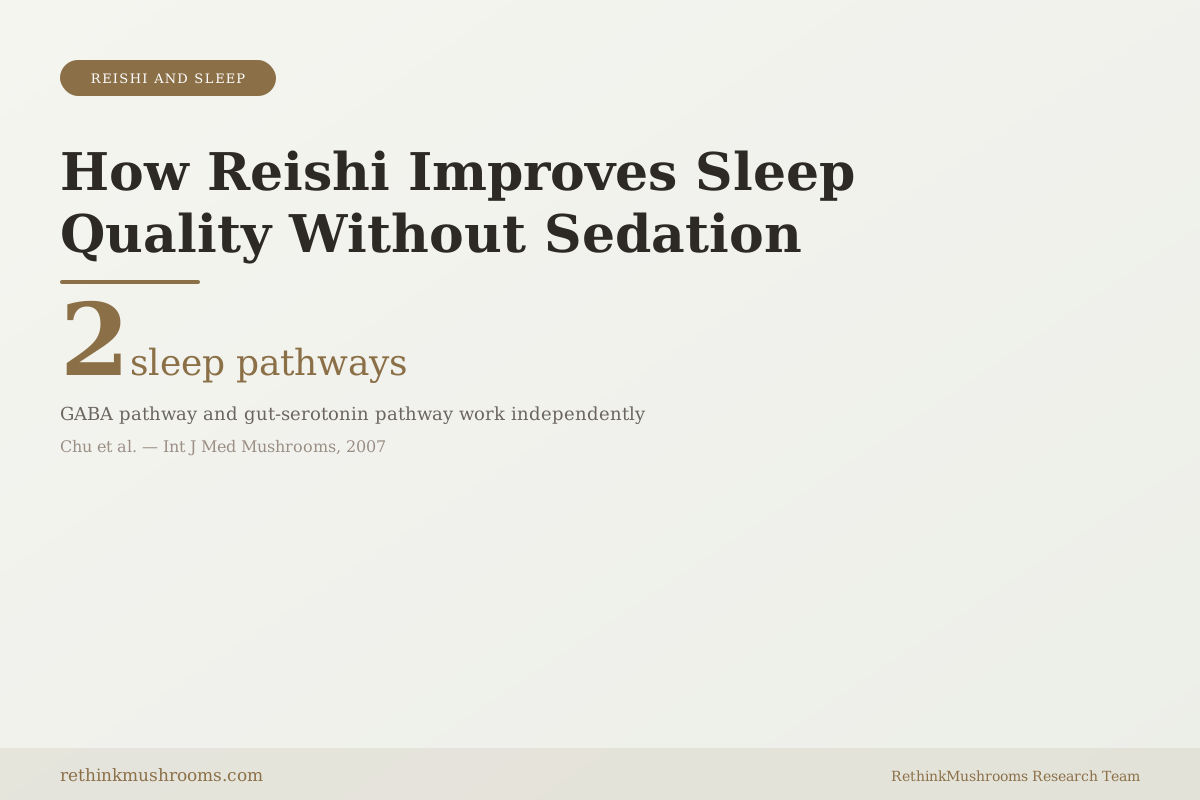
2 pathways
Chu et al. (2007) found reishi acts through two distinct sleep mechanisms. Blocking GABA receptors reduced sleep duration effects, but had no effect on delta-wave sleep architecture improvement, proving a second non-sedating pathway exists independently.
Chu et al., Int J Med Mushrooms, 2007
34 compounds
sedative-hypnotic bioactive compounds in Ganoderma targeting 51 genes simultaneously (Qiu et al., 2021)
Gut-dependent
antibiotic depletion of gut microbiota completely abolished reishi's sleep benefits (Yao et al., Sci Rep, 2021)
No impairment
reishi produced anxiolytic effects comparable to diazepam without motor coordination impairment (Socala et al., 2015)
Chu et al., Int J Med Mushrooms, 2007
 View as image ↗
Reishi doesn't work like a sleeping pill. You don't feel it pushing you toward sleep. You don't wake up groggy. The experience of taking reishi before bed is, for most people, not obviously different from taking nothing, at least in the short term.
And yet the research shows it improves sleep architecture, reducing sleep latency and enhancing the proportion of deep, slow-wave sleep. It works on sleep quality at the level of brainwave patterns, through mechanisms that operate differently from benzodiazepines, antihistamines, or melatonin.
The reason it can do this without sedating you is what this article is about. Understanding it requires a single pivotal experiment from 2007. For the broader profile of reishi's place in Chinese medicine, what reishi mushroom is and why it matters covers the foundational context.
Key Takeaways
- Chu et al. (2007, Int J Med Mushrooms) showed reishi extract reduced sleep latency and increased non-REM sleep; when GABA receptors were blocked with flumazenil, quantitative sleep effects were partially reduced but delta-wave enhancement was completely preserved, proving two distinct mechanisms.
- Socala et al. (2015, Int J Med Mushrooms) found reishi mycelium aqueous extract produced significant anxiolytic effects comparable to diazepam at moderate doses without causing motor coordination impairment, confirming the anxiolytic-without-sedation profile.
- Qiu et al. (2021, Frontiers in Pharmacology) used network pharmacology to identify 34 sedative-hypnotic bioactive compounds in Ganoderma operating on 51 target genes; the distributed multi-target mechanism explains why reishi doesn't produce the tolerance associated with single-receptor sleep drugs.
- Yao et al. (2021, Scientific Reports) found reishi significantly promoted sleep in mice, but antibiotic treatment that depleted gut microbiota abolished all sleep benefits; serotonin pathway involvement was confirmed, identifying a completely gut-dependent mechanism with no central nervous system sedation component.
The Sleeping Pill Problem
Pharmaceutical sleep drugs work by forcing sedation. Benzodiazepines (diazepam, lorazepam) and Z-drugs (zolpidem, zopiclone) bind GABA-A receptors in the brain, enhancing the effects of GABA (the brain's primary inhibitory neurotransmitter) and producing a sedative state. Antihistamine-based OTC sleep aids (diphenhydramine) block histamine receptors, causing drowsiness as a side effect. Melatonin supplements signal the circadian system that night has arrived.
All of these approaches work by imposing a state on the brain. The sedating drugs don't improve sleep architecture; they change its structure, often reducing REM sleep and deep slow-wave sleep while increasing lighter stages. Tolerance develops because the receptors being targeted downregulate in response to repeated stimulation.
Reishi doesn't do this. The research profile is different: sleep latency decreases (you fall asleep faster), non-REM sleep increases, and slow-wave sleep architecture improves. But there's no corresponding sedation, no motor impairment, and no evidence of tolerance development. The question is why.
The Chu 2007 Experiment: What Blocking GABA Revealed
The most important study for understanding reishi's non-sedating sleep mechanism was published by Chu and colleagues in the International Journal of Medicinal Mushrooms in 2007.[1]
Reishi has long been known to interact with GABA receptors. GABA is the central inhibitory neurotransmitter, and compounds in reishi, particularly certain triterpenoids, act as positive allosteric modulators of GABA-A receptors, the same receptor class targeted by benzodiazepines. This suggested a mechanism but also a problem: if reishi works through the same receptor as benzodiazepines, why doesn't it cause the same sedation and tolerance?
Chu's team designed an experiment to answer this. They administered reishi extract to mice with or without flumazenil, a drug that specifically blocks the benzodiazepine binding site on GABA-A receptors. If all of reishi's sleep benefits depended on GABA receptor activation, flumazenil should block them.
The results were revealing. Flumazenil partially reduced the quantitative sleep effects (sleep duration, sleep latency improvement). But it had no effect whatsoever on delta-wave enhancement.
Delta waves are the slow, high-amplitude brainwaves characteristic of deep, restorative sleep. Their proportion in total sleep time is the primary measure of sleep architecture quality; more delta waves means deeper, more restorative sleep. Chu's experiment showed that reishi's improvement of delta-wave sleep was completely independent of GABA-A receptor activation. A second mechanism, one that doesn't involve the benzodiazepine receptor at all, was responsible for the sleep quality improvement.
This is why reishi doesn't cause sedation the way benzodiazepines do. Benzodiazepines primarily work through the first pathway (GABA-A). Reishi's most distinctive sleep benefit, improved sleep architecture, operates through the second.
The GABA Pathway: Anxiolytic, Not Sedating
The portion of reishi's sleep effect that does involve GABA is also different from pharmaceutical GABA drugs in an important respect: it's anxiolytic without being sedating.
Socala and colleagues (2015) tested an aqueous mycelium extract of Ganoderma lucidum in mice using standard behavioral tests including elevated plus maze and open field tests.[2] The extract produced significant anxiolytic effects at moderate doses, comparable to the effect of diazepam. But unlike diazepam, it did not produce motor coordination impairment (measured by rotarod performance).
This distinction is mechanistically meaningful. Benzodiazepines bind broadly to GABA-A receptors across multiple brain regions, including those controlling motor function and producing sedation. The reishi triterpenoids appear to engage the receptor in a more limited way, producing the anxiolytic benefit, meaning calming of excessive neural activity in fear and anxiety circuits, without the full sedative profile that comes from widespread GABA-A activation.
The sleep benefit from this pathway is real but indirect. By reducing the anxious arousal that prevents sleep onset in many people, reishi makes it easier to fall asleep and stay asleep. That's different from forcing sedation. You could describe it as addressing the cause of sleeplessness rather than overriding wakefulness.
For a detailed treatment of how the GABA and serotonin pathways work together in reishi, how reishi affects GABA and serotonin pathways covers the compound-level mechanisms in depth.
The Gut Pathway: Sleep Driven From the Intestines
The second mechanism identified in the research is even further removed from pharmaceutical sleep pharmacology.
Yao and colleagues (2021) published a study in Scientific Reports that traced reishi's sleep effects to the gut microbiota and the serotonin pathway.[4] The experimental design was simple but definitive: they administered reishi to mice and confirmed it promoted sleep. Then they pretreated mice with antibiotics to deplete their gut microbiota, and tested reishi again.
Antibiotic pretreatment abolished all of reishi's sleep benefits. A treatment that completely eliminated gut bacteria also completely eliminated the sleep effects of reishi. This is the strongest possible evidence that the sleep mechanism is gut-dependent, not a direct effect of reishi compounds entering the brain.
The mechanism Yao's team traced involves serotonin. The gut contains roughly 90% of the body's serotonin, produced by intestinal cells and regulated by gut bacteria. Reishi's polysaccharides act as a prebiotic, reshaping gut microbiota composition in ways that increase serotonin production in the intestinal tract. Serotonin in the gut is a precursor for melatonin synthesis and influences sleep-promoting neurological signaling through the gut-brain axis. Crucially, this mechanism involves no central nervous system sedation; the sleep improvement comes from the bottom up, through the gut, not from reishi compounds directly modifying brain receptor activity.
This pathway also explains why consistent, sustained use appears to produce more reliable effects than single doses. Gut microbiota changes develop over days to weeks of regular reishi intake. The sleep benefits driven by this pathway build as the microbiome adapts, which is why some users report gradual rather than immediate improvement.
For the specific compounds responsible for these gut effects and how they differ from the triterpenoids driving the GABA pathway, reishi for sleep: what the research shows covers the full evidence landscape.
Why No Tolerance: The Network Pharmacology Picture
One of the practical advantages claimed for reishi over pharmaceutical sleep drugs is the absence of tolerance development. Benzodiazepines and Z-drugs typically lose effectiveness within weeks to months of daily use as the targeted receptors downregulate. This drives dose escalation and dependence.
Reishi doesn't produce this pattern in the research. Qiu and colleagues (2021) used network pharmacology to analyze the complete sedative-hypnotic pharmacological profile of Ganoderma.[3] They identified 34 separate bioactive compounds with sedative-hypnotic activity, acting on 51 different target genes. The mechanism operates simultaneously at both central nervous system and peripheral levels.
This distributed, multi-target pharmacology explains the absence of tolerance. When a drug acts through a single receptor subtype, that receptor can downregulate in response to repeated stimulation, reducing the effect. When 34 compounds act through 51 targets, there is no single receptor to downregulate. You would need simultaneous downregulation across dozens of targets and pathways to eliminate the effect, a biological improbability.
The core targets identified in Qiu's analysis include TNF (inflammatory signaling), CASP3 (apoptosis regulation), JUN (transcription factor involved in stress response), and HSP90AA1 (heat shock protein involved in stress response and homeostasis). These are not sleep-specific receptors. They are broad cellular stress and homeostasis regulators that, when appropriately modulated, appear to create conditions favorable to sleep without directly inducing it.
The Practical Difference
These mechanisms converge on a practical profile that distinguishes reishi from sedative sleep aids.
Reishi does not push you into sleep. It reduces the anxious arousal that prevents sleep onset (GABA pathway), improves the architecture of sleep you achieve (delta-wave pathway, independent of GABA), and supports the microbiome-serotonin axis that influences sleep quality from the gut (gut pathway). None of these mechanisms involves forcing unconsciousness or overriding wakefulness.
This means reishi is unlikely to be useful for acute sleep disruption where immediate sedation would help, like the first night of jet lag, a single night of stress-induced insomnia. It is more plausible as a support for the underlying conditions that chronically impair sleep quality: anxiety that prevents sleep onset, fragmented sleep architecture, gut-brain dysregulation. These are slow-moving targets that respond to consistent intervention over days to weeks, not single doses.
It also means you can take it and function normally the next morning, which is not guaranteed with sedative sleep drugs.
For the practical dosing and timing guidance grounded in the clinical trial data, reishi and insomnia: clinical studies and dosing covers the evidence on preparation type, dose, and duration. For how reishi compares specifically to melatonin, reishi vs. melatonin for sleep covers that comparison.
The Bottom Line
Reishi improves sleep quality through two mechanistically distinct pathways that together explain its non-sedating profile. A GABA receptor pathway (confirmed by Chu et al., 2007) reduces anxious arousal and improves sleep quantity, but delta-wave sleep architecture enhancement occurs through a second pathway completely independent of GABA receptor activation. A separate gut microbiota-serotonin pathway (Yao et al., 2021) drives sleep quality improvements from the gut without any central nervous system sedation component, and is dependent on consistent intake for the microbiome to adapt. The multi-target pharmacology across 34 compounds and 51 genes (Qiu et al., 2021) explains the absence of tolerance.
Frequently Asked Questions
Sources & References
- 1. Source details for this reference are not yet available.
- 2. Source details for this reference are not yet available.
- 3. Source details for this reference are not yet available.
- 4. Source details for this reference are not yet available.