Reishi (Ganoderma lucidum)
0 head-to-head trials
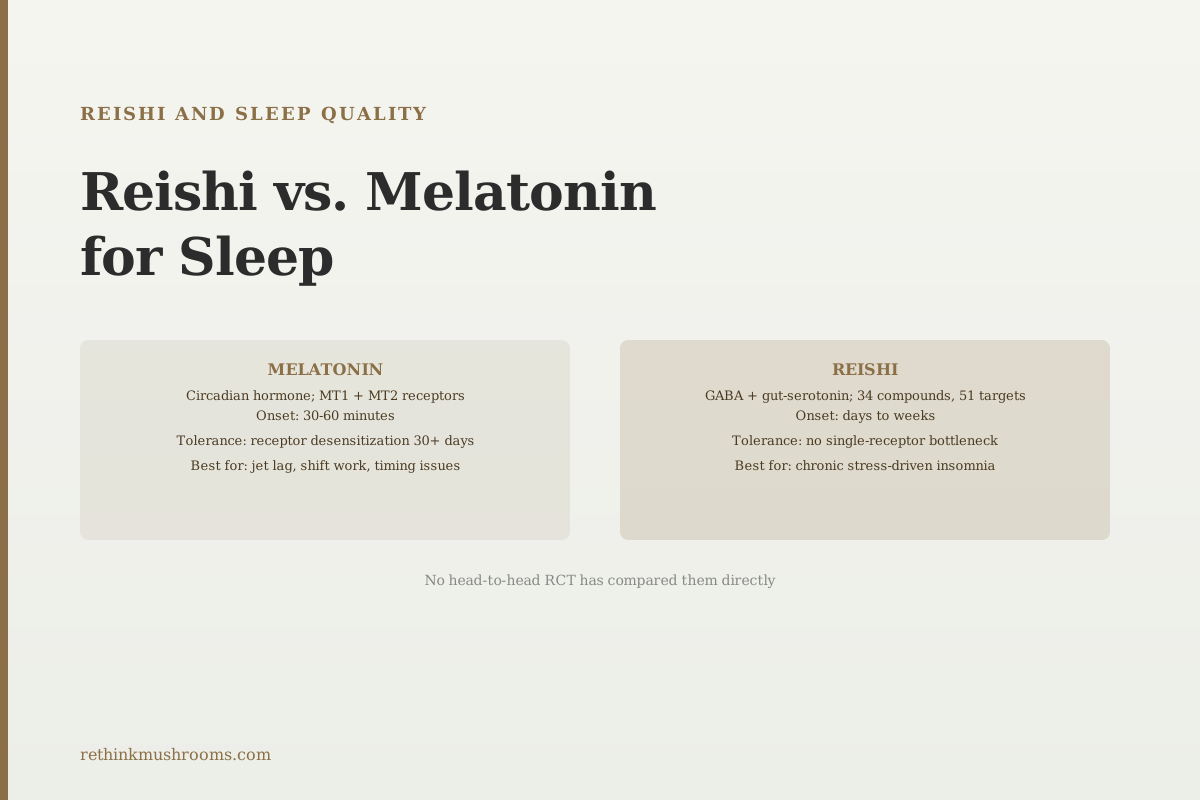
No randomised trial has ever compared reishi and melatonin for sleep. Every comparison — including this one — is assembled from two separate evidence bases: decades of human melatonin trials on one side, and rodent mechanism work on the other.
RethinkMushrooms review of the Ganoderma sleep literature, 2026
MT1 + MT2
the two receptors melatonin binds; MT2 desensitises readily in cell culture, MT1 much less so
GABA + gut
reishi's two best-characterised sleep pathways, both demonstrated only in rodents
0 sleep endpoints
no human reishi trial has measured sleep; the two usually cited measured mood and fitness
RethinkMushrooms review of the Ganoderma sleep literature, 2026
 View as image ↗
The most common question about reishi for sleep is how it compares to melatonin. The honest answer has two halves. The first half is genuinely interesting: they work through entirely different biological pathways and change different properties of sleep. The second half is less satisfying but more important: the evidence bases behind them are not remotely comparable in size or quality, and nobody has ever tested them against each other.
This article covers both halves. It also corrects a claim that circulates widely in reishi marketing — that melatonin stops working after about a month and reishi does not — because that claim turns out to rest on much less than it appears to.
For the full overview of reishi's science, see What Is Reishi Mushroom? The Science Behind the Mushroom of Immortality.
Key Takeaways
- Melatonin works by binding MT1 and MT2 receptors in the brain's master circadian clock; it shifts sleep timing and suppresses wakefulness signals rather than directly sedating
- Reishi operates through at least three distinct pathways demonstrated in rodents: benzodiazepine-site GABA signalling (Chu et al., Pharmacology Biochemistry and Behavior, 2007), a gut microbiota-dependent serotonin pathway (Yao et al., Scientific Reports, 2021), and TNF-α–mediated cytokine signalling (Cui et al., Journal of Ethnopharmacology, 2012)
- The gut pathway was confirmed by showing that antibiotics which deplete gut bacteria also abolish reishi's sleep effect in mice
- A computational network analysis predicted 34 sedative-hypnotic compounds in Ganoderma acting on 51 target genes (Qiu et al., BMC Microbiology, 2021); this is a database-derived hypothesis, not a measured pharmacological result, and it cannot by itself establish that tolerance is impossible
- The two human reishi trials usually cited in sleep discussions measured mood, quality of life and fitness — not sleep. The fibromyalgia trial (Pazzi et al., Healthcare, 2020) found no statistically significant between-group differences, and a 2024 trial in healthy students (Mitra et al., International Journal of Medicinal Mushrooms) found improved anxiety, vitality and well-being at 1000 mg/day
- Melatonin has vastly more human trial evidence. A 2024 dose-response meta-analysis of 26 randomised trials found efficacy peaking near 4 mg/day taken roughly 3 hours before bedtime — the opposite of the common "take 0.5 mg at bedtime" advice
- The claim that melatonin reliably loses effectiveness after 30 nights is not established in human trials; it is extrapolated from cell-culture receptor studies
- No randomised controlled trial has directly compared reishi and melatonin for any sleep outcome
The Short Comparison: Mechanism, Onset, and Evidence at a Glance
| Melatonin | Reishi | |
|---|---|---|
| Primary mechanism | Circadian hormone; MT1/MT2 receptor agonism in the SCN | GABA modulation, gut microbiota-dependent serotonin, TNF-α signalling |
| Onset | Same night; timing of the dose matters more than the size of it | Days to weeks in animal models (3–28 days of dosing) |
| Sleep architecture effect | Shifts sleep timing; limited direct effect on slow-wave sleep | Mixed: more total and non-REM sleep in rats, but no slow-wave or REM change in the one freely-moving EEG study |
| Tolerance risk | MT2 desensitises in cell culture; clinically meaningful tolerance not established in humans | Never tested — no study has dosed reishi long enough to look |
| Best-supported use case | Circadian problems: jet lag, shift work, delayed sleep phase | No human sleep indication is well supported; mechanism is most suggestive for stress- and inflammation-linked poor sleep |
| Human trial evidence | Dozens of RCTs with sleep endpoints; multiple meta-analyses | No RCT with a sleep endpoint; the two trials usually cited measured mood and fitness |
| Head-to-head comparison | None | None |
Neither is universally better, and the table above is not a scorecard where reishi and melatonin are separated by a few points. Melatonin is a well-studied intervention with a narrow, real indication. Reishi is a mechanistically rich compound whose human sleep evidence has not been collected yet.
Mechanism · Two Non-Overlapping Routes
Where Each One Actually Acts
These are not two versions of the same intervention. They enter the body differently, act on different targets, and change different properties of sleep.
Melatonin
Same nightSingle hormone, two receptors
Swallowed hormone enters circulation
- 1Binds MT1 and MT2 receptors
- 2Acts on the suprachiasmatic nucleus (the circadian clock)
- 3Shifts the phase of the sleep–wake cycle
Endpoint
Sleep timing moves earlier or later
Changes: When sleep happens
Does not: Does not sedate; does not rebuild sleep architecture
Reishi
Days to weeksMany compounds, many targets
Extract enters gut, compounds disperse
- 1Benzodiazepine-site GABA signalling (flumazenil-sensitive)
- 2Gut microbiota shift → hypothalamic serotonin
- 3TNF-α and cytokine modulation
Endpoint
Longer total sleep, more non-REM sleep
Changes: How much and what kind of sleep
Does not: Does not move the circadian clock
The gap between these columns
No randomised trial has given one group reishi and another group melatonin and measured the same sleep outcome. Every comparison on this page is built from two separate evidence bases read side by side — which is weaker than a head-to-head trial, and cannot tell you which works better for any individual.
How Melatonin Works, and Why Timing Beats Dose
Melatonin is a hormone your brain produces naturally. As evening light fades, the pineal gland releases melatonin into the bloodstream, where it binds two receptors — MT1 and MT2 — in the brain's master clock, a cluster of neurons in the hypothalamus called the suprachiasmatic nucleus.
MT1 activation suppresses the alertness signals the clock generates during waking hours. MT2 activation shifts the timing of the whole sleep-wake cycle. When melatonin rises in the evening, the body reads this as a signal that darkness has arrived and sleep should follow.
This is why melatonin works well for jet lag. The problem in jet lag is that the internal clock is set to the wrong time zone, and a strategically timed dose shifts it toward the new one.
The dosing advice most people have absorbed, however, appears to be wrong. A 2024 systematic review and dose-response meta-analysis in the Journal of Pineal Research pooled 26 double-blind randomised trials covering 1,689 observations in both insomnia patients and healthy volunteers. It found that melatonin's effect on sleep onset latency and total sleep time increased with dose, peaking around 4 mg per day — and that giving it roughly 3 hours before the desired bedtime outperformed the schedule most commonly used in practice (2 mg taken 30 minutes before bed).
That is close to the reverse of the popular guidance that a very low dose right at bedtime is optimal. Two caveats are worth keeping: this is a meta-analysis of heterogeneous trials rather than a single definitive experiment, and higher doses do not automatically mean better outcomes for every individual or every sleep problem.
How Reishi Works: Three Pathways Melatonin Does Not Use
Reishi does not interact with circadian clock receptors at all. Its sleep effects, as characterised in animals, come from at least three separate mechanisms.
Pathway 1: GABA-site signalling. GABA is the brain's primary calming signal; when GABA receptors are activated, neurons fire less and mental arousal drops. Benzodiazepines amplify this dramatically. Reishi appears to touch the same site far more gently.
Chu and colleagues gave rats an aqueous Ganoderma lucidum extract and recorded sleep.[1] The result has an important qualifier that is usually dropped: at 80 and 120 mg/kg, the extract had no effect on sleep architecture in normal rats. The effects appeared only in rats that had also been given pentobarbital, a barbiturate — there, the extract shortened sleep latency and increased sleeping time, non-REM sleep and light sleep.
When the researchers then gave flumazenil, a drug that blocks the benzodiazepine site on the GABA receptor, those quantitative sleep effects were significantly reversed. But the extract's effect on delta activity during non-REM sleep was not blocked — evidence that a second, GABA-independent mechanism contributes to sleep depth.
Chu, Wang, Cui, et al. (2007) · Pharmacology, Biochemistry, and Behavior
- Population
- Rats (sleep recordings) and mice (locomotor activity)
- Intervention
- Ganoderma lucidum aqueous extract, 80 and 120 mg/kg
- Comparator
- Vehicle control; flumazenil co-administration to block the benzodiazepine site
- Finding
- No effect on sleep architecture in normal rats. In pentobarbital-treated rats, the extract shortened sleep latency and increased non-REM and light sleep; flumazenil reversed those effects but did not block the increase in delta activity.
narrow-scope Frequently cited as proof that reishi promotes sleep. It more precisely shows that reishi potentiates a barbiturate's sleep effect through a benzodiazepine-like site — a narrower and more conditional claim.
Chu et al., Pharmacology Biochemistry and Behavior, 2007 (PMID 17383716)
That conditionality matters for the melatonin comparison. Melatonin's trials measure sleep in people who are simply trying to sleep. Chu's headline effects required a barbiturate on board.
A later study addressed exactly that gap. Cui and colleagues dosed freely moving rats with reishi extract for three days and recorded EEG and EMG overnight without any sedative.[2] At 80 mg/kg the extract significantly increased total sleep time and non-REM sleep time — but did not change slow-wave sleep or REM sleep. That is a genuine effect on sleep quantity in undrugged animals, and it is also narrower than the "reishi deepens your sleep" framing that circulates online.
Pathway 2: Gut microbiota-dependent serotonin. Yao and colleagues studied the acidic fraction of an alcohol extract of G. lucidum mycelia, given to mice at 25, 50 and 100 mg/kg for 28 days.[4] In pentobarbital-treated mice, it shortened sleep latency and prolonged sleeping time. Alongside that, it raised hypothalamic serotonin and increased transcripts in the serotonergic synapse pathway.
The decisive experiment came next. The researchers depleted the gut microbiome of a separate group with antibiotics. In those mice, both the sleep benefit and the metabolite changes that tracked with sleep disappeared entirely.
The extract enriched Bifidobacterium (including B. animalis) and metabolites such as indole-3-carboxylic acid, which correlated negatively with sleep latency and positively with sleeping time and hypothalamic serotonin. Melatonin has no equivalent gut-brain route; it is a direct hormonal signal. This pathway also explains why reishi's effects are studied over weeks rather than hours: microbial communities shift gradually.
Pathway 3: Cytokine signalling. Cui's freely-moving-rat study also found that TNF-α levels rose in serum, hypothalamus and dorsal raphe nucleus alongside the sleep increase — and that injecting a TNF-α antibody into the brain significantly blocked the sleep effect.[2] Giving sub-threshold doses of extract and TNF-α together produced an additive effect. TNF-α is a well-established sleep-regulatory cytokine, and this places reishi inside that system.
Qiu and colleagues used computational network pharmacology to map Ganoderma's sedative-hypnotic components against insomnia-associated genes.[3] Mining the TCMSP and TCMIP databases and applying target prediction, they identified 34 candidate components corresponding to 51 target genes, with TNF, CASP3, JUN and HSP90AA1 among the core hubs — converging with Cui's experimental TNF-α finding.
It is worth being precise about what this analysis is. No compound was dosed and no animal was measured. It is a structured hypothesis generated from databases, and its value is in pointing at TNF and related pathways, which independent experimental work then supports.
A separate 2024 study is a useful corrective to treating "reishi" as one thing: Li and colleagues compared different Ganoderma-containing formulations and found the sleep-aiding and anti-fatigue effects diverged sharply depending on preparation.[5] One recipe improved sleep latency and duration in mice; another improved endurance but not sleep. And Qin and colleagues showed a sporoderm-removed spore extract restored total, REM and non-REM sleep in a rat Alzheimer's model, acting through NF-κB/NLRP3 inflammatory signalling.[6]
For a deeper look at the GABA and serotonin pathways specifically, see How Reishi Affects GABA and Serotonin Pathways. For the cluster sleep mechanisms article, see How Reishi Improves Sleep Quality Without Sedation.
The Tolerance Question, Examined Properly
The standard argument for reishi over melatonin runs like this: melatonin hits two receptors, those receptors desensitise after about a month of nightly use, and melatonin stops working — whereas reishi's 34 compounds and 51 targets give the body no single bottleneck to downregulate.
The logic is elegant. Both of its premises are weaker than they sound.
Claim check
Does melatonin stop working after a month?
The claim
“Nightly melatonin desensitises MT1 and MT2 receptors after roughly 30 days, which is why it stops working — so you should switch to reishi.”
An extrapolation from cell-culture receptor studies, amplified by supplement marketing.
What research shows
OverstatedMelatonin receptor desensitisation is real but was demonstrated in engineered cell lines on a timescale of minutes, not months — and the two subtypes behave very differently. MT2 loses sensitivity and internalises rapidly; MT1 is markedly more resistant. Human trials have not established that nightly melatonin reliably loses its sleep effect over weeks, and clinical guidance does not treat melatonin as tolerance-forming the way it treats benzodiazepines.
This does not mean nobody experiences melatonin becoming less helpful. It means the specific receptor-desensitisation-at-30-days story is not what the human evidence shows, and habituation, dosing errors, mistimed doses or an underlying sleep disorder are at least as plausible explanations.
Gerdin et al., J Pharmacol Exp Ther, 2003 (PMID 12604667); Nishiyama et al., Eur J Pharmacol, 2016 (PMID 25797281)
Claim Check · Melatonin Tolerance
What “Melatonin Stops Working” Rests On
Reishi is often recommended as the answer to melatonin tolerance. That recommendation assumes the tolerance is established. Here is where the evidence for it actually sits.
Cell culture
Well demonstratedIn engineered cells, MT2 receptors lose sensitivity and are pulled inside the cell after as little as 10 minutes of melatonin exposure. MT1 is markedly more resistant to the same treatment.
Melatonin receptors can desensitise — and the two subtypes do not behave alike.
Whole animal
LimitedReceptor regulation has been characterised in animal tissue, but sustained nightly dosing models that track a loss of sleep effect over weeks are sparse.
The bridge from receptor behaviour to a fading sleep effect is mostly unbuilt.
Humans, nightly use over months
Not establishedLong-term trials have not shown a reliable loss of melatonin efficacy over time, and clinical guidance does not describe melatonin as tolerance-forming in the way benzodiazepines are.
The widely repeated claim that melatonin "stops working after about a month" is not something the human trial literature currently supports.
Why this matters for the comparison
If melatonin tolerance is uncertain, then “reishi avoids melatonin’s tolerance problem” is an argument built on an uncertain premise. Reishi may still be preferable for other reasons — but tolerance is a weaker reason than it is usually presented as, and no study has tested whether reishi’s own sleep effect fades with continued use either.
The second premise is equally shaky. Reishi's supposed immunity to tolerance rests almost entirely on Qiu's computational analysis — a target-prediction exercise, not a demonstration that 51 targets are all engaged at a meaningful dose in a living animal. A multi-target profile is a reasonable argument against a single-receptor bottleneck. It is not a finding.
More decisively: no study has ever tested whether reishi's sleep effect fades with continued use. The longest dosing in the studies above is 28 days. Absence of documented tolerance is not evidence of absence of tolerance when nobody has looked.
The honest position is that both compounds' long-term trajectories are less certain than the marketing on either side suggests, and "switch to reishi to escape melatonin tolerance" is a recommendation resting on two unproven premises rather than one established fact.
Evidence Reach · Reishi and Sleep
How Far Up the Ladder the Sleep Evidence Actually Goes
Reishi’s sleep research is unusually deep at the mechanism end and completely absent at the human end. Both halves matter when reading a comparison to melatonin.
Computational
Evidence existsDatabase-mined compound and target prediction
Qiu 2021 — 34 candidate sedative-hypnotic components, 51 predicted target genes
No compound was dosed and no animal was measured. This is a hypothesis generator.
Rodent — drug-assisted sleep
Evidence existsSleep measured after a barbiturate was given alongside the extract
Chu 2007 (rats), Yao 2021 (mice)
Chu found no effect on sleep architecture in untreated rats — the effect appeared only in pentobarbital-treated animals.
Rodent — undrugged sleep
Evidence existsEEG-recorded sleep in freely moving animals
Cui 2012 (rats), Qin 2024 (Alzheimer-model rats)
Cui found more total and non-REM sleep, but no change in slow-wave or REM sleep — narrower than the "deeper sleep" framing.
Human — sleep as primary outcome
No evidenceA trial that enrolls poor sleepers and measures their sleep
None identified
This is the tier that would justify recommending reishi for sleep. It is empty.
Human — sleep vs. melatonin
No evidenceHead-to-head randomised comparison
None identified
Nothing in the literature compares the two directly.
What Human Trials Actually Show: An Honest Assessment
This is where the comparison becomes genuinely lopsided, and where most articles on this topic go wrong.
Two randomised controlled trials of reishi are usually cited in sleep discussions. Neither of them measured sleep.
Pazzi and colleagues ran a double-blind, randomised placebo-controlled pilot trial in women with fibromyalgia, giving 6 g/day of micro-milled G. lucidum carpophores for six weeks and assessing happiness, depression, satisfaction with life and health-related quality of life.[7]
The result is routinely misreported. The trial found no statistically significant between-group differences on any outcome. The authors noted a within-group trend toward improved happiness and satisfaction with life and reduced depression in the reishi arm compared with its own baseline, and explicitly stated that further studies are needed to confirm the findings. A within-group trend in a pilot trial with a null between-group result is a reason to run a larger study, not a reason to recommend a supplement.
Pazzi, Adsuar, Domínguez-Muñoz, et al. (2020) · Healthcare (Basel)
- Population
- Women with fibromyalgia
- Intervention
- 6 g/day micro-milled Ganoderma lucidum carpophores, 6 weeks
- Comparator
- Placebo, double-blind randomised pilot design
- Finding
- No statistically significant between-group differences on happiness, depression, satisfaction with life or health-related quality of life. A within-group trend toward improvement was observed in the reishi arm.
null Sleep was not an outcome measure. This trial is frequently described as showing significant improvements in sleep, mood and fatigue; it did not.
Pazzi et al., Healthcare (Basel), 2020 (PMID 33265969)
The second trial is more positive but concerns a different population than usually claimed. Mitra and colleagues randomised 78 sedentary female college students in West Bengal, India to 500 mg/day reishi, 1000 mg/day reishi, or placebo for 30 days.[8] At 1000 mg/day, anxiety, depression, vitality and positive well-being scores significantly improved, alongside cardiovascular fitness measures such as VO2max and physical work capacity.
These were healthy young adults, not fibromyalgia patients — a point worth stressing, because it means reishi has been tested in a general population. But again, sleep was not measured. Improved vitality and reduced anxiety are plausible upstream contributors to better sleep; they are not sleep data.
So the human picture is this: reishi has one null pilot trial and one positive trial in healthy students, neither with a sleep endpoint. Melatonin has dozens of randomised trials with sleep as the primary outcome and multiple meta-analyses synthesising them. For any question of the form "which one should I take to sleep better tonight," that asymmetry is the single most important fact on this page.
For the full evidence review on reishi and sleep, see Reishi for Sleep: What the Research Shows. For mood and sleep overlap, see Reishi and Depression: Mood Regulation Evidence.
When Each One Makes More Sense
Neither option is universally superior, and the split is less about which is stronger than about which question you are asking.
Melatonin has the better case when:
- The problem is circadian: jet lag, shift work, or a sleep phase that has drifted late or early. This is melatonin's actual evidence-backed indication.
- Sleep timing is off rather than sleep quality — falling asleep at the wrong hour rather than sleeping poorly.
- Short-term use is planned around travel or a schedule change.
- You want an intervention whose dosing and timing have been studied in humans and can be adjusted with reference to trial data.
Reishi is a more reasonable experiment when:
- Circadian timing is not the issue and the problem is more diffuse — stress, anxiety, or an inflammatory load in the background.
- You have realistic expectations about the evidence: you are trying something with strong rodent mechanism data and no human sleep trials, not something with demonstrated efficacy.
- You can give it weeks rather than nights. Every animal protocol above dosed for 3 to 28 days.
- Product quality is verifiable. Li's formulation study is a direct warning that different Ganoderma preparations produce different effects, so "reishi" on a label does not specify the intervention.
One framing to retire: reishi as the answer to melatonin no longer working. If melatonin has stopped helping, the more useful questions are whether the dose and timing match what the trials support, and whether an underlying sleep disorder is being missed.
Before using either
ModerateChronic insomnia is a medical issue, not a supplement problem
Concern
Persistent insomnia can signal or worsen conditions including sleep apnoea, depression, thyroid disease and chronic pain. Self-treating with supplements can delay diagnosis. Reishi may also interact with anticoagulant and antiplatelet medications and with immunosuppressants, and it has been associated with rare liver injury reports; melatonin can interact with anticoagulants, anticonvulsants and immunosuppressants, and affects daytime alertness.
What the research says
Clinical guidelines consistently place cognitive behavioural therapy for insomnia (CBT-I) as the first-line treatment for chronic insomnia, ahead of any medication or supplement. Neither reishi nor melatonin is a substitute for evaluating why sleep is disrupted.
Particularly relevant for: Anyone with insomnia lasting more than a few weeks; anyone pregnant, breastfeeding, on anticoagulants or immunosuppressants, or with liver disease
What to do
Talk to a clinician before starting either supplement, especially alongside prescription medication. Seek evaluation if poor sleep has persisted beyond three months.
This article is educational and is not medical advice. Reishi and melatonin are supplements, not regulated medicines, and are not approved treatments for insomnia.
The Bottom Line
Reishi and melatonin reach sleep through different biological pathways with no overlap. Melatonin shifts circadian timing via MT1/MT2 receptors and is the better-evidenced option for jet lag and circadian disruption; a 2024 meta-analysis of 26 randomised trials found efficacy peaking near 4 mg taken about 3 hours before bedtime. Reishi acts through benzodiazepine-site GABA signalling, a gut microbiota-dependent serotonin pathway, and TNF-α cytokine signalling — all demonstrated in rodents only. The two published human reishi trials measured mood, quality of life and fitness rather than sleep, and the fibromyalgia trial found no significant between-group differences. The popular claim that melatonin reliably stops working after 30 nights is extrapolated from cell-culture receptor studies, not human trials, and reishi's own long-term tolerance has never been tested. No head-to-head trial exists.
Frequently Asked Questions
Sources & References
- 1RTHM-00210·Chu, Qing-Ping et al. (2007). “Extract of Ganoderma lucidum potentiates pentobarbital-induced sleep via a GABAergic mechanism..” Pharmacology.Study breakdown →PubMed →↩
- 2RTHM-00458·Cui, Xiang-Yu et al. (2012). “Extract of Ganoderma lucidum prolongs sleep time in rats..” Journal of ethnopharmacology.Study breakdown →PubMed →↩
- 3RTHM-01419·Qiu, Yu et al. (2021). “Exploration of the anti-insomnia mechanism of Ganoderma by central-peripheral multi-level interaction network analysis..” BMC microbiology.Study breakdown →PubMed →↩
- 4RTHM-00731·Yao, Chunyan et al. (2021). “Ganoderma lucidum promotes sleep through a gut microbiota-dependent and serotonin-involved pathway in mice..” Scientific reports.Study breakdown →PubMed →↩
- 5RTHM-01928·Li, Kexin et al. (2024). “The anti-fatigue and sleep-aiding effects vary significantly among different recipes containing Ganoderma lucidum extracts..” Heliyon.Study breakdown →PubMed →↩
- 6RTHM-01970·Qin, Yu et al. (2024). “Ganoderma lucidum spore extract improves sleep disturbances in a rat model of sporadic Alzheimer's disease..” Frontiers in pharmacology.Study breakdown →PubMed →↩
- 7RTHM-00648·Pazzi, Francesco et al. (2020). “Ganoderma lucidum Effects on Mood and Health-Related Quality of Life in Women with Fibromyalgia..” Healthcare (Basel.Study breakdown →PubMed →↩
- 8RTHM-00895·Mitra, Sudeep et al. (2024). “Efficacy of Lingzhi or Reishi Medicinal Mushroom Ganoderma lucidum (Agaricomycetes) Supplementation on Psychological Stress and Selective Fitness Profile Parameters in Female College Students in West Bengal, India..” International journal of medicinal mushrooms.Study breakdown →PubMed →↩