Reishi for Mental Health
2 distinct pathways
Reishi's effects on calm and mood come from two mechanistically separate pathways: triterpenes act on GABA-A receptors to reduce nervous system excitability, while polysaccharides reshape gut bacteria to increase serotonin production. Neither pathway is the same as the other.
Shah et al., J Ethnopharmacol, 2014; Yao et al., 2021
GABA-A
receptor type through which pachymic acid (a Reishi triterpene) produces calming effects
5-HT
serotonin increased by Reishi polysaccharides via gut microbiota tryptophan conversion (Yao 2021)
BDNF
the brain plasticity protein upregulated by Reishi polysaccharides via the Dectin-1 receptor pathway
Shah et al., J Ethnopharmacol, 2014; Yao et al., 2021
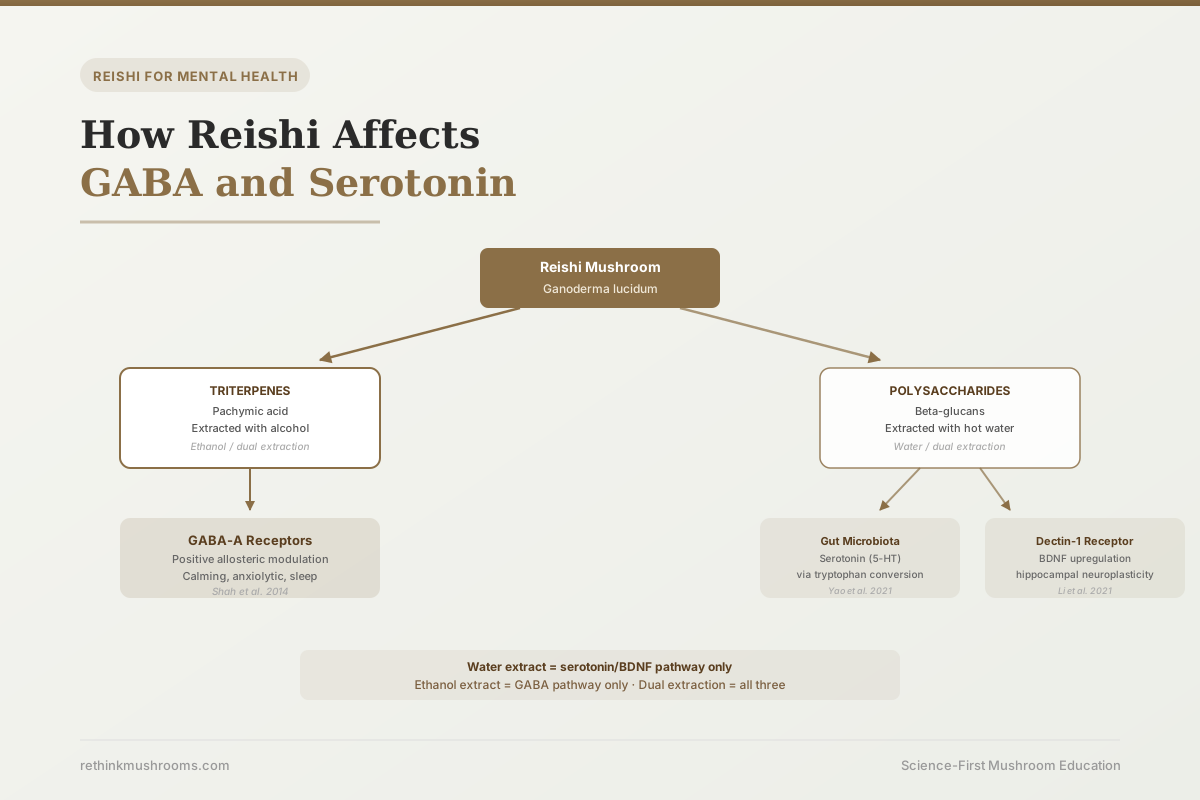 View as image ↗
Every website that covers Reishi for anxiety and mood says something like "Reishi supports GABA and serotonin." What almost none of them explain is that these two effects come from entirely different compounds in the mushroom, work through entirely different biological mechanisms, and require entirely different extraction methods to deliver. A water-based extract gives you one set of effects. An ethanol-based extract gives you another. A full-spectrum dual extraction gives you both. Understanding the distinction is the difference between using Reishi intelligently and guessing.
Reishi contains two major classes of bioactive compounds with separate nervous system actions: triterpenes, which are lipid-soluble and extracted with alcohol, and polysaccharides (including beta-glucans), which are water-soluble and extracted with hot water. The GABA pathway is driven by triterpenes. The serotonin pathway is driven by polysaccharides via the gut microbiome. A third downstream pathway, BDNF upregulation via the Dectin-1 immune receptor, is also polysaccharide-driven. None of these are the same mechanism. All three are documented in primary research.
This article traces each pathway from compound to receptor to downstream effect. For the clinical evidence of what Reishi supplementation actually does to anxiety and mood outcomes in humans, see Reishi for Anxiety: Calming Effects and Research and Reishi and Depression: Mood Regulation Evidence. For the broader context of how Reishi triterpenes and polysaccharides differ, see How Reishi Triterpenes Differ from Polysaccharides in Mechanism. For the foundational Reishi overview, see What Is Reishi Mushroom: The Science Behind the Mushroom of Immortality.
Key Takeaways
- Reishi's effects on GABA and serotonin come from two structurally different compound classes acting through two completely different biological pathways
- The GABA pathway is driven by pachymic acid, a lanostane triterpene: Shah and colleagues (2014) found it acts as a positive allosteric modulator of GABA-A receptors, the same receptors targeted by benzodiazepines, by binding to a different site and enhancing inhibitory signaling
- The serotonin pathway is driven by polysaccharides acting on gut microbiota: Yao and colleagues (2021) showed Reishi polysaccharides shift gut bacteria composition toward serotonin-promoting species, increasing intestinal tryptophan-to-5-HT conversion and extending non-REM sleep in mice
- A third pathway runs from polysaccharides through the Dectin-1 innate immune receptor to BDNF upregulation in the hippocampus, reducing depressive behavior in animal models (Li 2021)
- Li and colleagues (2024) directly compared polysaccharide-dominant vs triterpene-rich Reishi recipes and found the two produce measurably different effects: polysaccharide recipes showed superior anti-fatigue effects, while triterpene recipes showed superior sleep and calming effects
- The practical implication: water extraction captures polysaccharides (serotonin/BDNF pathway); ethanol extraction captures triterpenes (GABA pathway); dual extraction captures both; no single extract type delivers all three mechanisms
The GABA Pathway: How Pachymic Acid Calms the Nervous System
GABA (gamma-aminobutyric acid) is the brain's main inhibitory neurotransmitter. When GABA binds its receptors, it reduces neuronal firing and quiets excitatory signaling. The GABA-A receptor is a specific receptor subtype that, when activated, directly opens chloride ion channels in neurons, making them harder to fire. This is why compounds that enhance GABA-A activity produce calming, anxiolytic, and sleep-promoting effects.
Benzodiazepines (drugs like diazepam and lorazepam) work by binding to GABA-A receptors at an allosteric site, meaning they bind somewhere other than where GABA itself binds, and they amplify the response to any GABA that is present. This is why they are effective for anxiety and insomnia, and also why they carry risks of tolerance, dependence, and respiratory depression.
Shah and colleagues' 2014 study in the Journal of Ethnopharmacology identified pachymic acid, a lanostane triterpene found in both Poria cocos and Ganoderma lucidum, as a positive allosteric modulator of GABA-A receptors.[1] Like benzodiazepines, pachymic acid binds at an allosteric site on the GABA-A receptor and enhances its response to GABA. Unlike benzodiazepines, it is structurally a naturally occurring triterpene, not a synthetic benzodiazepine analog, and the researchers demonstrated it has different subunit selectivity than classical benzodiazepines.
The practical meaning: when you take a triterpene-rich Reishi extract, pachymic acid reaches the brain and modulates the same receptor type responsible for the calming effects of diazepam, but through a different binding site with different receptor subtype specificity. This is the mechanistic basis for claims that Reishi has a relaxing or sleep-promoting effect, and it is compound-specific: polysaccharide extracts do not deliver pachymic acid.
Singh and colleagues (2016) confirmed anxiolytic activity from Ganoderma-containing preparations in animal behavioral models using the elevated plus maze and open field tests, the standard assays for anxiolytic compound screening.[4] The anxiolytic effects were dose-dependent and species-specific. This animal evidence is consistent with the pachymic acid mechanism from Shah 2014 but does not prove the GABA-A receptor is the only pathway involved.
The Serotonin Pathway: How Polysaccharides Change Gut Bacteria
Serotonin (5-hydroxytryptamine, 5-HT) is often called the "feel-good neurotransmitter," though its function is considerably more complex. Approximately 90% of the body's serotonin is produced in the gut, not the brain. The gut's serotonin production depends on which bacteria inhabit the intestine, because specific bacteria promote the conversion of tryptophan (an amino acid from food) into 5-HT.
Yao and colleagues' 2021 study demonstrated this pathway specifically for Reishi.[2] In mouse models, Ganoderma lucidum treatment shifted gut microbiota composition in a specific direction: it increased species that promote tryptophan-to-5-HT conversion and reduced competing species. The result was elevated intestinal serotonin levels. The measurable behavioral outcome was extended non-REM (non-rapid eye movement) sleep, consistent with higher serotonin availability and its downstream conversion to melatonin.
The mechanism operates entirely in the gut-brain axis: Reishi polysaccharides (beta-glucans) are not absorbed and do not reach the brain directly. Instead, they function as prebiotics, selectively feeding beneficial gut bacteria that produce compounds influencing the gut-brain axis. The increased serotonin is produced in the gut epithelium, where it signals to the vagus nerve and influences brain function indirectly.
This pathway is completely separate from the GABA pathway. It requires polysaccharides (water-soluble), not triterpenes (lipid-soluble). It operates through gut bacteria, not through direct receptor binding in the nervous system. And its onset is necessarily slower: changing gut microbiota composition takes days to weeks, not hours.
The Dectin-1 Connection: Beta-Glucans, Immune Signaling, and BDNF
A third pathway explains part of Reishi's antidepressant-relevant effects, and it involves an immune receptor rather than a neurotransmitter receptor.
Dectin-1 is a pattern recognition receptor on immune cells that specifically recognizes beta-glucans, the structural polysaccharides in mushroom cell walls. When beta-glucans from Reishi bind Dectin-1, they activate innate immune signaling cascades. Li and colleagues' 2021 study showed that this Dectin-1 activation, triggered by Ganoderma polysaccharides, led to upregulation of BDNF (brain-derived neurotrophic factor) in the hippocampus.[3]
BDNF is sometimes called "fertilizer for the brain." It supports the growth, maintenance, and survival of neurons and is critical for synaptic plasticity, the brain's ability to form new connections. Low BDNF is strongly associated with depression, and most antidepressant drugs (including SSRIs) produce BDNF upregulation as part of their long-term mechanism. The fact that beta-glucan activation of an immune receptor leads to hippocampal BDNF upregulation represents a novel route from dietary compound to mood-relevant neurochemistry.
Zhao and colleagues' 2021 study extended this BDNF finding using a polysaccharide-peptide complex extracted from Ganoderma spores.[5] In the forced swim and tail suspension tests (standard mouse models for antidepressant screening), the spore extract significantly reduced immobility time and upregulated hippocampal BDNF and its receptor TrkB. The researchers compared the effect to fluoxetine (Prozac) at equal doses in mice: the spore extract produced comparable BDNF upregulation.
This is an animal model comparison to a pharmaceutical antidepressant. It does not mean Reishi replaces or matches fluoxetine in humans. But it does establish that the magnitude of BDNF upregulation from Ganoderma polysaccharide-peptide complexes is pharmacologically comparable in mice, which explains why this is considered a serious mechanistic finding rather than a minor observation.
The Extract Composition Finding That Changes Everything Practically
Shah 2014, Yao 2021, and Li 2021 establish three separate mechanisms. But which mechanism does any given Reishi product actually deliver? That question was answered more directly by Li and colleagues in 2024.[6]
Li and colleagues compared the effects of multiple Ganoderma lucidum recipes that differed in their polysaccharide-to-triterpene ratio. A polysaccharide-dominant recipe (called PGB) showed significantly superior anti-fatigue and energy effects. A triterpene-richer recipe (called GBS) showed significantly superior sleep-aiding and calming effects. The same mushroom, different extraction and composition, measurably different outcomes.
This finding has a direct practical interpretation:
Water hot extraction, which is how most Reishi supplements are manufactured, efficiently pulls polysaccharides but leaves most triterpenes behind. A water-extracted Reishi product is a polysaccharide-dominant product, and its primary nervous system effects are via the gut microbiota serotonin pathway and the Dectin-1/BDNF pathway.
Ethanol or alcohol extraction pulls triterpenes, including pachymic acid, but captures fewer polysaccharides. An ethanol-extracted Reishi product is a triterpene-dominant product, and its primary nervous system effects are via the GABA-A receptor pathway.
Dual extraction, using both hot water and ethanol sequentially, captures both compound classes. It is the only extraction method that can deliver both the GABA pathway and the serotonin/BDNF pathway in a single product.
This distinction matters for anyone choosing a Reishi supplement based on a specific intended effect: the label's extraction method tells you which of these pathways you are primarily accessing. For a detailed comparison of extraction methods and what they capture, see How Reishi Triterpenes Differ from Polysaccharides in Mechanism.
For how these mechanisms compare to Lion's Mane's NGF-based anxiety and mood mechanisms, see Lion's Mane and Anxiety Reduction: Mechanisms and Studies.
What the Mechanisms Don't Tell Us
Three well-characterized animal and in vitro mechanisms, and one human-relevant practical comparison, make Reishi one of the most mechanistically understood functional mushrooms for nervous system effects.
What these studies do not establish: whether taking a Reishi supplement produces measurable changes in human GABA, serotonin, or BDNF levels at typical supplement doses. The pachymic acid mechanism was demonstrated in vitro. The gut microbiota serotonin pathway was demonstrated in mice. The Dectin-1/BDNF pathway was demonstrated in mouse stress models. Human pharmacokinetic data confirming that pachymic acid reaches the human brain in calming concentrations, or that oral Reishi consumption meaningfully shifts human gut microbiota toward serotonin-promoting species, is limited.
The three human RCTs in this cluster (Tang 2005, Pazzi 2020, Mitra 2024) showed real improvements in anxiety, mood, and fatigue scores, which is consistent with these mechanisms being active in humans. But the mechanism studies are not the same as the outcome studies, and the chain of evidence runs from "mechanism in animals" to "outcomes in humans" without a clean human mechanistic study filling the gap.
For the neuroinflammation pathway that complements GABA and serotonin as a third depression-relevant mechanism, see Reishi and Neuroinflammation-Driven Depression: Microglial Research.
The Bottom Line
Reishi's effects on the nervous system run through two structurally separate compound classes with distinct mechanisms. Triterpenes, primarily pachymic acid, act as positive allosteric modulators of GABA-A receptors, amplifying inhibitory neuronal signaling through a mechanism similar to but structurally different from benzodiazepines. Polysaccharides work via gut microbiota: they shift intestinal bacteria toward serotonin-promoting species, increasing tryptophan-to-5-HT conversion (Yao 2021), and separately activate Dectin-1 immune receptors to upregulate hippocampal BDNF (Li 2021). The practical consequence is that water-extracted Reishi products deliver the polysaccharide pathways, ethanol-extracted products deliver the triterpene/GABA pathway, and dual-extracted products deliver both, a distinction directly confirmed by Li 2024's recipe composition comparison. Human mechanistic data connecting these pathways to measured GABA or serotonin changes remains limited.
Frequently Asked Questions
Sources & References
- 1. Source details for this reference are not yet available.
- 2. Source details for this reference are not yet available.
- 3. Source details for this reference are not yet available.
- 4. Source details for this reference are not yet available.
- 5. Source details for this reference are not yet available.
- 6. Source details for this reference are not yet available.