Reishi (Ganoderma lucidum)
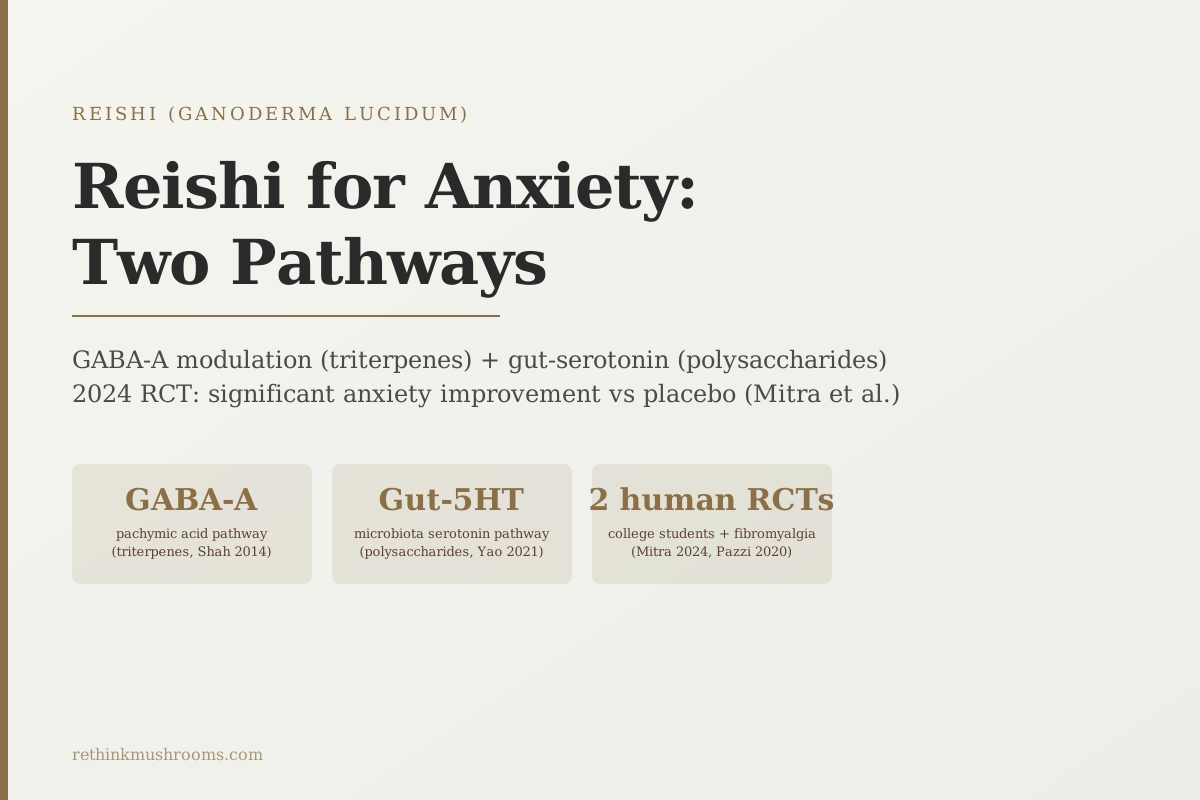
2 distinct anxiety pathways
Reishi's calming effects come from two separate mechanisms: triterpenes like pachymic acid potentiate GABA-A receptors (amplifying the brain's own GABA signal), while polysaccharides reshape gut microbiota to increase serotonin production. Most sites describe one; both pathways are active.
Shah et al., Biomol Ther, 2014; Yao et al., Sci Rep, 2021
2024 RCT
Mitra et al. found significant improvement in perceived stress, anxiety, depression, and vitality in female college students vs placebo
GABA-A
receptor pathway activated by pachymic acid — the same receptor benzodiazepines target, via a gentler allosteric mechanism
Gut-serotonin
second pathway: Reishi polysaccharides reshape gut bacteria to increase tryptophan-to-serotonin conversion (Yao et al., 2021)
Shah et al., Biomol Ther, 2014; Yao et al., Sci Rep, 2021
 View as image ↗
Reishi (Ganoderma lucidum) has two distinct calming mechanisms in preclinical research — and most articles about reishi and anxiety describe only one of them.
The first mechanism runs through GABA-A receptors — the same receptors that respond to GABA (gamma-aminobutyric acid), the brain's primary inhibitory neurotransmitter, and the same receptors that benzodiazepine drugs like diazepam activate. A lanostane triterpene called pachymic acid — characteristic of the related medicinal fungus Poria cocos and also reported in Ganoderma — potentiates these receptors: it doesn't directly activate them like a drug, but amplifies the receptor's response to GABA when GABA is present, producing a calming effect without the direct sedation of a benzodiazepine. Ganoderma lucidum extract itself potentiates GABAergic sleep in a way that the benzodiazepine-site antagonist flumazenil blocks, giving direct evidence that reishi engages this same GABA-A route.
The second mechanism runs through the gut. Reishi polysaccharides reshape the composition of gut bacteria, which affects how much tryptophan — an amino acid the body uses to make serotonin — is converted into serotonin in the intestinal tract. More serotonin in the gut influences the gut-brain axis in ways that affect mood and anxiety.
These are separate pathways, driven by different compound classes (triterpenes vs. polysaccharides), with different timescales and different targets. And in a 2024 double-blind placebo-controlled trial in female college students, reishi supplementation significantly improved validated scores for perceived stress, anxiety, depression, and vitality compared to placebo.[1]
For the pillar overview of Reishi, see what is reishi mushroom: the science behind the mushroom of immortality. For the GABA and serotonin pathways in detail, see how reishi affects GABA and serotonin pathways. For how reishi compares to Lion's Mane for anxiety, see Lion's Mane and anxiety reduction: mechanisms and studies.
Key Takeaways
- Mitra et al. (2024) ran a double-blind, randomized, placebo-controlled RCT in 78 female college students; supplementation at 1000 mg/day of Ganoderma lucidum for 30 days significantly improved validated anxiety, depression, vitality, and positive well-being scores vs placebo — the most recent and direct human evidence
- Pazzi et al. (Healthcare, 2020) found Ganoderma lucidum supplementation improved mood-related outcomes — happiness, depression, satisfaction with life, and health-related quality of life — in a controlled trial in women with fibromyalgia, extending the mood evidence to a second patient population
- Pachymic acid, a lanostane triterpene, acts as a GABA-A positive allosteric modulator — amplifying GABA's calming signal without directly firing the receptor; this mechanism was demonstrated in the related fungus Poria cocos (Shah et al., Biomol Ther, 2014), where pachymic acid is characteristic, and the compound is also reported in Ganoderma
- Ganoderma lucidum extract itself potentiates GABAergic sleep and the effect is reversed by the benzodiazepine-site antagonist flumazenil (Chu et al., 2007) — direct evidence that reishi engages the GABA-A route
- Reishi polysaccharides independently reshape gut microbiota to increase tryptophan-to-serotonin conversion in the intestinal tract; this was demonstrated against a sleep endpoint in mice (Yao et al., Sci Rep, 2021), with relevance to anxiety inferred through the gut-brain axis, distinct from the GABA mechanism
- Singh et al. (2016) found anxiolytic effects of Ganoderma species extracts in mice using standard measures (elevated plus maze, open field), and Socala et al. (2015) reported anxiolytic-like and antidepressant-like effects of G. lucidum mycelium extract — converging animal support
- The human evidence comes from specific populations (college students and fibromyalgia patients); no controlled trial has directly addressed clinical anxiety disorders or specific anxiety diagnoses
The Human Trial Evidence: What Controlled Studies Found
The 2024 College Student RCT
Mitra and colleagues ran a double-blind, randomized, placebo-controlled trial in 78 female college students supplementing with Ganoderma lucidum and assessed multiple validated psychological endpoints.[1] Participants took either 500 mg or 1000 mg of G. lucidum daily for 30 days. The significant psychological improvements — in anxiety, depression, vitality, and positive well-being scores compared to placebo — were seen in the 1000 mg/day group, alongside gains in cardiovascular fitness measures.
This is the most recent and most directly applicable human RCT for reishi's effects on anxiety-related outcomes. It was conducted in a healthy young adult population experiencing ordinary life stress — not a clinical patient population — which makes the findings relevant to the large majority of people who search for information about reishi and anxiety.
The study used validated psychological scales rather than subjective self-report alone, which strengthens the clinical relevance of the findings. The dose-dependence is worth noting: the psychological benefits reached significance at 1000 mg/day but not at the lower 500 mg/day dose.
One limitation matters for interpreting the results: the study enrolled female college students specifically. Whether the findings generalize to other populations, to older adults, or to people with diagnosed anxiety disorders is not established from this single trial.
The 2020 Fibromyalgia RCT
Pazzi and colleagues published a second human controlled trial in women with fibromyalgia (Healthcare, 2020), finding that Ganoderma lucidum supplementation improved mood-related outcomes — happiness, depression, satisfaction with life, and health-related quality of life — compared with a control group.[2]
Fibromyalgia has high rates of comorbid anxiety and depression. The mood and quality of life improvements seen in this population suggest reishi's calming and mood-supporting effects are not limited to healthy adults experiencing everyday stress, but extend to a clinical population with more substantial psychological burden.
The combination of these two human trials — one in healthy young adults, one in a clinical population with high anxiety/mood comorbidity — provides converging support for reishi's effects on anxiety-related outcomes across different populations.
Two Compounds, Two Pathways
How Reishi Calms Through Two Separate Mechanisms
Most articles describe one mechanism; reishi runs two. A triterpene (pachymic acid) potentiates the brain's GABA-A signal on a fast timescale, while polysaccharides reshape gut bacteria to raise serotonin over days to weeks. Different compounds, different targets, different speeds — reading the two lanes side by side shows why reishi's calming effect is not a single story.
Pachymic acid potentiates GABA-A signaling
A lanostane triterpene, pachymic acid amplifies the brain’s own GABA signal rather than firing the receptor directly: it prolongs pentobarbital sleep, synergizes with muscimol, and raises intracellular chloride — the signature of GABA-A potentiation. The mechanism was shown in Poria cocos, a related medicinal fungus; pachymic acid is characteristic of Poria and also reported in Ganoderma. Direct Ganoderma evidence comes from whole-extract GABAergic sleep potentiation that flumazenil (a benzodiazepine-site antagonist) blocks.
Shah 2014 [3] (pachymic acid, GABA-A-ergic, in Poria cocos) · Chu 2007 [7] (G. lucidum GABAergic sleep, flumazenil-sensitive)
Polysaccharides raise gut-derived serotonin
Reishi polysaccharides reshape gut microbiota and increase the conversion of tryptophan to serotonin (5-HT) in the intestine, signaling to the brain through the gut-brain axis. This was demonstrated as a gut-microbiota-dependent, serotonin-involved SLEEP-promoting mechanism in mice — its relevance to anxiety is mechanistic inference through the gut-brain axis, not a measured anxiety endpoint. It builds over days to weeks as microbiota composition shifts, a slower timescale than the GABA-A route.
Yao 2021 [4] (gut-microbiota-dependent, serotonin-involved; sleep endpoint in mice)
The two mechanisms are established in cell and animal studies; the pachymic-acid GABA-A evidence comes from the related fungus Poria cocos, and the gut-serotonin pathway was measured against a sleep endpoint, not anxiety. Human efficacy for anxiety and mood rests on two randomized controlled trials in specific populations (college students and fibromyalgia patients), not on trials in diagnosed anxiety disorders. This is a mechanism map, not medical advice.
Mechanism synthesis; arms from refs [1][2][3][4][5][7][8] (see references)
The First Mechanism: GABA-A Receptor Modulation via Pachymic Acid
Shah and colleagues published a study in Biomolecules & Therapeutics in 2014 that identified a specific molecular mechanism behind one of reishi's calming pathways.[3]
Pachymic acid — a lanostane-type triterpene characteristic of Poria cocos (a related medicinal fungus) and also reported in Ganoderma lucidum — potentiates GABA-A receptors. An important caveat for reishi specifically: the Shah 2014 experiments were conducted on pachymic acid from Poria cocos, not on Ganoderma. What that study establishes is that this triterpene, which reishi also contains, acts through the GABA-A system.
GABA-A receptors respond to GABA (gamma-aminobutyric acid), the brain's primary inhibitory signal. When GABA binds to a GABA-A receptor, it makes the nerve cell less likely to fire. This is how anxiety is calmed at the neurological level: GABA suppresses activity in regions of the brain involved in fear and threat-detection, including the amygdala and limbic system.
A positive allosteric modulator of GABA-A doesn't directly activate the receptor the way a drug would. Instead, it changes the shape of the receptor in a way that makes GABA's own effect stronger and longer. When GABA arrives at the receptor, the response is amplified. This is the same mechanism by which benzodiazepines work — but pachymic acid's molecular interaction with the receptor is different from benzodiazepines in ways that may explain why reishi produces calming effects without the sedation, tolerance, and dependence associated with pharmaceutical GABA-A modulators.
Direct evidence that Ganoderma lucidum itself works through this system comes from earlier work by Chu and colleagues, who found that G. lucidum extract prolongs sleep and shortens sleep latency in a GABAergic manner — an effect blocked by flumazenil, the antagonist that occupies the benzodiazepine site on the GABA-A receptor.[7] The flumazenil result is the clearest confirmation that reishi's calming action passes through the GABA-A benzodiazepine site, not merely a related pathway.
This mechanism explains both the calming effects of reishi and, when doses are high enough to produce strong GABA-A modulation, potential sedative effects — which answers the question "is reishi a sedative?" with nuance. At moderate doses, the effect is calming without impairing alertness. At very high doses, the GABA-A potentiation could become more sedating.
The Second Mechanism: Gut Microbiota and Serotonin Production
Yao and colleagues published research in Scientific Reports in 2021 demonstrating a second, distinct pathway — one measured against a sleep endpoint but with clear implications for mood — through which reishi acts on the brain via the gut.[4]
The study tracked what happened to gut microbiota composition and serotonin levels in mice treated with Ganoderma lucidum. The finding: reishi treatment reshaped the bacterial community in the gut, and this reshaping increased the conversion of tryptophan — an amino acid obtained from food — into serotonin (5-hydroxytryptamine, or 5-HT) in the intestinal tract. Serotonin produced in the gut doesn't directly enter the brain, but gut serotonin strongly influences the enteric nervous system and sends signals via the vagus nerve that affect brain function and emotional state. The mice showed extended non-REM sleep alongside the serotonin increase, suggesting the gut pathway affects both mood and sleep quality.
This mechanism is driven by polysaccharides — the long sugar-chain compounds in reishi cell walls — not by triterpenes like pachymic acid. It operates on a different timescale (gut microbiota composition changes take days to weeks, while GABA-A modulation is more immediate) and through a completely different molecular chain.
The practical implication: a product rich in polysaccharides (typically a hot water extract) delivers more of the gut-serotonin pathway's benefit. A product rich in triterpenes (an ethanol or dual extract) delivers more of the GABA-A pathway's effect. Full-spectrum extracts that capture both compound classes activate both pathways simultaneously. Most products are not standardized to explain this distinction to buyers.
Animal Model Support for Anxiolytic Effects
Singh and colleagues tested a mixture of four Ganoderma species (including G. lucidum) in animal anxiety models in 2016, finding significant anxiolytic effects measured through both the elevated plus maze — a standard test that measures how much time rodents spend in exposed vs. sheltered areas as a proxy for anxiety — and the open field test.[5]
A separate line of animal work reinforces this. Socala and colleagues (2015) tested an aqueous extract of cultured G. lucidum mycelium in mice and reported both anxiolytic-like effects (on the elevated plus maze) and antidepressant-like effects (on the forced swim test), converging with Singh's findings across different reishi preparations.[8] Because Singh tested whole-species extracts rather than isolated pachymic acid, these animal results establish that reishi preparations reduce anxiety-like behavior without pinning the effect to any single compound.
Shevelev and colleagues, in animal research from 2018 (published in Phytomedicine), studied a different dimension: they found that oral Ganoderma lucidum reduced blood pressure in hypertensive rats to a degree comparable to the drug losartan, while increasing cerebral blood flow and shifting the cortex's neurometabolite balance — a pattern the authors interpreted as a potential nootropic effect.[6] Notably, that neurotransmitter shift was toward excitation rather than sedation, a nuance we return to below. This study did not measure anxiety-like behavior directly; its relevance to anxiety is indirect — because hypertension and anxiety are frequently comorbid, a blood-pressure effect of this kind could matter for anxious individuals, but that link is inferential, not something the study tested.
Is Reishi a Sedative? The Distinction Matters
The short answer: it can be calming without being sedating at typical supplement doses.
The GABA-A mechanism — pachymic acid amplifying GABA's inhibitory effect — is the same molecular pathway that benzodiazepines like diazepam use. But "acting on GABA-A receptors" does not automatically mean "sedating." The magnitude of the effect depends on dose, receptor occupancy, and which GABA-A subunit composition the compound binds to.
At typical supplement doses of reishi extract (1-2g/day of a standardized extract), the GABA-A modulation appears to produce calming without significant sedation — the effect size is smaller than a pharmaceutical GABA-A drug and the interaction with the receptor differs at the structural level. At very high doses, sedation is possible and is documented in the animal literature.
The practical difference: most people using reishi for anxiety at studied doses describe reduced anxiety without impaired alertness, which is consistent with a mild GABA-A allosteric mechanism. People using reishi as a sleep aid (which involves the same GABA-A pathway) often take it in the evening specifically for the sleep-promoting effect.
Can Reishi Cause Anxiety?
Some people report a stimulating or alerting effect from reishi, particularly from products higher in polysaccharides or at first use. The mechanistic basis for this is less clear than the calming mechanisms — it may relate to immune activation pathways (reishi does activate certain immune cells, and inflammatory signaling can have excitatory CNS effects in some individuals), or to individual variation in gut microbiota response.
This is where the Shevelev 2018 finding becomes relevant: that study found reishi shifted the cortex's neurotransmitter balance toward excitation (which the authors read as a possible nootropic effect), alongside its blood-pressure reduction. An excitatory shift fits reports of alerting or stimulating effects better than a purely sedative picture, and it is a useful reminder that reishi's central effects are not uniformly calming. That said, this was a study in hypertensive rats and doesn't predict what happens in normotensive or anxious individuals with different autonomic profiles. The human RCT evidence (Mitra 2024, Pazzi 2020) showed anxiety and mood improvement, not worsening — but those trials enrolled specific populations and excluded people with certain health conditions.
Anyone experiencing increased anxiety with reishi should consider: the product form (powder vs. extract), the dose, the timing (morning vs. evening), and whether the product includes other compounds that could cause stimulation.
This article is educational and not medical advice. Reishi is not a substitute for evaluation or treatment of an anxiety disorder. If you have a diagnosed anxiety or mood condition, take prescription medication (reishi can affect the same GABA-A and cardiovascular systems as some drugs), or are pregnant or breastfeeding, talk with a qualified healthcare professional before using reishi.
For the full discussion of anxiety across functional mushrooms, see functional mushrooms for anxiety: what the research shows. For the pharmacology behind these effects, see the pharmacology of Ganoderma lucidum: how reishi works.
The Bottom Line
Reishi's calming effect rests on two distinct, compound-specific pathways: the triterpene pachymic acid potentiates GABA-A receptors (a mechanism demonstrated in the related fungus Poria cocos, with reishi extract itself showing flumazenil-sensitive GABAergic activity), while polysaccharides reshape gut microbiota to increase serotonin production (shown against a sleep endpoint). A 2024 double-blind RCT in college students (Mitra et al.) found significant improvement in anxiety, depression, and vitality scores vs placebo at 1000 mg/day. A second controlled trial in women with fibromyalgia (Pazzi 2020) showed mood and quality-of-life benefits. At typical doses the effect is calming rather than sedating, though one animal study found reishi shifted cortical signaling toward excitation, consistent with occasional reports of stimulation. The human evidence is promising but comes from specific populations; trials in diagnosed anxiety disorders have not been conducted. This is educational content, not medical advice.
Frequently Asked Questions
Sources & References
- 1RTHM-00895·Mitra, Sudeep et al. (2024). “Efficacy of Lingzhi or Reishi Medicinal Mushroom Ganoderma lucidum (Agaricomycetes) Supplementation on Psychological Stress and Selective Fitness Profile Parameters in Female College Students in West Bengal, India..” International journal of medicinal mushrooms.Study breakdown →PubMed →↩
- 2RTHM-00648·Pazzi, Francesco et al. (2020). “Ganoderma lucidum Effects on Mood and Health-Related Quality of Life in Women with Fibromyalgia..” Healthcare (Basel.Study breakdown →PubMed →↩
- 3RTHM-00641·Shah, Vikash Kumar et al. (2014). “Pachymic Acid Enhances Pentobarbital-Induced Sleeping Behaviors via GABAA-ergic Systems in Mice..” Biomolecules & therapeutics.Study breakdown →PubMed →↩
- 4RTHM-00731·Yao, Chunyan et al. (2021). “Ganoderma lucidum promotes sleep through a gut microbiota-dependent and serotonin-involved pathway in mice..” Scientific reports.Study breakdown →PubMed →↩
- 5RTHM-00826·Singh, Ranjeet et al. (2016). “Evaluation of Antianxiety Potential of Four Ganoderma (Agaricomycetes) Species from India in Mice..” International journal of medicinal mushrooms.Study breakdown →PubMed →↩
- 6RTHM-00530·Shevelev, Oleg B et al. (2018). “Hypotensive and neurometabolic effects of intragastric Reishi (Ganoderma lucidum) administration in hypertensive ISIAH rat strain..” Phytomedicine : international journal of phytotherapy and phytopharmacology.Study breakdown →PubMed →↩
- 7RTHM-00210·Chu, Qing-Ping et al. (2007). “Extract of Ganoderma lucidum potentiates pentobarbital-induced sleep via a GABAergic mechanism..” Pharmacology.Study breakdown →PubMed →↩
- 8RTHM-00400·Socala, Katarzyna et al. (2015). “Evaluation of Anticonvulsant, Antidepressant-, and Anxiolytic-like Effects of an Aqueous Extract from Cultured Mycelia of the Lingzhi or Reishi Medicinal Mushroom Ganoderma lucidum (Higher Basidiomycetes) in Mice..” International journal of medicinal mushrooms.Study breakdown →PubMed →↩