Reishi (Ganoderma lucidum)
12 primary pharmacological studies analyzed
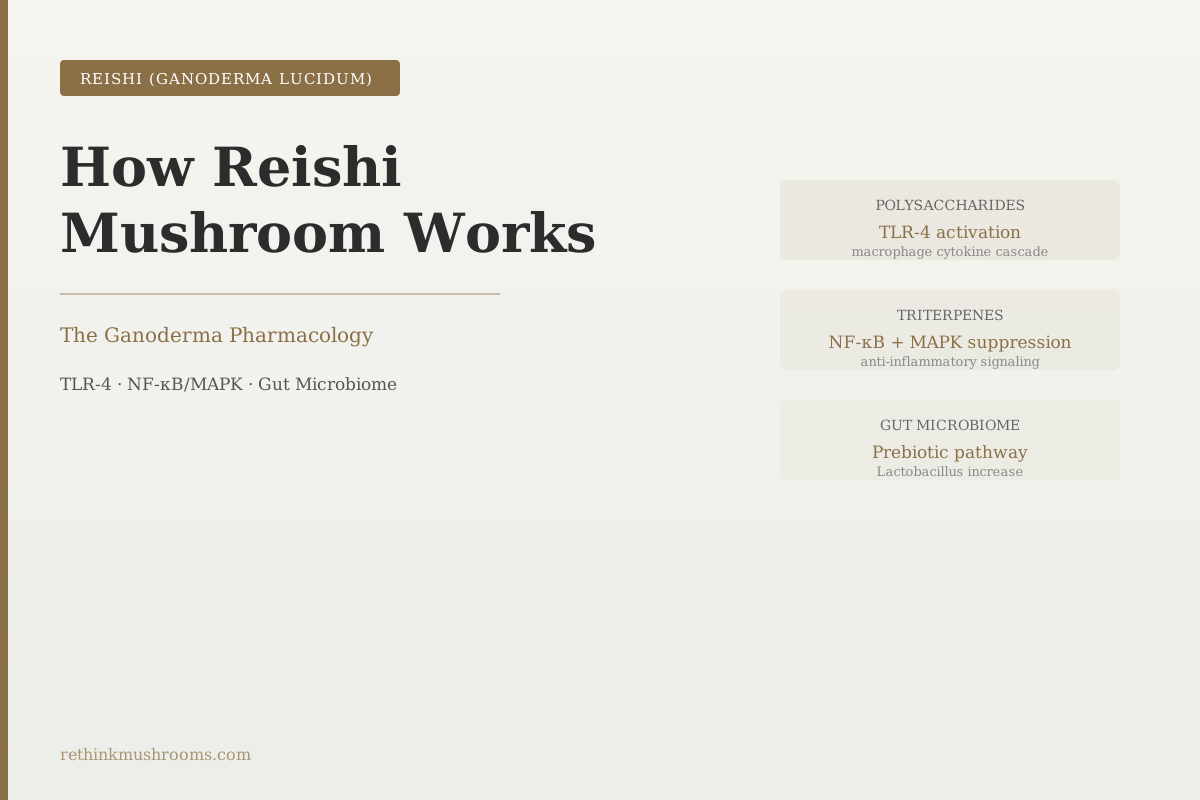
Reishi's pharmacological effects trace to three distinct mechanisms: polysaccharides activate immune cells via TLR-4 signaling; triterpenes suppress inflammation via NF-κB and MAPK pathways; and polysaccharides modulate the gut microbiome as prebiotics. A 37-page 2019 review by Wang and Lin synthesized the complete immune modulation literature.
Wang & Lin, Advances in Experimental Medicine and Biology, 2019
TLR-4
the cell-surface receptor through which reishi polysaccharides trigger immune activation
NF-κB + MAPK
the two inflammatory signaling pathways that reishi triterpenes suppress
n=132
Tang 2005 RCT, the strongest single human clinical trial for reishi polysaccharide extract
Wang & Lin, Advances in Experimental Medicine and Biology, 2019
 View as image ↗
Most discussions of how reishi mushroom works describe the effects: it supports the immune system, it reduces inflammation, it improves sleep. What they rarely provide is the mechanism: which compounds hit which cellular targets, through which pathways, to produce which physiological changes. The gap matters because it determines whether any given reishi product is likely to produce the effects attributed to the mushroom. A hot-water tea extracts polysaccharides, not triterpenes, so it activates immune pathways but not anti-inflammatory ones. A product with no standardized compounds may not activate any pathway reliably. For the background on what those compounds are, see Reishi Bioactive Compounds: Triterpenes, Polysaccharides, and Sterols. This article explains the mechanisms: how reishi mushroom actually works at the cellular level. For the broader overview of reishi's traditional use and clinical applications, see What Is Reishi Mushroom?.
Key Takeaways
- Reishi polysaccharides activate immune cells through the TLR-4 receptor on macrophages, triggering cytokine production (IL-1β, IL-2, IL-6, IFN-γ) that activates downstream T cells, B cells, and natural killer cells
- Reishi triterpenes (ganoderic acids) suppress inflammation by inhibiting two signaling pathways: NF-κB (which controls inflammatory protein production) and MAPK (which amplifies the cellular stress response)
- A 2026 meta-analysis of 23 preclinical studies confirmed triterpenes significantly reduce TNF-α, IL-1β, and IL-6 through NF-κB/MAPK downregulation
- Polysaccharides also work as prebiotics in the colon, shifting gut microbiome composition toward Lactobacillus and away from Fusobacterium, with some anti-inflammatory effects running through the microbiome rather than direct immune activation
- The strongest human clinical trial data comes from a 2005 RCT (n=132, 8 weeks) showing polysaccharide extract improved fatigue and well-being; a 2025 GRADE meta-analysis found most clinical evidence is low to very low quality
- Polysaccharides and triterpenes require different solvents to extract (water vs. ethanol); most of the human trial evidence used one or the other, not both combined
How Reishi Mushroom Works: The Three-Tier Framework
Reishi's pharmacological profile involves three distinct tiers: a specific compound, a specific molecular target, and a downstream physiological effect. The compounds are polysaccharides and triterpenes. The targets are cellular receptors and signaling proteins. The effects are immune activation, inflammation reduction, and gut microbiome modulation.
Understanding these three tiers explains something that supplement marketing obscures: "supports the immune system" can mean TLR-4 activation via polysaccharides, or it can mean NF-κB suppression via triterpenes. These are not the same thing. One activates an immune response; the other reduces it. Both can be true simultaneously in the same mushroom because the two compound classes act through different targets with different effects. The interaction is one reason why the clinical evidence is complex, and why product formulation determines which mechanism a given supplement is likely to engage.
A 2025 pharmacology review by Sarkar et al. in Natural Product Research describes this compound-pathway-effect architecture across all major G. lucidum compound classes.[11] The 2025 review by Ren et al. in Food Science & Nutrition provides an updated catalogue of the specific compounds involved in each pathway.[12]
Mechanism · Compound → Target → Effect
One Mushroom, Two Compound Classes, Opposite Effects
Reishi’s pharmacology is not one action but three. Polysaccharides and triterpenes hit different molecular targets, and they pull in opposite directions — one switches the immune system on, the other restrains inflammation. Both are true at once in a whole-mushroom preparation. This is direction of action from the mechanism studies, not a human-quantified effect size.
Compound
Polysaccharides (β-glucans)
Macrophage surface
Immune activation
Cytokine release (IL-1β, IL-2, IL-6, IFN-γ, TNF-α) activates NK cells, T cells, B cells
Lin 2005 [1] · Wang 2019 [2]
Compound
Triterpenes (ganoderic acids)
Intracellular signaling
Inflammation restrained
Suppressing these pathways lowers COX-2, TNF-α, IL-1β and IL-6 output simultaneously
Dudhgaonkar 2009 [3] · Pozzobon 2026 [4]
Compound
Polysaccharides (prebiotic)
Colon (indirect)
Microbiome shift
↑Lactobacillus, ↓Fusobacterium — some anti-inflammatory effect runs through the microbiome, not direct immune contact
Cai 2017 [5] · Guo 2021 [6]
The point of the diagram: “supports the immune system” can mean TLR-4 activation via polysaccharides or NF-κB suppression via triterpenes — opposite actions on the same pathway family. Which one a given product engages depends on how it was extracted: hot water pulls polysaccharides, ethanol pulls triterpenes.
Sources: Lin 2005 [1]; Wang & Lin 2019 [2]; Dudhgaonkar 2009 [3]; Pozzobon 2026 [4]; Cai 2017 [5]; Guo 2021 [6]
Mechanism 1: Immune Activation Through TLR-4 Signaling
The immune activation pathway is the most extensively studied mechanism for reishi polysaccharides.
The key receptor is TLR-4, a protein on the outer surface of macrophages (the immune system's patrol cells). When a beta-glucan polysaccharide molecule binds TLR-4, it triggers a signaling cascade inside the macrophage that results in the production of cytokines: signaling proteins that activate other immune cells.
Lin et al.'s foundational 2005 review in the Journal of Pharmacological Sciences mapped this pathway in detail for Ganoderma lucidum specifically.[1] The cytokines produced include IL-1β, IL-2, IL-6, IFN-γ, and TNF-α. Each has a specific downstream function: IL-2 activates T cells; IFN-γ activates natural killer (NK) cells and enhances T cell function; TNF-α coordinates the broader inflammatory response. The overall result is activation of both the innate immune response (macrophages, NK cells) and the adaptive immune response (T and B lymphocytes).
Wang and Lin's 2019 review, published in Advances in Experimental Medicine and Biology, is the most comprehensive synthesis of this literature: a 37-page analysis of the entire Ganoderma immunomodulation body of evidence through 2019, covering polysaccharide signaling through TLR-4/NF-κB, NK cell activation, and T-cell subset modulation with detailed mechanistic coverage.[2]
The activation is bidirectional: reishi polysaccharides appear to both activate underactive immune responses and modulate overactive ones, which is why the effect is described as "immunomodulatory" rather than simply "immunostimulatory." The mechanism by which the same compounds produce opposing effects in different immune states is not fully characterized in the current literature.
For the deeper mechanistic discussion of how this plays out in innate versus adaptive immunity, see How Reishi Modulates Innate and Adaptive Immunity.
Mechanism 2: Anti-Inflammatory Action Through NF-κB and MAPK Suppression
The triterpene pathway works through a different set of targets with a different functional outcome: reducing inflammation rather than activating immune cells.
NF-κB is a protein complex inside cells that functions as a master switch for inflammatory gene expression. When activated by stress signals (cytokines, pathogens, oxidative damage), NF-κB moves into the cell nucleus and turns on production of inflammatory proteins including COX-2, TNF-α, and interleukins. COX-2 is the same enzyme targeted by NSAIDs like ibuprofen. A compound that blocks NF-κB activation reduces the production of all these inflammatory mediators simultaneously.
Dudhgaonkar et al. (2009) isolated specific triterpenes from G. lucidum and demonstrated that they suppress both NF-κB and a related pathway called AP-1, reducing COX-2 expression in cell experiments.[3] The ganoderic acids were the primary agents, not the whole extract.
The 2026 meta-analysis by Pozzobon et al., covering 23 preclinical studies published between 2003 and 2025, provides the most rigorous synthesis.[4] Across these studies, G. lucidum triterpenes significantly reduced three key inflammatory signaling molecules: TNF-α, IL-1β, and IL-6. The reduction operated specifically through downregulation of MAPK and TLR-4/NF-κB pathways.
The apparent contradiction with mechanism 1, that polysaccharides activate a pathway (TLR-4/NF-κB) that triterpenes suppress, reflects the different functional roles of these compound classes in the whole mushroom. Polysaccharides activate immune surveillance; triterpenes restrain runaway inflammation. In a whole reishi preparation with both compound classes present, these effects coexist. Which dominates in any given tissue or condition likely depends on the relative concentrations and the baseline inflammatory state.
Mechanism 3: The Gut Microbiome Pathway
A third pathway, distinct from direct cellular immune activation, operates through the gut.
Cai et al. (2017) demonstrated that G. lucidum polysaccharides reduce microglial neuroinflammation (brain-resident immune cell activity) in a mouse model and improve behavioral outcomes.[5] This establishes that polysaccharides reach brain tissue in a form capable of affecting immune activity there.
Guo et al. (2021) tracked gut microbiome composition and colon inflammatory markers simultaneously after G. lucidum polysaccharide administration in mice with colon inflammation.[6] The polysaccharides increased Lactobacillus populations (beneficial bacteria) and decreased Fusobacterium populations (associated with gut inflammation). Inflammatory markers fell at the same time. Some of the anti-inflammatory effect appeared to operate through the microbiome shift rather than through direct immune cell contact.
This prebiotic pathway operates on a different timescale from the direct receptor mechanisms. TLR-4 binding and subsequent cytokine release occurs within hours. Shifting microbial populations takes days to weeks of consistent intake. This may help explain why some observed effects of consistent reishi use seem to emerge slowly, over weeks rather than days.
Mechanism 4: Antitumor and Anti-Angiogenic Activity
A fourth area of preclinical research covers direct antitumor effects through polysaccharide-peptide complexes.
Cao and Lin (2004) demonstrated that polysaccharide-peptide complexes isolated from G. lucidum inhibited tumor growth and blocked angiogenesis (new blood vessel formation that feeds tumors) in animal models.[7] The polysaccharide fraction was the active component, operating through immune-mediated mechanisms rather than direct cytotoxicity against cancer cells.
This work is preclinical. Animal model findings for antitumor activity have a poor track record of translating to human cancer treatment outcomes. The Cao 2004 findings establish that G. lucidum polysaccharides have anti-angiogenic and antitumor properties in controlled laboratory conditions. They do not establish clinical utility for cancer treatment. Reishi is used as a complement to conventional cancer care in some clinical contexts, but the evidence base for this use is separate from the mechanism data.
Mechanism 5: Metabolic and Peptide-Mediated Effects
Two additional pharmacological mechanisms are described in the recent review literature with less developed evidence bases.
Aref et al. (2023) conducted a systematic review and meta-analysis of animal studies on G. lucidum effects on serum lipid profiles.[8] Across the included studies, G. lucidum supplementation was associated with favorable changes in triglycerides, total cholesterol, LDL-C, HDL-C, and VLDL. These effects were observed consistently in the animal literature. The translation to human lipid outcomes is not established: this is mechanistic plausibility, not clinical evidence.
Sarkar et al. (2025) also describes ACE-inhibitory peptides isolated from G. lucidum, with potential relevance to blood pressure regulation through angiotensin-converting enzyme inhibition.[11] This represents a fourth potential pharmacological mechanism, but the human evidence is not yet available.
What Human Clinical Trials Actually Show
The mechanistic evidence above comes almost entirely from in vitro cell culture experiments and animal models. The most clinically important question is whether these mechanisms produce measurable effects in humans.
The strongest single human data point comes from Tang et al. (2005), a randomized double-blind placebo-controlled trial in 132 patients with neurasthenia (a condition characterized by persistent fatigue) over 8 weeks.[9] The G. lucidum polysaccharide extract significantly improved fatigue scores and sense of well-being compared to placebo. This is a specific outcome (fatigue/well-being), in a specific population (neurasthenia), using a specific preparation (polysaccharide extract). It should not be generalized beyond those parameters.
Jafari et al. (2025) conducted the most rigorous synthesis of the clinical trial literature: a GRADE-assessed systematic review and meta-analysis of clinical trials using doses of 200 to 11,200 mg per day over 1 to 24 weeks.[10] Their findings were specific: BMI and a marker of oxidative stress (MDA) showed significant effects in subgroups receiving low doses (under 1,400 mg per day) or younger patients (under 50 years). However, there were no significant effects on blood pressure, fasting glucose, or lipid profile in the overall analysis. The GRADE assessment rated the evidence quality as very low to low across outcomes.
The honest reading of this clinical picture is that the mechanistic evidence is strong and well-characterized, but it does not yet map cleanly onto confirmed human health outcomes. The polysaccharide immune pathway is well established mechanistically and has some human trial support for specific outcomes. The triterpene anti-inflammatory pathway is well supported preclinically but has almost no controlled human trial data on clinical outcomes. The gap between mechanism and clinical confirmation is the most important caveat in the reishi pharmacology literature.
Mechanism vs. Clinic
Well Understood, Not Yet Clinically Confirmed
Reishi’s mechanisms are mapped in detail across cells and animals. The human trial evidence is a different story: one solid RCT for one outcome, and a rigorous meta-analysis rating the rest very low certainty. Read the two tiers together and the gap is not in the mechanism — it is in the clinical confirmation.
The mechanism tier comes from cell and animal studies that establish direction and pathway [1]–[6]; the clinical tier is the human trial record [9][10]. Tang 2005 is a genuine positive result — but for one outcome, one population and one preparation, and should not be generalized. The honest reading: strong mechanism, unconfirmed clinic.
Evidence synthesis; tiers from refs [1]–[6], [9], [10] (see references)
The Bottom Line
Reishi works through five documented pharmacological mechanisms: TLR-4 immune activation via polysaccharides (Lin 2005, Wang 2019), NF-κB/MAPK anti-inflammatory suppression via triterpenes (Dudhgaonkar 2009, Pozzobon 2026 meta-analysis of 23 studies), gut microbiome prebiotic effects (Guo 2021), antitumor/anti-angiogenic activity in animal models (Cao 2004), and ACE-inhibitory metabolic effects (Sarkar 2025). The strongest human clinical evidence is for the polysaccharide fatigue/well-being effect (Tang 2005 RCT, n=132). A 2025 GRADE meta-analysis found most clinical evidence low to very low quality, confirming that the mechanistic picture is well developed but the clinical confirmation is not.
Frequently Asked Questions
Sources & References
- 1RTHM-00084·Lin, Zhi-Bin (2005). “Cellular and molecular mechanisms of immuno-modulation by Ganoderma lucidum..” Journal of pharmacological sciences.Study breakdown →PubMed →↩
- 2RTHM-00594·Wang, Xin et al. (2019). “Immunomodulating Effect of Ganoderma (Lingzhi) and Possible Mechanism..” Advances in experimental medicine and biology.Study breakdown →PubMed →↩
- 3RTHM-00152·Dudhgaonkar, Shailesh et al. (2009). “Suppression of the inflammatory response by triterpenes isolated from the mushroom Ganoderma lucidum..” International immunopharmacology.Study breakdown →PubMed →↩
- 4RTHM-02241·Pozzobon, Rafaela Guedes et al. (2026). “Anti-Inflammatory Potential of Ganoderma lucidum Triterpenes: A Systematic Review and Meta-Analysis of Preclinical Evidence..” Pharmaceuticals (Basel.Study breakdown →PubMed →↩
- 5RTHM-00462·Cai, Qing et al. (2017). “Polysaccharides from Ganoderma lucidum attenuate microglia-mediated neuroinflammation and modulate microglial phagocytosis and behavioural response..” Journal of neuroinflammation.Study breakdown →PubMed →↩
- 6RTHM-00690·Guo, Cuiling et al. (2021). “Ganoderma lucidum polysaccharide modulates gut microbiota and immune cell function to inhibit inflammation and tumorigenesis in colon..” Carbohydrate polymers.Study breakdown →PubMed →↩
- 7RTHM-00067·Cao, Qi-Zhen et al. (2004). “Antitumor and anti-angiogenic activity of Ganoderma lucidum polysaccharides peptide..” Acta pharmacologica Sinica.Study breakdown →PubMed →↩
- 8RTHM-01656·Aref, Maryam et al. (2023). “Effect of Ganoderma lucidum on serum lipid profiles: A systematic review and meta-analysis on animal studies..” Journal of research in medical sciences : the official journal of Isfahan University of Medical Sciences.Study breakdown →PubMed →↩
- 9RTHM-00088·Tang, Wenbo et al. (2005). “A randomized, double-blind and placebo-controlled study of a Ganoderma lucidum polysaccharide extract in neurasthenia..” Journal of medicinal food.Study breakdown →PubMed →↩
- 10RTHM-02098·Jafari, Ali et al. (2025). “The Nutritional Significance of Ganoderma lucidum on Human Health: A GRADE-Assessed Systematic Review and Meta-Analysis of Clinical Trials..” Food science & nutrition.Study breakdown →PubMed →↩
- 11RTHM-02175·Sarkar, Tumpa et al. (2025). “Reishi Mushroom (Ganoderma lucidum): pharmacology of a potent healer in traditional Chinese medicine..” Natural product research.Study breakdown →PubMed →↩
- 12RTHM-02166·Ren, Sizhu et al. (2025). “A Review of Bioactive Components and Pharmacological Effects of Ganoderma lucidum..” Food science & nutrition.Study breakdown →PubMed →↩