Reishi (Ganoderma lucidum)
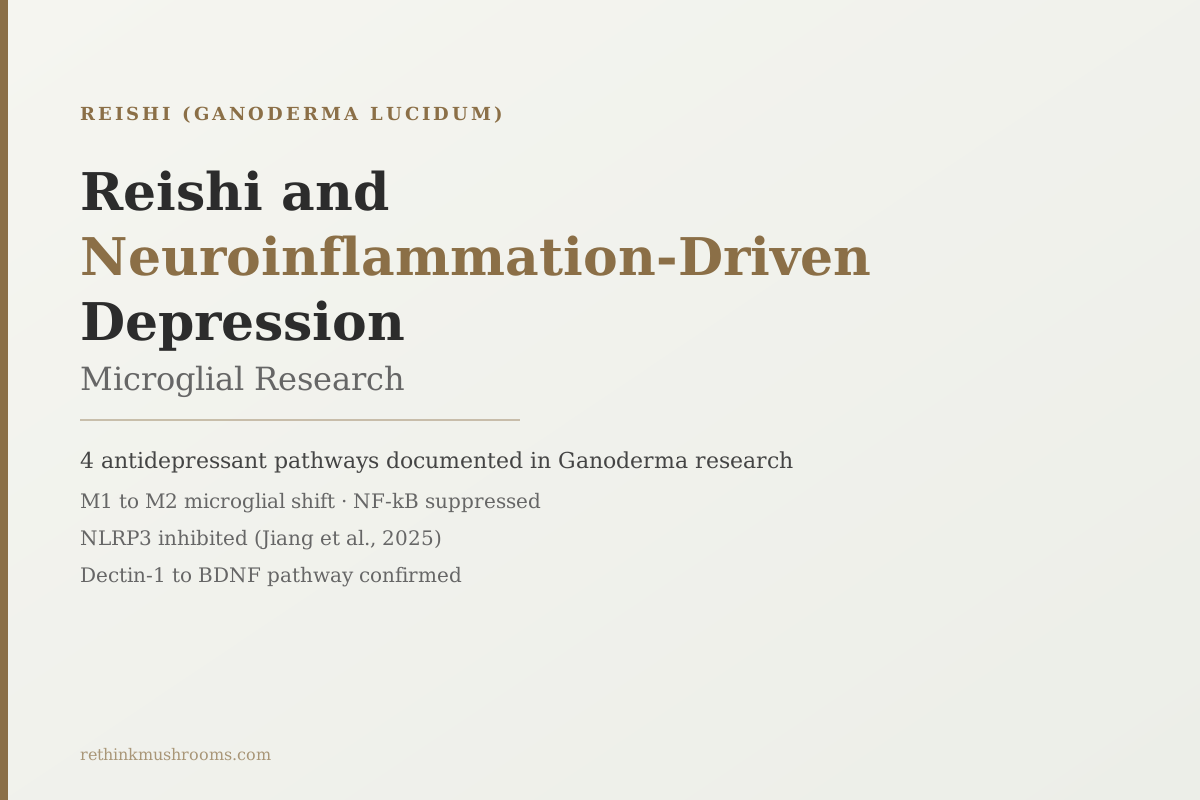
4 antidepressant pathways identified in Ganoderma research
A 2023 systematic review identified four distinct antidepressant mechanisms in Ganoderma lucidum research. Neuroinflammation suppression is the most recently mapped, and the one no competitor has explained in detail.
Lazur et al., 2023
M1 to M2 shift
microglia change from pro-inflammatory attack mode to repair mode after Ganoderma polysaccharide treatment (Cai et al., 2017)
NF-kB suppressed
the master inflammation gene switch, inhibited in MPTP neuroinflammation models (Ren et al., 2022)
NLRP3 inhibited
2025 finding: Ganoderma polysaccharides block this inflammasome complex, reducing IL-1beta release and restoring cognition (Jiang et al., 2025)
Lazur et al., 2023
 View as image ↗
In the past decade, the relationship between inflammation and depression has moved from hypothesis to one of the most active areas in psychiatry. Elevated inflammatory signaling molecules in blood are now consistently associated with treatment-resistant depression. The brain's immune cells, called microglia, appear to be the central players: when microglia are chronically overactivated, they suppress the cellular repair and growth that mood stability depends on.
Reishi neuroinflammation research for depression has investigated whether Ganoderma lucidum's polysaccharides can quiet that overactivation. Studies conducted in neuroinflammation models ranging from microglial cell cultures to neurotoxin-induced brain injury in mice consistently show that Ganoderma polysaccharides suppress the signaling pathway that drives microglia into attack mode. This article covers what those studies found and why it matters for understanding depression specifically. For an overview of what reishi contains and how it works generally, see What Is Reishi Mushroom?.
Key Takeaways
- A 2023 systematic review identified four distinct antidepressant pathways in Ganoderma lucidum research: BDNF upregulation, HPA axis normalization, gut-microbiota-to-serotonin, and neuroinflammation reduction. Ganoderma lucidum has mechanistic evidence across all four (Lazur et al., 2023).
- Ganoderma polysaccharides shift microglia from M1 (pro-inflammatory attack mode) to M2 (anti-inflammatory repair mode), suppressing IL-1β and TNF-α production in neuroinflammation models (Cai et al., 2017).
- In the MPTP model, the standard research tool for studying dopamine neuron damage and neuroinflammation, Ganoderma lucidum extract protected dopaminergic neurons by reducing microglial activation and cutting TNF-α and IL-1β levels in brain tissue (Ren et al., 2019).
- Ren and colleagues subsequently mapped the mechanism: Ganoderma suppresses NF-κB, the gene-switch inside cells that activates the full inflammatory cytokine cascade (Ren et al., Nutrients, 2022).
- A 2025 study added NLRP3 inhibition to the picture: Ganoderma polysaccharides blocked the NLRP3 inflammasome (a protein complex that triggers IL-1β release) and restored cognitive function in a hippocampal neuroinflammation model (Jiang et al., J Ethnopharmacol, 2025).
- The same polysaccharide mechanism that suppresses neuroinflammation also activates the Dectin-1 receptor on immune cells, driving BDNF upregulation. Anti-inflammatory and pro-neuroplasticity effects are part of the same signaling pathway (Li et al., 2021).
The Inflammation Theory of Depression: Why This Mechanism Is Being Studied
The inflammation theory of depression holds that chronically elevated inflammatory activity in the brain contributes to depressive symptoms, and that reducing it can produce antidepressant effects. This is not a fringe idea. Elevated blood levels of IL-6, an inflammatory signaling protein, have been found in people with treatment-resistant depression. Several antidepressants have anti-inflammatory effects that may contribute to their therapeutic action, not just their monoamine-elevating effects.
The four-pathway framework from Lazur and colleagues maps how mushroom-derived compounds interact with each proposed route. Ganoderma lucidum stands out because it has mechanistic evidence across all four: BDNF upregulation (the pathway shared by most effective antidepressants), HPA axis normalization (the stress-response pathway), gut-microbiota-mediated serotonin production, and neuroinflammation reduction. Most functional mushroom research covers one or two of these; Ganoderma's research base covers all of them.[1]
Neuroinflammation reduction is the most recently mapped of the four pathways and the one that is most relevant to treatment-resistant depression specifically. The hypothesis is straightforward: if overactivated brain immune cells are suppressing the neurotrophic (brain-growth-supporting) activity that antidepressants rely on, then a compound that quiets that overactivation could address a root cause that standard antidepressants do not.
Microglia: The Brain's Immune Cells, and Why Their State Matters for Mood
Microglia are the immune cells of the central nervous system. They serve a function analogous to macrophages in the rest of the body: they patrol brain tissue, respond to damage or infection, and clean up cellular debris. They exist in at least two distinct functional states.
When a threat is detected, microglia shift into what researchers call M1 state: a pro-inflammatory attack mode. In this state, they release signaling proteins including TNF-α, IL-1β, and IL-6, which activate other immune cells and damage anything nearby. This is useful for clearing infection. It becomes a problem when it persists without resolution.
In the absence of a threat, microglia ideally exist in or shift toward M2 state: an anti-inflammatory repair mode. In M2 state, they promote tissue healing, support neuron growth, and release anti-inflammatory compounds. The balance between M1 and M2 activity in brain tissue is increasingly understood as a factor in psychiatric conditions.
In depression, post-mortem brain studies have found elevated markers of M1 microglial activation. In neuroinflammatory animal models, inducing M1 microglial overactivation produces depressive-like behavior. These observations connect the immune cell biology to the behavioral and psychiatric outcome.
How Ganoderma Polysaccharides Shift Microglia Out of Attack Mode
Cai and colleagues conducted the direct test: they exposed microglia to Ganoderma lucidum polysaccharides in neuroinflammation models and measured the M1/M2 balance and the downstream cytokine profile.[2]
The result was a consistent shift away from M1 activity. Ganoderma polysaccharides suppressed the pro-inflammatory M1 state and reduced the release of IL-1β, the inflammatory signaling protein that is one of the primary outputs of activated microglia, and TNF-α, another pro-inflammatory molecule associated with neurotoxicity.
The mechanism here is not the mushroom killing the immune cells or generally suppressing immune function. It is a phenotype shift: the microglia change their functional mode from attack to repair. This distinction matters because indiscriminate immune suppression would be harmful. A targeted shift in microglial state, from one that damages neural tissue to one that supports it, is the therapeutic target.[2]
The Cai 2017 data established the principle. The subsequent MPTP studies by Ren and colleagues tested it in a more rigorous whole-animal model.
The MPTP Story: Watching Reishi Protect Neurons, Then Mapping Why
MPTP is a neurotoxin that specifically damages the neurons that produce dopamine in the brain region called the substantia nigra. Researchers use it to model the neuroinflammatory damage pattern seen in Parkinson's disease. It is relevant to depression because the same mechanisms that MPTP activates, specifically microglial overactivation and cytokine-driven neurotoxicity, are implicated in mood disorder pathology, not just movement disorder pathology.
Ren and colleagues published two studies building on each other. The 2019 paper tested whether Ganoderma lucidum extract could protect dopamine-producing neurons from MPTP damage. It did: dopaminergic neuron loss was reduced, and the microglial activation markers in the substantia nigra were lower in Ganoderma-treated animals than in controls.[3]
The 2022 paper from the same research group mapped the mechanism. They measured the full cytokine cascade: IL-6, TNF-α, and IL-1β levels, plus the activity of NF-κB. NF-κB, short for nuclear factor kappa-light-chain-enhancer of activated B cells, is a protein that functions like a master gene switch inside cells. When it is activated, it turns on the genes that produce pro-inflammatory cytokines. When it is blocked, the entire downstream cytokine production is reduced.[4]
Ren 2022 found that Ganoderma lucidum suppressed NF-κB activity in brain tissue, reducing the entire cytokine cascade that NF-κB drives. The mechanism of neuroprotection was not mysterious: Ganoderma blocked the central gene switch that turns on inflammation, and turning that switch back down protected the neurons from the inflammatory damage that MPTP otherwise causes.[4]
The 2025 NLRP3 Finding: A Specific Target Within the Inflammasome
Jiang and colleagues published a 2025 study that added a more specific molecular target to the picture. They focused on the NLRP3 inflammasome, a protein complex that assembles inside immune cells and acts as a specific trigger for IL-1β release. When NLRP3 activates, it cleaves a precursor molecule into the active form of IL-1β, releasing it into the surrounding tissue to drive inflammation.[5]
The NLRP3 inflammasome is distinct from the NF-κB pathway that Ren 2022 studied, though both contribute to neuroinflammation. NF-κB governs gene expression upstream; NLRP3 governs the protein processing of IL-1β downstream. A compound that inhibits both covers more of the inflammatory cascade.
Jiang's study tested Ganoderma lucidum polysaccharides in a hippocampal neuroinflammation model measuring cognitive function, neuroinflammatory markers, and NLRP3 activity. The results showed significant NLRP3 inhibition, reduced IL-1β release in hippocampal tissue, and restored cognitive function in the treated animals.[5]
The hippocampus is the brain region most directly associated with memory, learning, and neuroplasticity. It is also the region most clearly affected in depression: hippocampal volume reduction is one of the most replicated structural findings in major depressive disorder. A Ganoderma-derived compound that reduces hippocampal neuroinflammation and restores function in that specific region is mechanistically well-positioned as a potential antidepressant support.
The Alzheimer's Extension: Why the Same Mechanism Shows Up Across Neurological Conditions
Chen and colleagues reviewed Ganoderma lucidum's evidence specifically in Alzheimer's disease models in a 2024 Biomedicine and Pharmacotherapy paper. The overlap with the depression-neuroinflammation picture is direct: in Alzheimer's models, Ganoderma polysaccharides produced a microglial phenotype shift toward M2, reducing the neuroinflammation that accelerates amyloid plaque deposition. Triterpenes from reishi separately inhibited BACE1, an enzyme involved in generating the amyloid fragments that form plaques.[6]
The significance for the depression research is in the generalization. MPTP models are used for Parkinson's disease; the Jiang 2025 cognitive dysfunction model covers both Alzheimer's-relevant and depression-relevant hippocampal pathology; Cai 2017 was a general neuroinflammation model. The same polysaccharide-driven microglial shift and NF-κB/NLRP3 inhibition appears consistently across different neurodegenerative and neuroinflammatory contexts.[6]
Neuroinflammation is not a disease-specific phenomenon. The research supporting Ganoderma's anti-neuroinflammatory effects in Parkinson's models, Alzheimer's models, and general neuroinflammation models describes a shared mechanism, not a disease-specific one. This generalizability is what gives the depression hypothesis its mechanistic grounding.
For comparison, enoki mushrooms have independent neuroinflammation research that covers different molecular targets. That is explored in Enoki and Neuroinflammation: Brain Protection Research.
The Dectin-1 Bridge: Anti-Inflammation and BDNF as a Shared Pathway
Li and colleagues identified a specific receptor through which Ganoderma polysaccharides activate immune signaling: Dectin-1. Dectin-1 is a receptor on immune cells that specifically recognizes beta-glucans, the main polysaccharides in mushrooms. When Dectin-1 is activated by Ganoderma polysaccharides, it initiates a signaling cascade that ends with upregulated BDNF in the hippocampus, the brain's own neurotrophic growth factor.[7]
BDNF, brain-derived neurotrophic factor, is a protein that supports neuron growth, maintenance, and survival. It is central to the leading molecular theory of antidepressant action: virtually all effective antidepressants, from SSRIs to electroconvulsive therapy to psilocybin, increase BDNF expression in the hippocampus. Li's Dectin-1 finding links polysaccharide ingestion directly to that same BDNF pathway.
The connection to neuroinflammation runs in both directions. Neuroinflammation reduces BDNF by creating a toxic microenvironment for the neurons that produce it. Suppressing neuroinflammation therefore allows BDNF to increase. The Li 2021 finding shows that the polysaccharides also directly stimulate BDNF via the Dectin-1 pathway, independent of the neuroinflammation-suppression route.[7]
These two pathways, anti-neuroinflammatory and pro-BDNF, are not alternatives. They are additive: a compound that reduces the inflammatory suppression of BDNF while also directly stimulating BDNF production addresses both ends of the same biological problem. This is why the Lazur 2023 systematic review identified neuroinflammation reduction and BDNF upregulation as four related but mechanistically distinct antidepressant pathways in the same compound.
For a broader view of how reishi compares to lion's mane as an antidepressant candidate, see Lion's Mane for Depression: How NGF Supports Mood, where the equivalent mechanism runs through nerve growth factor (NGF) rather than BDNF.
What This Evidence Can and Cannot Support
The research reviewed here is mechanistically compelling and methodologically specific. The MPTP models are well-validated research tools. The NLRP3 and NF-κB findings are precise molecular targets with clear relevance to depression biology. The Dectin-1 finding connects the polysaccharide receptor to the BDNF pathway that has the strongest evidence base in antidepressant pharmacology.
What this evidence base does not include: any clinical trial testing Ganoderma lucidum specifically in patients with neuroinflammatory depression. The human trials in this research cluster (Tang 2005 for neurasthenia, Pazzi 2020 for fibromyalgia, Mitra 2024 for college student stress) did not measure neuroinflammatory biomarkers or enroll patients selected for elevated inflammatory markers. Whether the anti-neuroinflammatory mechanism observed in animal models translates to antidepressant effects in humans with inflammatory depression is not yet established.
The broader clinical mushroom depression evidence is covered in Reishi and Depression: Mood Regulation Evidence and Functional Mushrooms for Depression: Non-Psychedelic Options. For the reishi cluster's treatment of GABA and serotonin mechanisms, see How Reishi Affects GABA and Serotonin Pathways.
The Bottom Line
Ganoderma lucidum polysaccharides suppress neuroinflammation through multiple convergent mechanisms: shifting microglia from pro-inflammatory M1 to repair M2 states (Cai 2017), suppressing NF-κB to reduce the full inflammatory cytokine cascade (Ren 2022), and inhibiting the NLRP3 inflammasome specifically in hippocampal tissue (Jiang 2025). The same polysaccharides activate the Dectin-1 receptor to drive BDNF upregulation alongside the anti-inflammatory effect. This positions neuroinflammation reduction as mechanistically distinct from Ganoderma's GABA and serotonin pathways. No clinical trial has yet tested this mechanism specifically in humans with inflammatory depression.
Frequently Asked Questions
Sources & References
- 1. Source details for this reference are not yet available.
- 2. Source details for this reference are not yet available.
- 3. Source details for this reference are not yet available.
- 4. Source details for this reference are not yet available.
- 5. Source details for this reference are not yet available.
- 6. Source details for this reference are not yet available.
- 7. Source details for this reference are not yet available.