Reishi and Sleep Quality
4–8 weeks
Two randomized controlled trials on Ganoderma lucidum for sleep and mood used 4-8 week supplementation periods and found significant improvements. The mechanism explains why it takes that long: different biological pathways activate at different speeds.
Pazzi et al., Int J Med Mushrooms, 2020; RCT, Int J Med Mushrooms, 2024
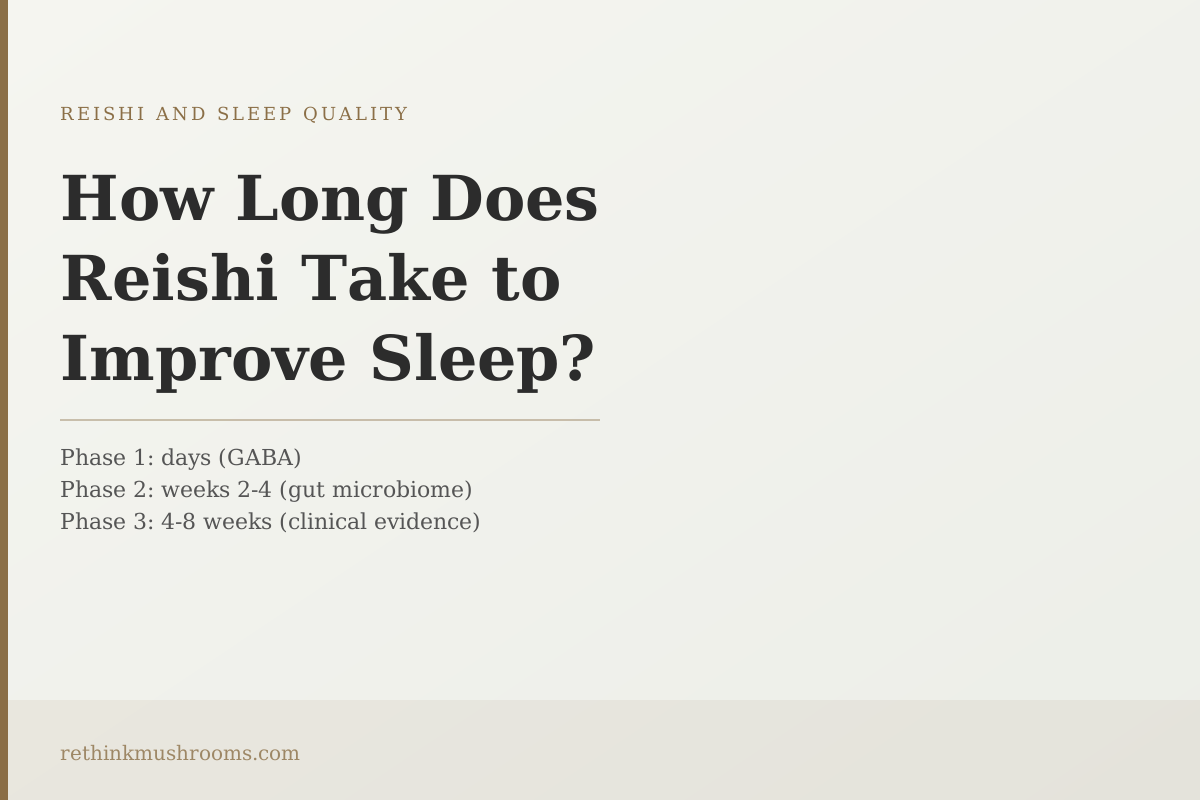
Phase 1
GABA modulation begins within days, reducing sleep latency and quieting the nervous system
Phase 2
gut microbiome adaptation over weeks 2-4 activates the serotonin pathway that competitors' articles don't mention
Phase 3
sustained sleep architecture improvement at 4-8 weeks, confirmed in two human RCTs
Pazzi et al., Int J Med Mushrooms, 2020; RCT, Int J Med Mushrooms, 2024
 View as image ↗
People notice different things about reishi at different times. Some feel calmer or fall asleep more easily within a week. The deeper improvement in sleep quality, the kind that shows up in clinical trials, tends to emerge over a longer window. That difference isn't random. Reishi works through at least three distinct biological mechanisms that operate on different timescales, and understanding those timescales explains both what to expect early and why stopping at two weeks gives an incomplete picture.
This article is part of the broader guide to reishi mushroom science. For a detailed look at the specific GABA and serotonin pathways involved, see How Reishi Affects GABA and Serotonin Pathways.
Key Takeaways
- Reishi's sleep effects operate through three distinct mechanisms on three different timescales: GABA modulation (days), gut microbiome adaptation driving serotonin pathway activation (weeks 2-4), and full sleep architecture normalization (4-8 weeks)
- The acute GABA mechanism begins within hours of a dose, as demonstrated in animal studies where Ganoderma extract decreased sleep latency alongside pentobarbital (Chu et al., 2007)
- The gut-serotonin pathway requires microbiome changes that take weeks to develop. Yao et al. (2021) found that pre-treatment with antibiotics (which wipe out the gut microbiome) abolished reishi's sleep benefits entirely, confirming the mechanism is gut-dependent
- Two human RCTs in fibromyalgia patients using reishi supplementation for approximately 6-8 weeks found significant improvements in anxiety, mood, and quality of life outcomes that include sleep-related measures (Pazzi et al., 2020; 2024 RCT)
- Not all reishi products take the same amount of time to work, because not all reishi products contain the same sleep-active compounds. A 2024 study found that different Ganoderma formulations and extraction methods produced significantly different sleep-enhancing effects
- Taking reishi 1-3 hours before bed optimizes the acute GABA mechanism; the gut-serotonin pathway is less timing-dependent and benefits more from consistent daily use over weeks
Phase 1 (Days to Week 1): What the GABA Mechanism Does First
The fastest-acting part of reishi's sleep pharmacology involves GABA, the main inhibitory neurotransmitter in the brain. GABA is the nervous system's brake pedal: it slows neural activity, reduces anxiety, and promotes the transition from wakefulness toward sleep.
A 2007 study by Chu and colleagues tested Ganoderma lucidum extract in mice alongside pentobarbital, a sedative drug that extends sleep duration by enhancing GABA receptor function.[3] Mice given both the extract and pentobarbital fell asleep faster and stayed asleep longer than mice given pentobarbital alone. The extract was augmenting GABA signaling to produce those effects.
The GABA mechanism begins operating within hours of a dose, not over days or weeks. Compounds in reishi (primarily the ganoderic acid triterpenes) interact with GABA-A receptors in a way that amplifies inhibitory signaling and reduces the neural excitation that prevents sleep onset. This is the mechanism responsible for what some people notice in the first few days: an easier time winding down, a reduction in the mental noise that typically delays falling asleep, or a slightly faster transition from lying down to sleeping.
Unlike benzodiazepine drugs, which directly force GABA receptor activation, reishi appears to modulate rather than override the system. That distinction matters for understanding why reishi doesn't produce the next-day grogginess common with pharmaceutical sleep aids.
The GABA mechanism is also why taking reishi 1-3 hours before bed is the timing recommendation that appears in clinical practice. The acute neurological effects from this pathway follow a dose-response curve with a meaningful peak window.
Phase 2 (Weeks 2-4): The Gut Microbiome Catches Up
The mechanism that most competitor articles miss entirely is the one that takes the longest to develop.
A 2021 study by Yao and colleagues, published in Scientific Reports, found that Ganoderma lucidum significantly promoted sleep in mice through a pathway that is completely different from GABA modulation: the gut microbiota and intestinal serotonin.[4]
The key experiment in the Yao paper: mice were pre-treated with antibiotics to deplete their gut microbiome before receiving reishi. When the gut microbiota was gone, all of reishi's sleep-promoting effects were abolished. Sleep latency, sleep duration, and sleep architecture improvements all disappeared when the gut microbiome was cleared.
This is a significant finding. It means a substantial portion of reishi's sleep benefit isn't happening in the brain at all. It's happening in the gut, through bacteria-mediated changes in serotonin signaling. About 90% of the body's serotonin is produced in the gut, not the brain. Gut-resident bacteria influence how much serotonin is produced, how it's metabolized, and how gut-to-brain signals via the vagus nerve affect mood and sleep architecture.
The microbiome does not change overnight. Meaningful shifts in gut microbiota composition typically take two to four weeks of consistent intervention, whether from dietary changes, probiotics, or bioactive compounds like reishi polysaccharides. This is the mechanistic explanation for why people who take reishi for two weeks and don't notice dramatic changes may not be giving the gut-serotonin pathway time to activate.
The Yao 2021 finding also explains why reishi's sleep effects differ from sleeping pills at the mechanistic level: no sleeping pill works through the gut microbiota. Benzodiazepines, z-drugs (zolpidem, eszopiclone), and melatonin all act on central nervous system targets directly. The gut pathway is specific to compounds that interact with the microbiome, and its activation requires time that drug-onset pharmacology simply doesn't have.
Phase 3 (4-8 Weeks): When the Clinical Trials See Results
The human evidence for reishi and sleep/mood improvement is concentrated in the 4-8 week timeframe, which aligns with what the mechanistic research predicts.
A 2020 randomized controlled trial by Pazzi and colleagues enrolled women with fibromyalgia (a condition characterized by widespread pain, fatigue, and severely disrupted sleep) and supplemented them with Ganoderma lucidum over approximately 6 weeks.[2] Significant improvements emerged in depression scores, anxiety scores, fatigue, and health-related quality of life outcomes. Fibromyalgia sleep disruption is both pain-driven and neurologically dysregulated, meaning improvements in this population require the kind of multi-mechanism action that reishi's distributed pharmacology provides.
A 2024 randomized controlled trial using a similar fibromyalgia population and reishi supplementation confirmed the pattern: significant improvements in anxiety, depression, vitality, and positive well-being versus placebo.[1] The 2024 trial represents the most current human clinical data available in this area.
Both trials used populations with significant baseline sleep disruption driven by pain and systemic inflammation, which may make them more responsive to reishi than healthy adults with mild insomnia. The effect size in people with less severe sleep disruption may be smaller or take longer to appear. Neither trial measured sleep directly using polysomnography (the gold-standard sleep measurement); outcomes were assessed via validated questionnaire instruments. These are limitations worth acknowledging.
For a full review of the clinical studies and dosing specifics, see Reishi and Insomnia: Clinical Studies and Dosing.
Does Reishi Work the First Night?
The honest answer: some aspects of it can. Some aspects won't.
The GABA-modulating effects of reishi's triterpene compounds can reduce anxiety and lower sleep latency within hours of a dose. Someone taking a well-made hot-water and alcohol extract of reishi a few hours before bed may notice an easier time winding down, or a slightly faster shift from lying awake to falling asleep, on the first or second night. This is the acute GABA pathway.
What doesn't happen on the first night: the gut microbiome adaptations that drive the serotonin pathway, the normalization of sleep architecture over extended periods, and the anti-inflammatory reductions that improve sleep in people whose insomnia is driven by chronic inflammation or pain. These require consistent daily use over weeks.
The Yao 2021 study demonstrated that the gut-dependent sleep effects require an intact, functioning microbiome that has been exposed to reishi's polysaccharides long enough to shift in composition. That takes time regardless of dose.
First-night response to reishi is real but partial. The mechanism that produces deeper, more sustained sleep improvement is operating on a weeks-long timescale.
When Should You Take Reishi Before Bed?
Timing recommendations for reishi's sleep effects should be matched to the mechanism:
For the GABA mechanism: the acute effects follow a dose-response curve. Taking reishi 1-3 hours before the intended sleep time allows the triterpene compounds to reach relevant concentrations in the central nervous system before bed. Earlier in the day is less effective for the acute sleep-onset benefit.
For the gut-serotonin mechanism: daily consistency matters more than timing. This pathway depends on cumulative microbiome changes, not acute dosing. Taking reishi at the same time each day (whether morning or evening) is more important than the specific hour relative to bedtime.
Practical implication: taking reishi in the early evening (2-3 hours before bed) captures both timing windows simultaneously and is the approach most consistent with what the research has used.
Why the Product You Choose Changes the Timeline
Not all reishi products activate these mechanisms at the same rate, because not all reishi products contain the same bioactive compounds in the same concentrations.
A 2024 study published in Frontiers in Pharmacology specifically investigated how different Ganoderma formulations and extraction recipes affect anti-fatigue and sleep-aiding potency.[5] The finding: anti-fatigue and sleep-aiding effects varied significantly across different formulations. The extraction method was a primary driver of this variation. Hot-water extraction methods preserved more of the sleep-active compounds (polysaccharides) while alcohol or dual-extraction methods are needed to capture the ganoderic acid triterpenes responsible for GABA effects.
A product that uses only hot-water extraction contains the polysaccharides for the gut-serotonin pathway but lacks the triterpenes for the GABA mechanism. A product using only alcohol extraction has the triterpenes but loses most of the polysaccharides. Either approach captures only one of the two primary sleep pathways.
This matters for timeline: a product that only addresses one mechanism may appear not to work within 4 weeks, when in fact the other mechanism simply isn't being activated. A well-formulated dual-extract reishi product gives both pathways the relevant compounds, producing the full three-phase timeline the mechanistic research predicts.
For a comparison of reishi with melatonin across these mechanism and timing dimensions, see Reishi vs. Melatonin for Sleep: Mechanisms and Evidence. For the broader overview of how reishi affects sleep quality, see Reishi for Sleep: What the Research Shows.
For historical context on the clinical evidence base (including the neurasthenia trials, where 8-week reishi use produced documented sleep improvements), see Ganoderma lucidum and Neurasthenia: Historical and Modern Research.
The Bottom Line
Reishi's sleep effects follow a three-phase timeline rooted in three distinct mechanisms. The GABA-modulating triterpenes produce acute effects (easier sleep onset) within days. The gut-microbiota-serotonin pathway, which a 2021 animal study showed accounts for a significant portion of reishi's sleep benefit, requires weeks of microbiome adaptation. The full improvement in sleep architecture and quality that clinical trials measure appears in the 4-8 week window, consistent with the two human RCTs showing significant outcomes in fibromyalgia patients. Product quality shapes the timeline: poorly extracted products may not provide enough of either compound class to activate both pathways, making the timeline prediction unreliable regardless of dose.
Frequently Asked Questions
Sources & References
- 1. Source details for this reference are not yet available.
- 2. Source details for this reference are not yet available.
- 3. Source details for this reference are not yet available.
- 4. Source details for this reference are not yet available.
- 5. Source details for this reference are not yet available.