Reishi for Mental Health
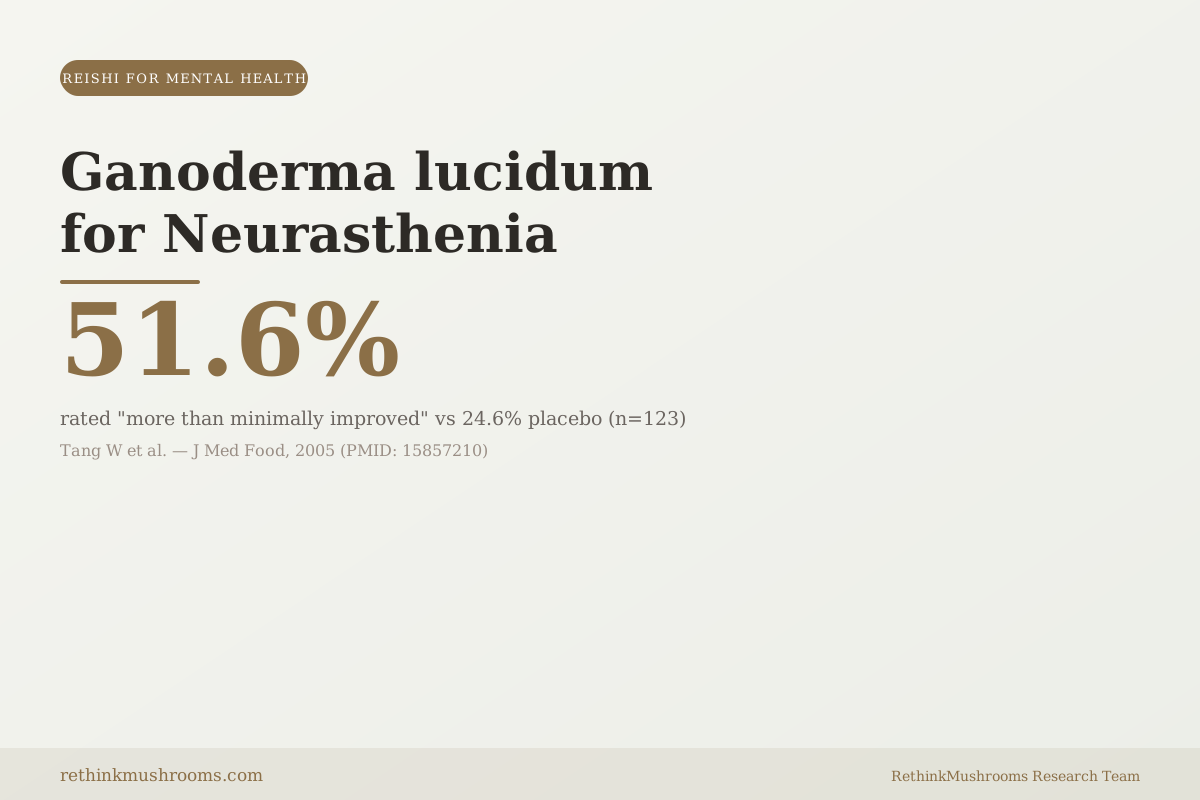
51.6%
Of neurasthenia patients treated with Ganopoly (a standardized Ganoderma polysaccharide extract) rated 'more than minimally improved' in an 8-week double-blind RCT, versus 24.6% on placebo, the only dedicated placebo-controlled trial for neurasthenia with any functional mushroom.
Tang W et al., J Med Food, 2005
123
patients in the Tang 2005 double-blind, placebo-controlled neurasthenia trial (PMID: 15857210)
15.5%
CGI severity reduction in Ganopoly group vs 4.9% for placebo over 8 weeks (Tang et al., 2005)
Polysaccharides
polysaccharide-dominant extracts show superior anti-fatigue effects vs triterpene-dominant extracts for sleep (Li et al., 2024)
Tang W et al., J Med Food, 2005
 View as image ↗
Neurasthenia has almost disappeared from Western medical vocabulary. The diagnosis was removed from the American DSM in 1980, replaced by more specific categories. In much of Asia, it remains a recognized and common diagnosis: persistent mental fatigue, poor concentration, physical exhaustion after ordinary effort, sleep disturbances, and emotional irritability that doesn't resolve with rest. The ICD-10 still lists it.
That difference in diagnostic usage matters for understanding one of the most specific human trials ever run on Ganoderma lucidum. In 2005, a team led by Tang and colleagues conducted a double-blind, placebo-controlled trial in 123 neurasthenia patients using Ganopoly, a standardized Ganoderma lucidum polysaccharide extract. The results were the most statistically specific evidence for any functional mushroom in any fatigue-related condition to date.
In Western functional mushroom content, this trial is almost entirely absent. That's the gap this article addresses. For the broader profile of Reishi and its place in Chinese medical history, what Reishi mushroom is and the science behind it covers the foundational context.
Key Takeaways
- Tang et al. (2005, J Med Food, PMID: 15857210) conducted a double-blind, placebo-controlled RCT testing Ganopoly, a standardized Ganoderma polysaccharide extract, in 123 neurasthenia patients over 8 weeks.
- 51.6% of Ganopoly-treated patients rated "more than minimally improved" versus 24.6% in the placebo group, a statistically significant difference.
- CGI (Clinical Global Impression) severity scores decreased by 15.5% in the Ganopoly group versus 4.9% in the placebo group at 8 weeks.
- Pazzi et al. (2020, Clin Exp Rheumatol) found Ganoderma lucidum significantly improved fatigue levels, quality of life, and mood regulation versus placebo in fibromyalgia patients, extending the fatigue evidence to a Western patient population.
- Mitra et al. (2024) found Reishi supplementation significantly improved vitality scores alongside stress and anxiety measures in female college students in a double-blind RCT.
- Li et al. (2024, Heliyon) found polysaccharide-dominant Reishi preparations produced superior anti-fatigue effects, while triterpene-dominant preparations produced superior sleep-aiding effects, demonstrating that extract composition determines which benefit is received.
What Neurasthenia Is, and Why Western Medicine Retired the Diagnosis
Neurasthenia was coined by American neurologist George Beard in 1869 to describe a constellation of symptoms he attributed to "exhaustion of the nervous system": persistent fatigue that rest doesn't fix, difficulty concentrating, headaches, poor sleep, physical weakness, and emotional sensitivity that makes ordinary stressors disproportionately difficult to manage.
The diagnosis spread rapidly through Western medicine and then, by the mid-20th century, began fracturing as psychiatry developed more precise diagnostic categories. Depression, anxiety disorders, adjustment disorder, and eventually chronic fatigue syndrome (CFS/ME) each absorbed portions of what neurasthenia had described. By 1980, the DSM had discontinued it.
China took a different path. Neurasthenia remained in the Chinese Classification of Mental Disorders, where it continues to describe a distinct clinical entity. Epidemiological studies have estimated that neurasthenia accounts for a significant proportion of outpatient psychiatric visits in China. The symptoms broadly overlap with what Western clinicians might diagnose as burnout, adjustment disorder, or CFS, depending on duration and severity.
This diagnostic discrepancy explains why the only dedicated RCT for neurasthenia with a functional mushroom came from China in 2005. In Western clinical settings, there is no neurasthenia cohort to recruit. The research infrastructure followed the diagnostic usage.
The Tang 2005 RCT: The Specific Numbers
Tang and colleagues published their randomized, double-blind, placebo-controlled trial in the Journal of Medicinal Food in 2005 (PMID: 15857210).[1] The trial enrolled 123 patients meeting the Chinese classification criteria for neurasthenia.
Patients were randomized to receive either Ganopoly (a Ganoderma lucidum polysaccharide extract standardized to 25% polysaccharide content, 1,800 mg per day) or matched placebo for 8 weeks. The primary outcome was the Clinical Global Impression of Improvement (CGI-I) rating at endpoint.
The results at 8 weeks:
51.6% of Ganopoly-treated patients rated "more than minimally improved" on the CGI-I, versus 24.6% of placebo patients. CGI severity scores decreased by 15.5% from baseline in the Ganopoly group, compared to 4.9% in the placebo group. Fatigue sub-scores, physical function, and general well-being measures all showed greater improvement in the Ganopoly group, with the fatigue-specific measures showing some of the largest between-group differences.
A few aspects of this trial are worth noting beyond the headline numbers. First, Ganopoly is a polysaccharide-enriched extract, not a whole-mushroom preparation. The trial was testing the polysaccharide fraction specifically. Second, the placebo response was substantial (24.6% rated as improved), which is typical for neurasthenia and for fatigue conditions generally. The Ganopoly advantage was significant despite that baseline. Third, the 8-week duration is shorter than what might be needed to capture the full adaptive response to polysaccharide supplementation.
This remains the only dedicated placebo-controlled trial for neurasthenia with any functional mushroom. Its absence from Western functional mushroom content is striking, given that it provides exactly the kind of human clinical data that readers searching for evidence on Ganoderma and fatigue are looking for.
Modern Extensions: Fibromyalgia Patients and College Students
Tang 2005 tests a specific diagnosis in a specific cultural context. Two subsequent trials extend the evidence to populations and conditions that Western readers are more likely to find relevant.
Pazzi et al. (2020) tested Ganoderma lucidum in fibromyalgia patients in a randomized, controlled clinical trial published in Clinical and Experimental Rheumatology.[2] Fibromyalgia is characterized by widespread musculoskeletal pain and persistent fatigue, with high rates of comorbid depression and sleep disturbance. It is not the same as neurasthenia, but the symptom profile overlaps substantially: fatigue that doesn't resolve with rest, sleep problems, and mood dysregulation. Pazzi et al. found Ganoderma supplementation significantly improved quality of life scores, fatigue levels, and mood regulation versus placebo.
Mitra et al. (2024) took a different approach: a double-blind, placebo-controlled trial in female college students experiencing significant psychological stress.[3] The population is younger and healthy, not clinically diagnosed with any condition. Outcomes included validated measures of perceived stress, anxiety, depression, vitality, and positive well-being. Reishi supplementation significantly improved scores across all of these measures versus placebo. The vitality finding is particularly relevant to neurasthenia: vitality in psychometric research specifically captures the subjective experience of energy and aliveness that neurasthenia patients report losing.
These three trials (Tang 2005, Pazzi 2020, Mitra 2024) are the human clinical evidence base for Ganoderma and fatigue-related mental health outcomes. They span neurasthenia, fibromyalgia, and college student stress. None of them is a perfect match for any specific reader's situation. Together, they draw a consistent picture across different populations: Ganoderma lucidum supplementation produces meaningful improvements in fatigue and psychological well-being versus placebo in controlled conditions.
Why Extract Type Determines Whether You Get Energy or Sleep
The Tang 2005 trial used a polysaccharide-enriched extract. This turns out to be mechanistically important, not just a preparation detail.
Li et al. (2024, Heliyon) systematically tested multiple Ganoderma lucidum extract preparations in animal models, comparing preparations with different ratios of polysaccharide to triterpene content.[4] Their key finding: polysaccharide-dominant recipes showed significantly better anti-fatigue effects, while triterpene-dominant recipes showed significantly better sleep-aiding effects. These are measurably different outcomes from extracts of the same mushroom species, driven by composition.
The anti-fatigue effect of polysaccharides likely operates through their immune-modulating and cellular energy-supporting activities. The sleep and calming effects of triterpenes are more specifically understood: triterpenes like pachymic acid act as positive allosteric modulators of GABA-A receptors, the same receptor targeted by benzodiazepines, producing sedative and anxiolytic effects through that pathway.
This distinction has direct implications for anyone looking at neurasthenia or fatigue-type conditions. If the primary symptom is daytime exhaustion and impaired concentration (the signature of neurasthenia), polysaccharide-enriched extracts are what the evidence supports. If the primary issue is sleep onset and quality, triterpene-rich extracts are more mechanistically aligned. Full-spectrum preparations, which maintain both fractions, address both targets but may not optimize either.
For a detailed treatment of how the GABA and serotonin pathways work in Reishi, how Reishi affects GABA and serotonin pathways covers the biochemistry in depth.
The Historical Backdrop: Why Reishi Was Used for Nervous Exhaustion
The Tang 2005 trial was not a shot in the dark. It drew on a long tradition of Ganoderma lucidum use for exactly the kind of mental-physical depletion that neurasthenia describes.
In Chinese medical classification, Ganoderma lucidum is described as nourishing the "shen," a concept encompassing spirit, mind, and consciousness. The mushroom's traditional indications include calming the mind, relieving restlessness, improving sleep, and restoring strength after prolonged effort or illness. These are precisely the symptoms of neurasthenia: exhausted body, unsettled mind, disrupted sleep, diminished resilience.
Singh et al. (2016) tested a preparation combining Ganoderma lucidum with related species in standard anxiety models (elevated plus maze, open field test) and confirmed anxiolytic effects consistent with its traditional calming reputation.[5] This is preclinical data, but it validates the direction.
The historical "mushroom of immortality" framing that appears in Daoist texts and Tang Dynasty court records primarily referenced this mental-physical restoration function. The longevity association came not from lifespan extension in the literal sense, but from the restoration of depleted vitality. For more on the historical context, Reishi and longevity: the "mushroom of immortality" tradition covers the 2,000-year pharmacopoeial record.
The Evidence Limits: What This Research Doesn't Prove
The Tang 2005 trial is compelling, but it sits alone. A single RCT, even a well-designed one, establishes a signal rather than a certainty. Several limitations constrain how broadly the findings can be applied.
The neurasthenia diagnosis is not directly equivalent to chronic fatigue syndrome, CFS/ME, or burnout. These conditions overlap symptomatically but differ in diagnostic criteria, pathophysiology, and likely treatment response. The evidence from Tang 2005 applies most directly to patients meeting the Chinese classification criteria for neurasthenia. Whether the same polysaccharide extract produces similar benefits in CFS/ME, where immune dysfunction and post-exertional malaise are more central features, has not been tested.
The Ganopoly product tested is a standardized extract. Off-the-shelf Reishi products vary enormously in polysaccharide content, species verification, and extraction method. The 51.6% response rate in Tang 2005 is a property of a specific preparation at a specific dose, not an intrinsic property of any Reishi supplement.
The 8-week duration captures short-term effects. Whether the benefits persist, reverse, or continue to build with longer use is unknown from this data.
What the converging human trial data does establish is a consistent signal: Ganoderma lucidum supplementation, using standardized preparations, produces measurable improvements in fatigue and mental well-being versus placebo across multiple populations and study contexts. That pattern across Tang 2005, Pazzi 2020, and Mitra 2024 is more meaningful than any single trial alone.
For the broader question of how Reishi compares to other functional mushrooms for fatigue and mood, Lion's Mane and Reishi for depression: non-psychedelic mood support covers the comparative evidence.
The Bottom Line
The Tang 2005 double-blind RCT remains the only dedicated placebo-controlled trial for neurasthenia with any functional mushroom, and it found meaningful improvement with a Ganoderma polysaccharide extract: 51.6% rated "more than minimally improved" versus 24.6% on placebo at 8 weeks, with a 15.5% versus 4.9% reduction in CGI severity scores. The Li 2024 extract-composition finding adds practical precision: polysaccharide-dominant preparations show better anti-fatigue effects, while triterpene-dominant preparations show better sleep effects. What remains unestablished is whether these findings generalize to Western diagnoses of chronic fatigue syndrome or burnout, and whether commercially available Reishi products achieve the polysaccharide concentrations used in the clinical research.
Frequently Asked Questions
Sources & References
- 1. Source details for this reference are not yet available.
- 2. Source details for this reference are not yet available.
- 3. Source details for this reference are not yet available.
- 4. Source details for this reference are not yet available.
- 5. Source details for this reference are not yet available.