Mushrooms & Cancer
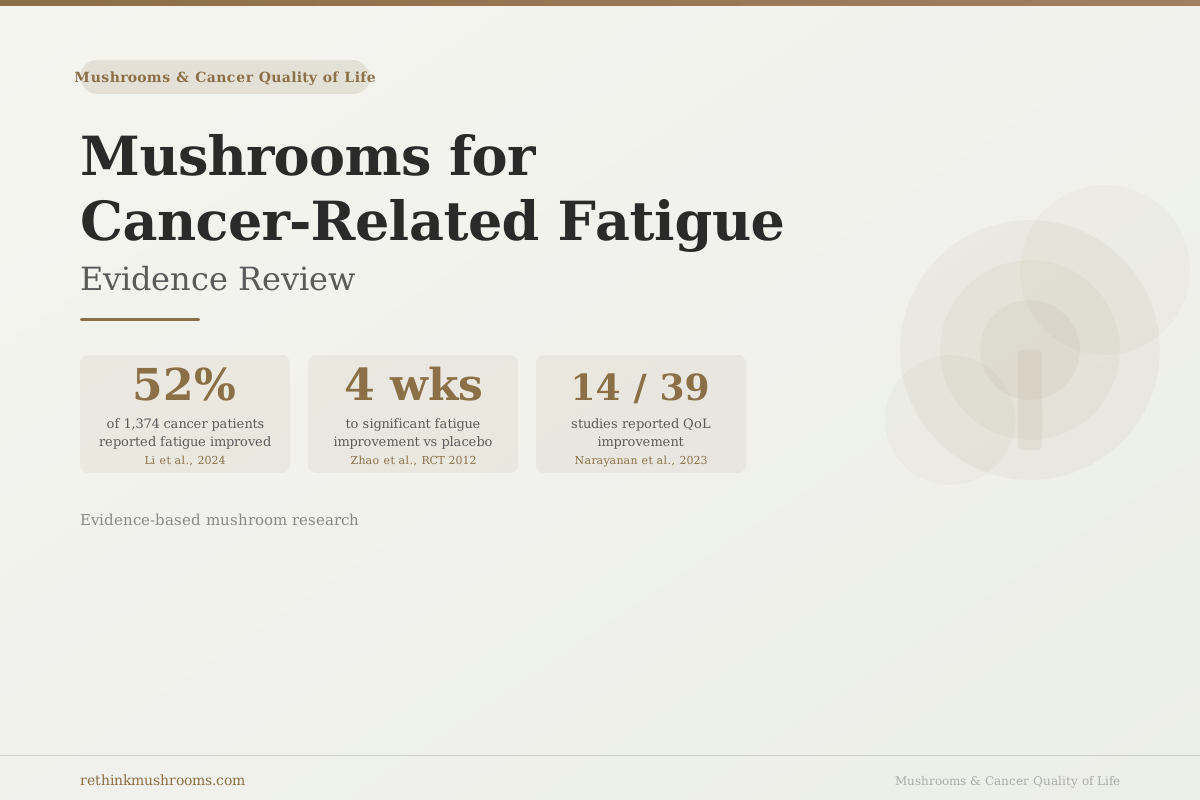
52% reported less fatigue
Among 1,374 cancer patients using Reishi, 52% reported fatigue improved quite a bit or very much in a 2024 cross-sectional survey.
Li et al., Integrative Cancer Therapies, 2024
48 patients
in the Zhao 2012 RCT where Reishi spore powder reduced fatigue vs placebo in 4 weeks
14 of 39
clinical studies reported QoL improvements in a 2023 systematic review of 12 mushroom preparations
beta-glucans
the compound class that drives cytokine normalization and immune restoration behind the fatigue effect
Li et al., Integrative Cancer Therapies, 2024
 View as image ↗
Cancer-related fatigue is not the same as ordinary tiredness. Oncologists distinguish carefully between the two: regular tiredness resolves with rest; cancer-related fatigue persists regardless of sleep and can last months or years after treatment ends. It is one of the most frequently reported symptoms by people undergoing chemotherapy, radiation, and hormone therapy, and it is one of the primary reasons cancer patients seek complementary approaches.
The research on mushrooms and cancer-related fatigue now includes a randomized controlled trial, two systematic reviews, a meta-analysis, a 1,374-patient real-world survey, and mechanistic data explaining why the effect might be real. This article covers all of it as part of the Mushrooms & Cancer series.
Key Takeaways
- A 2012 pilot RCT of 48 breast cancer patients found that Reishi (Ganoderma lucidum) spore powder significantly improved fatigue, physical function, global quality of life, sleep disturbance, and appetite compared to placebo after 4 weeks (Zhao et al., 2012)
- A 2024 cross-sectional survey of 1,374 cancer patients taking Reishi found that 52% reported fatigue improved quite a bit or very much, making fatigue the second most commonly improved symptom after nausea (Li et al., 2024)
- A 2023 systematic review of 39 clinical studies covering 12 mushroom preparations found that quality of life improvement, including reduced fatigue, was reported in 14 of those studies (Narayanan et al., 2023)
- Beta-glucans in mushrooms activate immune receptors (Dectin-1 and toll-like receptors) that normalize inflammatory cytokines including IL-6 and TNF-alpha, two of the primary drivers of cancer-related fatigue (van Steenwijk et al., 2021)
- Cancer patients with gynecological cancers who took Agaricus blazei extract during chemotherapy had both higher NK cell activity AND higher quality of life scores compared to controls, connecting immune restoration directly to reduced fatigue symptoms (Ahn et al., 2004)
- The primary limitations: most trials are small, preparations vary widely across studies, and no large-scale RCT has been completed; the evidence supports continued investigation, not clinical conclusions
Cancer-Related Fatigue Is a Clinical Target, Not Just Tiredness
Before examining what mushrooms do, it helps to understand what cancer-related fatigue actually is. It is a distinct clinical entity that researchers study and measure separately from ordinary tiredness.
Cancer-related fatigue is driven primarily by inflammation. Tumors and cancer treatments produce high levels of inflammatory molecules called cytokines, particularly interleukin-6 (IL-6) and tumor necrosis factor-alpha (TNF-alpha). These cytokines disrupt the brain's energy regulation, alter sleep architecture, reduce muscle function, and produce a persistent sense of exhaustion that sleep does not relieve.
It is measured in clinical trials using standardized tools. The most common in European oncology research is the EORTC QLQ-C30, a 30-item quality of life questionnaire that measures fatigue as one of several symptom subscales. A change in the fatigue subscale score represents a measurable clinical change, not a subjective impression.
Understanding that cancer-related fatigue has an inflammatory mechanism matters for evaluating whether mushrooms could plausibly help. If a compound can normalize the cytokines driving the fatigue, there is a biological pathway by which it could reduce symptoms.
The Reishi RCT: 4 Weeks, 48 Patients, and Improved Fatigue Scores
The most rigorously controlled study of mushrooms and cancer-related fatigue is a pilot RCT by Zhao and colleagues, published in 2012.[1]
The trial enrolled 48 breast cancer patients undergoing endocrine (hormone) therapy. Half received Ganoderma lucidum (reishi) spore powder; half received a matched placebo. Both groups took their assigned treatment for 4 weeks. Quality of life was measured using the EORTC QLQ-C30 at baseline and at the end of the trial.
The reishi group showed statistically significant improvements compared to placebo across multiple EORTC subscales: fatigue, physical function, global quality of life, sleep disturbance, and appetite. All five improved in the treatment group and did not improve meaningfully in the placebo group.
Several aspects of this study make it worth citing carefully:
First, the reishi group was on endocrine therapy, not chemotherapy. Endocrine therapy produces fatigue through a different mechanism than chemotherapy (hormonal suppression rather than acute cytotoxicity). The fact that reishi spore powder improved fatigue during endocrine therapy suggests the effect may extend beyond chemotherapy-specific fatigue.
Second, sleep disturbance improved alongside fatigue. This is mechanistically coherent: cancer-related fatigue and sleep disruption share inflammatory drivers. An intervention that addresses the underlying cytokine elevation could plausibly improve both.
Third, this was a placebo-controlled design. The fatigue improvements are not self-report without comparison; they are changes relative to a group taking an identical-appearing capsule.
Forty-eight patients is a small sample for an RCT. This was explicitly a pilot study, designed to establish feasibility and estimate effect sizes for a larger trial. The results justify a larger trial, not a clinical conclusion.
1,374 Patients on Reishi: What They Reported About Their Fatigue
The Zhao 2012 RCT provides the most rigorous single data point on this topic. The Li 2024 survey provides the largest real-world dataset.[2]
Li and colleagues surveyed 1,374 cancer patients who were using Reishi (Ganoderma lucidum) as a supplement. Participants rated symptom changes across multiple domains using standardized scales.
The fatigue data: 52% of patients reported fatigue improved quite a bit or very much. Among all reported symptoms, fatigue was the second most commonly improved, behind nausea (55%). Depression improved in 50% of respondents; poor appetite in 51%.
Adverse effects were reported by 9.1% of the sample, primarily dry mouth, constipation, and in some cases insomnia. Most adverse effects were classified as mild to moderate, consistent with grade 1 to 2 on the standard oncology adverse event scale.
Cross-sectional surveys have obvious limitations. They capture what people report about their experience while taking a supplement, not what happens in a controlled comparison. There is no placebo group; attribution of improvement to Reishi rather than to other factors in a patient's treatment or recovery is impossible. The sample self-selected, meaning people who found Reishi helpful may be overrepresented.
What a survey of 1,374 people can establish that a 48-patient RCT cannot is that the symptom improvements reported in the Zhao trial are not an artifact of one research center or one patient population. A large, geographically diverse group of cancer patients using Reishi reports the same pattern of improvement (fatigue, nausea, appetite, and depression) that the RCT measured prospectively.
The Mechanism: How Beta-Glucans Target the Inflammation Behind Cancer Fatigue
The argument for biological plausibility comes from understanding what beta-glucans, the primary active compounds in mushrooms, do inside the immune system.
A 2021 systematic review by van Steenwijk and colleagues examined the clinical evidence for fungal beta-glucans as cancer adjuvants and documented the mechanism in detail.[4] Beta-glucans bind to two immune receptors: Dectin-1 on macrophages and dendritic cells, and toll-like receptors (TLR-2 and TLR-4) on innate immune cells. Activating these receptors through beta-glucans shifts the immune system toward a surveillance state rather than the dysregulated inflammatory state that chemotherapy and tumor activity produce.
The downstream effect is cytokine normalization. Beta-glucan binding reduces output of IL-6 and TNF-alpha, the same cytokines that drive cancer-related fatigue, while increasing activity of NK (natural killer) cells and cytotoxic T cells that target tumor cells. The mechanism is bidirectional: less fatigue-causing inflammation, more immune surveillance.
Direct evidence of this pathway in cancer patients comes from Gao and colleagues, who measured immune parameters in advanced lung cancer patients taking Ganoderma lucidum polysaccharides.[6] Patients in the treatment group showed improvements in NK cell counts, CD4+/CD8+ T cell ratios, and quality of life scores compared to controls. Immune restoration and quality of life improved together, which is exactly what the cytokine mechanism predicts.
A similar pattern appeared in gynecological cancer patients. Ahn and colleagues found that patients taking Agaricus blazei extract during chemotherapy had both significantly higher NK cell activity and higher quality of life scores compared to controls.[7] The pairing of immune measurement and quality of life data in the same study is particularly useful because it shows the two variables moving together, supporting the causal chain from beta-glucans to immune restoration to reduced fatigue.
For more on the mechanisms by which beta-glucans and mushroom polysaccharides affect cancer patients' well-being, see How Mushroom Supplements Improve Well-Being for Cancer Patients.
How Many Studies Show Fatigue Improvements? What Systematic Reviews Found
Individual studies are useful but limited. Systematic reviews that pool across studies give a cleaner picture of the evidence landscape.
A 2023 systematic review by Narayanan and colleagues examined 39 clinical studies of medicinal mushroom supplements in cancer, covering 12 different mushroom preparations.[3] Quality of life improvement, including reduced fatigue, was reported in 14 of those 39 studies. The three most studied preparations were Ganoderma lucidum (reishi), Trametes versicolor (turkey tail), and Agaricus blazei. Adverse effects were generally grade 2 or lower across the trials.
The 2019 meta-analysis by Zhong and colleagues focused specifically on Coriolus versicolor and Ganoderma lucidum as cancer adjuncts and found statistically significant improvements in quality of life scores and immune parameters compared to conventional treatment alone in the pooled RCT data.[5]
Jeitler and colleagues reviewed 8 RCTs and 1 controlled clinical trial in a 2020 narrative review in Frontiers in Pharmacology.[8] The review documented improvements in quality of life, reduced side effect burden, improved hematologic parameters, and immunomodulation across the included trials. The authors concluded that the evidence supports integration into standard oncology care alongside physician oversight, which is a more concrete recommendation than most systematic reviews make.
From a Japanese consumer perspective, Talcott and colleagues surveyed Japanese cancer patients consuming Agaricus blazei extract and found that the most commonly reported benefits were improved energy, reduced fatigue, better appetite, and improved overall well-being.[9] Like the Li 2024 survey, this is patient-report data without controls, but it provides a consistent pattern across populations.
What These Studies Do and Don't Establish
The evidence for mushrooms and cancer-related fatigue is more developed than what most cancer patients encounter when they search the topic. It is also more limited than what enthusiastic supplement coverage suggests.
What the studies establish: a small but consistent signal that reishi spore powder improves measured fatigue scores in a controlled setting, that large numbers of cancer patients report fatigue improvement while taking reishi, and that beta-glucan compounds have a mechanistically coherent pathway to cytokine normalization that would explain the effect.
What the studies do not establish: that mushrooms reliably reduce cancer-related fatigue in a general cancer population, or that any specific mushroom preparation is effective at a specific dose in a defined patient group. The Zhao 2012 RCT used reishi spore powder in breast cancer patients on endocrine therapy; whether the same effect occurs in other cancers, other treatments, or other mushroom forms is not yet established.
The primary methodological gaps are sample size and preparation standardization. Most trials are small. Mushroom extracts vary substantially in their beta-glucan content, extraction method, and dosing. A study of reishi whole powder cannot be directly compared to a study of reishi spore extract or a study using a standardized polysaccharide fraction. The 2023 systematic review noted this heterogeneity as a key limitation.
For broader coverage of the reishi cancer adjunct evidence, see Ganoderma lucidum as a Cancer Adjunct: Clinical Evidence. For the complete picture of mushroom quality of life research across fatigue, sleep, and appetite, see Mushrooms and Cancer Quality of Life: Fatigue, Sleep, and Emotional Well-Being Data.
The Bottom Line
The evidence for mushrooms and cancer-related fatigue rests on three distinct layers. A 2012 pilot RCT of 48 breast cancer patients found Reishi spore powder significantly improved fatigue, sleep, and appetite versus placebo in four weeks. A 2024 survey of 1,374 cancer patients using Reishi found 52% reported fatigue improved. Mechanistic research shows that beta-glucans activate Dectin-1 and toll-like receptors to normalize IL-6 and TNF-alpha, the cytokines that drive cancer-related fatigue, with direct evidence of NK cell restoration and quality of life improvement moving together in two separate clinical studies. The evidence supports continued research and informed patient discussion; the current trial base is too small to support clinical conclusions.
Frequently Asked Questions
Sources & References
- 1. Source details for this reference are not yet available.
- 2. Source details for this reference are not yet available.
- 3. Source details for this reference are not yet available.
- 4. Source details for this reference are not yet available.
- 5. Source details for this reference are not yet available.
- 6. Source details for this reference are not yet available.
- 7. Source details for this reference are not yet available.
- 8. Source details for this reference are not yet available.
- 9. Source details for this reference are not yet available.