Mushrooms & Cancer Quality of Life
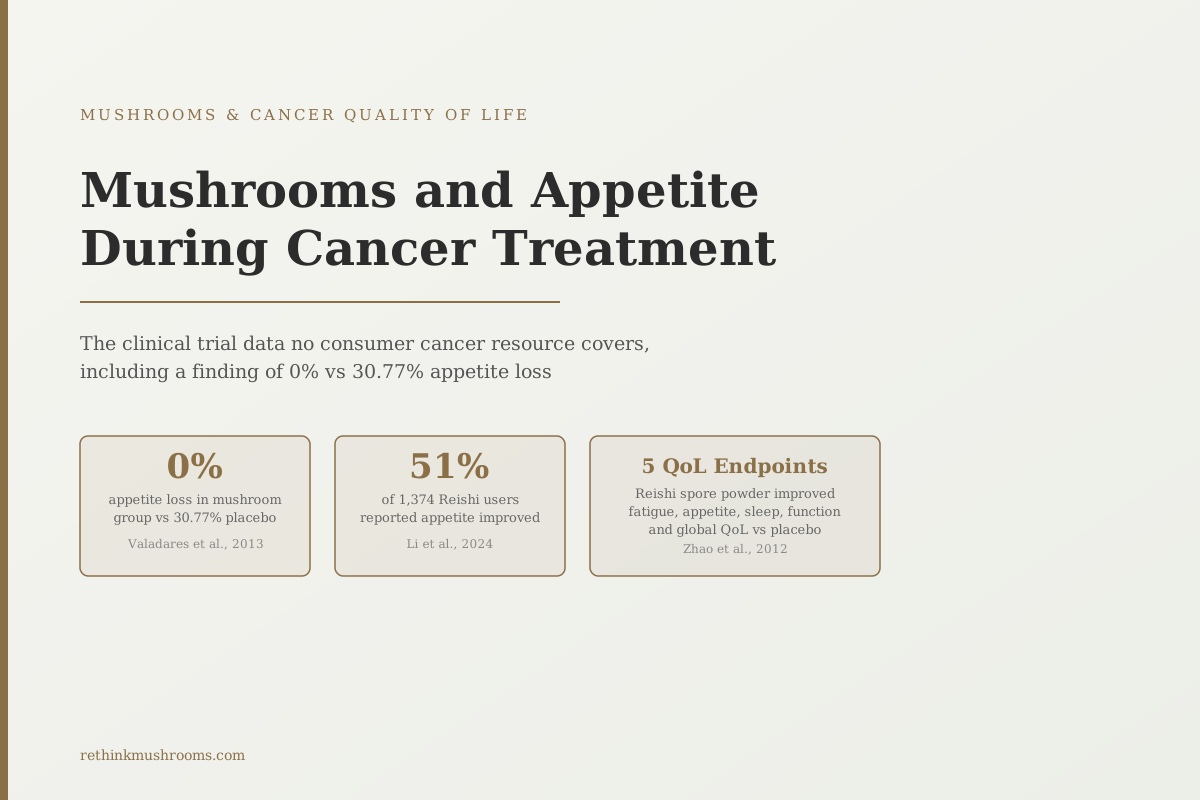
0% appetite loss
In a double-blind RCT, breast cancer patients taking Agaricus sylvaticus during chemotherapy had 0% appetite loss at 3 months. In the placebo group, 30.77% had appetite loss at the same timepoint.
Valadares et al., Indian Journal of Pharmacology, 2013
0% vs 30.77%
appetite loss: mushroom vs. placebo at 3 months in 46 breast cancer patients during chemotherapy (Valadares et al., 2013)
51%
of 1,374 cancer patients using Reishi reported appetite improved quite a bit or very much (Li et al., 2024)
5 endpoints
Reishi spore powder improved fatigue, appetite, sleep, physical function, and global QoL vs placebo in a 4-week breast cancer RCT (Zhao et al., 2012)
Valadares et al., Indian Journal of Pharmacology, 2013
 View as image ↗
In a double-blind, placebo-controlled trial, Valadares and colleagues (2013) gave Agaricus sylvaticus extract or placebo to 46 breast cancer patients during chemotherapy. At three months, 0% of the patients receiving the mushroom supplement reported appetite loss. In the placebo group, 30.77% had appetite loss at the same timepoint. By six months, appetite loss affected 80% of the placebo group.[1] This single data point does not appear in any major consumer cancer resource. It appeared in a peer-reviewed pharmacology journal in 2013 and has reached essentially no patients who might benefit from knowing it. This article presents the clinical evidence on mushrooms and appetite during cancer treatment, including what the data shows and where its limits are. It sits within the broader evidence covered in medicinal mushrooms in cancer treatment.
Key Takeaways
- A double-blind RCT of 46 breast cancer patients found 0% appetite loss in those taking Agaricus sylvaticus extract during chemotherapy versus 30.77% in the placebo group at 3 months, rising to 80% in the placebo group at 6 months (Valadares et al., 2013)
- A 2024 cross-sectional survey of 1,374 cancer patients using Reishi found 51% reported their appetite improved quite a bit or very much; 55% reported nausea improved (Li et al., 2024)
- A 2012 pilot RCT of 48 breast cancer patients found Reishi spore powder significantly improved appetite, fatigue, sleep disturbance, physical function, and global quality of life compared to placebo in 4 weeks (Zhao et al., 2012)
- Agaricus sylvaticus is related to the common white button mushroom (Agaricus bisporus) but has been cultivated to have higher beta-glucan content and has been specifically studied in cancer populations
- All RCTs are small (under 50 patients); no head-to-head comparison of mushroom supplementation versus pharmaceutical appetite stimulants exists in the clinical literature
- The evidence supports the appetite angle specifically: these are not just general "feel better" claims but controlled trials measuring appetite loss as a defined clinical endpoint
Why Appetite Loss During Cancer Treatment Is So Consequential
Appetite loss, medically called anorexia, is one of the most debilitating and underaddressed symptoms in cancer care. For patients undergoing chemotherapy, it compounds an already severe physical stress.
The problem operates on multiple levels. Chemotherapy drugs damage the rapidly dividing cells lining the gastrointestinal tract, causing nausea, mouth sores, taste changes, and gut disruption that make eating difficult and unpleasant. Many drugs trigger the brain's chemoreceptor trigger zone, producing nausea independent of the gut. Tumor metabolism itself alters appetite-regulating hormone signals, particularly ghrelin (the hunger hormone) and leptin, creating a state in which the body stops sending hunger signals even when caloric needs are high.
The consequences extend beyond discomfort. Cancer-related malnutrition is associated with worse treatment tolerance, greater chemotherapy toxicity, more hospitalizations, and in some analyses, shorter survival. Patients who cannot maintain adequate nutrition often require dose reductions in chemotherapy or interruptions in treatment, reducing therapeutic efficacy. Maintaining nutritional status during treatment is a clinically meaningful goal, not a quality-of-life nicety.
Standard pharmaceutical interventions include corticosteroids (dexamethasone, methylprednisolone), megestrol acetate, and cannabinoids. Each carries significant side effects and limitations. The search for well-tolerated appetite-preserving interventions has led some researchers toward mushroom polysaccharides, which appear to interact with both gut mucosa health and systemic inflammatory signaling in ways that could address appetite disruption upstream.
The RCT That Found 0% Appetite Loss in the Mushroom Group
Valadares and colleagues (2013) enrolled 46 women with stage II or III breast cancer undergoing chemotherapy in a randomized, double-blind, placebo-controlled trial, published in the Indian Journal of Pharmacology.[1] Participants received either Agaricus sylvaticus extract or placebo throughout their chemotherapy course.
Agaricus sylvaticus is a wild mushroom that has been selectively cultivated for higher polysaccharide content and has been studied specifically in cancer populations in Brazil, where it has a history of use in oncology settings. It is related to Agaricus bisporus, the white button mushroom most commonly found in grocery stores, but the cultivated version used in this research has been bred to concentrate the beta-glucan and other polysaccharide fractions.
At the three-month assessment: 0% of the Agaricus sylvaticus group reported appetite loss. In the placebo group, 30.77% had appetite loss.
At six months: the gap widened further. Appetite loss affected 80% of the placebo group while remaining significantly lower in the treated group.
Several caveats apply. The sample size is small (23 per group). The study enrolled only breast cancer patients during chemotherapy, limiting generalizability. The preparation used may differ from commercially available Agaricus mushroom supplements. But the directional finding is striking: in a controlled comparison, a mushroom extract was associated with near-complete protection against chemotherapy-associated appetite loss during the treatment period studied.
For the full scope of mushroom evidence across gastric, breast, and colorectal cancers, see the Dan 2023 scoping review findings covered in mushrooms for cancer quality of life.
The 1,374-Patient Survey: Reishi and Appetite
Li and colleagues (2024) published the largest patient-reported outcomes dataset on this topic in Integrative Cancer Therapies.[2] The cross-sectional survey included 1,374 cancer patients who were using Reishi (Ganoderma lucidum) mushroom supplements.
Among respondents:
- 51% reported their appetite had improved "quite a bit" or "very much"
- 55% reported nausea improved at the same level
- 52% reported fatigue improved
- 50% reported depression improved
The study is not a clinical trial. It is a survey, which means selection bias is significant: patients using Reishi may be those who are already doing better, or may attribute improvements to Reishi that would have occurred regardless. The study cannot determine whether Reishi caused these improvements.
What it provides is the largest available picture of what cancer patients experience when using Reishi, across a broad range of cancer types and treatment contexts. The 51% appetite improvement rate, applied to a group of 1,374, represents a substantial number of patients reporting a clinically meaningful symptom change. The adverse effect rate was 9.1%, primarily dry mouth and constipation, and most reported effects were mild.
The Zhao 2012 Reishi RCT: Appetite as One of Five Measured Endpoints
Zhao and colleagues (2012) conducted the most rigorous single study in this cluster: a 48-patient, double-blind, placebo-controlled pilot RCT of Reishi spore powder in breast cancer patients undergoing endocrine therapy, published in Evidence-Based Complementary and Alternative Medicine.[3]
The primary outcome was cancer-related fatigue, measured using the EORTC QLQ-C30 scale, a standardized quality-of-life instrument used in oncology research worldwide. The trial measured five endpoints on this scale: fatigue, appetite loss, sleep disturbance, physical function, and global quality of life.
All five improved significantly in the Reishi group versus placebo at 4 weeks. Appetite loss was explicitly included as a measured endpoint, and it improved significantly. The trial used Reishi spore powder specifically, not a whole mushroom or general beta-glucan extract.
The Zhao trial is the most frequently cited mushroom QoL study in the academic literature, yet it appears in essentially no consumer cancer content. The appetite-specific finding is typically subsumed into general "quality of life improved" summaries that obscure the clinical specificity of what was actually measured.
For the full clinical evidence on Reishi as a cancer adjunct, see Ganoderma lucidum as a cancer adjunct: clinical evidence.
The Broader Evidence and What It Confirms
Novaes and colleagues (2011) reviewed the evidence for Agaricales mushrooms in breast cancer, finding consistent signals of appetite preservation and reduced adverse effects of chemotherapy in Agaricus sylvaticus supplementation groups across the available studies at that time.[4]
Dan and colleagues (2023) published a scoping review covering medicinal mushrooms in gastric, breast, and colorectal cancers in Cureus. All nine of the RCTs and clinical trials they included reported benefits from mushroom extracts, including improvements in quality of life and immune function across the three cancer types studied. The mushroom species included Lentinus edodes (shiitake), Coriolus versicolor (turkey tail), and Agaricus sylvaticus.[5]
A 2007 survey by Talcott and colleagues of Japanese cancer patients consuming Agaricus blazei extract found that improved appetite and reduced fatigue were among the most commonly reported perceived benefits, consistent with the clinical trial findings in a patient-experience framework.[6]
Jeitler and colleagues (2020), reviewing 8 RCTs and 1 controlled clinical trial in a narrative review in Frontiers in Pharmacology, reported improvements in chemotherapy side effect burden and quality of life including appetite-related endpoints as common findings across the trials reviewed.[7]
For the mechanism connecting mushroom polysaccharides to appetite hormone regulation via gut signaling, see how mushroom polysaccharides affect gut hormones that regulate appetite.
What the Evidence Cannot Yet Say
The evidence reviewed here is clinically meaningful and consistently directional, but it has real limitations.
Sample sizes are small. The two RCTs have 46 and 48 patients respectively. These are pilot trials that establish feasibility and signal, not the larger trials needed to confirm efficacy.
Species and preparations vary. Valadares 2013 used Agaricus sylvaticus extract. Zhao 2012 used Reishi spore powder. Li 2024 surveyed patients using general Reishi supplements. These are different preparations and species with different compound profiles. No direct comparison between mushroom species for appetite preservation exists.
No comparison to pharmaceutical appetite stimulants. There is no head-to-head trial of a mushroom supplement versus megestrol acetate or corticosteroids for chemotherapy-related appetite loss. These are established pharmaceutical interventions with known efficacy and known toxicity profiles.
Mechanism is inferred, not directly established. The hypothesis that mushroom polysaccharides preserve appetite through gut mucosal protection and inflammatory cytokine modulation is mechanistically plausible and supported by the broader beta-glucan literature, but it has not been established in a direct mechanistic human trial specifically for appetite endpoints.
The honest summary: the clinical evidence is more specific and more compelling than most cancer patients or their oncologists are aware of. Two controlled trials with appetite as a measured endpoint both show signals in the same direction. A large survey confirms the clinical pattern. But the evidence base needs replication in larger, more rigorously designed trials before strong clinical guidance can be given.
For the full quality of life evidence across fatigue, sleep, and emotional endpoints, see mushrooms and cancer quality of life: fatigue, sleep, and emotional well-being data. For cancer-related fatigue specifically, see mushrooms for cancer-related fatigue: evidence review. For the broader well-being mechanisms, see how mushroom supplements improve well-being for cancer patients.
The Bottom Line
Two controlled clinical trials have measured appetite as a specific endpoint in cancer patients taking mushroom supplements. Valadares (2013) found 0% appetite loss in 23 breast cancer patients taking Agaricus sylvaticus versus 30.77% in placebo at 3 months, expanding to 80% in placebo at 6 months. Zhao (2012) found Reishi spore powder significantly improved appetite alongside fatigue, sleep, and global quality of life in 48 breast cancer patients. A 2024 survey of 1,374 Reishi users with cancer found 51% reported appetite improved. Both RCTs are small and require replication, but the directional evidence is consistent.
Frequently Asked Questions
Sources & References
- 1. Source details for this reference are not yet available.
- 2. Source details for this reference are not yet available.
- 3. Source details for this reference are not yet available.
- 4. Source details for this reference are not yet available.
- 5. Source details for this reference are not yet available.
- 6. Source details for this reference are not yet available.
- 7. Source details for this reference are not yet available.