Shiitake Foundation & Science
1985 Japan drug approval
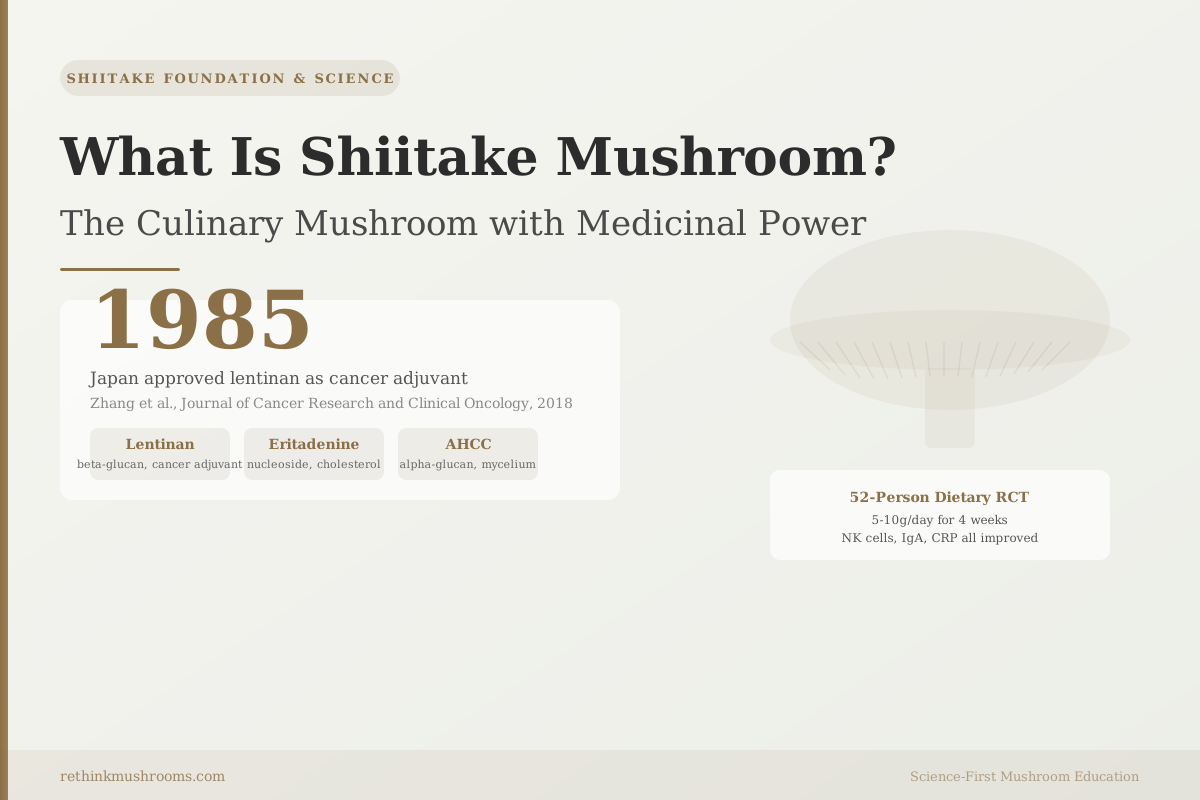
Japan's Ministry of Health approved lentinan, a compound extracted from shiitake, as a prescription cancer adjuvant in 1985. Shiitake is the only culinary mushroom with a pharmaceutical derivative that has cleared a national drug regulator.
Zhang et al., Journal of Cancer Research and Clinical Oncology, 2018
52 adults
showed improved γδ-T and NK-T cell activity eating shiitake daily for 4 weeks
3 compounds
lentinan, eritadenine, AHCC — each structurally distinct with separate evidence
40+ years
of lentinan clinical research across Japan and China
Zhang et al., Journal of Cancer Research and Clinical Oncology, 2018
 View as image ↗
In 1985, Japan approved lentinan as a prescription cancer treatment. Lentinan comes from shiitake mushrooms. This single fact separates shiitake from every other culinary mushroom in the world: it's the only one with a pharmaceutical derivative that has cleared a national drug regulator.
Shiitake (Lentinula edodes) is a mushroom people have been eating for at least a thousand years. It's also the most clinically researched edible mushroom on the planet. Those two facts are connected. Japan's biomedical establishment began seriously studying shiitake in the 1960s, and what they found led directly to that 1985 approval and to decades of clinical trials in Japan and China that followed.
Understanding shiitake's pharmacology requires a framework that almost no health resource gets right. Shiitake doesn't have one active compound. It has three distinct compound classes, each with its own molecular structure, its own biological mechanism, and its own clinical evidence base. Conflating them produces articles that are, at best, misleading. Getting them right is the starting point for understanding what shiitake actually does in a human body.
Key Takeaways
- Lentinan, a beta-glucan from shiitake's fruiting body, was approved in Japan in 1985 as a cancer adjuvant; a 2018 review of 12 years of Chinese lung-cancer trials found lentinan added to chemotherapy raised the overall response rate from 43.3% to 56.9%
- A 2009 individual patient data meta-analysis found lentinan plus chemotherapy significantly improved overall survival in unresectable or recurrent gastric cancer compared to chemotherapy alone (hazard ratio 0.80)
- In a 2015 randomized dietary intervention, 52 healthy adults who ate 5-10g of dried shiitake daily for four weeks showed increased γδ-T cell and natural killer T (NK-T) cell proliferation, higher secretory IgA levels, and reduced CRP
- Eritadenine, a nucleoside unique to shiitake, modulates cholesterol removal rather than blocking cholesterol synthesis; its content varies significantly by shiitake strain, according to 2007 analytical research
- AHCC is not lentinan: AHCC is an alpha-glucan complex derived from shiitake mycelium; lentinan is a beta-glucan from the fruiting body; they are structurally distinct compounds with different evidence bases
- Cooking method affects shiitake's nutritional profile; drying with UV exposure increases vitamin D2 content, while different preparations affect antioxidant activity and beta-glucan preservation differently
Three Compounds, Three Evidence Bases: Why Shiitake Is Pharmacologically Unique
Every competitor writing about shiitake treats it as "a mushroom with health benefits." That framing misses the actual science. Shiitake contains three distinct pharmacologically active compound classes, and they are not interchangeable.
Lentinan is a high-molecular-weight polysaccharide. Its backbone is a chain of glucose molecules linked in a specific configuration (beta-1,3 linkage with beta-1,6 side branches). It's found in the fruiting body: the part of the mushroom people eat. Lentinan is a registered pharmaceutical drug in Japan, administered intravenously as an adjuvant to cancer chemotherapy.
Eritadenine is a nucleoside. It's a small molecule, chemically distinct from lentinan, and it's also found in the fruiting body. Its primary studied effect is on cholesterol metabolism. The mechanism is different from statins. Where statins block the liver's ability to synthesize cholesterol, eritadenine appears to enhance the body's existing cholesterol removal pathways.
AHCC (Active Hexose Correlated Compound) is an alpha-glucan complex derived from the mycelium of shiitake, not the fruiting body. It's structurally different from lentinan: alpha-glucan rather than beta-glucan. AHCC is sold as a supplement with its own body of clinical research. AHCC and lentinan both come from shiitake, but they are not the same compound and do not share the same mechanism or evidence base. Conflating them is the most common error in shiitake health content.
This three-compound framework is the foundation for everything that follows. Each compound leads to different conclusions about mechanisms, evidence quality, and practical implications. The rest of this article walks through each one in detail, then explains what the research shows about eating shiitake as a food.
Shiitake · Three Compounds, Three Evidence Bases
Why Shiitake Is Not “One Mushroom With Benefits”
Lentinan, eritadenine, and AHCC are structurally distinct, come from different parts of the organism, and each carries its own evidence. Conflating them is the most common error in shiitake health content.
Lentinan
The approved drug
- Structure
- Beta-(1,3)/(1,6)-glucan (polysaccharide)
- Source
- Fruiting body — the edible cap
- Mechanism
- Immune activation
- Form studied
- Intravenous, as a chemotherapy adjuvant
- Evidence base
- Approved in Japan (1985); IPD meta-analysis and multi-trial reviews
Eritadenine
The cholesterol nucleoside
- Structure
- Nucleoside (small molecule)
- Source
- Fruiting body — the edible cap
- Mechanism
- Enhances cholesterol removal (unlike statins, which block synthesis)
- Form studied
- Dietary / oral
- Evidence base
- Mechanistic and animal work; human clinical data still building
AHCC
The mycelium supplement
- Structure
- Alpha-glucan complex
- Source
- Mycelium — not the cap that is eaten
- Mechanism
- Immune modulation
- Form studied
- Oral supplement
- Evidence base
- A separate evidence base from lentinan — not the same compound
Sources: Oba et al. (2009) [ref 2]; Zhang et al. (2018) [ref 3]; Enman et al. (2007) [ref 4].
Readers who want deeper mechanistic detail can find it in Shiitake Bioactive Compounds: Lentinan, Eritadenine, and Beyond, and the full receptor-level pharmacology is covered in The Pharmacology of Lentinula edodes: How Shiitake Works.
Lentinan: The Compound Japan Approved as a Cancer Drug in 1985
Lentinan has one of the most unusual research histories of any compound found in food. The story starts in 1969 when Chihara and colleagues at Japan's National Cancer Center isolated an antitumor polysaccharide from shiitake. They called it lentinan. Over the next 16 years, Japanese pharmaceutical researchers ran clinical trials testing lentinan as an adjuvant to standard chemotherapy. In 1985, Japan's Ministry of Health approved it.
That approval is significant for two reasons. First, it means lentinan cleared a rigorous regulatory process that required demonstrating clinical benefit in controlled trials. Second, the approved use is as a cancer adjuvant: it's used alongside chemotherapy, not as a standalone cancer treatment.
The most comprehensive look at lentinan's clinical evidence comes from a 2009 individual patient data meta-analysis by Oba and colleagues, published in Anticancer Research. Individual patient data meta-analyses are the most rigorous type of pooled analysis because they work with raw patient-level records rather than published summary statistics. Pooling 650 patients from five randomized trials, Oba's analysis found that lentinan combined with chemotherapy significantly improved overall survival in patients with unresectable or recurrent gastric cancer compared to chemotherapy alone (hazard ratio 0.80, 95% CI 0.68-0.95).[2]
Lentinan research didn't stop in Japan. A 2018 systematic review by Zhang and colleagues, published in the Journal of Cancer Research and Clinical Oncology, examined 12 years of lentinan clinical research in China, focused on lung cancer. Pooling 38 randomized controlled trials covering more than 3,100 patients, the review found that adding lentinan to chemotherapy raised the mean overall response rate from 43.3% with chemotherapy alone to 56.9%, and reported improvements in quality of life.[3] This represents a substantial ongoing clinical research program that most Western health content is entirely unaware of.
A 2021 systematic review by Steimbach and colleagues took a broader view, compiling 16 clinical trials (1,650 patients) that used fungal beta-glucans, including lentinan, as adjuvants during cancer treatment. It concluded that beta-glucan adjuvants are safe and well tolerated, and that most trials reported reduced treatment-related immune suppression or faster recovery of white blood cell counts. Importantly, the authors were careful about efficacy: some trials found no significant difference between beta-glucan and control groups, the methods varied widely, and they concluded that more rigorous trials are needed before efficacy can be considered established.[5]
Two important caveats belong here. First, lentinan in clinical trials is administered intravenously. The oral bioavailability of lentinan from eating shiitake mushrooms has not been established at therapeutic levels. Second, lentinan is studied as an adjuvant to chemotherapy. The clinical evidence is specifically for this combination use, in specific cancer types, in patients already receiving medical treatment. The data does not extrapolate to "eating shiitake prevents cancer."
The full lentinan research history, from the Chihara 1969 discovery through the Oba 2009 meta-analysis, is covered in depth in Lentinan: Shiitake's Star Compound and Its 40-Year Research History.
The 2015 Dietary RCT: Eating Shiitake for Four Weeks Improved Measurable Immunity
The lentinan research above describes pharmaceutical-grade intravenous administration. A separate and equally interesting question: does eating shiitake as food, at amounts a person could realistically consume, produce measurable health effects in healthy people?
In 2015, Dai and colleagues (working in Susan Percival's laboratory at the University of Florida) published a randomized dietary intervention in the Journal of the American College of Nutrition that is the most compelling study in this space. The study enrolled 52 healthy young adults. Half ate 5g of dried shiitake per day; the other half ate 10g per day. The duration was four weeks. Because both groups ate shiitake, the study was a dose comparison that measured each participant's change from their own baseline rather than against a placebo group.[1]
The results were notable across both doses. Proliferation of gamma-delta (γδ) T cells rose by about 60%, and natural killer T (NK-T) cell counts roughly doubled, both with high statistical significance. Cells from both populations also expressed more activation receptors, a sign of greater readiness to respond. Secretory IgA levels, a marker of mucosal immunity (the immune defenses at the body's surfaces), increased. And C-reactive protein (CRP), a standard inflammatory marker, decreased.[1]
Dai 2015 · Direction of Change
Not a One-Way “Boost”: What Rose and What Fell in the Same 4 Weeks
In the same 52 healthy adults, immune-cell readiness went up while two inflammation markers went down — the fingerprint of immunomodulation rather than blanket immunostimulation.
Rose after 4 weeks
γδ-T cell proliferation
ex vivo, p < 0.0001
NK-T cell counts
roughly doubled, p < 0.0001
Activation-receptor expression
both γδ-T and NK-T populations
Secretory IgA (saliva)
mucosal frontline antibody
IL-4, IL-10, TNF-α, IL-1α
mixed anti- and pro-inflammatory
Fell after 4 weeks
C-reactive protein (CRP)
systemic inflammation marker
MIP-1α / CCL3
inflammatory chemokine
The trial had no placebo or no-treatment arm — both groups ate shiitake (5 g or 10 g/day) — so these changes from baseline cannot be attributed to shiitake as cleanly as in a placebo-controlled design, and the two doses showed no separation on self-reported illness.
Source: Dai et al. (2015), Journal of the American College of Nutrition [ref 1].
Several features make this study unusually credible. It tested dietary consumption rather than extracted supplements. It ran long enough (four weeks) to capture meaningful immune changes. It measured multiple immune parameters simultaneously. And it recruited healthy adults rather than people with existing immune conditions, meaning the changes occurred above a normal baseline, not just a sick population recovering.
γδ-T cells and NK-T cells are early responders that patrol the body's mucosal surfaces and help detect virally infected and abnormal cells. A measurable increase in their proliferation and activation from eating shiitake, in healthy adults, over a realistic dietary timeframe, holds up to scrutiny. It is worth being precise, though: the trial had no placebo arm and the two doses behaved similarly, so the cleanest reading is that daily shiitake shifted several immune and inflammatory markers from each participant's starting point.
5g of dried shiitake per day is roughly equivalent to a moderate fresh shiitake serving four times per week. 10g would be approximately daily consumption. Both doses showed improvements in the same direction.
The deep dive on this specific study is at Eating Shiitake Daily Boosts Immunity: The Landmark 2015 Study.
Eritadenine: A Cholesterol Mechanism That Works Differently from Statins
Eritadenine is a nucleoside found in shiitake's fruiting body. It's the compound most associated with shiitake's traditional reputation for cardiovascular support. Its proposed mechanism of action is distinct from statins, the most commonly prescribed cholesterol-lowering drugs, which is pharmacologically interesting regardless of clinical evidence strength.
Statins work by blocking an enzyme in the liver's cholesterol synthesis pathway. The liver produces less cholesterol and blood levels drop. Eritadenine's proposed mechanism is different: rather than blocking synthesis, it appears to enhance the metabolism of phosphatidylcholine (a fat-carrying molecule in the blood), which influences how the body transports and removes cholesterol. The effect is on removal efficiency rather than production. These are two different pathways, and they're not redundant.
Eritadenine's content in shiitake is not fixed. A 2007 study by Enman and colleagues, published in the Journal of Agricultural and Food Chemistry, quantified eritadenine across four shiitake strains and found substantial variation, with some strains containing up to ten times more eritadenine than levels previously reported.[4] The strain grown, and the preparation method, affect how much eritadenine a serving of shiitake actually contains.
The clinical evidence for eritadenine's cholesterol effects in humans is thinner than the mechanistic research suggests. The foundational work is from animal models. The mechanism is biologically plausible and the compound is demonstrably present in shiitake. But readers who want the current state of human clinical evidence should look at Eritadenine in Shiitake: The Unique Cholesterol-Lowering Nucleoside and How Shiitake Lowers LDL Cholesterol: Clinical Evidence, which cover the actual trial data.
AHCC vs Lentinan: The Distinction Almost Every Source Gets Wrong
AHCC is one of the most widely sold shiitake-derived supplements in the world. It has its own separate body of research, entirely distinct from the lentinan evidence base. But it is routinely described, incorrectly, as lentinan or as a functionally equivalent compound.
The distinction is structural. Lentinan is a beta-(1,3)-glucan: glucose molecules linked in a beta configuration, extracted from shiitake's fruiting body. AHCC is an alpha-glucan complex: glucose molecules linked in an alpha configuration, derived from shiitake mycelium, the root-like underground network, not the cap that's eaten as food.
Beta-glucans and alpha-glucans interact with the immune system differently. They bind to different surface receptors on immune cells. They trigger different signaling cascades downstream. Treating AHCC and lentinan as interchangeable because they both "come from shiitake" is like treating two medications as equivalent because they share a manufacturing plant.
This matters for reading research. If a clinical trial shows AHCC improves NK cell function, that finding does not automatically apply to lentinan. If a study tests lentinan for cancer survival, its findings do not transfer to AHCC. Their mechanisms, sources, structures, and evidence bases are distinct.
Most consumer health content conflates these compounds. AHCC is frequently described as a "shiitake extract" alongside lentinan, with no structural or sourcing distinction drawn. This creates the misleading impression that they represent a single class of shiitake-derived immune compounds, which they don't.
What Cooking Does to Shiitake's Bioactives
Shiitake is primarily a food. Most people consume it cooked, not as an extracted supplement. How preparation affects the compounds matters for anyone thinking about dietary intake.
Roncero-Ramos and colleagues' 2017 study, which tested boiling, microwaving, grilling, and deep frying across four cultivated mushrooms including shiitake, found that cooking method significantly changes antioxidant activity and nutritional profile. Boiling and frying caused the largest losses in antioxidant capacity, protein, and carbohydrates, while microwaving and grilling best preserved the nutritional profile.[6]
Drying with UV exposure increases vitamin D2 content substantially. Shiitake, like human skin, converts ergosterol to vitamin D2 when exposed to UV light. Sun-dried shiitake contains meaningfully more vitamin D2 than indoor-dried or fresh shiitake. Some commercial producers capitalize on this by exposing mushrooms gill-side-up to sunlight during drying.
Beta-glucan content also shifts with cooking, not always downward. In the Roncero-Ramos analysis, boiling actually increased the measurable total glucan content by enhancing the beta-glucan fraction.[6] The practical point is that cooking method changes how much of a compound is present and measurable, and the direction of that change depends on both the method and the compound.
Eritadenine and growing conditions are also linked. A 2021 fermentation study found that heat stress suppresses eritadenine synthesis in Lentinula edodes, so conditions during growth, not just how the mushroom is cooked, influence the final eritadenine content.[7] How the mushroom is grown affects the compound profile of what ends up on a plate.
The practical takeaway from the cooking research: shiitake retains meaningful nutritional value through normal cooking. The Dai 2015 trial used dried shiitake eaten in normal food preparations, and its 52 participants showed measurable immune changes through dietary consumption rather than supplementation.
What the Research Does Not Show
Stating what the evidence does not support belongs in any honest overview.
The lentinan cancer evidence is specific to intravenous administration as an adjuvant to chemotherapy. There is no published clinical evidence that eating shiitake mushrooms treats, prevents, or helps manage cancer in humans. The gap between "lentinan IV improves survival in gastric cancer patients on chemotherapy" and "eating shiitake prevents cancer" is enormous and not bridged by any current data.
AHCC has its own clinical evidence base and should be evaluated on its own terms. The fact that Japan approved lentinan as a drug does not confer equivalent status or evidence quality to AHCC.
Eritadenine's evidence for cholesterol effects in humans remains thinner than the mechanistic research implies. The compound is real, the mechanism is plausible, and it's present in measurable amounts in commercial shiitake. But the clinical evidence for meaningful LDL reduction from dietary shiitake consumption is still building.
Shiitake is a safe, nutritious food with more clinical research behind it than any other culinary mushroom. Understanding what that research shows requires keeping the three compounds separate and evaluating each one against its own specific evidence.
This article is for education only and is not medical advice. Lentinan's cancer evidence comes from a prescription drug used under medical supervision alongside chemotherapy; it is not a reason to self-treat any condition with shiitake or shiitake supplements. Talk to your doctor before using shiitake extracts, especially if you are undergoing cancer treatment or taking prescription medication.
Explore the Full Shiitake Research Picture
The articles below go deeper on each specific topic covered in this overview:
- Shiitake Bioactive Compounds: Lentinan, Eritadenine, and Beyond: Full molecular detail on all three compound classes, including extraction method effects and strain variability
- Shiitake: Where Culinary Tradition Meets Clinical Research: The historical arc from Song Dynasty traditional use to the 1985 Japan approval to the 2015 dietary RCT
- The Pharmacology of Lentinula edodes: How Shiitake Works: Receptor-level mechanisms for immune activation, anti-inflammatory effects, and cholesterol modulation
- Lentinan: Shiitake's Star Compound and Its 40-Year Research History: The complete lentinan clinical timeline, from Chihara's 1969 discovery through the Oba 2009 meta-analysis
The Bottom Line
Shiitake is the most clinically researched culinary mushroom, distinguished by three pharmacologically distinct compound classes: lentinan (a beta-glucan from the fruiting body, approved as a cancer adjuvant in Japan in 1985), eritadenine (a nucleoside that modulates cholesterol removal via a different mechanism than statins), and AHCC (an alpha-glucan from the mycelium with a separate evidence base). The strongest dietary evidence comes from a 2015 randomized dietary intervention in which 52 healthy adults eating 5-10g of dried shiitake daily for four weeks showed measurable improvements in γδ-T and NK-T cell proliferation, secretory IgA, and CRP. Understanding shiitake's research requires keeping these three compounds separate, as conflating them produces misleading conclusions about what eating shiitake actually does in the body.
Frequently Asked Questions
Sources & References
- 1RTHM-00368·Dai, Xiaoshuang et al. (2015). “Consuming Lentinula edodes (Shiitake) Mushrooms Daily Improves Human Immunity: A Randomized Dietary Intervention in Healthy Young Adults..” Journal of the American College of Nutrition.Study breakdown →PubMed →↩
- 2RTHM-00313·Oba, Koji et al. (2009). “Individual patient based meta-analysis of lentinan for unresectable/recurrent gastric cancer..” Anticancer research.Study breakdown →PubMed →↩
- 3RTHM-00538·Zhang, Yiran et al. (2018). “Lentinan as an immunotherapeutic for treating lung cancer: a review of 12 years clinical studies in China..” Journal of cancer research and clinical oncology.Study breakdown →PubMed →↩
- 4RTHM-00211·Enman, Josefine et al. (2007). “Quantification of the bioactive compound eritadenine in selected strains of shiitake mushroom (Lentinus edodes)..” Journal of agricultural and food chemistry.Study breakdown →PubMed →↩
- 5RTHM-00719·Steimbach, Laiza et al. (2021). “Fungal beta-glucans as adjuvants for treating cancer patients - A systematic review of clinical trials..” Clinical nutrition (Edinburgh.Study breakdown →PubMed →↩
- 6RTHM-00488·Roncero-Ramos, Irene et al. (2017). “Effect of different cooking methods on nutritional value and antioxidant activity of cultivated mushrooms..” International journal of food sciences and nutrition.Study breakdown →PubMed →↩
- 7RTHM-00734·Zhang, Jing et al. (2021). “Effects of Heat Stress and the Addition of Different Purines on the Synthesis of Eritadenine in Liquid Fermentation of Shiitake Culinary-Medicinal Mushroom, Lentinula edodes (Agaricomycetes)..” International journal of medicinal mushrooms.Study breakdown →PubMed →↩