Shiitake (Lentinula edodes)
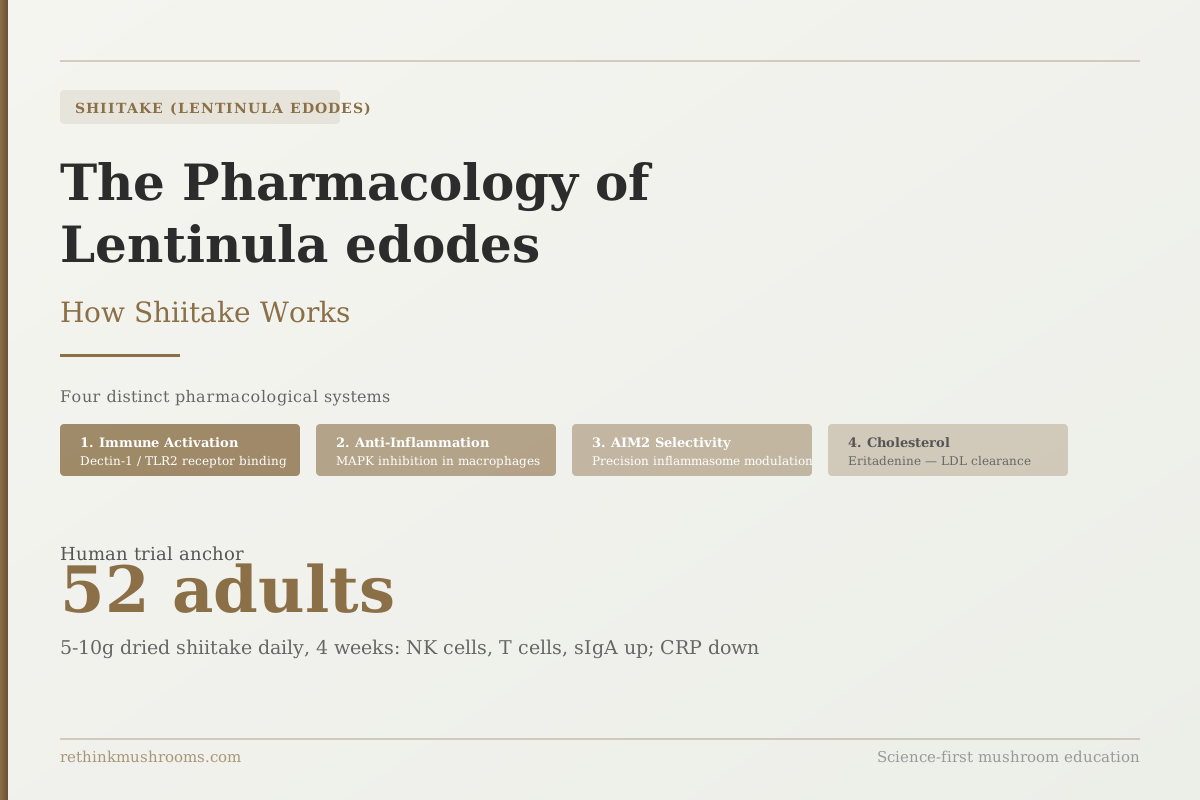
52 adults
Eating 5 or 10g of dried shiitake daily for four weeks increased γδ-T and NK-T cell proliferation, raised salivary secretory IgA, and lowered CRP — outcomes that trace to more than one molecular mechanism.
Dai et al., Journal of the American College of Nutrition, 2015
4 weeks
to produce measurable immune changes with dietary shiitake in a controlled trial
β-(1→3)-glucan
lentinan's backbone structure, the pattern Dectin-1 receptors recognize
AIM2 selective
lentinan modulates specific inflammasome pathways in mice, not all inflammation
Dai et al., Journal of the American College of Nutrition, 2015
 View as image ↗
Lentinula edodes, the scientific name for shiitake mushroom, has a pharmacology built around distinct compound classes, each with a different molecular target. Lentinan is a specific type of fiber, a beta-glucan, that binds immune receptors and is an approved injectable adjuvant drug in several Asian countries.[9] Eritadenine is a small nitrogen-containing molecule that lowers cholesterol through a pathway different from statins. And beta-glucan fractions more broadly affect inflammation through specific signaling relays inside immune cells.
A 2015 randomized dietary trial established what these mechanisms look like in practice. Dai and colleagues put 52 healthy adults on either 5g or 10g of dried shiitake daily for four weeks and measured the result. Proliferation of γδ-T cells rose 60%. NK-T cell proliferation doubled. Salivary secretory IgA increased. C-reactive protein fell.[2] Several distinct measurable outcomes from one dietary addition, tracing to more than one molecular mechanism.
This article maps those mechanisms. For the broader overview of shiitake's evidence and history, see What Is Shiitake Mushroom?.
Key Takeaways
- Lentinan's β-(1→3)-glucan backbone with β-(1→6) branch points is the structural pattern Dectin-1 receptors on immune cells recognize, which is how a dietary fiber becomes an immune signal (Ren et al., 2018; Brown et al., 2007)
- Eating 5 or 10g of dried shiitake daily for 4 weeks increased γδ-T cell proliferation by 60%, doubled NK-T cell proliferation, raised salivary secretory IgA, and lowered CRP in 52 healthy adults aged 21-41. This is the landmark dietary pharmacology trial (Dai et al., 2015)
- Oral lentinan reaches immune tissue by a defined route: M cells transport it into Peyer's patches, where Dectin-1 mediates uptake by mononuclear phagocytes (Wang et al., 2024)
- Shiitake beta-glucan blocks specific arms of the MAPK relay inside macrophages (JNK1/2 and ERK1/2), reducing nitric oxide and TNF-alpha triggered by bacterial signals — in a mouse cell line (Xu et al., 2012)
- Lentinan selectively attenuates AIM2 and non-canonical inflammasome activation while increasing pro-inflammatory cytokine production via TLR4. This is precision modulation, not broad immunosuppression — demonstrated in mouse macrophages and mouse models (Ahn et al., 2017)
- Eritadenine works through a different pathway than statins: statins block cholesterol synthesis; eritadenine alters hepatic phospholipid metabolism, shifting the phosphatidylcholine-to-phosphatidylethanolamine ratio (Sugiyama et al., 1995). The evidence is from rats; human RCTs on isolated eritadenine are lacking
- Beta-glucans differing in source, purity and processing produce different magnitudes of immune gene induction in human THP-1 macrophages. Preparation matters, though the direction of effect was broadly similar (Chanput et al., 2012)
Not One Mechanism, Four
The Four Pharmacologies of Lentinula edodes — and What Each One Rests On
“Shiitake” is not a single drug. Two different molecules act on four different targets, and the evidence behind each is at a different tier. Reading the lanes together is the fastest way to see why a finding about injected lentinan in mouse macrophages says nothing about the cholesterol claim on a supplement label — and vice versa.
β-(1→3)-glucan structure → Dectin-1
Lentinan's β-(1→3) backbone with (1→6) side branches is the shape Dectin-1 evolved to detect. Orally, M cells ferry it into Peyer's patches, where Dectin-1 hands it to mononuclear phagocytes — the route that connects eating shiitake to immune signaling.
Ren 2018 [1] (structure, mycelial fraction) · Brown 2007 [3] (receptor structure) · Wang 2024 [4] (oral route, mice)
JNK1/2 + ERK1/2 inhibition → ↓NO, ↓TNF-α
In LPS-stimulated macrophages, lentinan blocks two arms of the MAPK relay and lowers nitric oxide, TNF-α and iNOS. Notably NF-κB was enhanced, not suppressed, and blocking Dectin-1 or TLR2 barely changed the effect — a separate route from Pathway 1.
Xu 2012 [5] (mouse RAW 264.7 cell line)
AIM2 + non-canonical inflammasomes damped, TLR4 cytokines kept
Lentinan selectively attenuates AIM2 and non-canonical inflammasome activation (↓caspase-1, ↓IL-1β, ↓IL-18) while up-regulating pro-inflammatory cytokines through TLR4. Selective modulation, not blanket immunosuppression.
Ahn 2017 [6] (mouse BMDMs + Listeria and endotoxin models)
Eritadenine → hepatic phospholipid metabolism
A separate molecule with a separate target. Eritadenine lowers the liver microsomal phosphatidylcholine:phosphatidylethanolamine ratio, and that shift precedes the plasma cholesterol drop. Statins block synthesis; this does not.
Sugiyama 1995 [10] (rats) · Kabir 1987 [11] (whole shiitake, SHR rats — LDL unchanged)
Pathways 1-3 act on lentinan; Pathway 4 acts on a different molecule entirely, which is why “shiitake extract” on a label is not a pharmacological description. Evidence tiers are stated per lane deliberately: three of the four rest on cell-culture or rodent work, and the single human trial [2] measured immune biomarkers in healthy young adults over four weeks, not disease outcomes.
Mechanism synthesis; lanes from refs [1]-[6], [10], [11] (see references)
The Structural Basis of Lentinula edodes Pharmacology: How Shape Determines Function
Lentinan's biological activity starts with its physical structure. Ren and colleagues characterized a lentinan fraction in a 2018 structural study and confirmed a β-(1→3)-glucan backbone with (1→6)-glucosyl side branches terminated by mannosyl and galactosyl residues, with a molecular weight of about 3.79 × 10⁵ Da.[1] In plain terms: lentinan is a long molecular chain made of glucose units connected in a specific three-dimensional arrangement. That shape matters because pattern recognition receptors on human immune cells evolved to recognize exactly this kind of arrangement.
Dectin-1 is the best characterized of those receptors. Its job is to detect molecular shapes associated with fungi. Structural work on the receptor itself shows a binding groove suited to recognizing β-(1→3)-glucan chains.[3] When a β-glucan of the right structure engages Dectin-1, the receptor signals the immune cell to activate, triggering a downstream cascade that reaches cytokine-producing machinery and, indirectly, lymphocyte responses.
One caveat worth stating plainly: the lentinan Ren characterized was extracted from mycelia, not fruiting bodies.[1] That study also demonstrated antiviral activity against infectious hematopoietic necrosis virus, a fish rhabdovirus, confirming that the characterized fraction was biologically active in that model. It does not establish antiviral activity in humans.
The distinction between beta-glucans and alpha-glucans matters in practical terms. AHCC, a different shiitake-derived product, is primarily composed of alpha-glucans from mycelium. It binds different receptors, produces different biological effects, and has an entirely separate evidence base from lentinan. Calling both "shiitake extract" is accurate in origin but pharmacologically misleading; they are not interchangeable, and the research on one does not apply to the other.
For a full breakdown of shiitake's compound classes and how to tell them apart, see Shiitake Bioactive Compounds: Lentinan, Eritadenine, and Beyond.
How an Eaten Polysaccharide Reaches the Immune System
There is an obvious objection to any account of dietary shiitake pharmacology: lentinan is a large polysaccharide, and large polysaccharides are not supposed to cross the gut wall. Most of the clinical literature uses injected lentinan, which sidesteps the question entirely.
Wang and colleagues addressed it directly in 2024 using fluorescently traceable lentinan.[4] After oral administration, near-infrared imaging confirmed absorption in the small intestine and accumulation within Peyer's patches, the organized lymphoid tissue embedded in the gut wall. Tissue imaging identified M cells as the cells responsible for transporting lentinan into those patches, and both in vitro and in vivo work showed that Dectin-1 then mediates uptake by mononuclear phagocytes inside the tissue.
This is the missing link between "eating mushrooms" and "immune receptor signaling." Oral lentinan does not need to reach the bloodstream intact to act. It is sampled by specialized gut cells and delivered directly to immune tissue that is already equipped with the receptor that recognizes it. That mechanism is animal work, but it is a coherent explanation for why a dietary intervention produced systemic immune readouts in the human trial below.
From Receptor to Measurable Outcome: The Human Immune Trial
The chain from receptor binding to clinical outcome was demonstrated by Dai and colleagues in a 2015 randomized dietary trial in the Journal of the American College of Nutrition.[2]
The study enrolled 52 healthy males and females between 21 and 41 years old in a four-week parallel-group design, assigning them either 5g or 10g of whole dried shiitake daily. This was a dietary intervention. The goal was to establish what eating shiitake regularly does to human immune function, not what injecting pharmaceutical lentinan does.
The outcomes were specific, and the specificity matters. Ex vivo proliferation of γδ-T cells increased by 60% (p < 0.0001), and NK-T cell proliferation doubled (p < 0.0001). Both cell types also expressed activation receptors more readily, suggesting improved effector function rather than merely more cells. Secretory IgA in saliva rose, which the authors read as improved mucosal immunity. C-reactive protein in serum fell.
What the Landmark Trial Actually Measured
Dai 2015 by Marker and Direction — Including the Ones That Went Up
52 healthy adults aged 21-41, 5g or 10g of whole dried shiitake daily, four weeks, parallel-group design. The trial is usually summarized as “boosts immunity, lowers inflammation.” The full readout is more interesting: CRP fell while several pro-inflammatory cytokines rose. That is a modulation signature, not a suppression signature — and it is the reason the honest label here is “immunomodulatory,” not “anti-inflammatory.”
Measured — with real direction
- increased: +60%γδ-T cell proliferationex vivo, p < 0.0001
- increased: ×2NK-T cell proliferationex vivo, p < 0.0001
- increased: greaterActivation receptor expressionboth cell types
- increased: increasedSecretory IgA (saliva)read as mucosal immunity
- decreased: reducedC-reactive protein (serum)systemic inflammation marker
- increased: increasedIL-4, IL-10, TNF-α, IL-1αpro- and anti-inflammatory both rose
- decreased: decreasedMIP-1α / CCL3chemokine
- unchanged: no changeIL-6, IL-1β, MIP-1β, IL-17, IFN-γunchanged
Not measured — and not implied
- Infection rates or illness frequency
- Cancer incidence, progression, or survival
- LDL cholesterol or any lipid endpoint
- Effects in older, ill, or immunocompromised people
- Anything beyond the 4-week window
Every outcome in this trial is an immune biomarker. Biomarkers are how you detect that a mechanism is operating in humans — they are not evidence that the mechanism prevents or treats disease.
Note the cell types: γδ-T and NK-T cells, not conventional NK cells, which are frequently substituted in secondhand summaries. The authors’ own conclusion was that immunity improved under conditions that were less inflammatory than before consumption, as judged by CRP and the cytokine pattern taken together.
All values from Dai 2015 [2] (see references)
One result complicates any simple "shiitake is anti-inflammatory" reading: the cytokine panel moved in both directions. IL-4, IL-10, TNF-α and IL-1α all increased, MIP-1α/CCL3 decreased, and IL-6, IL-1β, MIP-1β, IL-17 and IFN-γ did not change.[2] The authors' own framing is careful: immune function improved under conditions that were less inflammatory than before, as judged by CRP, even though individual pro-inflammatory cytokines rose. That is a modulation signature, not a suppression signature.
Two limits are worth keeping in view. These were healthy young adults, so the findings do not transfer automatically to older or immunocompromised populations. And the readouts are immune biomarkers, not clinical endpoints — nobody in this trial was tracked for infection rates, cancer incidence, or survival.
The Anti-Inflammatory Pathway: How Shiitake Beta-Glucan Calms Macrophages
Xu and colleagues identified the specific molecular relay through which shiitake beta-glucan reduces inflammatory signaling in macrophages, publishing the work in the Journal of Biological Chemistry in 2012.[5]
MAPK stands for mitogen-activated protein kinase. It is a signaling relay system inside cells, a chain of proteins that passes activation signals from the cell's outer surface toward its nucleus, like a bucket brigade. When macrophages detect a bacterial signal (LPS, a component of bacterial cell walls), they typically activate MAPK, which contributes to production of nitric oxide and TNF-alpha. Both are pro-inflammatory compounds that amplify immune responses. They are useful against infection but damaging to tissue when overproduced.
In the Xu study, lentinan extracted by sonication strongly inhibited TNF-α and nitric oxide production in LPS-stimulated murine RAW 264.7 macrophages, along with inducible nitric oxide synthase protein and the corresponding mRNA. The specific relay arms affected were JNK1/2 and ERK1/2, whose phosphorylation was severely inhibited.
Two details from that paper deserve emphasis, because they are usually dropped. First, NF-κB activity went the other way: lentinan enhanced LPS-induced NF-κB p65 nuclear translocation. So this is not a general shutdown of inflammatory signaling. Second, neutralizing antibodies against Dectin-1 and TLR2 barely affected the inhibition of nitric oxide production, meaning this anti-inflammatory effect does not appear to run through Dectin-1 at all. It is a separate mechanism from the receptor pathway described earlier.
That resolves an apparent paradox. The same mushroom compound appears to both activate immune cells and dampen them. The resolution is that these are different pathways with different receptors and different readouts. Dectin-1 engagement drives immune surveillance and effector function. JNK/ERK inhibition reduces a specific type of bacterial-signal-driven inflammatory output. This work is in a mouse macrophage cell line, so it explains a mechanism rather than demonstrating a human effect.
Precision Inflammasome Modulation: Lentinan's Most Important Safety Feature
The most pharmacologically specific finding about lentinan comes from Ahn and colleagues in 2017, published in Scientific Reports.[6]
An inflammasome is a protein complex inside immune cells that functions as an alarm system. It detects signals like cytosolic DNA, cellular stress, or pathogen-associated molecules, then triggers a powerful inflammatory response. Several distinct inflammasome types exist. They matter in cancer biology because uncontrolled inflammasome activation causes dangerous systemic inflammation, and because these pathways shape the immune environment around tumors.
Working in mouse bone marrow-derived macrophages, Ahn found that lentinan selectively inhibited AIM2 (absent in melanoma 2) inflammasome activation, measured through maturation of IL-1β, IL-18 and caspase-1. At the same time, lentinan up-regulated pro-inflammatory cytokines and induced inflammasome-related gene expression through TLR4 signaling. In mice, lentinan attenuated IL-1β secretion driven by Listeria monocytogenes (an AIM2-mediated model) and reduced endotoxin lethality by inhibiting non-canonical inflammasome activation.
In practical terms: lentinan does not shut down all inflammation. It specifically damps two particular inflammatory alarm systems while leaving — and in places amplifying — the rest of immune signaling. The authors' own conclusion is that lentinan is a candidate anti-AIM2 and anti-non-canonical inflammasome agent despite its up-regulation of cytokine expression.
The clinical implication is plausible but not yet demonstrated in humans. A broad immune suppressant would be a poor fit for cancer patients receiving chemotherapy, whose immune systems are already compromised. A compound that modulates selected inflammatory pathways while preserving others is a different proposition. That selectivity is a reasonable mechanistic hypothesis for why lentinan has been tolerated as a cancer adjuvant in Japan and China for decades — but the inflammasome data are from mice, and no human study has tested this selectivity directly.
The clinical record itself is separate from the mechanism. A retrospective comparison in advanced gastric cancer found median overall survival of 689 days with lentinan plus S-1-based chemotherapy versus 565 days with chemotherapy alone (p = 0.0406).[7] A meta-analysis of 12 clinical studies in non-small cell lung cancer, covering 492 patients and 458 controls, found improved objective response rate when lentinan injection was added to chemotherapy.[8] A broader review of 38 randomized trials in Chinese lung cancer patients covering 3,117 participants reached similar conclusions.[9] These involve injected pharmaceutical lentinan at defined doses, and much of the trial literature is regionally concentrated — both facts limit how far the results generalize.
For the clinical evidence on how lentinan's cytokine effects apply in cancer settings, see Lentinan and Inflammatory Cytokine Modulation.
Eritadenine and Cholesterol: A Different Pathway From Statins
Eritadenine is a purine-derived compound found in shiitake. It does not bind Dectin-1. It does not act on the MAPK relay or inflammasome pathways. Its target is entirely different: cholesterol metabolism.
Statins work by blocking HMG-CoA reductase, the enzyme that controls the rate of cholesterol synthesis inside liver cells. Less synthesis means lower circulating cholesterol. Eritadenine's mechanism is different. Sugiyama and colleagues showed in 1995 that eritadenine supplementation in rats significantly decreased the phosphatidylcholine-to-phosphatidylethanolamine ratio in liver microsomes and the S-adenosylmethionine-to-S-adenosylhomocysteine ratio in the liver, alongside plasma cholesterol.[10] Both ratios shifted before plasma cholesterol dropped — one day versus two — which is the observation that supports altered hepatic phospholipid metabolism as a cause rather than a consequence.
Two Routes to Lower Cholesterol
Eritadenine vs. Statins: Different Targets, Very Different Evidence
Eritadenine genuinely does not work the way statins work — that part of the popular story is correct. What usually goes missing is the evidence asymmetry underneath it. Statins were tested against clinical outcomes in people; eritadenine’s mechanism was worked out in rats, comes with a rat safety signal, and has never been put through a randomized human trial on its own.
- Target
- HMG-CoA reductase
- What it does
- Block the rate-controlling enzyme of cholesterol synthesis in the liver
- Result
- Less cholesterol is produced
- Evidence behind it
- Decades of human randomized trials with clinical outcome endpoints
- Target
- Hepatic phospholipid metabolism
- What it does
- Lowers the liver microsomal phosphatidylcholine:phosphatidylethanolamine ratio and the SAM:SAH ratio
- Result
- Plasma cholesterol falls — and the ratio shifts first (day 1 vs day 2)
- Evidence behind it
- Rat mechanism study [10]. No randomized human trial of isolated eritadenine
The whole-mushroom rat data did not lower LDL
Spontaneously hypertensive rats fed 5% shiitake powder for nine weeks showed reduced blood pressure and plasma free cholesterol — but VLDL- and HDL-cholesterol fell and LDL-cholesterol was unaffected [11].
The mechanism carries a safety signal
Eritadenine caused fatty liver in rats on diets low in choline. Adequate dietary choline prevented it without reducing the cholesterol effect [10] — a pathway through phospholipid metabolism is not automatically benign.
"Different pathway" is not "proven complementary"
Acting on a separate target makes additivity plausible, not demonstrated. No trial has tested eritadenine alongside statin therapy in people.
Nothing here is a reason to change lipid-lowering medication. The defensible reading is narrow: eritadenine has a real, distinct, rat-characterized mechanism for lowering plasma cholesterol, and its effect in humans — alone or alongside a statin — is untested.
Mechanism comparison; eritadenine data from refs [10][11] (see references)
That study carries its own warning. Eritadenine caused fatty liver in rats fed diets low in choline; adequate dietary choline prevented the fatty liver without diminishing the cholesterol-lowering effect.[10] A mechanism that runs through phospholipid metabolism is not automatically benign.
Evidence from whole mushrooms is more modest than the mechanism suggests. Kabir and colleagues fed spontaneously hypertensive rats a diet containing 5% shiitake powder for nine weeks in 1987. Blood pressure increases were prevented and plasma free cholesterol fell, but VLDL- and HDL-cholesterol decreased and plasma LDL-cholesterol was not affected.[11] That is an important correction to a common claim: the founding whole-mushroom animal data do not show LDL reduction, and they tested whole shiitake rather than isolated eritadenine.
So the honest summary is narrower than most sources state. Eritadenine has a well-characterized cholesterol-lowering mechanism in rats that is distinct from statin inhibition. Whether isolated eritadenine lowers LDL in humans, and whether it adds anything to statin therapy, has not been established by randomized human trials.
One practical consideration: eritadenine content is not fixed. A 2021 study examined eritadenine synthesis in liquid fermentation of Lentinula edodes mycelium and found that heat stress inhibited both mycelial growth and eritadenine synthesis, while adding hypoxanthine raised eritadenine production to 1.54 times the control.[12] That is submerged mycelial culture, not fruiting-body cultivation, so it does not directly measure variation in the dried shiitake sold as food. It does establish that eritadenine output is sensitive to growing conditions, which is a reason to be cautious about treating all shiitake products as pharmacologically equivalent.
Why Preparation Changes the Biology: The Product Quality Problem
A 2012 study by Chanput and colleagues has direct implications for anyone evaluating shiitake supplements.[13] They applied beta-glucans from different food sources — oat, barley and shiitake — to PMA-differentiated human THP-1 macrophages, and included commercially purified barley beta-glucan and lentinan to compare beta-glucans of the same origin but different purity and processing. They then tracked inflammation-related gene expression (IL-1β, IL-8, NF-κB, IL-10) at 3, 6 and 24 hours.
The finding is more nuanced than "different extraction, different biology," and the nuance is the useful part. All tested beta-glucans mildly upregulated the inflammation-related genes, and crude extracts showed similar gene expression kinetics to their commercial counterparts — but with different fold-induction values. Pre-incubating the macrophages with beta-glucan before LPS exposure reduced the induction of inflammation-related genes compared with LPS alone. The authors concluded that the beta-glucans had varying levels of immunomodulating activity, likely related to structure, molecular weight and compositional characteristics.
The implication for buyers: source, purity and processing change the magnitude of the immune response a beta-glucan produces, even when the general pattern of response is similar. A dose number on a supplement label does not tell you the structure, molecular weight, or purity of what is inside, and those are the variables this study links to activity.
This is why pharmaceutical lentinan was developed as a standardized compound. The clinical trial history for gastric and lung cancer is built on defined material at defined doses.[7][8] Most consumer shiitake supplements do not meet that standard, which is not a disqualifier for every use case, but it is relevant when judging whether a commercial product can be expected to replicate specific clinical outcomes.
The Dai 2015 trial used whole dried shiitake at dietary doses and produced measurable human immune outcomes.[2] That establishes a floor: dietary shiitake consumption has detectable pharmacological effects in healthy young adults. But it used food, not a standardized extract, and it measured immune biomarkers, not the cancer-specific outcomes documented in lentinan pharmaceutical trials. The distinction matters.
For the 40-year clinical research history of lentinan as a compound, see Lentinan: Shiitake's Star Compound and Its 40-Year Research History.
What This Does and Does Not Tell You
This article describes mechanisms, not treatments. Most of the pathway evidence here comes from cell culture and animal models; the one human trial measured immune biomarkers in healthy young adults over four weeks. None of it establishes that shiitake or lentinan treats, prevents, or cures any disease in humans outside the specific adjuvant chemotherapy settings noted above.
This is research education, not medical advice. Shiitake is a food and is generally well tolerated as such, but concentrated extracts are a different matter, injected lentinan is a prescription drug in the countries where it is approved, and anyone with a medical condition or taking medication — particularly immunosuppressants, anticoagulants, or lipid-lowering drugs — should talk to a physician before adding a concentrated mushroom supplement. Do not substitute a supplement for prescribed therapy.
The Bottom Line
Lentinula edodes operates through several distinct pharmacological systems: Dectin-1 recognition of its β-(1→3)-glucan structure, with oral lentinan reaching gut immune tissue via M-cell transport into Peyer's patches; inhibition of the JNK1/2 and ERK1/2 arms of the MAPK relay in macrophages, reducing nitric oxide and TNF-α without suppressing NF-κB; selective attenuation of AIM2 and non-canonical inflammasomes while TLR4-driven cytokine production is preserved or increased; and eritadenine-mediated cholesterol lowering through altered hepatic phospholipid metabolism, a pathway distinct from statin inhibition. A 2015 dietary RCT confirmed that four weeks of whole dried shiitake produces measurable immune changes in healthy adults, including a 60% rise in γδ-T cell proliferation and reduced CRP. Most mechanistic work is preclinical, human RCT evidence for eritadenine is lacking, and source, purity and processing measurably change how much immune activity a given beta-glucan preparation produces.
Frequently Asked Questions
Sources & References
- 1RTHM-00528·Ren, Guangming et al. (2018). “Structural characterization and antiviral activity of lentinan from Lentinus edodes mycelia against infectious hematopoietic necrosis virus..” International journal of biological macromolecules.Study breakdown →PubMed →↩
- 2RTHM-00368·Dai, Xiaoshuang et al. (2015). “Consuming Lentinula edodes (Shiitake) Mushrooms Daily Improves Human Immunity: A Randomized Dietary Intervention in Healthy Young Adults..” Journal of the American College of Nutrition.Study breakdown →PubMed →↩
- 3RTHM-00111·Brown, James et al. (2007). “Structure of the fungal beta-glucan-binding immune receptor dectin-1: implications for function..” Protein science : a publication of the Protein Society.Study breakdown →PubMed →↩
- 4RTHM-02013·Wang, Kaiping et al. (2024). “Insights into oral lentinan immunomodulation: Dectin-1-mediated lymphatic transport from Peyer's patch M cells to mononuclear phagocytes..” Carbohydrate polymers.Study breakdown →PubMed →↩
- 5RTHM-00272·Xu, Xiaojuan et al. (2012). “β-Glucan from Lentinus edodes inhibits nitric oxide and tumor necrosis factor-α production and phosphorylation of mitogen-activated protein kinases in lipopolysaccharide-stimulated murine RAW 264.7 macrophages..” The Journal of biological chemistry.Study breakdown →PubMed →↩
- 6RTHM-00459·Ahn, Huijeong et al. (2017). “Lentinan from shiitake selectively attenuates AIM2 and non-canonical inflammasome activation while inducing pro-inflammatory cytokine production..” Scientific reports.Study breakdown →PubMed →↩
- 7RTHM-00404·Ina, Kenji et al. (2011). “Lentinan prolonged survival in patients with gastric cancer receiving S-1-based chemotherapy..” World journal of clinical oncology.Study breakdown →PubMed →↩
- 8RTHM-00752·Yin, X et al. (2015). “A meta-analysis of lentinan injection combined with chemotherapy in the treatment of nonsmall cell lung cancer..” Indian journal of cancer.Study breakdown →PubMed →↩
- 9RTHM-00538·Zhang, Yiran et al. (2018). “Lentinan as an immunotherapeutic for treating lung cancer: a review of 12 years clinical studies in China..” Journal of cancer research and clinical oncology.Study breakdown →PubMed →↩
- 10RTHM-00045·Sugiyama, K et al. (1995). “Hypocholesterolemic action of eritadenine is mediated by a modification of hepatic phospholipid metabolism in rats..” The Journal of nutrition.Study breakdown →PubMed →↩
- 11RTHM-00007·Kabir, Y et al. (1987). “Effect of shiitake (Lentinus edodes) and maitake (Grifola frondosa) mushrooms on blood pressure and plasma lipids of spontaneously hypertensive rats..” Journal of nutritional science and vitaminology.Study breakdown →PubMed →↩
- 12RTHM-00734·Zhang, Jing et al. (2021). “Effects of Heat Stress and the Addition of Different Purines on the Synthesis of Eritadenine in Liquid Fermentation of Shiitake Culinary-Medicinal Mushroom, Lentinula edodes (Agaricomycetes)..” International journal of medicinal mushrooms.Study breakdown →PubMed →↩
- 13RTHM-02300·Chanput, Wasaporn et al. (2012). “β-Glucans are involved in immune-modulation of THP-1 macrophages..” Molecular nutrition & food research.Study breakdown →PubMed →↩