Shiitake (Lentinula edodes)
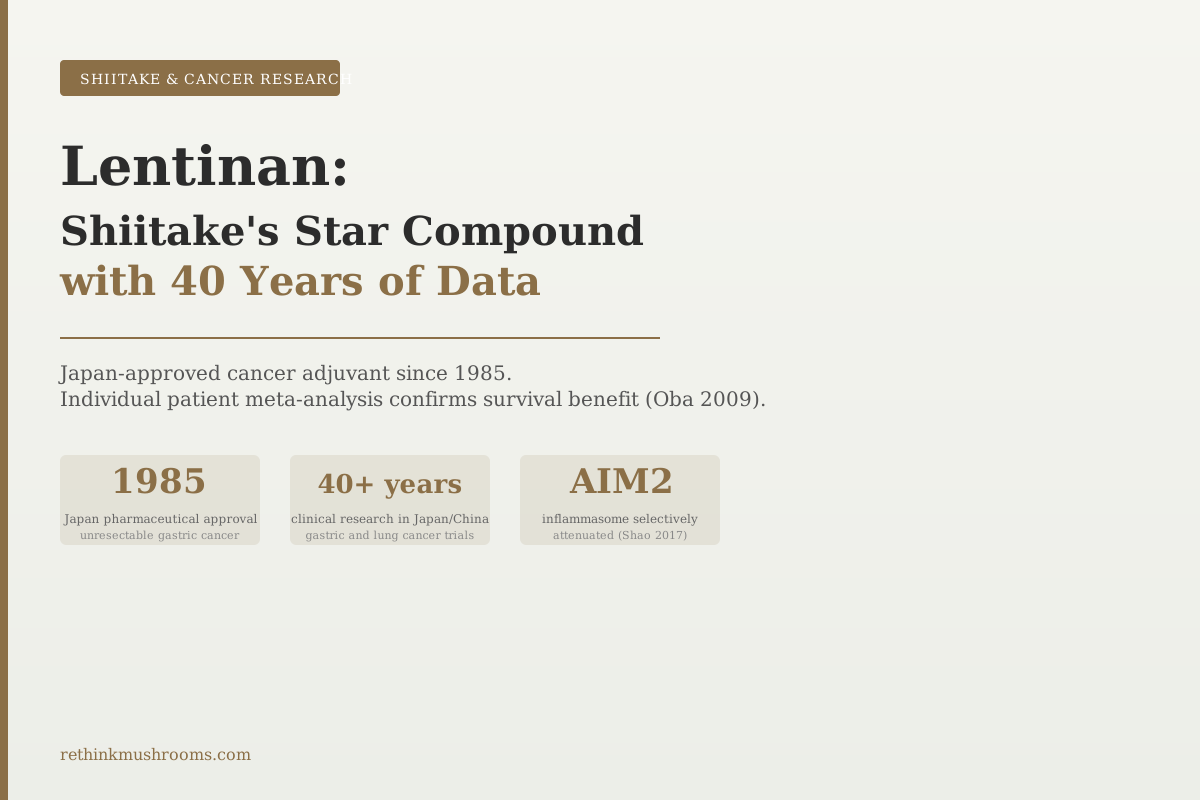
1985
Lentinan became the first mushroom-derived compound approved by Japan's Ministry of Health as an adjuvant for unresectable gastric cancer, after 16 years of research from its discovery by Chihara et al. in 1969.
Zhang et al., J Cancer Res Clin Oncol, 2018; Oba et al., Anticancer Research, 2009
40+ years
continuous clinical research in Japan and China on lentinan for gastric and lung cancers
2009
year of Oba et al. individual patient data meta-analysis confirming survival benefit in gastric cancer
AIM2
inflammasome selectively attenuated by lentinan while preserving cancer-fighting cytokines (Ahn 2017)
Zhang et al., J Cancer Res Clin Oncol, 2018; Oba et al., Anticancer Research, 2009
 View as image ↗
Lentinan is a beta-glucan polysaccharide isolated from the fruiting body of Lentinula edodes, the shiitake mushroom. It is the most clinically studied compound from any culinary mushroom in the world. Its lentinan shiitake research history spans over 40 years, two countries, multiple cancer types, and a formal pharmaceutical approval that most supplement discussions omit. This article traces that history, names the studies, and covers the mechanism that explains why lentinan is used as a cancer adjuvant rather than an immune supplement.
This is a cluster article in the Shiitake series. For a broader introduction to shiitake's three distinct bioactive compound classes (lentinan, eritadenine, and AHCC), see What Is Shiitake Mushroom? The Culinary Mushroom with Medicinal Power.
Key Takeaways
- Lentinan is a beta-1,3-glucan with beta-1,6 branch points, structurally characterized by Ren et al. (2018) using infrared and nuclear magnetic resonance spectroscopy, with the backbone confirmed as responsible for its biological activity.
- Japan's Ministry of Health approved lentinan as a pharmaceutical adjuvant for unresectable gastric cancer in 1985, making it one of the first mushroom compounds to receive formal drug approval anywhere in the world.
- Oba et al. (Anticancer Research, 2009) conducted an individual patient data meta-analysis and found that lentinan combined with chemotherapy significantly improved overall survival in unresectable or recurrent gastric cancer compared to chemotherapy alone.
- Zhang et al. (J Cancer Res Clin Oncol, 2018) reviewed 12 years of clinical studies on lentinan for lung cancer in China, finding consistent improvements in response rates and survival when combined with standard chemotherapy.
- Ahn et al. (Scientific Reports, 2017) identified the mechanism that makes lentinan useful as a cancer adjuvant: it selectively attenuates AIM2 and non-canonical inflammasome activation while preserving pro-inflammatory cytokines, explaining why it activates anti-tumor immunity without causing dangerous systemic inflammation.
- In clinical trials, lentinan is administered intravenously, not orally. Dietary shiitake consumption provides lentinan but at far lower systemic levels than clinical preparations.
What Lentinan Is: A Specific Beta-Glucan with a Confirmed Structure
Beta-glucans are polysaccharides built from glucose units. The specific architecture of those glucose links determines what the molecule does biologically. Lentinan's structure was formally characterized in 2018 by Ren and colleagues, who used infrared spectroscopy and NMR to confirm the beta-1,3-glucan backbone with beta-1,6 branch points that define the compound.[5]
That structural specificity matters. Not all beta-glucans are lentinan. Different beta-glucan sources have different backbone linkages, different degrees of branching, and different molecular weights. These structural variables determine which immune receptors the polysaccharide binds and what downstream effects it produces. Lentinan's beta-1,3 backbone with beta-1,6 branches is the specific architecture associated with its clinical activity. Supplements claiming to provide "shiitake beta-glucans" may or may not contain lentinan at sufficient concentrations or structural integrity to produce the effects documented in clinical trials.
The Ren 2018 study also demonstrated antiviral activity against a fish virus as part of its structural validation work, but that application is separate from the 40-year cancer adjuvant story.[5]
An additional mechanism operates at the molecular anti-inflammatory level. Xu and colleagues showed in 2012 that beta-glucan from Lentinus edodes inhibits nitric oxide and TNF-alpha production in LPS-stimulated macrophages via suppression of MAPK phosphorylation (a signaling cascade that drives inflammation).[6] Nitric oxide and TNF-alpha are pro-inflammatory signaling molecules; their overproduction drives chronic inflammation. The MAPK pathway suppression provides a specific molecular mechanism for anti-inflammatory effects documented in earlier animal and clinical work.
1969 to 1985: From Laboratory Discovery to Pharmaceutical Approval
In 1969, Goro Chihara and colleagues at the National Cancer Center Research Institute in Japan isolated a polysaccharide from shiitake mushrooms that showed significant antitumor activity in animal models. They named it lentinan, derived from the species name Lentinus edodes (the earlier classification for shiitake, now corrected to Lentinula edodes). This discovery paper, published in Nature in 1969, documented inhibition of mouse sarcoma 180 and marked the beginning of the formal research program.[7]
Chihara's group spent the following decade characterizing lentinan's structure and testing it through the research and development pipeline. Ajinomoto, the Japanese food and pharmaceutical company, took on commercial development. The clinical trial program in Japan evaluated lentinan as an adjuvant to chemotherapy for gastric cancer, which was at the time one of Japan's leading causes of cancer death.
In 1985, Japan's Ministry of Health approved lentinan as a pharmaceutical agent for unresectable gastric cancer when combined with chemotherapy. This was not a supplement registration or a health claim approval. It was a pharmaceutical drug approval for a specific clinical indication. The approved administration route was intravenous injection, not oral, and the approved context was adjuvant use alongside established cancer treatment. Zhang and colleagues' 2018 review in the Journal of Cancer Research and Clinical Oncology notes this 1985 approval as the foundation for the subsequent clinical expansion of lentinan research into other cancer types.[1]
The Lentinan Research Timeline: Six Milestones
The clinical history of lentinan organizes into a coherent arc across four decades:
1969: Chihara et al. isolate lentinan from Lentinus edodes and document antitumor activity in animal models (Nature).
1985: Japan's Ministry of Health approves lentinan as a pharmaceutical adjuvant for unresectable gastric cancer combined with chemotherapy.
1990s: China begins its own clinical research program on lentinan, initially for gastric cancer and later expanding to lung cancer.
2009: Oba and colleagues publish an individual patient data meta-analysis in Anticancer Research, confirming survival benefit for lentinan plus chemotherapy in unresectable or recurrent gastric cancer.
2018: Zhang and colleagues review 12 years of Chinese clinical studies, documenting consistent response rate and survival improvements in lung cancer patients treated with lentinan alongside chemotherapy.
2021: Steimbach and colleagues publish a systematic review of RCTs evaluating fungal beta-glucans (including lentinan) as cancer adjuvants, finding quality-of-life and some survival outcome improvements, with the strongest evidence in gastric and lung cancer.
The Oba 2009 Meta-Analysis: What Individual Patient Data Shows
The most rigorous piece of evidence for lentinan's clinical efficacy is the 2009 meta-analysis by Oba and colleagues, published in Anticancer Research.[2]
Oba et al. (2009) · Anticancer Research
- Population
- Patients with unresectable or recurrent gastric cancer (pooled Japanese trials)
- Intervention
- Intravenous lentinan added to standard chemotherapy
- Comparator
- Chemotherapy alone
- Finding
- Pooling patient-level records across trials, lentinan combined with chemotherapy significantly improved overall survival versus chemotherapy alone.
positive Individual patient data meta-analysis is the most rigorous synthesis design; reconstructing patient-level records allows tighter control of confounders than pooling published summary outcomes.
Oba et al., Anticancer Research, 2009 (PMID 19596954) [ref 2]
What makes the Oba analysis methodologically significant is the use of individual patient data rather than aggregate trial-level data. Most meta-analyses summarize published outcomes from each study and pool them. Individual patient data meta-analyses reconstruct the combined dataset from the actual patient records across studies, which allows finer statistical control over confounders and produces more reliable effect estimates.
Oba's group applied this approach to the available Japanese clinical trials of lentinan for unresectable or recurrent gastric cancer. The conclusion was direct: lentinan combined with chemotherapy significantly improved overall survival compared to chemotherapy alone. The survival benefit was clinically meaningful, not a statistical artifact from aggregating inadequate data.
This finding sits atop the evidence hierarchy for lentinan. It is not a press release summary, a single trial, or an animal study extrapolation. It is a rigorous evidence synthesis from patient-level data.
- Cell & Lab Studiescompleted
Structural characterization and mechanism: beta-1,3/1,6-glucan backbone (Ren 2018), selective AIM2 and non-canonical inflammasome attenuation with preserved pro-inflammatory cytokines (Ahn 2017), and MAPK-mediated suppression of nitric oxide and TNF-alpha (Xu 2012)
- Animal Studiescompleted
The founding observation: Chihara et al. (1969) showed lentinan inhibits mouse sarcoma 180, launching the research program
- Case Reports & Early Seriescompleted
Early Japanese clinical use following the 1985 Ministry of Health approval for unresectable gastric cancer
- Small Human Trialscompleted
Multiple Japanese and Chinese randomized trials of intravenous lentinan added to chemotherapy for gastric and lung cancer
- Large Randomized Trialscurrent
12 years of Chinese lung cancer trials reviewed by Zhang et al. (2018) show consistent objective-response-rate improvements; individual large multi-center confirmatory RCTs remain limited
- Meta-Analyses & Systematic Reviewscompleted
Oba et al. (2009) individual patient data meta-analysis confirms a gastric-cancer survival benefit; Steimbach et al. (2021) systematic review corroborates fungal beta-glucan adjuvant benefit, strongest in gastric and lung cancer
Unusually for a mushroom-derived compound, lentinan's cancer-adjuvant evidence reaches the top of the ladder: an individual patient data meta-analysis plus a cross-country systematic review, built on decades of trials and a fully characterized mechanism. The evidence is specific to intravenous pharmaceutical lentinan alongside chemotherapy, not dietary shiitake.
Chihara 1969; Xu 2012; Ahn 2017; Ren 2018; Oba 2009; Zhang 2018; Steimbach 2021
Consumer health content almost universally ignores this study. The Oba 2009 meta-analysis is cited frequently in the oncology and integrative medicine literature but essentially never appears in mushroom supplement marketing or general health content about shiitake. The gap between the available evidence and the public's awareness of it is substantial.
12 Years of Lung Cancer Trials in China: The Zhang 2018 Review
Following the Japan gastric cancer program, China developed its own parallel clinical research program on lentinan, focusing primarily on lung cancer, which has high incidence in Chinese populations.
Zhang and colleagues reviewed the results of this 12-year clinical program in a 2018 paper in the Journal of Cancer Research and Clinical Oncology.[1] Their analysis covered multiple clinical trials conducted in China between the late 1990s and 2010s evaluating lentinan as an adjuvant to standard chemotherapy regimens for lung cancer.
The consistent finding across this body of research was that lentinan combined with chemotherapy improved objective response rates (the proportion of patients showing tumor shrinkage or stabilization) compared to chemotherapy alone. Survival outcomes also showed improvements in multiple studies, though the degree of benefit varied across patient populations and chemotherapy protocols.
The 12-year China lung cancer program represents a substantial clinical dataset that is almost entirely invisible in Western health content. The studies were published primarily in Chinese medical journals, and the review itself, while in English, receives far fewer citations in English-language consumer content than its evidence base warrants.
Steimbach and colleagues' 2021 systematic review of fungal beta-glucan RCTs corroborates this evidence base, concluding that the best-documented cancer applications for fungal beta-glucans including lentinan are gastric and lung cancers, consistent with the geographic distribution of clinical research.[3]
The Mechanism That Makes Lentinan Useful as a Cancer Adjuvant
Understanding why lentinan works alongside chemotherapy requires understanding what makes it biologically unusual among immune-activating compounds.
Standard immunostimulatory compounds activate the immune system broadly. Broadly activated immune systems produce cytokine storms (dangerous overproduction of inflammatory signals) and can cause autoimmune effects. These risks make many immune-activating compounds impractical in cancer patients who are already immunocompromised from chemotherapy.
Lentinan does not appear to work this way. Ahn and colleagues published in Scientific Reports in 2017 that lentinan selectively attenuates AIM2 inflammasome and non-canonical inflammasome activation while simultaneously inducing pro-inflammatory cytokine production.[4]
The AIM2 inflammasome is a molecular complex that activates intense inflammatory responses, including processes that can cause cell death in normal tissues and dangerous systemic inflammation. Suppressing this pathway reduces the risk of excessive inflammation. The non-canonical inflammasome pathway is involved in similar systemic inflammatory cascades.
Simultaneously, lentinan promotes the production of specific pro-inflammatory cytokines (signaling molecules that recruit and activate immune cells against tumors). The net effect is immune activation targeted at cancer cells without the systemic inflammation that makes broad immunostimulation dangerous.
In practical terms: lentinan appears to be a precision immunomodulator rather than a general immunostimulant. It enhances the cancer-fighting functions of the immune system through one pathway while suppressing the pathways that would cause dangerous collateral inflammatory effects. This selectivity profile helps explain why lentinan has been tolerated in cancer patients across multiple clinical trials without causing the severe immune-related adverse events associated with some modern immunotherapy agents.
This Ahn 2017 finding is almost never discussed in consumer health or supplement content about shiitake. It is the mechanism that answers the question "why can you use an immune-activating compound alongside chemotherapy without causing harm?" and it has been published for nearly a decade without appearing in mainstream health coverage.
For detailed coverage of how lentinan enhances anti-tumor immune responses at the cellular level, see How Lentinan Enhances Anti-Tumor Immunity. The survival synergy with chemotherapy is examined in Lentinan and Chemotherapy: Synergistic Effects on Survival.
Can You Get Clinical-Level Lentinan from Eating Shiitake Mushrooms?
This question appears as a FAQ because it reflects a genuine practical concern. The clinical trials that produced the survival outcomes reviewed above used intravenous lentinan, not dietary shiitake consumption.
Intravenous delivery bypasses the gastrointestinal tract and delivers a precisely quantified dose of structurally intact lentinan directly into the bloodstream. Typical clinical doses in the Japanese and Chinese trials were 1-2 mg administered IV, usually three times per week. This delivery method was chosen specifically because lentinan's large molecular size and beta-glucan structure make it challenging to absorb intact through the intestinal wall.
Eating shiitake mushrooms does provide dietary lentinan. A 2015 dietary RCT led by Dai and colleagues (covered in depth in the pillar article and in the culinary tradition article) showed that eating 5-10g of dried shiitake per day for 4 weeks produced measurable immune improvements, including increased NK cell activity and improved secretory IgA, in healthy adults.[8] This demonstrates that food-level shiitake consumption has some systemic immunological effect.
However, the magnitude and nature of that dietary effect differ from the clinical effects documented in intravenous cancer adjuvant trials. Food-level consumption and pharmaceutical IV administration are different interventions producing different systemic lentinan exposures. Whether oral shiitake consumption at dietary levels produces cancer-relevant immune effects is a separate research question from whether IV lentinan improves gastric cancer survival alongside chemotherapy. The answer to the second question is supported by an individual patient data meta-analysis. The answer to the first question remains under investigation.
Medical Context
ModerateLentinan's cancer evidence is for an intravenous drug given with chemotherapy, not a supplement
Concern
The survival and response-rate results described here come from pharmaceutical intravenous lentinan administered alongside conventional chemotherapy in oncology settings. None of this evidence supports using shiitake supplements or extracts in place of oncologist-directed cancer treatment, and dietary intake produces far lower systemic lentinan exposure than the clinical preparations.
What the research says
If you are in cancer care, treat any shiitake or lentinan product as a supplement to discuss with your oncology team, not a substitute for treatment. Immune-active compounds can interact with therapy and warrant clinician oversight.
Particularly relevant for: Anyone undergoing or considering cancer treatment
What to do
Talk to your oncologist before adding any mushroom, beta-glucan, or lentinan product during treatment. This article is educational and is not medical advice.
Oba et al., 2009 (PMID 19596954); Steimbach et al., 2021 systematic review (PMID 33309412)
The Bottom Line
Lentinan is a beta-1,3-glucan with beta-1,6 branch points isolated from shiitake mushrooms. Japan approved it as a pharmaceutical cancer adjuvant in 1985, the culmination of a research program that began with Chihara's 1969 discovery paper. The Oba 2009 individual patient data meta-analysis confirmed that lentinan combined with chemotherapy significantly improved overall survival in unresectable gastric cancer. Zhang 2018 reviewed 12 years of Chinese clinical research showing consistent response rate improvements in lung cancer. The mechanism involves selective AIM2 inflammasome attenuation alongside pro-inflammatory cytokine activation (Ahn et al., 2017), explaining the precision immunomodulation that makes it safe as a cancer adjuvant. In clinical trials, lentinan is administered intravenously; dietary shiitake provides lentinan but at different systemic exposure levels than clinical preparations.
Frequently Asked Questions
Sources & References
- 1. Source details for this reference are not yet available.
- 2. Source details for this reference are not yet available.
- 3. Source details for this reference are not yet available.
- 4. Source details for this reference are not yet available.
- 5. Source details for this reference are not yet available.
- 6. Source details for this reference are not yet available.
- 7. Source details for this reference are not yet available.
- 8. Source details for this reference are not yet available.