Shiitake (Lentinula edodes)
1985 Japan drug approval
Lentinan, derived from shiitake, became Japan's first mushroom-derived pharmaceutical drug approved as a cancer adjuvant in 1985. A dietary RCT 30 years later confirmed that eating shiitake regularly produces measurable immune changes.
Zhang et al., Journal of Cancer Research and Clinical Oncology, 2018
5-10g
dried shiitake daily for 4 weeks improved NK cell activity, T-cell proliferation, and IgA while reducing CRP in 52 healthy adults (Percival 2015)
40 years
of lentinan clinical trials in Japan and China, culminating in the Oba 2009 individual patient meta-analysis confirming survival benefit in gastric cancer
960 AD
approximate date of the earliest documented use of shiitake as medicine, in texts from the Song Dynasty period in China
Zhang et al., Journal of Cancer Research and Clinical Oncology, 2018
 View as image ↗
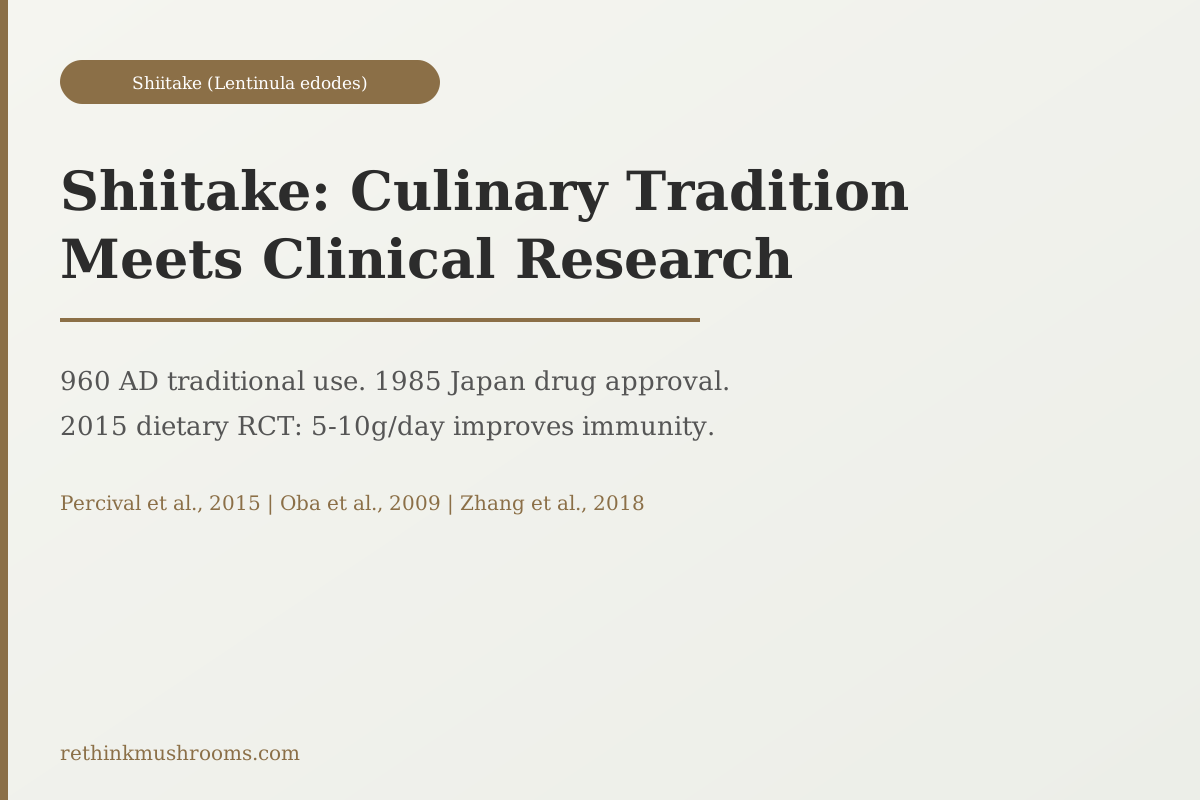
Shiitake (Lentinula edodes) has the most documented medicinal history of any culinary mushroom. Written records of its use as medicine appear in Chinese texts from the Song Dynasty, around 960 AD. In 1985, Japan's Ministry of Health approved a shiitake-derived compound as a cancer treatment drug. In 2015, a randomized dietary trial confirmed that healthy adults who ate 5-10 grams of dried shiitake daily for four weeks showed measurable improvements in immune markers.
The distance from "Song Dynasty herbal record" to "randomized controlled trial" to "pharmaceutical approval" took approximately 1,000 years. Few foods have a research arc of that length.
This article traces that arc and explains where the clinical evidence now stands. For the complete compound-by-compound pharmacology, see What Is Shiitake Mushroom? The Culinary Mushroom with Medicinal Power.
Key Takeaways
- Shiitake has the longest documented history of medicinal use of any widely consumed culinary mushroom, with texts from approximately 960 AD describing its health properties in China
- In 2015, a double-blind randomized dietary trial in 52 healthy adults found that eating 5-10g dried shiitake daily for 4 weeks increased NK cell activity, improved T-cell proliferation and secretory IgA, and reduced CRP (Percival et al., 2015)
- Lentinan, a beta-glucan extracted from shiitake, was approved as a cancer adjuvant in Japan in 1985; an individual patient meta-analysis (Oba et al., 2009) confirmed it improved overall survival in unresectable or recurrent gastric cancer when combined with chemotherapy
- A 12-year review of clinical use in China found lentinan combined with chemotherapy improved response rates and survival in lung cancer patients; the review covered trials from the 1990s through 2018 (Zhang et al., 2018)
- Cooking method significantly affects shiitake's bioactive compound profile: some cooking methods preserve more beta-glucans than others, and drying under UV exposure increases vitamin D2 content (Guo et al., 2017)
- Shiitake contains three pharmacologically distinct active compound classes: lentinan (beta-glucan, cancer adjuvant), eritadenine (cholesterol-lowering nucleoside), and AHCC (alpha-glucan complex, different compound from lentinan)
1,000 Years Before the Clinical Trial: Song Dynasty to Showa Japan
The earliest known written account of shiitake as medicine dates to the Song Dynasty period in China (960-1279 AD), where texts describe the mushroom as beneficial for energy and longevity. By the Edo period in Japan (1603-1868 AD), shiitake cultivation was well-established, with records indicating it was grown on oak logs and used both as food and as medicine in traditional practice.
This historical use is not itself scientific evidence. Traditional use tells us a substance was considered beneficial; it does not confirm that benefit through controlled testing. But it does establish a baseline: shiitake was significant enough in Asian medical traditions to be cultivated, distributed, and recorded over centuries before any laboratory ever analyzed what was inside it.
What traditional practitioners were using was primarily the whole mushroom, dried or cooked. The specific compounds responsible for any benefits were not understood. That understanding began to develop in the 20th century, when Japanese food scientists and pharmacologists began isolating shiitake's active components.
1969 to 1985: When a Traditional Food Became a Pharmaceutical
The key step from traditional food to pharmaceutical began in 1969, when Dr. Goro Chihara at the Japanese National Cancer Center isolated an antitumor polysaccharide from Lentinus edodes. He named it lentinan. This extraction established that shiitake contained a specific, purifiable compound with measurable antitumor effects in animal models.
Chihara's discovery launched a clinical program. Over the following 15 years, researchers at multiple Japanese institutions tested lentinan as an adjuvant to standard chemotherapy in gastric cancer patients. Gastric cancer was one of the leading causes of cancer mortality in Japan at the time, and the hypothesis was that lentinan's immune-activating properties could enhance the effectiveness of chemotherapy.
In 1985, Japan's Ministry of Health approved lentinan as a pharmaceutical drug for use as an adjuvant in gastric cancer chemotherapy. This was the first time a mushroom-derived compound had been approved as a cancer drug in any major regulatory system. The lentinan pharmaceutical product was administered intravenously, not as a food supplement.
The approval was based on trial data showing improved patient outcomes. The landmark synthesis of that data came from Oba and colleagues' individual patient meta-analysis published in 2009.[2]
The Oba 2009 Meta-Analysis: Confirming Survival Benefit
Individual patient data meta-analyses are considered among the highest-quality evidence in clinical research because they use raw data from individual participants rather than summary statistics from published trials. Oba and colleagues assembled individual patient data from multiple lentinan gastric cancer trials and analyzed whether lentinan combined with chemotherapy improved overall survival compared to chemotherapy alone in patients with unresectable or recurrent gastric cancer.
The finding: lentinan plus chemotherapy significantly improved overall survival compared to chemotherapy alone.[2]
This is why the 1985 Japanese approval has lasted. The drug was approved when clinical evidence standards were different; the Oba 2009 meta-analysis confirmed using contemporary methodology that the original clinical observation was real.
The lentinan clinical program then expanded to China. Zhang and colleagues published a 12-year review of lentinan use for lung cancer in China, covering trials from the 1990s through 2018.[4] The review found that lentinan combined with chemotherapy improved response rates and survival in lung cancer patients. The scale of this clinical experience in China is substantial: lentinan has been tested in thousands of cancer patients across these trials.
For the full history and mechanism of the lentinan compound, see Lentinan: Shiitake's Star Compound and Its 40-Year Research History.
The 2015 Dietary Study: What Happens When Healthy People Eat Shiitake Daily
The lentinan pharmaceutical program used intravenous administration. The drug compound was purified and injected. This raises the question that the pharmaceutical history does not answer: does eating shiitake as food produce any of the same effects?
Percival and colleagues (2015) conducted the most carefully designed dietary study of this question published to date.[1] They enrolled 52 healthy young adults in a randomized dietary intervention and assigned participants to consume 5-10 grams of dried shiitake mushrooms daily for four weeks. The study was double-blind for the immune assessment measures.
The immune effects measured at the end of four weeks compared to baseline:
- Natural killer (NK) cell activity increased
- T-cell proliferation improved
- Secretory immunoglobulin A (IgA) levels increased
- C-reactive protein (CRP) decreased
NK cells are the immune system's primary front-line response to viral infection and tumor surveillance. T cells coordinate adaptive immune responses. Secretory IgA is the body's main mucosal defense protein, present in saliva, gut lining, and respiratory secretions. CRP is a marker of systemic inflammation. Improvements across all four of these measures from dietary intake is a finding that no comparable study had previously demonstrated for shiitake.
The dose matters here. 5-10 grams of dried shiitake daily is achievable as a regular dietary habit. It corresponds to roughly 50-100 grams of fresh shiitake. The study was testing culinary amounts, not supplement doses.
For a deeper look at the Percival 2015 study design and findings, see Eating Shiitake Daily Boosts Immunity: The Landmark 2015 Study.
Cooking Shiitake: Which Methods Best Preserve the Bioactives
Guo and colleagues (2017) studied the effect of different cooking methods on shiitake's nutritional profile and antioxidant activity.[3] Several findings are practically relevant:
Cooking method significantly affects antioxidant activity. The study found variation across boiling, steaming, microwaving, and stir-frying in terms of how much of the original antioxidant capacity was preserved. Some methods involve significant water loss of water-soluble compounds; others preserve more.
Drying under UV exposure increases vitamin D2 content. Shiitake, like most fungi, converts ergosterol to vitamin D2 when exposed to ultraviolet light. Dried shiitake that has been sun-dried or UV-treated can be a meaningful dietary source of vitamin D. This is not a property of fresh shiitake kept away from sunlight or dried without UV exposure.
Lentinan is a large polysaccharide molecule. Water-based cooking extracts it into the cooking liquid to some degree. This means shiitake broth or shiitake cooking water retains some of the beta-glucan content that would otherwise remain in the mushroom tissue.
The practical implication is that preparation method is not irrelevant to the biological activity of shiitake consumed as food. Traditional uses that involve long simmering (dashi stocks, soups) may extract beta-glucans effectively. Stir-frying at high heat for short periods may preserve antioxidant capacity while retaining structural compounds.
Three Compound Classes, Three Evidence Stories
Shiitake's bioactive profile is more varied than any competitor's coverage reflects. The research history spans three distinct compound classes, each with its own evidence base:
Lentinan is a beta-(1,3)-glucan extracted from shiitake fruiting bodies. It has the strongest and most extensively tested evidence base, including pharmaceutical approval in Japan and 40 years of clinical trials. However, the pharmaceutical evidence is for intravenous administration in cancer patients, not dietary consumption in healthy people.
Eritadenine is a nucleoside unique to shiitake that promotes cholesterol removal through a pathway distinct from statin medications. The human evidence is limited to a small number of trials. Unlike lentinan, eritadenine is active in the digestive system and is relevant to dietary intake rather than requiring pharmaceutical extraction.
AHCC (Active Hexose Correlated Compound) is an alpha-glucan complex derived from shiitake mycelium. It is a different compound from lentinan, not the same thing with a different name. AHCC has its own clinical trial literature, primarily for immune support in various settings. Some commercial products market AHCC as synonymous with lentinan; they are not the same compound.
For the full compound-level analysis, see Shiitake Bioactive Compounds: Lentinan, Eritadenine, and Beyond. For the mechanistic pharmacology, see The Pharmacology of Lentinula edodes: How Shiitake Works.
The Bottom Line
Shiitake has the most documented clinical and traditional use history of any widely consumed culinary mushroom. Traditional records date to approximately 960 AD. The isolation of lentinan in 1969 launched a clinical program that led to Japan's pharmaceutical approval of lentinan as a cancer adjuvant in 1985, confirmed by the Oba 2009 individual patient meta-analysis. The Percival 2015 dietary RCT established that regular dietary consumption of 5-10g dried shiitake daily for four weeks produces measurable immune improvements in healthy adults. Cooking method affects bioactive preservation, with UV-dried shiitake providing vitamin D2 and water-based cooking extracting beta-glucan compounds. Shiitake's three distinct bioactive compound classes (lentinan, eritadenine, AHCC) each have different evidence bases and applications.
Frequently Asked Questions
Sources & References
- 1. Source details for this reference are not yet available.
- 2. Source details for this reference are not yet available.
- 3. Source details for this reference are not yet available.
- 4. Source details for this reference are not yet available.