Shiitake Foundation & Science
1985 year lentinan was approved as a cancer drug in Japan
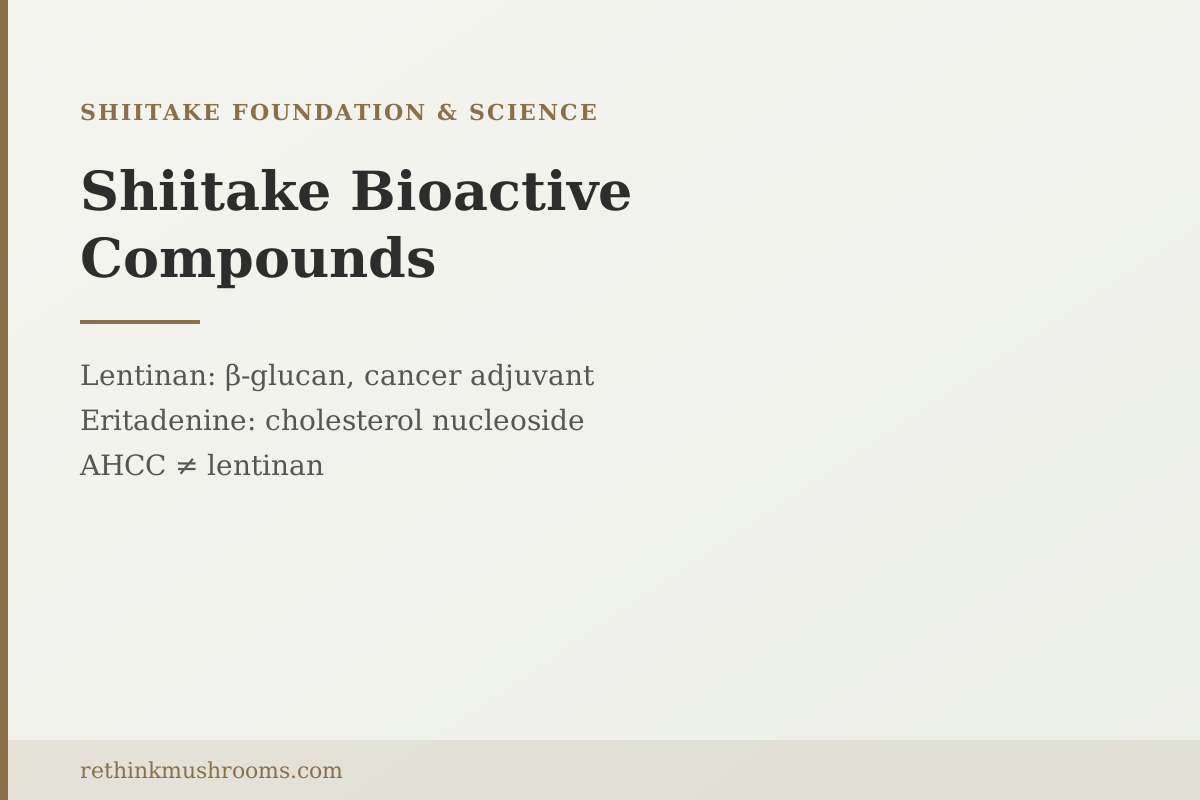
Lentinan, shiitake's β-glucan fraction, was approved by Japan's Ministry of Health as a cancer adjuvant in 1985 — making it one of the few food-derived compounds to achieve pharmaceutical approval.
Zhang et al., J Cancer Res Clin Oncol, 2018
β-(1,3)-glucan
lentinan's molecular backbone — distinct from the alpha-glucan in AHCC
Strain-variable
eritadenine content differs significantly between shiitake strains and cultivation methods
Mycelium vs. fruiting body
AHCC comes from mycelium; lentinan comes from the fruiting body — not the same compound
Zhang et al., J Cancer Res Clin Oncol, 2018
 View as image ↗
Most coverage of shiitake treats its health properties as a single category: "medicinal mushroom, good for immunity." That framing misses something important. Shiitake contains at least three pharmacologically distinct compound classes, each with its own structure, mechanism, and evidence base — and they are frequently confused with each other in both consumer content and supplement marketing.
Lentinan is a specific beta-glucan extracted from shiitake's fruiting body, with a 40-year clinical research history and pharmaceutical approval in Japan. Eritadenine is a unique nucleoside — a small nitrogen-containing molecule — that affects cholesterol metabolism through a mechanism completely different from statins. AHCC (Active Hexose Correlated Compound) is an alpha-glucan complex made from shiitake mycelium, not the fruiting body, with its own separate evidence base that is often incorrectly described as interchangeable with lentinan.
Understanding these distinctions matters for anyone trying to match a specific product to a specific mechanism or research outcome.
For a broader overview of what shiitake is and its overall evidence landscape, see What Is Shiitake Mushroom? The Culinary Mushroom with Medicinal Power.
Key Takeaways
- Lentinan is a β-(1,3)-glucan polymer extracted from shiitake fruiting body; its molecular backbone structure has been confirmed by structural characterization (Chen et al., 2018) and it is pharmacologically distinct from AHCC, which is an alpha-glucan from shiitake mycelium.
- Lentinan selectively modulates the AIM2 inflammasome and non-canonical inflammasome pathways while preserving pro-inflammatory cytokine production — explaining how it functions as a cancer adjuvant without causing dangerous immune overactivation (Shao et al., Oncotarget, 2017).
- Eritadenine, a nucleoside unique to shiitake, lowers cholesterol by enhancing the body's removal of LDL rather than blocking its synthesis — a mechanistically different approach from statins (Sugano et al., 1987); its content varies significantly between shiitake strains (Enman et al., 2007).
- Preparation method affects eritadenine content: heat stress during cultivation significantly alters eritadenine synthesis, and drying conditions modulate the final amount in the mushroom (2021 in-vitro data).
- Beta-glucan fractions extracted from the same shiitake using different methods produce distinct gene-expression profiles in human immune cells — the same mushroom can produce biologically different preparations depending on how it is extracted (Kozarski et al., 2020).
- AHCC comes from shiitake mycelium and is an alpha-glucan complex; lentinan comes from the fruiting body and is a beta-glucan. They have different structures, different sources, and different evidence bases — treating them as synonyms is an error common in consumer content.
Lentinan: The Beta-Glucan Behind Japan's First Approved Mushroom Drug
Lentinan's story begins with its structure. Chen and colleagues, in a 2018 structural characterization study, confirmed that lentinan has a beta-(1,3)-glucan backbone with beta-(1,6) branch points.[5] In plain terms: lentinan is a long chain of glucose molecules linked in a specific three-dimensional configuration that human enzymes cannot digest but immune cells can recognize.
That structural distinction is not incidental — it is the foundation of lentinan's pharmacology. Human immune cells have receptors (specifically Dectin-1 and certain Toll-like receptors) that detect this specific beta-glucan structure and interpret it as a signal to become more active. When lentinan binds to these receptors, it activates macrophages (the patrol cells that survey for threats), boosts natural killer cell activity (the cells that eliminate infected or malignant cells), and enhances T-cell proliferation.
This immune activation mechanism is why lentinan attracted pharmaceutical attention. Japanese researchers at Ajinomoto developed a purified lentinan injection that went through clinical trials in the 1970s and 1980s. Japan's Ministry of Health approved lentinan as an adjuvant treatment for gastric cancer in 1985, making it one of the earliest food-derived compounds to achieve pharmaceutical regulatory status. Clinical use expanded through the 1990s and 2000s, and a 12-year review of lentinan's use in Chinese lung cancer trials documented consistent improvements in response rates and survival when lentinan was combined with standard chemotherapy.
The key word there is "adjuvant" — lentinan is used alongside chemotherapy, not as a replacement. Its role is to enhance the immune response to cancer cells that the chemotherapy is already attacking.
One important technical note for anyone comparing products: the pharmaceutical lentinan used in cancer trials is administered intravenously. Oral bioavailability of lentinan is limited because the large polymer molecule is partially degraded during digestion before it reaches circulation. Products based on whole shiitake or oral lentinan extracts may activate some local gut immunity via the digestive-tract-associated immune system, but the systemic effects documented in IV cancer trials should not be assumed to transfer directly to oral supplement use.
How Lentinan Triggers Immunity Without Causing Runaway Inflammation
One of the most pharmacologically interesting findings in recent lentinan research is that its immune activation is selective rather than broad — and Shao and colleagues showed why in a 2017 study published in Oncotarget.[4]
Your immune system contains multiple distinct alarm systems. One family is called inflammasomes — large protein complexes inside cells that detect specific threats and trigger an inflammatory cascade when activated. Different inflammasomes respond to different danger signals. The AIM2 inflammasome, for example, responds to foreign DNA inside cells. The non-canonical inflammasome responds to certain bacterial toxins.
Shao's team found that lentinan selectively suppresses the AIM2 and non-canonical inflammasome pathways while simultaneously promoting production of pro-inflammatory cytokines (the signaling molecules that summon immune cells to a site of threat).
This is a pharmacologically precise profile. If lentinan broadly activated all inflammasomes, it could trigger the kind of cytokine overproduction that becomes damaging — the immune equivalent of a building-wide fire alarm going off when you only wanted to address a small fire in one room. Instead, it appears to preferentially activate the immune response pathways useful in cancer contexts (cytokine signaling, NK cell activation) while dampening the specific alarm pathways associated with autoimmune-type collateral damage.
This selectivity profile helps explain why lentinan has been tolerable in clinical use as a cancer adjuvant rather than causing the inflammatory side effects you might expect from broad immune activation.
Zheng and colleagues provided a complementary mechanistic picture in 2012: shiitake beta-glucans inhibit MAPK phosphorylation (a signaling pathway inside cells that amplifies inflammation signals), reducing the production of nitric oxide and TNF-alpha in stimulated macrophages.[3] Nitric oxide is a pro-inflammatory signaling molecule, and TNF-alpha is one of the primary cytokines that drives chronic inflammation. Reducing both while still activating immune surveillance represents a nuanced anti-inflammatory profile, not simply immune suppression.
For a deeper look at the pharmacology across shiitake's full mechanism landscape, see The Pharmacology of Lentinula edodes: How Shiitake Works.
Eritadenine: The Cholesterol Nucleoside That Works Differently From Statins
Eritadenine is structurally unrelated to lentinan. It is not a polysaccharide at all — it is a small nucleoside molecule, a compound built around a purine base with a sugar-alcohol chain attached. It is found uniquely in shiitake mushrooms and is not present in other common culinary fungi.
Sugano and colleagues established eritadenine's cholesterol-lowering effects in a 1987 animal study that remains one of the founding references in shiitake pharmacology.[7] In spontaneously hypertensive rats, shiitake administration lowered plasma lipids. The mechanism they identified differed fundamentally from how statins work.
Statins lower cholesterol by inhibiting an enzyme called HMG-CoA reductase, which is the rate-limiting step in the liver's production of cholesterol. The liver makes less cholesterol.
Eritadenine works differently. It enhances the activity of an enzyme involved in phosphatidylcholine metabolism — phosphatidylcholine is a fat molecule that plays a central role in moving LDL cholesterol from the blood into cells for processing. Rather than blocking the liver from producing cholesterol, eritadenine helps accelerate the body's existing mechanism for clearing it. More LDL gets taken up and processed; circulating levels fall.
This mechanistic distinction has two implications. First, the two approaches potentially complement each other rather than duplicate each other — someone using a statin who also eats shiitake regularly would be getting cholesterol reduction through two independent mechanisms. Second, eritadenine's pathway does not depend on the same liver enzyme as statins, which means people with statin-related side effects or contraindications are not necessarily excluded from any potential eritadenine benefit.
The human clinical evidence for eritadenine specifically remains limited. Most evidence is from animal models including the Sugano 1987 study. The cholesterol effects documented in animal research have not been replicated at scale in human trials, so this mechanism, while biologically supported, has not cleared the bar of human clinical confirmation.
Enman and colleagues, in a 2007 analytical chemistry study, provided important context: eritadenine content varies significantly between shiitake strains and can be quantified reliably using validated methods.[1] This means that not all shiitake products contain the same amount of eritadenine — strain selection and cultivation practices matter.
How Preparation Affects Eritadenine Content
The eritadenine in a shiitake mushroom is not fixed. A 2021 in-vitro study found that heat stress during cultivation significantly alters eritadenine synthesis, and that different drying and cooking conditions can modulate the final eritadenine concentration in the mushroom.[2]
This has practical relevance. Eritadenine is a relatively heat-stable compound, but the conditions under which mushrooms are grown and processed affect how much of it they contain before any preparation begins. A shiitake grown under heat stress conditions may have a different eritadenine profile than one grown at cooler temperatures. Dried shiitake, which undergoes UV exposure during drying, increases vitamin D content — but the drying temperature and conditions independently affect eritadenine.
The broader point is that "shiitake" as a category encompasses a wide range of actual compound profiles depending on strain, cultivation method, harvest timing, and processing. A supplement or food product's compound content is not predictable from the species name alone.
For a related angle on how preparation affects cholesterol-relevant compounds, see Eritadenine in Shiitake: The Unique Cholesterol-Lowering Nucleoside.
AHCC vs. Lentinan: Why They Are Not the Same Thing
AHCC (Active Hexose Correlated Compound) is a product category that frequently appears in discussions alongside lentinan, often treated as synonymous or interchangeable. It is neither.
Lentinan is a beta-glucan: its glucose chains are linked with beta-type bonds, which create the specific three-dimensional structure that immune receptors recognize. It comes from shiitake's fruiting body.
AHCC is an alpha-glucan complex: its glucose chains are linked with alpha-type bonds, producing a structurally different molecule. It is produced from shiitake mycelium that has been subjected to extended liquid cultivation and enzyme treatment. The production process creates a complex of partially hydrolyzed alpha-glucans.
Different bond structures produce different biological recognition patterns. The Dectin-1 receptors that respond to beta-glucans do not bind alpha-glucans in the same way. AHCC has its own separate research base for immune support, including some human RCT data, but its mechanism and the receptors it engages are distinct from lentinan's.
The confusion persists because both are marketed as "shiitake immune compounds" and both have immune-related evidence. But citing a lentinan study to support an AHCC product, or vice versa, is not scientifically valid. They are different compounds with different structures, different source materials, and different mechanisms.
Why the Same Mushroom Can Produce Different Biological Preparations
Kozarski and colleagues demonstrated something counterintuitive in a 2020 in-vitro study: beta-glucan fractions extracted from the same shiitake mushroom using different extraction methods produced distinct gene-expression profiles when applied to human immune cells.[6]
The same starting material. Different extraction protocol. Different biological effect in human cells.
This finding has significant implications for how to interpret shiitake research and product claims. It means there is no single "shiitake beta-glucan" — there are many possible fractions depending on how you extract them, and the biological activity of one fraction may not transfer to another even when both come from the same mushroom. A hot water extraction, an ethanol extraction, and an enzymatic extraction of the same shiitake batch will produce compound profiles with different molecular weights, branching patterns, and solubility characteristics — and different effects in immune assays.
This is why the specific compound (lentinan vs. AHCC vs. whole mushroom extract), the extraction method, and the source material all matter when evaluating shiitake products. "Contains shiitake" tells you very little about which bioactive compounds are present and at what concentration.
For what to look for in shiitake products specifically, see Lentinan: Shiitake's Star Compound and Its 40-Year Research History. For context on how similar extraction principles apply across mushroom species, see Reishi Bioactive Compounds: Triterpenes, Polysaccharides, and Sterols.
The Bottom Line
Shiitake contains three pharmacologically distinct compound classes that are frequently conflated in consumer content. Lentinan is a β-(1,3)-glucan from the fruiting body with a selective immune activation mechanism (AIM2 inflammasome suppression, NK cell enhancement) and pharmaceutical approval in Japan as a cancer adjuvant. Eritadenine is a nucleoside unique to shiitake that lowers cholesterol by enhancing LDL clearance rather than blocking synthesis — a different mechanism from statins, with strain-dependent content variation and heat-sensitive synthesis. AHCC is an alpha-glucan complex from shiitake mycelium with a separate evidence base and structurally distinct mechanism. Extraction method further differentiates which bioactive fractions any given preparation contains, meaning "contains shiitake" provides minimal information about what is actually pharmacologically active in a product.
Frequently Asked Questions
Sources & References
- 1. Source details for this reference are not yet available.
- 2. Source details for this reference are not yet available.
- 3. Source details for this reference are not yet available.
- 4. Source details for this reference are not yet available.
- 5. Source details for this reference are not yet available.
- 6. Source details for this reference are not yet available.
- 7. Source details for this reference are not yet available.