Shiitake & Immunity
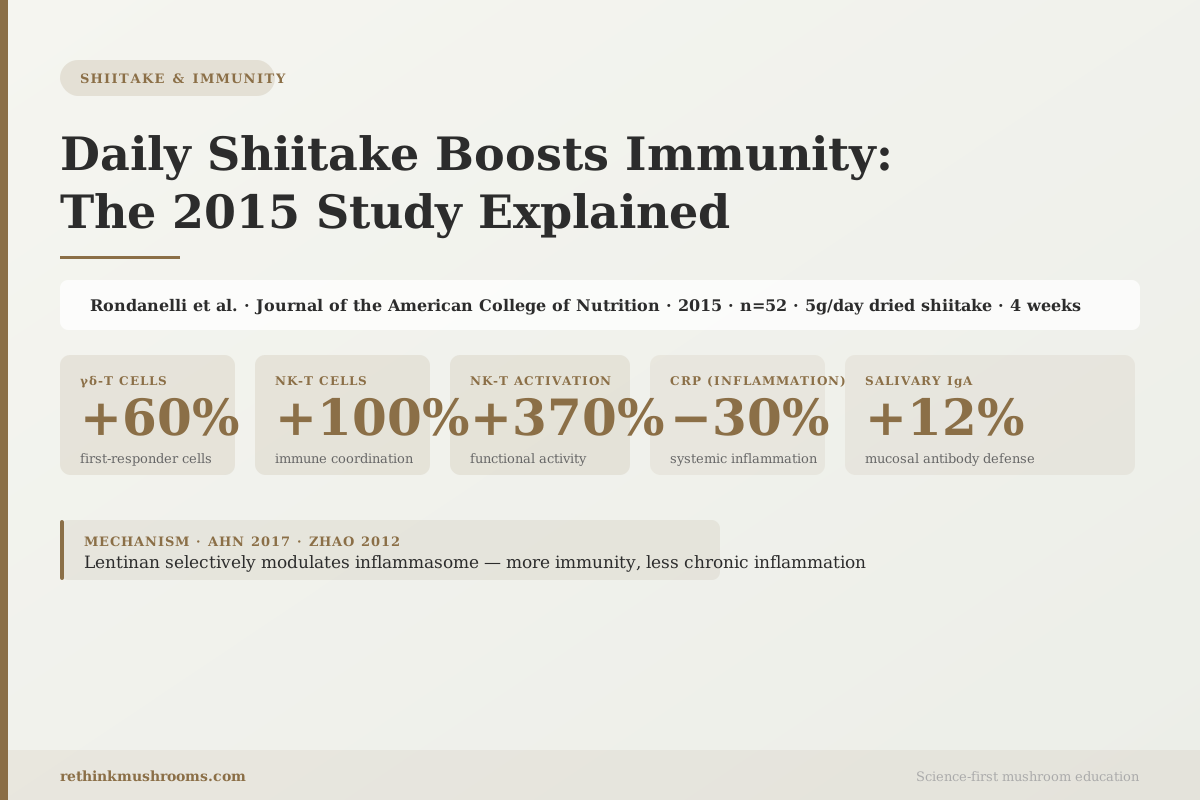
+60% γδ-T cell proliferation, NK-T cells doubled
52 healthy adults aged 21-41 ate 5 g or 10 g of dried shiitake daily for 4 weeks. Ex vivo γδ-T cell proliferation increased 60% (p < 0.0001), NK-T cells doubled (p < 0.0001), activation receptor expression rose for both populations, secretory IgA in saliva rose, CRP fell, and the cytokine pattern shifted toward higher IL-4, IL-10, TNF-α, IL-1α and lower MIP-1α/CCL3. The study had no placebo or no-treatment arm.
Dai et al., Journal of the American College of Nutrition, 2015
n=52
healthy adults aged 21-41 in a 4-week parallel-group dietary intervention
5 or 10 g/day
dried shiitake consumed daily; 5 g ≈ 4-5 medium fresh shiitake
No placebo
the study compared 5 g vs 10 g, not vs an inactive control
Dai et al., Journal of the American College of Nutrition, 2015
 View as image ↗
A 2015 dietary intervention recruited 52 healthy adults, randomized them between two daily mushroom doses (5 g or 10 g of dried shiitake) over four weeks, and measured their immune systems before and after. The trial did not include a placebo or no-treatment arm — both groups consumed shiitake.
The results were clear enough that the study has since been cited in dozens of subsequent papers on food and immunity. Ex vivo γδ-T cell proliferation, the response of cells that act as first-line tissue-surface defenders, increased 60% (p < 0.0001). NK-T cells, hybrid cells that coordinate immune attack, doubled (p < 0.0001). Both cell types showed greater ability to express activation receptors. Secretory IgA in saliva rose. CRP in serum fell. The cytokine secretion pattern shifted toward higher IL-4, IL-10, TNF-α, and IL-1α, with lower MIP-1α/CCL3.
The paper noted two limitations: the absence of a placebo or no-treatment arm, and no measurable difference in self-reported illness burden between the 5 g and 10 g serving sizes.
This article explains what each of those findings means biologically, what the mechanism behind them is, and what the study can and cannot tell you.
For an overview of shiitake's full range of documented bioactive compounds, see What Is Shiitake Mushroom? The Culinary Mushroom with Medicinal Power.
Key Takeaways
- A 2015 dietary intervention (Dai et al., n=52, healthy adults aged 21-41) had participants consume either 5 g or 10 g of dried Lentinula edodes daily for 4 weeks; the trial had no placebo or no-treatment arm
- Ex vivo γδ-T cell proliferation increased 60% (p < 0.0001) and NK-T cell counts approximately doubled (p < 0.0001) after 4 weeks of daily shiitake consumption; both cell populations also showed greater activation receptor expression
- Secretory IgA in saliva rose, serum C-reactive protein (CRP) fell, and the cytokine pattern shifted toward higher IL-4, IL-10, TNF-α, and IL-1α with lower MIP-1α/CCL3
- The simultaneous immune-cell activation and CRP/MIP-1α reduction is consistent with lentinan acting as an immunomodulator rather than a one-directional immunostimulant
- The mechanistic literature supports this: in mouse macrophages, lentinan selectively inhibits the AIM2 inflammasome (Ahn 2017) and inhibits LPS-induced nitric oxide and TNF-α via JNK1/2 and ERK1/2 inhibition (Xu 2012)
- 5 g of dried shiitake corresponds to roughly 40-50 g of fresh shiitake, or approximately 4-5 medium fresh mushrooms; the study reported no measurable difference in self-reported illness between 5 g and 10 g doses
The Study That Gave Researchers a Human Data Point
Before this trial, most evidence for shiitake's immune effects came from animal models, in vitro cell culture, and clinical studies in cancer patients using highly processed extracts. Those sources are useful, but they don't tell you what happens when a healthy person simply eats shiitake mushrooms in food-sized quantities every day.
Dai and colleagues designed a trial to answer exactly that question.[1] The study enrolled 52 healthy male and female adults between 21 and 41 years old. Participants were randomized to consume either 5 grams or 10 grams of dried Lentinula edodes daily in a 4-week parallel-group design. Blood, serum, and saliva samples were collected at baseline and after 4 weeks. Peripheral blood mononuclear cells were cultured in autologous serum and analyzed by flow cytometry.
The intervention was whole dried shiitake consumed as food rather than as a capsule or extract. This is an important distinction. Many clinical trials of mushroom immune effects use extracted, concentrated preparations. This trial tested what dietary consumption of whole dried mushrooms actually does — though it did so without an inactive control arm, which limits how strongly the cell-level changes can be attributed specifically to shiitake consumption versus other 4-week trends in healthy young adults.
The simplicity and real-world relevance of the design is part of why the study has become a reference point. You don't need a prescription compound. You need to eat dried shiitake as part of your diet.
Dai et al. (2015) · Journal of the American College of Nutrition
- Population
- 52 healthy adults aged 21-41 (parallel-group dietary intervention)
- Intervention
- 5 g or 10 g dried Lentinula edodes daily, eaten as food — 4 weeks
- Comparator
- None — 5 g vs 10 g only; no placebo or no-treatment arm
- Finding
- Ex vivo γδ-T cell proliferation +60% (p < 0.0001), NK-T cell counts approximately doubled (p < 0.0001), activation-receptor expression up in both populations, secretory IgA up, serum CRP down, and a mixed cytokine shift (IL-4, IL-10, TNF-α, IL-1α up; MIP-1α/CCL3 down).
mixed The cell-level changes are large and statistically robust, but the absence of a placebo arm means they cannot be attributed to shiitake as cleanly as in a controlled design, and the two doses did not separate on self-reported illness.
Dai et al. (2015), Journal of the American College of Nutrition [ref 1]
What Happened to Immune Cells: γδ-T Cells and NK-T Cells
The two immune cell populations that changed most dramatically in this trial are γδ-T cells and NK-T cells. Both are part of the innate immune system, which responds rapidly and without prior exposure to specific pathogens.
γδ-T cells (gamma-delta T cells) sit at mucosal surfaces throughout the body, including the lining of the gut, the respiratory tract, and the skin. They are among the first responders when those surfaces are breached. Unlike the more familiar αβ-T cells (which take days to develop a pathogen-specific response), γδ-T cells respond within hours using generalized pathogen-recognition mechanisms. The 60% increase in ex vivo γδ-T cell proliferation in this trial reflects an increased proliferative capacity in response to stimulation, not a 60% rise in resting cell counts.
NK-T cells (natural killer T cells) are a hybrid cell type that combines properties of NK cells (which kill infected or abnormal cells on contact) and T cells (which orchestrate broader immune responses). They respond particularly well to lipid antigens. NK-T cell counts approximately doubled, and the paper reports that both γδ-T cells and NK-T cells "demonstrated a greater ability to express activation receptors" after 4 weeks, indicating a more responsive activation profile alongside the cell-count increases.
The simultaneous increase in both cell populations matters because γδ-T cells and NK-T cells communicate with each other during an immune response, supporting a more coordinated early-stage defense.
The Inflammation and Cytokine Picture: CRP and MIP-1α Down, IL-4 and IL-10 Up
The trial also measured serum inflammatory markers and a cytokine secretion panel, which is where the results became more nuanced than a simple "immune booster" framing would suggest.
CRP (C-reactive protein) is a blood protein produced by the liver in response to systemic inflammation. High CRP is associated with chronic disease risk, acute infection, and chronic low-grade inflammatory states. The trial reported CRP fell after 4 weeks of daily shiitake consumption, consistent with a lower systemic inflammatory baseline even while immune cell readiness was rising.
MIP-1α (macrophage inflammatory protein 1 alpha, also called CCL3) is a chemokine that recruits inflammatory cells to sites of infection. It's part of the acute inflammatory cascade, necessary for fighting off a pathogen but chronically elevated in some people as part of a dysregulated immune state. The cytokine panel reported lower MIP-1α/CCL3 alongside the CRP decline.
The cytokine pattern was not a simple suppression of inflammation, however. The same panel reported higher IL-4, IL-10, TNF-α, and IL-1α. IL-4 and IL-10 are classically anti-inflammatory or Th2-type cytokines, while TNF-α and IL-1α are pro-inflammatory cytokines. The mixed direction is consistent with lentinan acting as an immunomodulator — pushing a more responsive cytokine repertoire — rather than simply turning inflammation up or down across the board. This Dai 2015 trial shows the in-vivo footprint of that modulation in healthy adults, even without a placebo arm to contrast against.
Dai 2015 · Direction of Change
Not a One-Way “Boost”: What Rose and What Fell in the Same 4 Weeks
In the same 52 healthy adults, immune-cell readiness went up while two inflammation markers went down — the fingerprint of immunomodulation rather than blanket immunostimulation.
Rose after 4 weeks
γδ-T cell proliferation
ex vivo, p < 0.0001
NK-T cell counts
roughly doubled, p < 0.0001
Activation-receptor expression
both γδ-T and NK-T populations
Secretory IgA (saliva)
mucosal frontline antibody
IL-4, IL-10, TNF-α, IL-1α
mixed anti- and pro-inflammatory
Fell after 4 weeks
C-reactive protein (CRP)
systemic inflammation marker
MIP-1α / CCL3
inflammatory chemokine
The trial had no placebo or no-treatment arm — both groups ate shiitake (5 g or 10 g/day) — so these changes from baseline cannot be attributed to shiitake as cleanly as in a placebo-controlled design, and the two doses showed no separation on self-reported illness.
Source: Dai et al. (2015), Journal of the American College of Nutrition [ref 1].
How Lentinan Modulates Macrophage Signaling
The mechanistic backdrop for the Dai 2015 cytokine pattern comes from preclinical work on lentinan, shiitake's principal β-glucan, in macrophage cell-culture and mouse models.
Ahn and colleagues tested lentinan in mouse bone marrow-derived macrophages and in mouse infection models, using IL-1β, IL-18, and caspase-1 maturation as readouts of inflammasome activation.[2] Lentinan selectively inhibited the absent in melanoma 2 (AIM2) inflammasome and the non-canonical inflammasome, while up-regulating pro-inflammatory cytokines and inducing inflammasome-related gene expression through TLR4 signaling. In mice, lentinan attenuated IL-1β secretion in a Listeria-mediated AIM2 inflammasome model and reduced endotoxin lethality via inhibition of non-canonical inflammasome activation.
This is a more nuanced picture than "lentinan is anti-inflammatory." Lentinan suppresses specific inflammasome pathways linked to sterile or endotoxin-driven inflammation while up-regulating pro-inflammatory cytokine production through TLR4 — which is consistent with the mixed cytokine pattern (lower MIP-1α, higher TNF-α and IL-1α) that Dai 2015 reported in humans.
Xu and colleagues reported a complementary in-vitro finding: lentinan extracted by sonication (LNT-S) inhibited LPS-induced NO and TNF-α production in mouse RAW 264.7 macrophages and suppressed iNOS protein and gene expression.[3] Notably, LNT-S enhanced LPS-induced NF-κB nuclear translocation while inhibiting JNK1/2 and ERK1/2 phosphorylation, and the suppression of NO production was attributed at least partially to that JNK/ERK MAPK inhibition. Anti-Dectin-1 and anti-TLR2 neutralization had little effect, suggesting the mechanism is not primarily Dectin-1– or TLR2-dependent.
Together these mouse and cell-culture findings sketch a plausible molecular picture for the in-vivo Dai 2015 result: lentinan up-regulates some pro-inflammatory cytokine output while inhibiting specific inflammasome and MAPK-mediated inflammatory pathways. Whether this translates cleanly to human macrophages at dietary shiitake exposures remains untested.
Salivary IgA: Why a Mucosal Antibody Rise Matters for Respiratory Health
Salivary IgA is an immunoglobulin (antibody) secreted directly into saliva and mucus at mucosal surfaces. It forms a frontline defense against pathogens that enter through the mouth, nose, and throat — the primary routes of transmission for respiratory infections.
Unlike serum IgG and IgM (the blood-based antibodies most people associate with immunity), salivary IgA doesn't circulate through the blood. It works locally: coating viral and bacterial particles in the mucus layer before they can attach to and infect epithelial cells. Higher salivary IgA means more of this first-line antibody is present at the surface where respiratory viruses first make contact.
The Dai 2015 trial reported that secretory IgA in saliva increased after 4 weeks of daily shiitake consumption. The trial did not measure cold or flu rates (that would require a much larger study and a longer follow-up period), and it explicitly reported no measurable difference in self-reported illness burden between the 5 g and 10 g serving sizes. But raising the mucosal antibody level at the primary point of respiratory pathogen entry is a plausible biological mechanism by which dietary shiitake could affect respiratory infection susceptibility.
This finding is why the 2015 study is referenced in discussions of cold and flu prevention, despite not being a cold prevention trial. The sIgA data provides a plausible intermediate biological step between "eating shiitake daily" and "fewer colds," but the trial's own illness-burden data did not separate the two doses. For more on how this mechanism connects to cold and flu protection, see Shiitake for Cold and Flu Prevention: Immune Priming Effects.
What 5 (or 10) Grams of Dried Shiitake Looks Like in Practice
The Dai 2015 trial tested two daily doses: 5 g and 10 g of dried shiitake, and reported similar immune outcomes between the two with no measurable difference in self-reported illness burden. Understanding what those quantities mean in practical dietary terms matters for anyone trying to model the study's protocol through food rather than supplements.
Dried shiitake rehydrates at approximately a 10:1 ratio: 5 g of dried shiitake corresponds to roughly 40-50 g of fresh mushroom, or approximately 4-5 medium-sized fresh shiitake. 10 g of dried shiitake is roughly 80-100 g of fresh mushroom, or 8-10 medium fresh shiitake. The 5 g dose is a reasonable portion for a meal; the 10 g dose is closer to a heavier mushroom-forward serving.
The study consumed the mushrooms as food, incorporated into participants' normal diet rather than as a standardized capsule or extract. This means the bioavailability of lentinan and other compounds reflected normal culinary preparation. The fact that immune effects were measurable at 4 weeks suggests that dietary-level exposure, through normal cooking, is sufficient to produce the cell-level changes measured.
Supplements claiming to replicate the Dai 2015 findings should ideally be standardized to the same compound class (lentinan, a β-1,3-D-glucan from shiitake fruiting body) at comparable doses. Products derived from shiitake mycelium use different compound profiles (alpha-glucan rather than beta-glucan). For a detailed look at that distinction, see Shiitake and the AHCC Controversy: Clinical Evidence for Active Hexose Correlated Compound.
Dose Comparison
Shiitake (Lentinula edodes): Research vs. commercial doses
What research used
5-10 g dried whole mushroom
oral (eaten as food)
once daily · 4 weeks
Dai 2015 — the only whole-food dietary-intervention trial in healthy adults; ~40-100 g fresh equivalent
What supplements sell
Highly variable — often 500-1,000 mg extract
oral capsule or tincture
1-2× daily
Lentinan or 'shiitake extract' capsules; many mycelium-on-grain products use alpha-glucan, not the beta-glucan tested here
The human immune data come from eating whole dried shiitake as food, not from any capsule. No supplement has reproduced the Dai 2015 immune-cell outcomes, and mycelium-based products carry a different compound profile entirely. The most evidence-aligned option is simply cooked dried shiitake in the diet.
- *The trial did not standardize a specific beta-glucan percentage — it used whole dried mushroom
- *5 g and 10 g produced similar outcomes, with no separation on self-reported illness
- *Effects below 5 g/day or above 10 g/day have not been tested
Dai et al. (2015), Journal of the American College of Nutrition [ref 1]
For the broader picture of lentinan as a compound and its four decades of research, see Lentinan: Shiitake's Star Compound and Its 40-Year Research History.
Safety
LowCook shiitake before eating it daily — raw or undercooked can trigger shiitake dermatitis
Concern
Lentinan, the same heat-labile beta-glucan behind shiitake's immune effects, can cause 'shiitake dermatitis' (flagellate erythema) — an itchy, whip-like rash — when the mushrooms are eaten raw or lightly cooked. The Dai 2015 protocol used dried shiitake incorporated into normal cooking, not raw mushroom.
What the research says
Cooking denatures the lentinan responsible for the reaction. Always cook shiitake thoroughly; drying and standard culinary heat make it safe for daily consumption.
Particularly relevant for: Anyone eating shiitake regularly, especially raw or briefly cooked preparations
What to do
Eat shiitake cooked, as the study participants did — this article is educational and not medical advice.
Established clinical literature on shiitake (flagellate) dermatitis; see Raw Shiitake Risks: Why You Should Always Cook Them (/articles/raw-shiitake-risks-why-you-should-always-cook-them)
What the Study Can and Can't Tell You
The Dai 2015 trial produced clear cell-level changes, but its scope has limits worth stating directly.
The trial had no placebo or no-treatment arm — both groups consumed shiitake (5 g or 10 g daily). That means the cell-level changes from baseline cannot be attributed to shiitake versus other 4-week trends as cleanly as in a placebo-controlled design. The two-dose comparison did not separate on self-reported illness burden, which is the closest the trial came to a clinical-outcome question.
The participants were healthy adults aged 21-41. The immune effects measured are those that occur in immunocompetent young adults with no specific illness. The trial doesn't tell us whether shiitake consumption helps people who are already sick recover faster, or whether immune-compromised individuals would see similar changes.
The intervention lasted four weeks. Whether the immune cell changes and CRP/cytokine shifts persist with continued consumption or plateau has not been tested. Whether stopping daily shiitake consumption returns markers to baseline within a defined period is also unknown.
The doses were 5 g/day and 10 g/day of dried whole shiitake, not extracts standardized to a specific beta-glucan percentage. Whether lower doses produce proportional effects, or whether a threshold below which no effect occurs exists, has not been tested.
These are not reasons to dismiss the study. They are the appropriate scope boundaries for interpreting a single trial without an inactive control. For the multi-study evidence landscape including systematic reviews, see Shiitake and the Immune System: Clinical Trial Results.
- Cell & Lab Studiescompleted
Lentinan modulates macrophage signaling — AIM2/non-canonical inflammasome inhibition (Ahn 2017) and JNK/ERK-mediated suppression of NO and TNF-α (Xu 2012)
- Animal Studiescompleted
In mice, lentinan attenuated IL-1β in a Listeria AIM2 model and reduced endotoxin lethality (Ahn 2017)
- Case Reportsmissing
Not the relevant evidence type for a dietary intervention in healthy adults
- Small Human Dietary Trialcurrent
Dai 2015 (n=52, healthy adults) — significant cell-level changes from baseline, but no placebo/no-treatment arm
- Placebo-Controlled / Large Human RCTmissing
No placebo-controlled trial of whole-food shiitake on these immune markers, and no clinical-outcome (infection-rate) trial, exists
- Meta-Analysismissing
Too few controlled dietary trials to pool
Dai 2015 is a genuine human data point backed by coherent mechanistic work in cells and mice — stronger than the animal-only evidence behind many supplement claims. But it sits below a placebo-controlled trial: the immune-cell changes are real from baseline, yet no controlled or clinical-outcome study has confirmed that eating shiitake daily reduces infections.
Assessment based on Dai 2015, Ahn 2017, and Xu 2012 [refs 1-3]
The Bottom Line
The Dai 2015 trial is the clearest human dietary intervention showing that culinary shiitake consumption changes immune cell behavior in healthy adults. In 52 people eating 5 g or 10 g of dried shiitake daily for 4 weeks, ex vivo γδ-T cell proliferation increased 60% (p < 0.0001), NK-T cells doubled (p < 0.0001), both populations gained activation receptor expression, secretory IgA in saliva rose, CRP fell, and the cytokine pattern shifted toward higher IL-4, IL-10, TNF-α, IL-1α and lower MIP-1α. The trial had no placebo arm and showed no separation on self-reported illness burden between the 5 g and 10 g doses. Mouse and cell-culture work on lentinan's effects on the AIM2 inflammasome (Ahn 2017) and on macrophage MAPK signalling (Xu 2012) provide a plausible molecular backdrop for the in-vivo cytokine pattern.
Frequently Asked Questions
Sources & References
- 1RTHM-00368·Dai, Xiaoshuang et al. (2015). “Consuming Lentinula edodes (Shiitake) Mushrooms Daily Improves Human Immunity: A Randomized Dietary Intervention in Healthy Young Adults..” Journal of the American College of Nutrition.Study breakdown →PubMed →↩
- 2RTHM-00459·Ahn, Huijeong et al. (2017). “Lentinan from shiitake selectively attenuates AIM2 and non-canonical inflammasome activation while inducing pro-inflammatory cytokine production..” Scientific reports.Study breakdown →PubMed →↩
- 3RTHM-00272·Xu, Xiaojuan et al. (2012). “β-Glucan from Lentinus edodes inhibits nitric oxide and tumor necrosis factor-α production and phosphorylation of mitogen-activated protein kinases in lipopolysaccharide-stimulated murine RAW 264.7 macrophages..” The Journal of biological chemistry.Study breakdown →PubMed →↩