Shiitake & Cardiovascular Health
~10% triglyceride reduction
A 66-day double-blind RCT in 68 adults with borderline-high cholesterol found shiitake reduced triglycerides and improved antioxidant markers. LDL did not change.
Spim et al., International Journal of Medicinal Mushrooms, 2021
n=68
double-blind human RCT
66 days
trial duration
0
human trials showing LDL reduction
Spim et al., International Journal of Medicinal Mushrooms, 2021
 View as image ↗
Most articles about shiitake and cholesterol either oversell the evidence or ignore it. The honest answer is more interesting than either version.
Shiitake contains eritadenine, a compound that interferes with a specific liver enzyme involved in cholesterol metabolism. The mechanism is well characterized in cell and animal research. The question is whether eating shiitake produces meaningful cholesterol changes in humans — and on the specific question of LDL, the human answer so far is no.
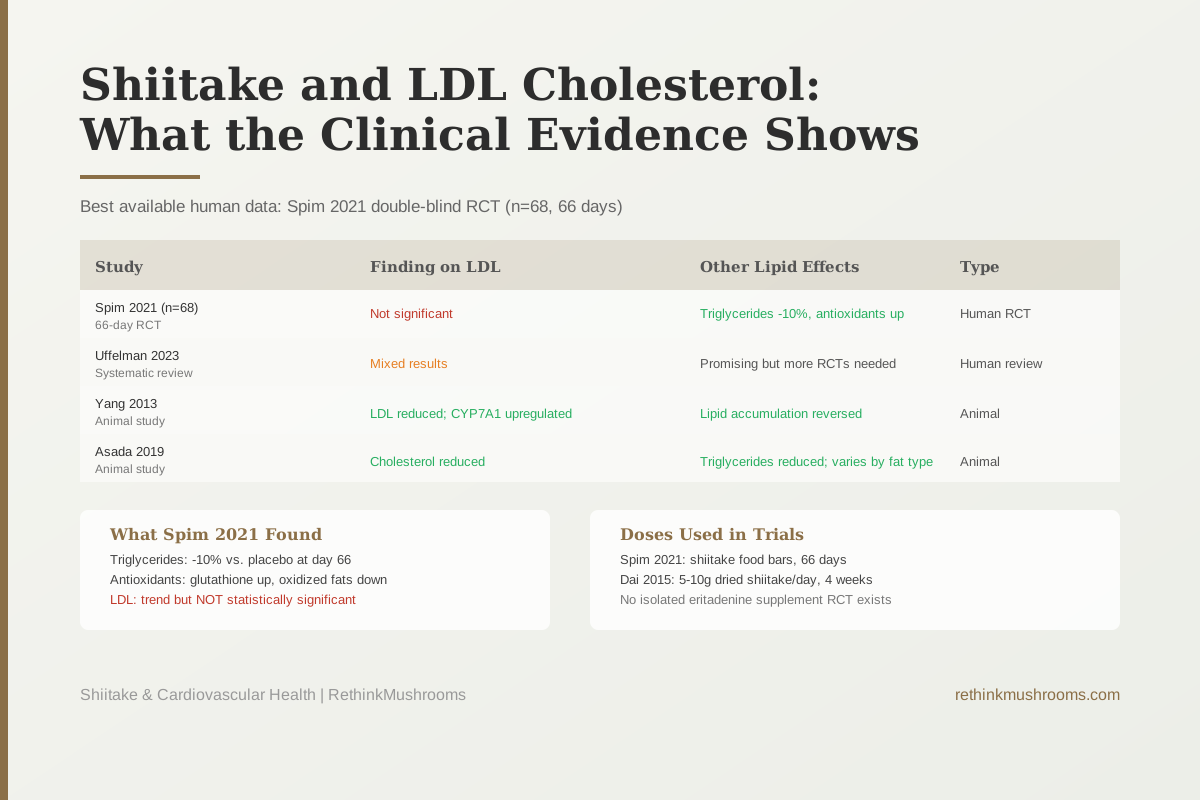
The only human trial designed to test shiitake's effect on lipid profiles in people with elevated cholesterol found that triglycerides fell by roughly 10% and antioxidant markers improved, while LDL — the headline target — did not move. That result, from Spim and colleagues in 2021, is the most important data point in this discussion, and this article builds outward from it.[1]
For a broader look at shiitake and its full range of research, see What Is Shiitake Mushroom? The Culinary Mushroom with Medicinal Power.
Key Takeaways
- The only targeted human RCT (Spim 2021, n=68, double-blind, 66 days) found shiitake reduced triglycerides by approximately 10% (P = 0.0352) and improved antioxidant markers. It reported no significant change in LDL, total cholesterol, HDL, or glucose
- Uffelman 2023, a systematic review of 22 human studies in Nutrients, reached the same conclusion from a much wider base: mushroom consumption improves triglycerides and hs-CRP "but not other lipids, lipoproteins," and observational data show no association with LDL cholesterol
- Krittanawong 2021, in the American Journal of Medicine, reviewed 7 prospective studies and concluded that mushroom consumption "has not been shown to conclusively affect cardiovascular risk factors to date," though lipid and blood-pressure benefits may exist
- Animal studies are consistently positive and dose-dependent: Yang 2013 found total cholesterol, LDL, and triglycerides fell dose-dependently in hypercholesterolemic mice with CYP7A1 upregulation; Yu 2016 found a 55% triglyceride reduction in rats at the highest dose
- The animal doses were 1–20% of total diet. Scaled to body surface area, the strongest arms correspond to roughly 90–180 g of dried shiitake per day for an adult — 9 to 36 times the 5–10 g daily doses tested in humans
- Spim 2021 also recorded shiitake dermatitis in 10% of sensitive participants, a documented reaction to lentinan that is worth knowing before starting daily shiitake
The Best Human Trial: What Spim 2021 Found (and Didn't Find)
In 2021, Spim and colleagues published the first double-blind, placebo-controlled RCT specifically enrolling adults with borderline-high cholesterol, LDL, or triglycerides to test shiitake's effect on lipid profiles. Sixty-eight individuals were randomly allocated to placebo (n = 32) or shiitake bars (n = 36), with blood drawn at days 0, 33, and 66.[1]
The triglyceride result was the trial's positive finding: a 10% reduction after 66 days of consuming the shiitake bars, at P = 0.0352.
The antioxidant findings were also notable. The shiitake group showed increased reduced glutathione — the main endogenous antioxidant, the chemical cells use to neutralize damaging molecules produced by normal metabolism — and reduced lipid peroxidation, a measure of chemical damage accumulating in fats circulating through the bloodstream.
LDL did not change. Neither did total cholesterol, HDL, or glucose. The published abstract reports no significant effect on any of these and does not describe a directional trend toward lower LDL.
It is tempting to treat that null as settled proof that shiitake does nothing for LDL. It is not, and the reason is arithmetic. Sixty-eight people split across two arms is a small trial. The authors report no power calculation for LDL as an endpoint, so the study cannot distinguish between "shiitake does not lower LDL" and "shiitake lowers LDL by an amount too small for 68 people to detect." What makes the null more persuasive is not this trial alone — it is that a much larger body of human evidence points the same direction.
Spim et al. (2021) · International Journal of Medicinal Mushrooms
- Population
- 68 adults with borderline-high cholesterol, LDL, or triglycerides; 32 placebo, 36 intervention
- Intervention
- Lentinus edodes food bars daily for 66 days, with blood sampling at days 0, 33, and 66
- Comparator
- Identical placebo bars, double-blind, delivered in unmarked opaque envelopes
- Finding
- Triglycerides fell 10% in the intervention group at day 66 (P = 0.0352). Reduced glutathione increased and lipid peroxidation decreased. No significant change was reported in total cholesterol, LDL, HDL, or glucose. Shiitake exposure triggered dermatitis in 10% of individuals sensitive to the mushroom.
mixed A genuine positive on triglycerides and redox status, and a genuine null on LDL. The authors' own conclusion is modest: shiitake bars are a nutritious functional food that 'can be considered as an adjuvant in the prevention of dyslipidemia' — not a cholesterol treatment.
Spim et al., International Journal of Medicinal Mushrooms, 2021 [ref 1]
Systematic Reviews: The Broader Human Evidence Agrees
Two systematic reviews cover the wider human literature, and both are more restrained than they are usually reported to be.
Uffelman and colleagues published a systematic review in Nutrients in 2023, identifying 22 articles — 11 experimental and 11 observational — on mushroom consumption and cardiometabolic risk.[6] Their finding is unusually specific and lands directly on this article's question. Limited experimental evidence suggests mushroom consumption improves serum triglycerides and hs-CRP, "but not other lipids, lipoproteins," measures of glucose control, or blood pressure. Limited observational evidence suggests no association between mushroom consumption and fasting total or LDL cholesterol, or with cardiovascular morbidity and mortality. They also rated the majority of the articles they vetted as "poor" quality on the NHLBI assessment tool. Two of the authors disclosed research funding from The Mushroom Council — worth noting precisely because the review's conclusions are conservative rather than promotional.
That review matters because it independently reproduces the Spim 2021 pattern at scale: triglycerides move, LDL does not.
Krittanawong and colleagues published a systematic review in the American Journal of Medicine in 2021, screening 1,479 studies and identifying 7 prospective observational studies.[5] Mushroom consumption "may have favorable effects on lipid profiles" and is "probably associated with reduced mean blood pressure," but the review found effects on overall cardiovascular risk, stroke risk, and coronary artery disease to be inconsistent. Their conclusion is explicit: edible mushroom consumption "has not been shown to conclusively affect cardiovascular risk factors to date," while potential benefits may exist. This is frequently cited as evidence that mushrooms reduce cardiovascular risk. It says something weaker and more careful than that.
Endpoint Ledger · Six Sources, Four Outcomes
Triglycerides Move in Every Study. LDL Moves in None of the Human Ones.
“Shiitake lowers cholesterol” averages six sources into one sentence. Split by endpoint instead, the disagreement has a shape: the animal rows reduce almost everything, and the human rows reduce triglycerides while leaving LDL exactly where it was.
| Source | Triglycerides | LDL | Other lipids | Redox / inflammation |
|---|---|---|---|---|
| Spim 2021[ref 1]Double-blind RCT, 68 adults, 66 days | ↓ Reduced−10% (P = 0.0352) | — No changeNo significant change | — No changeTotal-C, HDL, glucose unchanged | ↓ ReducedGlutathione up, lipid peroxidation down |
| Uffelman 2023[ref 6]Systematic review, 22 studies (11 experimental, 11 observational) | ↓ ReducedImproved (experimental) | — No changeNo association (observational) | — No change"Not other lipids, lipoproteins" | ↓ Reducedhs-CRP improved |
| Krittanawong 2021[ref 5]Systematic review, 7 prospective studies of 1,479 screened | ~ InconclusiveLipid profile "may" improve; fractions not separated | ~ InconclusiveNamed among markers that may change; not conclusive | ~ InconclusiveMean blood pressure "probably" reduced | · Not measuredNot an endpoint |
| Yang 2013[ref 3]Hypercholesterolemic mice, 5 / 10 / 20% of diet, 4 weeks | ↓ ReducedDose-dependent reduction | ↓ ReducedDose-dependent reduction | ↓ ReducedTotal-C down; HDL not significantly altered | ↓ ReducedCYP7A1 restored; plaque formation suppressed |
| Yu 2016[ref 7]Sprague-Dawley rats, 1 / 4 / 10% of diet, gestation to day 126 | ↓ Reduced−55% at the 10% diet, both sexes | · Not measuredReported as non-HDL, not LDL | ↓ ReducedTotal-C, HDL, non-HDL all 3–27% lower | ~ InconclusiveLipophilic antioxidant capacity 31–86% LOWER |
| Asada 2019[ref 4]Rats on high plant oil, lard, or MCT-rich oil diets | ↓ ReducedGreatest fall on MCT-rich plant oil | · Not measuredFractions not separated | ↓ ReducedTotal-C and LCAT activity down | · Not measuredNot an endpoint |
The column that agrees: triglycerides fall in the human RCT, in the 22-study systematic review, and in all three rodent studies. This is the one endpoint where whole-food shiitake has convergent evidence across species and study design.
The column that doesn’t: LDL falls dose-dependently in mice and does not move in humans — not in the one targeted RCT, and not in the eleven observational studies pooled by Uffelman. Two of the three rodent studies never separated LDL from total cholesterol at all.
Sources: Spim et al. (2021), Int J Med Mushrooms 23(7) [ref 1]; Yang et al. (2013), Exp Ther Med 6(6) [ref 3]; Asada et al. (2019), J Diet Suppl 16(3) [ref 4]; Krittanawong et al. (2021), Am J Med 134(5) [ref 5]; Uffelman et al. (2023), Nutrients 15(5) [ref 6]; Yu et al. (2016), J Nutr 146(12) [ref 7]. “No change” means the source reported no statistically significant effect, not that an effect was ruled out. The two systematic reviews summarise overlapping literatures across many mushroom species, not shiitake alone.
Animal Studies: Consistent, Dose-Dependent, and Not About Food
Animal research is where the LDL story looks most favorable — and where the translation problem is clearest.
Yang and colleagues fed hypercholesterolemic mice a high-fat diet supplemented with 5%, 10%, or 20% Lentinus edodes, or with isolated eritadenine at 10 mg/kg body weight, for four weeks.[3] Serum total cholesterol, LDL, and triglycerides all fell in a dose-dependent manner. HDL was unchanged. Liver lipid accumulation was reduced, atherosclerotic plaque formation was suppressed, and mRNA expression of CYP7A1 — the enzyme that converts cholesterol into bile acids so the body can excrete it — was restored after being suppressed by the high-fat diet. That last finding is the mechanistic core: it points to active cholesterol clearance through the bile acid pathway rather than to reduced synthesis alone.
Yu and colleagues fed Sprague-Dawley rats diets containing 0%, 1%, 4%, or 10% shiitake powder from gestation through postnatal day 126.[7] Lipidemia-related factors fell dose-dependently in both sexes. At the 10% dose, serum triglycerides dropped 55%. Total, HDL, and non-HDL cholesterol were 3–27% lower than controls. But the same study found serum lipophilic antioxidant capacity was 31–86% lower in shiitake-fed animals — the opposite direction from Spim's human antioxidant result. The authors interpreted this as reflecting a lower pro-oxidative state requiring less antioxidant defense. It is a plausible reading, and it is also a reminder that the antioxidant story is not as clean as it is usually told.
Asada and colleagues tested shiitake supplementation in rats fed three different high-lipid diets: high plant oil, high animal fat (lard), or high medium-chain-triglyceride (MCT) plant oil.[4] The effect depended on which fat the animals ate. Serum triglycerides, cholesterol, and LCAT activity were lower in shiitake-fed rats given MCT-rich plant oil than in those given lard, and the MCT-rich diet showed the greatest rate of decrease across all serum lipid measures. In other words, shiitake worked best alongside a medium-chain plant oil, not alongside saturated animal fat — a background-diet dependency that is easy to control in a rodent study and nearly impossible to control in a human dietary trial.
Dose Translation · Percent-of-Diet vs. Grams-per-Day
Humans Have Never Eaten the Dose That Worked in Rodents
The rodent studies dosed shiitake as a share of the whole diet. The human studies dosed it in grams. Converted to a common scale, the human trials sit at the very bottom of the rodent range — below every arm that produced an LDL effect. The human null on LDL may not be a contradiction of the animal data so much as an untested exposure.
20% of total diet, 4 weeks — LDL reduced (highest of three dose-dependent arms)
10% of total diet, gestation to day 126 — Triglycerides −55%; cholesterol fractions 3–27% lower. LDL not reported separately
5% of total diet, 4 weeks — LDL reduced (lowest arm that still produced an effect)
1% of total diet — Smallest arm of a dose-dependent series, and the only rodent exposure inside the human range. LDL not reported separately
10 g dried shiitake/day, 4 weeks — Lipids not measured — immune endpoints only
5 g dried shiitake/day, 4 weeks — Lipids not measured — immune endpoints only
Shiitake food bars daily, 66 days (grams per bar not stated) — No significant change in LDL
The gap in one number: the lowest rodent arm that reduced LDL specifically scales to roughly 46 g of dried shiitake a day. The highest dose ever given in a human trial was 10 g. That is a four- to eighteen-fold shortfall, and 182 g/day — the top rodent arm — is close to two kilograms of fresh shiitake daily.
What this does not license: it is not an argument that more shiitake would lower your LDL. No trial has tested 46 g/day for safety or effect, the human trial at edible doses found nothing, and the observational data in Uffelman 2023 found no LDL association at ordinary intakes either.
Reported doses: Yang et al. (2013), Exp Ther Med 6(6) [ref 3]; Yu et al. (2016), J Nutr 146(12) [ref 7]; Dai et al. (2015), J Am Coll Nutr 34(6) [ref 2]; Spim et al. (2021), Int J Med Mushrooms 23(7) [ref 1]. Human-equivalent doses are derived estimates, not values reported by the authors: FDA body-surface-area scaling (animal mg/kg ÷ 12.3 for mouse, ÷ 6.2 for rat) applied to a 70 kg adult, assuming conventional daily food intake of 4 g for a 25 g mouse and 20 g for a 250 g rat. Different intake or body-weight assumptions shift these figures, but not the order of magnitude. Spim 2021 is plotted at a nominal position because its per-bar shiitake content is not given in the published abstract.
The Clinical Evidence at a Glance
The available evidence on shiitake and LDL cholesterol, organized by study type:
| Evidence Type | Key Finding | Source |
|---|---|---|
| Human RCT (n=68, double-blind) | Triglycerides reduced ~10% (P = 0.0352); glutathione up, lipid peroxidation down; no significant change in LDL, total cholesterol, HDL, or glucose | Spim 2021 |
| Systematic review, 22 studies (2023) | Triglycerides and hs-CRP improve; other lipids and lipoproteins do not; no observational association with LDL | Uffelman 2023 |
| Systematic review, 7 prospective studies (2021) | Possible favorable lipid and blood-pressure effects; overall cardiovascular risk effects not consistent or conclusive | Krittanawong 2021 |
| Animal study (mice) | Total cholesterol, LDL, and triglycerides reduced dose-dependently; CYP7A1 restored; plaque formation suppressed | Yang 2013 |
| Animal study (rats) | Triglycerides down 55% at 10% diet; cholesterol fractions down 3–27%; lipophilic antioxidant capacity also reduced | Yu 2016 |
| Animal study (rats) | Lipid lowering greatest with MCT-rich plant oil; weakest against lard | Asada 2019 |
The pattern is consistent, and it is not the pattern most articles describe. Animal evidence is strongly positive for LDL. Human evidence is positive for triglycerides and null for LDL, in both the one targeted trial and the systematic reviews.
- Cell and mechanism studiescompleted
Eritadenine's inhibition of S-adenosylhomocysteine hydrolase and the resulting shift in hepatic phospholipid metabolism are well characterized.
- Animal studiescompleted
Dose-dependent reductions in total cholesterol, LDL, and triglycerides in hypercholesterolemic mice (Yang 2013) and in rats across dose and diet type (Yu 2016; Asada 2019).
- Human observational datacompleted
Seven prospective studies reviewed by Krittanawong 2021; eleven observational studies in Uffelman 2023. Neither found a consistent association with LDL cholesterol.
- Small human trialscurrent
One targeted, double-blind, placebo-controlled RCT in 68 adults with borderline-high cholesterol (Spim 2021): triglycerides fell, LDL did not.
- Large randomised trialsmissing
None. No adequately powered RCT has tested shiitake or isolated eritadenine against LDL as a primary endpoint in humans.
- Meta-analysismissing
No meta-analysis of shiitake-specific lipid trials exists, because there are not enough trials to pool.
For triglycerides, shiitake has one positive human RCT and supportive systematic-review evidence. For LDL specifically, the ladder stops at animal work: the mechanism is established, the rodent data are consistent, and the human rungs above are either null or empty.
Spim et al., 2021 [ref 1]; Yang et al., 2013 [ref 3]; Asada et al., 2019 [ref 4]; Krittanawong et al., 2021 [ref 5]; Uffelman et al., 2023 [ref 6]; Yu et al., 2016 [ref 7]
How Much and How Long: The Clinical Trial Numbers
Dai and colleagues ran a 4-week parallel-group study in 52 healthy adults aged 21–41, assigned to either 5 g or 10 g of dried shiitake daily.[2] That study measured immune outcomes — which improved significantly — not lipids. What it establishes for this article is a tolerated human dose: 5 to 10 g of dried shiitake every day for a month, without reported adverse effects.
Ten grams of dried shiitake is roughly 100 g of fresh shiitake, which at about 19 g per medium cap is around five caps a day. That is a substantial but achievable amount of food.
Spim 2021 used shiitake-based food bars daily for 66 days. The triglyceride improvement appeared at day 66 but not at day 33, which suggests that lipid effects at dietary doses take longer than a month to emerge — and that four-week studies like Dai 2015 may simply be too short to detect them.
No human RCT has tested isolated eritadenine as a concentrated supplement. Every piece of human evidence in this article comes from whole-food shiitake or shiitake in food form.
Why Shiitake Still Has a Cardiovascular Case
The null LDL result is worth taking seriously. It does not eliminate the cardiovascular rationale for eating shiitake.
Triglycerides are an independent cardiovascular risk factor, not merely a marker of other problems. A roughly 10% reduction from a dietary change is a real effect, and it is the one endpoint where a single trial and a 22-study systematic review agree. The caveats are that Spim's result came in at P = 0.0352 in a small trial, and that no study has followed shiitake consumption through to a cardiovascular event.
The redox findings matter mechanistically, with the Yu 2016 caveat attached: shiitake reduced lipid peroxidation in humans, but reduced measured antioxidant capacity in rats. Both results are consistent with a lower oxidative burden, but they are not the same measurement, and neither has been linked to a clinical outcome.
The mechanistic basis for why shiitake should lower LDL is real. Eritadenine's inhibition of S-adenosylhomocysteine hydrolase is established, and Yang 2013 showed CYP7A1 restoration alongside LDL reduction in mice.
One frequently repeated mechanism deserves more caution than it usually gets. Beta-glucans are often described as binding bile acids in the gut and forcing the liver to draw down circulating cholesterol to replace them. That mechanism is well established for the cereal beta-glucans in oats and barley, which have a (1,3)(1,4) structure that forms a viscous gel — and which carry authorized health claims on that basis. Shiitake's beta-glucans are (1,3)(1,6)-branched, structurally different, and far less viscous. The bile-acid-sequestration mechanism has not been demonstrated for fungal beta-glucans at dietary doses. Borrowing the oat evidence for shiitake is a substitution, not a citation.
For the mechanism in full detail, see Shiitake and Cholesterol: Eritadenine's Unique Mechanism and Eritadenine in Shiitake: The Unique Cholesterol-Lowering Nucleoside.
Fact Check
The rodent-to-human transfer
The claim
“Shiitake is clinically proven to lower LDL cholesterol.”
Supplement copy and roundup articles that cite the consistent animal data — Yang 2013, Yu 2016 — without noting that these were 5–20%-of-diet rodent feeding studies, and that the one human trial designed to test LDL found nothing.
What research shows
OverstatedEvery human data source examined here points the same way on LDL. The one targeted RCT reported no significant change (Spim 2021). A systematic review of 22 studies found mushrooms improve triglycerides 'but not other lipids, lipoproteins' (Uffelman 2023). A review of 7 prospective studies found effects on cardiovascular risk factors inconclusive (Krittanawong 2021).
The animal data are not wrong and the mechanism is not fabricated. They were generated at doses that translate to roughly 90–180 g of dried shiitake a day for an adult — 9 to 36 times any dose tested in a human trial. The defensible claim is that shiitake lowers triglycerides modestly and improves redox markers, and that its effect on human LDL is unproven at edible doses.
Spim et al., 2021 [ref 1]; Yang et al., 2013 [ref 3]; Krittanawong et al., 2021 [ref 5]; Uffelman et al., 2023 [ref 6]; Yu et al., 2016 [ref 7]
Can Shiitake Replace Statins?
No, and the evidence is not close.
Statins lower LDL substantially and predictably. Under the standard intensity framework, moderate-intensity regimens reduce LDL by roughly 30–49% and high-intensity regimens by 50% or more, and long-term randomized trials in tens of thousands of patients have shown corresponding reductions in heart attacks and strokes. The evidence base is among the strongest in cardiovascular medicine.
Shiitake, in the only human RCT enrolling adults with elevated cholesterol, did not significantly lower LDL at all. It reduced triglycerides by approximately 10% and improved redox markers over 66 days, in 68 people.
The mechanisms are also entirely different. Statins inhibit HMG-CoA reductase, the rate-limiting enzyme in cholesterol synthesis. Eritadenine acts on the methionine cycle and hepatic membrane composition. These are not weaker versions of the same intervention; they are different interventions with different evidence bases and different endpoints.
There is one more thing worth knowing before treating daily shiitake as a free intervention. Shiitake carries a specific, well-documented adverse reaction — shiitake dermatitis, a flagellated rash caused by lentinan and reviewed across 50 published cases by Nguyen and colleagues in 2017.[8] It appeared in Spim 2021 itself, in 10% of sensitive participants.
Before You Act On This
ModerateShiitake dermatitis is a documented reaction, and this article is not medical advice
Concern
Spim 2021 recorded that exposure to Lentinus edodes triggered dermatitis in 10% of individuals sensitive to the mushroom — inside the very trial this article is built on. A systematic review of 50 published cases describes shiitake dermatitis as a reaction to lentinan presenting as a linear, flagellated rash in 98% of cases, with itching in 78%, and sometimes fever, diarrhea, and mucosal ulcers. The majority of cases followed consumption of raw mushrooms; 22% followed lightly or undercooked ones.
What the research says
The condition is self-limiting and resolves in roughly 12.5 days without treatment. Thorough cooking is the main preventive measure, and avoiding re-exposure is the standard recommendation after a reaction. Separately, no shiitake product is approved to treat high cholesterol, and nothing in this article supports substituting shiitake for prescribed lipid-lowering therapy.
Particularly relevant for: Anyone eating raw or undercooked shiitake; people taking statins or other lipid-lowering medication; anyone managing diagnosed dyslipidemia or cardiovascular disease
What to do
This article is educational and is not medical advice. Do not stop, reduce, or replace prescribed cholesterol medication based on it. Talk to your doctor or a qualified healthcare provider before making changes to cholesterol treatment or adding a mushroom supplement.
Spim et al., International Journal of Medicinal Mushrooms, 2021 [ref 1]; Nguyen et al., International Journal of Dermatology, 2017 [ref 8]
For a comparison of how different mushroom species approach cholesterol, see Mushrooms That Lower Cholesterol: What the Research Shows and Shiitake and Maitake for High Cholesterol: Head-to-Head Research Comparison.
The Bottom Line
The strongest human trial on shiitake and lipids (Spim 2021, n=68, double-blind, 66 days) found a 10% triglyceride reduction and improved redox markers, with no significant change in LDL, total cholesterol, or HDL. Two systematic reviews reach the same split verdict from a wider base: Uffelman 2023 found mushrooms improve triglycerides and hs-CRP "but not other lipids, lipoproteins," and Krittanawong 2021 concluded that cardiovascular risk-factor effects are not yet conclusive. Animal studies are consistently positive for LDL, but at 1–20%-of-diet doses that scale to roughly 90–180 g of dried shiitake per day for an adult — far beyond the 5–10 g tested in humans. The cardiovascular case for shiitake currently rests on triglycerides and oxidative stress, not on LDL reduction.
Frequently Asked Questions
Sources & References
- 1RTHM-01436·Spim, Sara Rosicler Vieira et al. (2021). “Effects of Shiitake Culinary-Medicinal Mushroom, Lentinus edodes (Agaricomycetes), Bars on Lipid and Antioxidant Profiles in Individuals with Borderline High Cholesterol: A Double-Blind Randomized Clinical Trial..” International journal of medicinal mushrooms.Study breakdown →PubMed →↩
- 2RTHM-00368·Dai, Xiaoshuang et al. (2015). “Consuming Lentinula edodes (Shiitake) Mushrooms Daily Improves Human Immunity: A Randomized Dietary Intervention in Healthy Young Adults..” Journal of the American College of Nutrition.Study breakdown →PubMed →↩
- 3RTHM-00567·Yang, Hyun et al. (2013). “Lentinus edodes promotes fat removal in hypercholesterolemic mice..” Experimental and therapeutic medicine.Study breakdown →PubMed →↩
- 4RTHM-01030·Asada, Norihiko et al. (2019). “Effects of Shiitake Intake on Serum Lipids in Rats Fed Different High-Oil or High-Fat Diets..” Journal of dietary supplements.Study breakdown →PubMed →↩
- 5RTHM-01376·Krittanawong, Chayakrit et al. (2021). “Mushroom Consumption and Cardiovascular Health: A Systematic Review..” The American journal of medicine.Study breakdown →PubMed →↩
- 6RTHM-01810·Uffelman, Cassi N et al. (2023). “An Assessment of Mushroom Consumption on Cardiometabolic Disease Risk Factors and Morbidities in Humans: A Systematic Review..” Nutrients.Study breakdown →PubMed →↩
- 7RTHM-00846·Yu, Shanggong et al. (2016). “Diets Containing Shiitake Mushroom Reduce Serum Lipids and Serum Lipophilic Antioxidant Capacity in Rats..” The Journal of nutrition.Study breakdown →PubMed →↩
- 8RTHM-00901·Nguyen, Austin H et al. (2017). “Clinical features of shiitake dermatitis: a systematic review..” International journal of dermatology.Study breakdown →PubMed →↩