Mushrooms & Cardiovascular Health
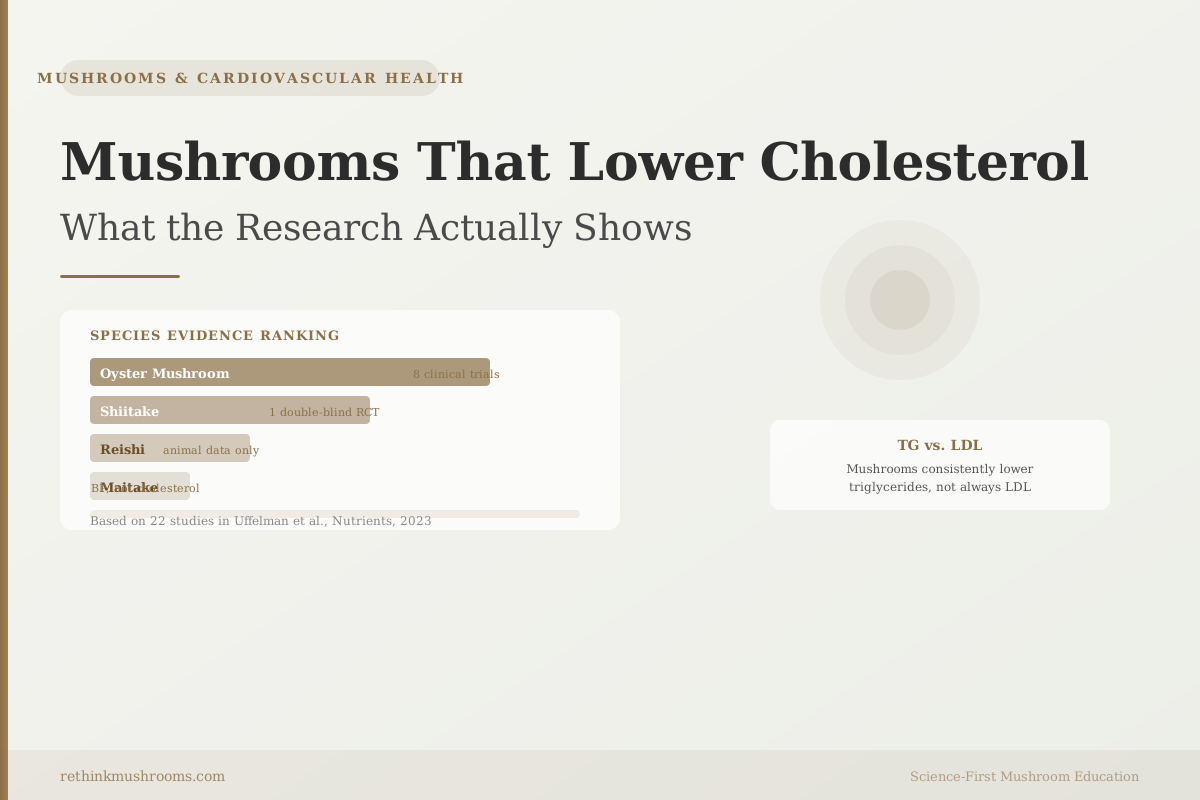
8 clinical trials found oyster mushroom improved a lipid or glucose measure
Among all edible mushroom species, oyster mushroom has the most consistent human clinical evidence for cholesterol management — though the reviewers who counted those eight trials also rated the evidence low-certainty, and the full picture across species is far more nuanced than most sources suggest.
Dicks & Ellinger, Nutrients, 2020
22
articles in the 2023 systematic review of mushrooms and cardiometabolic risk (Uffelman et al.)
Eritadenine
shiitake's unique cholesterol compound, absent in all other common edible species
TG not LDL
mushrooms most consistently improve triglycerides; LDL effects are species-specific and unreliable
Dicks & Ellinger, Nutrients, 2020
 View as image ↗
Searching "mushrooms that lower cholesterol" returns the same confident claims across dozens of health websites: mushrooms are great for cholesterol, certain species can reduce LDL, eat more and your numbers will improve. Most of those claims are either unqualified or drawn from animal studies presented as if they were human evidence. The actual clinical picture is more honest and, in some ways, more interesting than what those sources present.
In 2023, Uffelman and colleagues published the most comprehensive systematic review of mushroom consumption and cardiometabolic markers to date, covering 22 articles.[1] The headline finding: limited evidence from experimental research suggests mushroom consumption improves serum triglycerides and a marker of inflammation (hs-CRP). It did not improve LDL cholesterol, total cholesterol, or other lipids and lipoproteins, nor measures of glucose control or blood pressure. Some individual species showed positive signals in individual trials, but the overall picture is one of a consistent triglyceride signal and an absent LDL one.
That's not a reason to dismiss mushrooms for heart health. Triglycerides matter. Reducing elevated triglycerides is genuinely clinically valuable. And the species-level data shows real differences: oyster mushrooms have eight clinical trials reporting lipid or glucose improvements; shiitake has a double-blind RCT confirming a triglyceride reduction; reishi has strong animal data that human trials have not replicated. Maitake's cardiovascular evidence points more toward blood pressure than toward direct cholesterol lowering.
This article walks through the evidence for each species, explains why the mechanisms differ, and tells you what the human data actually shows — including where it is weaker than the confident version you'll find elsewhere.
Key Takeaways
- A 2023 systematic review of 22 articles found limited experimental evidence that mushrooms improve triglycerides and hs-CRP, but no improvement in LDL cholesterol, total cholesterol, glucose control, or blood pressure (Uffelman et al., 2023)
- Oyster mushrooms have the strongest human clinical record: a systematic review identified 8 trials reporting beneficial effects on glucose and/or lipids — but the same reviewers judged risk of bias high or unclear in most of them and rated the overall evidence low (Dicks & Ellinger, 2020)
- Shiitake is the only common edible mushroom containing eritadenine, a potent inhibitor of S-adenosylhomocysteine hydrolase; one double-blind RCT found a 10% triglyceride reduction over 66 days (Spim et al., 2021)
- Reishi (Ganoderma lucidum) showed large lipid effects across a meta-analysis of 49 animal studies, but a Cochrane review of human randomized trials found no significant effect on total or LDL cholesterol (Aref et al., 2023; Klupp et al., 2015)
- Maitake's cardiovascular evidence centers on blood pressure rather than cholesterol; in the foundational 1987 rat study it was maitake, not shiitake, that lowered total cholesterol — and neither species changed LDL (Kabir et al., 1987)
- The mechanisms differ by species: statin-like HMG-CoA inhibition via lovastatin (oyster), beta-glucan bile-acid sequestration (most species), transcriptional modulation by fungal sterols (mixed extracts), and eritadenine's effect on hepatic phospholipid metabolism (shiitake only)
- No mushroom has been shown to substitute for statin therapy, and nothing here is medical advice — decisions about treating elevated LDL belong with your physician
What 22 Studies Tell Us: Triglycerides vs. LDL
Research shows mushrooms most reliably improve triglycerides rather than LDL cholesterol. Among species, oyster mushrooms have the strongest human clinical evidence, with eight trials reporting improvements. Shiitake contains eritadenine, a unique cholesterol-lowering compound, with one double-blind RCT confirming a triglyceride reduction. Reishi has strong animal data but human RCTs have found no significant benefit. Maitake's cardiovascular strength is blood pressure, not cholesterol.
That paragraph is a fair summary of the published record. But the distinction between triglycerides and LDL matters clinically, and it's worth explaining before getting into species.
Elevated triglycerides, particularly above 150 mg/dL, are an independent cardiovascular risk factor. Lowering triglycerides and lowering LDL are both valuable goals, but they are not the same goal, and interventions that accomplish one don't always accomplish the other.
The Uffelman 2023 review covered 11 experimental studies and 11 observational studies, involving species including oyster, shiitake, reishi, and button mushrooms.[1] Across the experimental arm, triglycerides and hs-CRP improved. LDL cholesterol did not, and neither did total cholesterol, glucose control, or blood pressure. In the observational arm, seven of 11 articles found no association between mushroom consumption and total or LDL cholesterol, glucose, or cardiovascular morbidity and mortality. Blood pressure, HDL and triglycerides were deemed inconsistent across that arm; HbA1c and hs-CRP were deemed insufficient.
Endpoint Split
What 22 Studies Actually Moved — and What They Didn’t
Uffelman et al. (2023), a systematic review of 22 articles on mushroom consumption and cardiometabolic risk. Bars encode the direction of the review’s verdict, not effect magnitude — no pooled estimate was calculated.
Triglycerides
ImprovedThe review’s clearest experimental signal — the basis for its headline conclusion
hs-CRP (inflammation)
ImprovedImproved in experimental research; graded insufficient in the observational arm
LDL cholesterol
No improvementNot improved in experimental research; no association in observational research
Total cholesterol
No improvementGrouped with "other lipids and lipoproteins" that did not improve
Fasting glucose
No improvementNo improvement in measures of glucose control
Blood pressure
InconsistentNo improvement experimentally; deemed inconsistent overall
HDL cholesterol
InconsistentExplicitly deemed inconsistent across the included articles
HbA1c / hyperglycemia
Insufficient dataExplicitly deemed insufficient — too little evidence to judge
Two endpoints improved; four did not move or were inconsistent; one had too little evidence to grade. The review also rated the majority of included articles “poor” on the NHLBI study-quality tool, and was funded by the Mushroom Council — a trade body with a commercial interest in a favorable result.
Source: Uffelman et al., “An Assessment of Mushroom Consumption on Cardiometabolic Disease Risk Factors and Morbidities in Humans: A Systematic Review,” Nutrients, 2023 [ref 1].
Two caveats belong with that review, and most secondary coverage omits both. First, the authors rated the majority of included articles "poor" on the NHLBI study-quality assessment tool, citing study methodology and reporting problems. Second, the review was funded by the Mushroom Council, a mushroom industry trade body. Neither fact makes the triglyceride finding wrong, and the review is unusually candid about the weakness of its own evidence base. But a favorable-to-mushrooms result from an industry-funded review of largely poor-quality studies deserves to be reported with its caveats attached.
Why might mushrooms move triglycerides while leaving LDL alone? The most likely explanation is that the mechanisms differ. Beta-glucan fiber, present in most edible mushrooms, primarily acts by binding bile acids in the gut — a route that should affect total and LDL cholesterol most directly, but that appears to be too weak at dietary mushroom doses to register. Triglyceride lowering may run through separate pathways, including reduced hepatic lipid synthesis and improved insulin sensitivity, which may be more readily engaged at realistic intakes.
How Mushrooms Lower Cholesterol: The Biology
Edible mushrooms don't all work by the same mechanism, and this is where most popular coverage goes wrong — it treats "mushrooms" as a single intervention. There are at least four distinct proposed routes, each carried by different species and each supported by a different quality of evidence.
Mechanism Map
Four Routes, Four Different Species Stories
Each proposed pathway, the species that actually carries it, and how far the evidence for that specific mechanism has travelled.
01HMG-CoA reductase inhibition
In vitro / compositionOyster (Pleurotus ostreatus)
Naturally occurring lovastatin blocks the rate-limiting enzyme of hepatic cholesterol synthesis — the same target as prescription statins.
Evidence reach: Presence confirmed in Pleurotus fruiting bodies in 1995, but the concentration is low and inconsistent — a later study quantifying bioactives in raw and processed oyster mushroom did not detect lovastatin at all.
refs 10, 14
02Beta-glucan bile-acid sequestration
Animal evidenceMost edible species; best characterized in oyster and shiitake
Soluble beta-glucans bind bile acids and lipids in the gut so they are excreted rather than reabsorbed, forcing the liver to draw on circulating cholesterol to replace them.
Evidence reach: Reviewed mechanism; effect depends on whether the beta-glucan is the soluble or insoluble form. Not isolated as a discrete human endpoint in mushroom trials.
ref 3
03Transcriptional modulation
In vitro / compositionMixed edible extracts (button, shiitake, oyster)
Fungal sterols and water-soluble fractions down-regulate genes governing cholesterol homeostasis (Srebf2, Nr1h4/FXR), producing expression profiles resembling simvastatin or ezetimibe.
Evidence reach: In vitro and in vivo gene-expression work. A transcriptional resemblance to a drug is not the same as a drug-sized clinical effect.
ref 2
04Eritadenine (SAHH inhibition)
Animal evidenceShiitake only (Lentinula edodes)
Eritadenine potently inhibits S-adenosylhomocysteine hydrolase, shifting the liver’s SAM:SAH ratio and altering phosphatidylcholine metabolism — which is what lowers plasma cholesterol.
Evidence reach: Enzyme inhibition confirmed at Kᴵ = 30 nM with a solved crystal structure; rats fed eritadenine dropped total plasma cholesterol ~42%. No isolated human eritadenine trial.
refs 11, 12
Only one of these routes is unique to a single species (eritadenine, shiitake), and none has been isolated as a discrete endpoint in a human trial. Treating “mushrooms” as one intervention for cholesterol collapses four different pharmacologies with four different amounts of evidence behind them.
Sources: Gil-Ramírez et al. (2018) [ref 2]; Sima et al. (2018) [ref 3]; Gunde-Cimerman & Cimerman (1995) [ref 10]; Yamada et al. (2007) [ref 11]; Sugiyama et al. (1995) [ref 12]; Lam & Okello (2015) [ref 14].
HMG-CoA reductase inhibition. This is the same target as statin medications: the enzyme controlling the rate-limiting step of cholesterol synthesis in the liver. Oyster mushrooms contain lovastatin, a naturally occurring compound of exactly this class — Gunde-Cimerman and Cimerman confirmed its presence in Pleurotus fruiting bodies in 1995.[10] The pharmacological action is real. The quantity is the problem, and we return to it below.
Beta-glucan bile-acid sequestration. Beta-glucans are polysaccharides found in the cell walls of most edible mushrooms. In the gut they interact with lipids and bile acids so that those bile acids are excreted rather than reabsorbed; the liver then draws on circulating cholesterol to make replacements. Sima and colleagues reviewed this mechanism in 2018, noting that beta-glucans exist in both soluble and insoluble forms and that this structural difference governs how they interact with bile salts.[3]
Transcriptional modulation. Gil-Ramírez and colleagues, reviewing the molecular actions of hypocholesterolaemic compounds from edible mushrooms in 2018, described a subtler route: fungal sterols down-regulate genes governing cholesterol homeostasis such as Srebf2 and Nr1h4 (FXR), and certain water-soluble mushroom fractions produce transcriptional profiles resembling those of simvastatin or ezetimibe.[2] It is worth being precise about what that means: a gene-expression profile that resembles a drug's is a mechanistic clue, not evidence of a drug-sized clinical effect.
Eritadenine. This one is specific to shiitake, and it is the mechanism most often described incorrectly. Eritadenine is a potent inhibitor of S-adenosylhomocysteine hydrolase (SAHH). The downstream consequence is not bile acid excretion — it is a shift in the liver's ratio of S-adenosylmethionine to S-adenosylhomocysteine, which alters phosphatidylcholine metabolism in liver microsomes, and that is what lowers plasma cholesterol. Sugiyama and colleagues demonstrated this sequence in rats in 1995, showing that both ratios shifted a full day before plasma cholesterol fell.[12]
Understanding these mechanisms matters because it explains why species perform differently in clinical trials. A mushroom containing lovastatin should behave differently from one relying purely on beta-glucan, or one carrying a unique small molecule. Treating all mushrooms as equivalent for cholesterol is a pharmacological error, not just a simplification.
Oyster Mushroom: Eight Clinical Trials and the Best Human Evidence
Oyster mushrooms (Pleurotus ostreatus) are the species with the most consistent human clinical evidence for cardiometabolic improvement, and the gap between oyster and the other species is meaningful.
Dicks & Ellinger (2020) · Nutrients
- Population
- Adults across eight clinical trials of chronic Pleurotus ostreatus intake; the trials varied in population, dose and duration
- Intervention
- Pleurotus ostreatus intake (whole mushroom and preparations, varying doses and durations)
- Comparator
- Control or baseline, varying by trial
- Finding
- All eight trials reported beneficial effects on glucose metabolism (reduced fasting and/or 2-hour postprandial glucose) and/or lipids (reduced total cholesterol, LDL and/or triglycerides). Some also found reduced blood pressure. Body weight did not change.
mixed The reviewers assessed risk of bias as high or unclear in most included studies due to methodological weaknesses and inadequate reporting, and concluded the evidence for cardiometabolic benefit is low.
Dicks & Ellinger, Nutrients, 2020
That review, published in Nutrients in 2020, is the single most-cited basis for the claim that oyster mushrooms lower cholesterol.[4] It deserves to be reported accurately in both directions: eight trials is genuinely the largest clinical base of any edible mushroom species for these outcomes, and the reviewers' own conclusion was that the evidence is low-certainty and that further trials with adequate design are needed to validate it. Popular summaries almost always carry the first half of that sentence and drop the second.
Two mechanisms plausibly explain oyster mushroom's activity. The first is the lovastatin content confirmed by Gunde-Cimerman and Cimerman.[10] The honest caveat is quantitative, and it is sharper than most coverage admits: when Lam and Okello set out to quantify the bioactive compounds in raw and processed oyster mushroom, lovastatin was not detected at all, though they measured beta-glucan at 23.9% of dry matter.[14] Lovastatin's presence in Pleurotus is established, but the concentration is evidently low and inconsistent enough that a dedicated analysis can fail to find it. Eating oyster mushrooms is not equivalent to taking a prescription statin, and no trial has shown otherwise.
The claim you'll see everywhere
“Oyster mushrooms contain a natural statin, so they work like statin drugs”
The claim
“Because oyster mushrooms contain lovastatin — the same molecule sold as a prescription statin — eating them delivers statin-like cholesterol lowering.”
A true premise (lovastatin really is present in Pleurotus) fused to an unstated and false assumption about dose.
What research shows
OverstatedLovastatin was confirmed in Pleurotus fruiting bodies in 1995, but the concentration is low and inconsistent — a later study that set out to quantify bioactives in raw and processed oyster mushroom did not detect lovastatin at all, while measuring beta-glucan at 23.9% of dry matter.
The eight clinical trials in the oyster mushroom systematic review reported improvements in lipid or glucose measures, but the reviewers rated risk of bias high or unclear in most and graded the overall evidence low. No trial has compared oyster mushroom against a statin, and none has demonstrated equivalence.
Gunde-Cimerman & Cimerman, 1995; Lam & Okello, 2015; Dicks & Ellinger, Nutrients, 2020
The second mechanism is beta-glucan fiber, which oyster mushrooms contain in meaningful quantities. The plausible combination of two distinct routes is the best available explanation for why oyster mushroom trials outperform species relying on a single pathway — though no trial has isolated either mechanism's contribution.
For a deep dive into the clinical evidence specifically for oyster mushroom and LDL, including lovastatin quantification and what doses the trials actually used, see oyster mushroom and LDL cholesterol: clinical evidence and mechanisms.
Shiitake: The One Mushroom With a Unique Cholesterol Compound
Shiitake (Lentinula edodes) occupies a distinct position in this literature because of one compound found nowhere else among common edible fungi: eritadenine.
Eritadenine works by a completely different route from beta-glucan or lovastatin. Yamada and colleagues characterized it in detail in 2007, establishing d-eritadenine as a potent SAHH inhibitor with an inhibition constant of 30 nM, confirmed by a solved crystal structure of the enzyme-inhibitor complex; rats fed eritadenine dropped total plasma cholesterol by roughly 42%.[11] Those are striking numbers — and they are rat numbers. No trial has tested isolated eritadenine in humans.
The original comparative animal evidence for shiitake and maitake came from a 1987 study by Kabir and colleagues, who fed spontaneously hypertensive rats a diet containing 5% mushroom powder for nine weeks.[5] This study is cited constantly and described sloppily, so the actual result is worth stating precisely: both mushrooms lowered blood pressure. Shiitake reduced plasma free cholesterol; maitake reduced total cholesterol. Both reduced VLDL cholesterol, shiitake also reduced HDL, and — importantly — LDL cholesterol was not affected by either mushroom, nor were triglycerides. The paper's own conclusion was about blood pressure, not cholesterol.
The best human evidence for shiitake is a double-blind randomized placebo-controlled trial by Spim and colleagues, published in the International Journal of Medicinal Mushrooms in 2021.[6] Sixty-eight adults with borderline-high cholesterol, LDL or triglycerides were randomized to shiitake bars (n = 36) or placebo (n = 32), with blood drawn at 0, 33 and 66 days. The intervention group showed a 10% reduction in triglycerides at 66 days (P = 0.0352), along with increased reduced glutathione and decreased lipid peroxidation. The trial did not report a significant LDL benefit.
- Cell & Lab Studiescompleted
d-Eritadenine confirmed as a potent SAHH inhibitor (Kᴵ = 30 nM) with a solved crystal structure of the enzyme-inhibitor complex (Yamada 2007)
- Animal Studiescompleted
Rats fed d-eritadenine dropped total plasma cholesterol ~42% (Yamada 2007); a separate rat study traced the route to altered hepatic phospholipid metabolism, with the SAM:SAH and PC:PE ratios shifting a day before cholesterol fell (Sugiyama 1995). Whole shiitake powder lowered free cholesterol and blood pressure in hypertensive rats but did not move LDL (Kabir 1987)
- Case Reports & Early Seriescompleted
Extensive case literature exists — but for shiitake dermatitis, an adverse reaction, not for cholesterol benefit (Nguyen 2017)
- Small Human Trialscurrent
One double-blind RCT, 68 participants, 66 days: triglycerides down 10% (P = 0.0352), oxidative stress markers improved, no significant LDL effect (Spim 2021)
- Large Randomized Trialsmissing
No large trial of shiitake or isolated eritadenine for lipid endpoints in humans
- Meta-Analyses & Systematic Reviewsmissing
No shiitake-specific lipid meta-analysis exists; shiitake appears only as one species among several in broader mushroom reviews
Shiitake has the best-characterized cholesterol mechanism of any mushroom and the weakest human confirmation of it. The enzyme biology is solved to crystal-structure resolution; the human evidence is a single 68-person trial that moved triglycerides, not LDL. Nothing tests isolated eritadenine in people.
Yamada 2007; Sugiyama 1995; Kabir 1987; Spim 2021; Nguyen 2017
That trial also documented a safety signal worth knowing about, and one that most coverage of this topic omits entirely. It is also routinely described incorrectly: the trigger, lentinan, is a polysaccharide in shiitake cell walls, not a protein.[13]
Shiitake-specific adverse reaction
ModerateShiitake dermatitis: a real, if uncommon, reaction
Concern
In the Spim trial, exposure to Lentinula edodes triggered dermatitis in 10% of individuals sensitive to the mushroom. The reaction — shiitake dermatitis — is a cutaneous response to lentinan, a polysaccharide in shiitake cell walls, and presents as a characteristic linear, whip-like (flagellate) rash in 98% of reported cases, often with itching and sometimes fever or diarrhea.
What the research says
It is self-limiting, resolving in roughly 12.5 days without treatment. Across the case literature, the majority of cases followed consumption of raw mushrooms, and a further 22% followed lightly or undercooked shiitake. Thorough cooking is the practical preventive measure; treatment is symptomatic, and avoiding re-exposure is the standard recommendation.
Particularly relevant for: People eating raw, lightly cooked or undercooked shiitake; those already sensitized are at higher risk
What to do
Cook shiitake thoroughly. If a linear, whip-like rash appears after eating shiitake, stop eating it and speak to a clinician — the rash is distinctive but a diagnosis should not be self-made.
Spim et al., Int J Med Mushrooms, 2021; Nguyen et al., Int J Dermatol, 2017
Shiitake also contains beta-glucans, meaning it potentially works through two pathways like oyster mushroom. But the human trial data is thinner: one RCT versus eight trials for oyster. For an evidence-based comparison and a full review of eritadenine biology, see shiitake and maitake for high cholesterol: head-to-head research comparison.
Reishi: Why Animal Studies and Human Trials Tell Different Stories
Reishi (Ganoderma lucidum) presents the widest evidence discrepancy in the entire mushroom-cholesterol literature: animal data pointing strongly one way, human data pointing nowhere.
The animal case is genuinely impressive. Aref and colleagues published a 2023 systematic review and meta-analysis of 49 animal studies, finding that G. lucidum significantly reduced triglycerides (SMD −1.52), total cholesterol (SMD −1.51), LDL cholesterol (SMD −2.03) and VLDL (SMD −1.06), while increasing HDL (SMD +1.03).[7] Those effect sizes are large. In rodents, reishi essentially normalizes lipid profiles.
The human evidence is a different story. Klupp and colleagues conducted a Cochrane systematic review of randomized and controlled clinical trials of G. lucidum for cardiovascular risk factors, published in the Cochrane Database of Systematic Reviews in 2015.[8] Five trials with 398 participants met inclusion criteria; the three with analysable data compared 1.4–3 g/day of G. lucidum against placebo over 12 to 16 weeks, in participants who all had type 2 diabetes. The pooled results found no statistically or clinically significant effect on total cholesterol (WMD −0.07 mmol/L, 95% CI −0.57 to 0.42), LDL cholesterol (WMD +0.02 mmol/L, 95% CI −0.41 to 0.45), HbA1c, or BMI.
Translation Gap
Reishi’s Lipid Effects: 49 Animal Studies vs. the Human Trials
Bars show pooled standardised mean differences from animal studies, scaled to the largest effect. The right-hand column shows what happened when the same endpoints were measured in randomised human trials.
LDL cholesterol
SMD −2.03Animal (49 studies)
Human (randomised trials)
WMD +0.02 mmol/L (95% CI −0.41 to 0.45), n = 107
No reduction — point estimate marginally the wrong way
Triglycerides
SMD −1.52Animal (49 studies)
Human (randomised trials)
Not pooled as a separate outcome in the human review
Total cholesterol
SMD −1.51Animal (49 studies)
Human (randomised trials)
WMD −0.07 mmol/L (95% CI −0.57 to 0.42), n = 107
No statistically or clinically significant reduction
VLDL
SMD −1.06Animal (49 studies)
Human (randomised trials)
Not pooled as a separate outcome in the human review
HDL cholesterol
SMD +1.03Animal (49 studies)
Human (randomised trials)
Not pooled as a separate outcome in the human review
In rodents, reishi produces some of the largest lipid effects reported for any mushroom. In people, the two endpoints that were actually pooled — total and LDL cholesterol — did not move, and the confidence intervals comfortably include zero. The human evidence is also thin: three analysable trials, 107 participants for the lipid outcomes, all with type 2 diabetes, and risk of bias unclear in four of the five included studies.
Sources: Aref et al., J Res Med Sci, 2023 — meta-analysis of 49 animal studies [ref 7]; Klupp et al., Cochrane Database of Systematic Reviews, 2015 [ref 8].
Possible explanations for the gap include poor bioavailability of ganoderic acids in humans relative to rodents, differences between the doses and preparations used in animal versus human work, and the possibility that effects require longer durations or different populations. None of these is confirmed. It is also worth noting the human evidence is thin on its own terms — 107 participants contributed to the lipid analyses, and risk of bias was unclear in four of the five included trials — so this is better described as an absence of demonstrated benefit than as a demonstrated absence of benefit.
The honest position: reishi may hold value for other cardiovascular endpoints, but cholesterol lowering in humans is not currently supported by the randomized evidence.
For a full breakdown of the ganoderic acid mechanism and the animal-human gap, see reishi and cholesterol management: triterpene mechanisms.
Maitake: Better Evidence for Blood Pressure Than Cholesterol
Maitake (Grifola frondosa) frequently appears in lists of "cholesterol-lowering mushrooms," usually alongside shiitake in articles that treat the two as pharmacologically equivalent. They are not.
Kundaković and Kolundžić reviewed the therapeutic properties of mushrooms for managing the adverse effects of metabolic syndrome in 2013, surveying the compound classes involved.[9] Their account is a compound-level one rather than a species ranking: edible mushrooms, their extracts, polysaccharide fractions and isolated compounds show hypoglycaemic, cholesterol- and triglyceride-lowering, and hypotensive activity, with the most active compounds being beta-glucans, lectins, and smaller molecules including eritadenine, triterpenes, sterols and phenolics. That review supports the claim that different compound classes drive different effects — it does not itself rank oyster above maitake for lipids, and it should not be cited as though it does.
The stronger evidence for the maitake distinction comes from the 1987 Kabir rat study itself.[5] There, maitake did lower total cholesterol where shiitake lowered only free cholesterol — but neither moved LDL, and the paper's headline conclusion was that dietary mushrooms prevent blood pressure increases in hypertension. Maitake's human cardiovascular evidence has continued along that blood-pressure track rather than a lipid one, with the D-fraction beta-glucan extract most studied for blood pressure and insulin sensitivity. The practical distinction: someone focused on cholesterol has better reasons to look at oyster or shiitake, while maitake's case is stronger for blood pressure.
For a head-to-head analysis of what shiitake and maitake each do well, see shiitake and maitake for high cholesterol: head-to-head research comparison.
If your interest extends beyond cholesterol to vascular function, the evidence for cordyceps and endothelial health is a separate but complementary angle. See cordyceps and vascular health: endothelial function and nitric oxide.
Ranking the Evidence: Which Mushroom for Cholesterol?
The clinical evidence, taken honestly, produces a ranking — with the caveat that every rung of it rests on low-certainty evidence.
Oyster mushroom sits at the top. Eight clinical trials reporting lipid or glucose improvements, two plausible mechanisms (lovastatin and beta-glucan), and the broadest human base of any species. The reviewers who assembled that base nonetheless rated its certainty low, and the lovastatin content is far below pharmaceutical doses — inconsistent enough that one dedicated quantification study found none at all.
Shiitake is the most mechanistically distinctive species, with eritadenine providing a route no other common mushroom has, characterized down to a crystal structure. One double-blind RCT found a 10% triglyceride reduction. Shiitake dermatitis is a real if uncommon adverse reaction worth knowing about. The human evidence base is smaller than oyster's.
Reishi has the most impressive preclinical lipid data of any mushroom and no human confirmation of it. The animal-human gap is large and unexplained. Someone hoping to lower LDL with reishi is relying on rodent evidence that has not translated.
Maitake is best described as a metabolic and antihypertensive mushroom rather than a cholesterol-lowering one. Its direct cholesterol evidence is the weakest in this group.
These rankings reflect the quality and quantity of human clinical evidence, not animal or in vitro data alone. The 2023 Uffelman review remains the most current comprehensive summary, and it supports the conclusion that mushrooms as a category have a signal for triglycerides and hs-CRP but not for LDL cholesterol.[1]
One thing the evidence does not support is substitution. No trial has compared any mushroom against statin therapy, and none has shown a mushroom to be an adequate replacement for pharmaceutical management of elevated LDL. This article is a review of published research, not medical advice; if your LDL is elevated, decisions about how to treat it — including whether to add mushrooms to your diet alongside existing treatment — belong with your physician, particularly if you take lipid-lowering or blood-pressure medication.
For a broader review of how mushrooms interact with blood pressure, another major cardiovascular risk factor, see mushrooms and blood pressure: a comprehensive research review.
The Bottom Line
Mushrooms improve triglycerides more consistently than LDL cholesterol in human research, and species matter significantly. Oyster mushrooms have the largest human clinical base for lipid and glucose management — eight trials — though the reviewers who counted them graded the evidence low-certainty. Shiitake offers a mechanistically unique route via eritadenine, confirmed to crystal-structure resolution in the lab, with one double-blind RCT showing a 10% triglyceride reduction and no significant LDL effect. Reishi's large animal effect sizes have not replicated in randomized human trials. Maitake's cardiovascular evidence centers on blood pressure rather than cholesterol. No clinical evidence supports mushrooms as a replacement for statins in people who need pharmaceutical management of elevated LDL, and nothing here is medical advice. The triglyceride signal is consistent and real. The LDL signal is species-specific and weaker than most sources suggest.
Frequently Asked Questions
Sources & References
- 1RTHM-01810·Uffelman, Cassi N et al. (2023). “An Assessment of Mushroom Consumption on Cardiometabolic Disease Risk Factors and Morbidities in Humans: A Systematic Review..” Nutrients.Study breakdown →PubMed →↩
- 2RTHM-00510·Gil-Ramírez, Alicia et al. (2018). “Molecular actions of hypocholesterolaemic compounds from edible mushrooms..” Food & function.Study breakdown →PubMed →↩
- 3RTHM-00531·Sima, Petr et al. (2018). “β-glucans and cholesterol (Review)..” International journal of molecular medicine.Study breakdown →PubMed →↩
- 4RTHM-00614·Dicks, Lisa et al. (2020). “Effect of the Intake of Oyster Mushrooms (Pleurotus ostreatus) on Cardiometabolic Parameters-A Systematic Review of Clinical Trials..” Nutrients.Study breakdown →PubMed →↩
- 5RTHM-00007·Kabir, Y et al. (1987). “Effect of shiitake (Lentinus edodes) and maitake (Grifola frondosa) mushrooms on blood pressure and plasma lipids of spontaneously hypertensive rats..” Journal of nutritional science and vitaminology.Study breakdown →PubMed →↩
- 6RTHM-01436·Spim, Sara Rosicler Vieira et al. (2021). “Effects of Shiitake Culinary-Medicinal Mushroom, Lentinus edodes (Agaricomycetes), Bars on Lipid and Antioxidant Profiles in Individuals with Borderline High Cholesterol: A Double-Blind Randomized Clinical Trial..” International journal of medicinal mushrooms.Study breakdown →PubMed →↩
- 7RTHM-01656·Aref, Maryam et al. (2023). “Effect of Ganoderma lucidum on serum lipid profiles: A systematic review and meta-analysis on animal studies..” Journal of research in medical sciences : the official journal of Isfahan University of Medical Sciences.Study breakdown →PubMed →↩
- 8RTHM-00380·Klupp, Nerida L et al. (2015). “Ganoderma lucidum mushroom for the treatment of cardiovascular risk factors..” The Cochrane database of systematic reviews.Study breakdown →PubMed →↩
- 9RTHM-00294·Kundaković, Tatjana et al. (2013). “Therapeutic properties of mushrooms in managing adverse effects in the metabolic syndrome..” Current topics in medicinal chemistry.Study breakdown →PubMed →↩
- 10RTHM-00016·Gunde-Cimerman, N et al. (1995). “Pleurotus fruiting bodies contain the inhibitor of 3-hydroxy-3-methylglutaryl-coenzyme A reductase-lovastatin..” Experimental mycology.Study breakdown →PubMed →↩
- 11RTHM-00238·Yamada, Taro et al. (2007). “Structure and function of eritadenine and its 3-deaza analogues: potent inhibitors of S-adenosylhomocysteine hydrolase and hypocholesterolemic agents..” Biochemical pharmacology.Study breakdown →PubMed →↩
- 12RTHM-00045·Sugiyama, K et al. (1995). “Hypocholesterolemic action of eritadenine is mediated by a modification of hepatic phospholipid metabolism in rats..” The Journal of nutrition.Study breakdown →PubMed →↩
- 13RTHM-00901·Nguyen, Austin H et al. (2017). “Clinical features of shiitake dermatitis: a systematic review..” International journal of dermatology.Study breakdown →PubMed →↩
- 14RTHM-00384·Lam, Yu Shan et al. (2015). “Determination of Lovastatin, β-glucan, Total Polyphenols, and Antioxidant Activity in Raw and Processed Oyster Culinary-Medicinal Mushroom, Pleurotus ostreatus (Higher Basidiomycetes)..” International journal of medicinal mushrooms.Study breakdown →PubMed →↩