Mushrooms and Blood Pressure
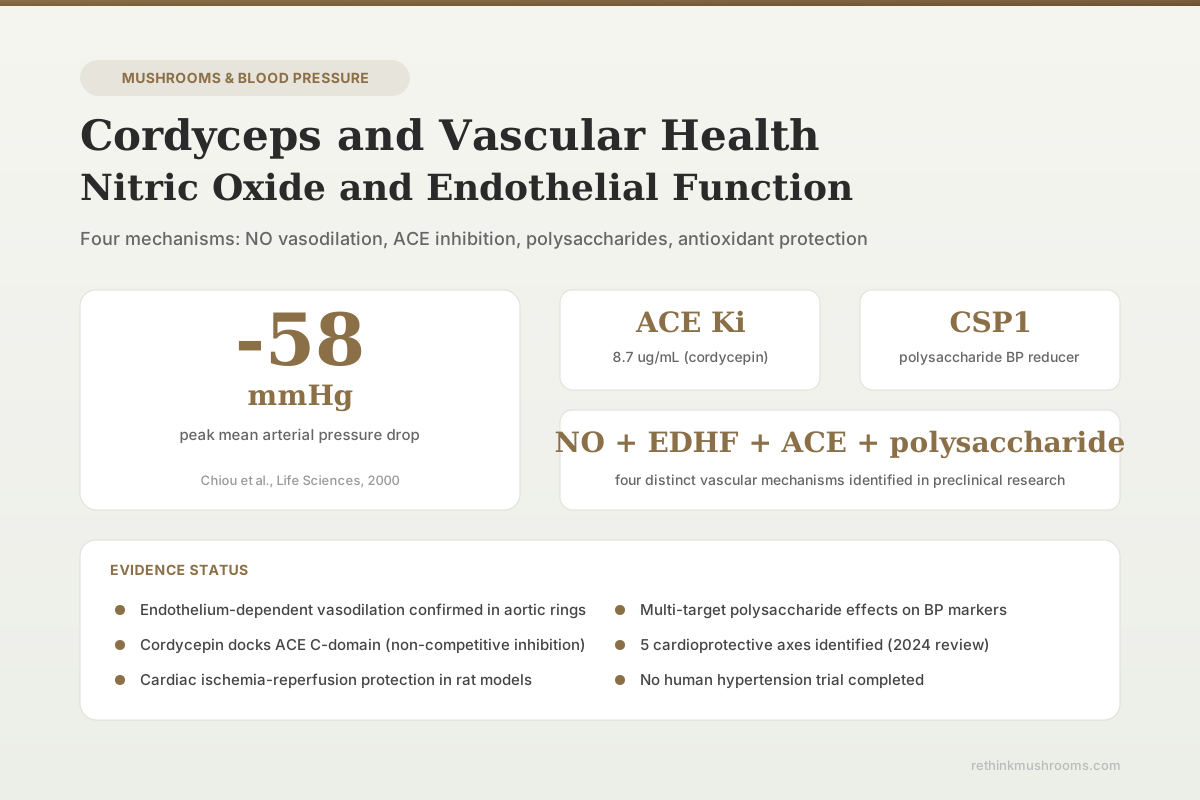
58 mmHg peak BP reduction
Chiou et al. (2000) found that intravenous Cordyceps sinensis extract at 32 mg/kg produced a maximal 58 mmHg drop in mean arterial pressure in rats, with endothelium-dependent vasodilation confirmed in isolated aortic rings.
Chiou et al., Life Sciences, 2000
ACE inhibition
cordycepin binds ACE C-domain
NO + EDHF
dual endothelial relaxation factors
CSP1 polysaccharide
reduced BP in hypertensive rats
Chiou et al., Life Sciences, 2000
 View as image ↗
Cordyceps research in vascular biology has moved beyond the general observation that the fungus "lowers blood pressure" to identify specific molecular targets: nitric oxide (NO) synthase activation, endothelium-derived hyperpolarizing factor (EDHF) release, angiotensin-converting enzyme (ACE) inhibition, and polysaccharide-mediated reduction of vasoconstricting hormones. Each mechanism operates through a different protein or pathway, and each has different implications for vascular health. This article traces the evidence for each pathway and identifies where the data supports confident claims versus where gaps remain. For the broader overview of mushrooms and blood pressure, see Can mushrooms replace blood pressure medication? What the evidence says. For reishi-specific ACE research, see Reishi and hypertension: ACE inhibition and vasodilation research.
Key Takeaways
- Chiou et al. (2000) demonstrated that a protein constituent in Cordyceps sinensis reduced mean arterial pressure by up to 58 mmHg in rats and induced endothelium-dependent vasodilation through nitric oxide and endothelium-derived hyperpolarizing factor, operating independently of the ACTH/cAMP pathway
- Valdez-Solana et al. (2022) identified cordycepin as a non-competitive ACE inhibitor with Ki of 8.7 ug/mL, showing molecular docking evidence that cordycepin binds the ACE C-domain and alters the enzyme's spatial conformation
- Xiang et al. (2016) isolated a polysaccharide fraction (CSP1) from Cordyceps sinensis that lowered blood pressure in spontaneously hypertensive rats by increasing NO, decreasing endothelin-1, reducing catecholamines, and suppressing angiotensin II
- Yan et al. (2013) showed Cordyceps sinensis mycelium extracts protected against cardiac ischemia-reperfusion injury in rats by maintaining antioxidant enzyme levels and reducing infarct size
- Li et al. (2024) published a comprehensive review identifying five cardioprotective axes of cordyceps: anti-inflammatory, antioxidant, anti-apoptotic, pro-autophagic, and blood-brain barrier stabilization
- No randomized controlled trial has tested cordyceps for blood pressure reduction in human subjects with hypertension
Nitric Oxide and Endothelial Vasodilation
The most direct evidence for cordyceps affecting vascular tone comes from Chiou et al. (2000), published in Life Sciences. The team tested a water extract of Cordyceps sinensis in two models: whole-animal blood pressure measurement and isolated aortic ring preparations.[1]
Intravenous injection of the extract in rats produced dose-dependent blood pressure reduction. At 8 mg/kg, the effect was modest. At 32 mg/kg, mean arterial pressure dropped by 58 mmHg (plus or minus 4 mmHg), the maximal response. The onset was rapid and the effect sustained.
In isolated aortic rings pre-contracted with phenylephrine, the extract induced dose-dependent relaxation. This relaxation was endothelium-dependent: removing the endothelial cell layer abolished the effect. Two endothelium-derived factors were responsible. Treatment with L-NAME (an NO synthase inhibitor) partially blocked relaxation, confirming NO involvement. Treatment with indomethacin (a cyclooxygenase inhibitor) had no additional blocking effect, ruling out prostacyclin. The remaining relaxation after L-NAME blockade was attributed to endothelium-derived hyperpolarizing factor (EDHF), confirmed by potassium channel blocker experiments.
The active component was proteinaceous. Heat denaturation, protease treatment (pronase), and SDS denaturation all abolished the vasorelaxant activity, while lipid extraction and carbohydrate-cleaving enzymes had no effect. This narrows the bioactive molecule to a protein or polypeptide in the Cordyceps extract.
The clinical relevance: if the vasorelaxant effect depends on an intact protein, oral bioavailability becomes critical. Proteins are typically degraded in the gastrointestinal tract. Whether this specific Cordyceps protein survives digestion, or whether other heat-stable compounds in oral preparations produce the same vascular effects through different mechanisms, is the central unanswered question.
ACE Inhibition by Cordycepin
Angiotensin-converting enzyme converts angiotensin I to angiotensin II, a potent vasoconstrictor. ACE inhibitors are among the most prescribed antihypertensive drugs. Valdez-Solana et al. (2022), published in Life, investigated whether Cordyceps militaris extract could inhibit ACE activity.[2]
The C. militaris extract exhibited non-competitive ACE inhibition with a Ki value of 8.7 ug/mL. Kinetic analysis confirmed non-competitive binding, meaning the active compound binds the enzyme at a site other than the active site, reducing catalytic efficiency without competing with the substrate.
Molecular docking studies identified cordycepin (3'-deoxyadenosine) as the likely inhibitor. Cordycepin showed binding affinity for the ACE C-domain, one of two catalytic domains in somatic ACE. The docking models showed cordycepin interacting with specific amino acid residues in the C-domain cavity, altering the spatial conformation of the enzyme and reducing its capacity to cleave angiotensin I.
This was the first study to use molecular docking to characterize cordycepin-ACE interactions. The non-competitive inhibition mechanism is distinct from standard ACE inhibitor drugs (captopril, enalapril), which compete with angiotensin I for the active site. Whether non-competitive inhibition at these concentrations produces clinically meaningful blood pressure effects in humans is unknown.
For context, the Ki of 8.7 ug/mL is substantially weaker than pharmaceutical ACE inhibitors, which operate at nanomolar concentrations. This does not preclude a contribution to blood pressure regulation in vivo, particularly if cordycepin acts synergistically with other Cordyceps compounds, but it suggests cordyceps is unlikely to replace prescription ACE inhibitors based on ACE binding affinity alone.
Polysaccharide-Mediated Blood Pressure Reduction
Xiang et al. (2016), published in the International Journal of Biological Macromolecules, took a different approach by isolating a polysaccharide fraction (designated CSP1) from Cordyceps sinensis and testing it in spontaneously hypertensive rats (SHR), a genetic model that develops high blood pressure without pharmacological induction.[3]
CSP1 treatment reduced blood pressure through multiple parallel mechanisms. Serum nitric oxide levels increased, promoting vasodilation. Endothelin-1 (ET-1), a potent vasoconstrictor produced by endothelial cells, decreased. Catecholamine levels (epinephrine and norepinephrine, which raise blood pressure through sympathetic activation) dropped. Angiotensin II levels fell.
Beyond direct vascular effects, CSP1 suppressed transforming growth factor beta-1 (TGF-beta-1), which drives vascular remodeling and fibrosis in chronic hypertension, and reduced C-reactive protein (CRP), a marker of systemic inflammation linked to cardiovascular risk.
This multi-target profile distinguishes CSP1 from single-mechanism antihypertensive drugs. The polysaccharide appears to affect the vasodilator/vasoconstrictor balance (NO up, ET-1 down), the neurohormonal axis (catecholamines and angiotensin II down), and the inflammatory/remodeling pathways (TGF-beta-1 and CRP down) simultaneously.
The limitation is familiar: this is an animal model. SHR rats develop hypertension through genetic mechanisms that may not fully replicate human essential hypertension. The dose translation from rat to human is uncertain. No human trial has tested isolated Cordyceps polysaccharide for blood pressure reduction.
Cardiovascular Protection: Ischemia-Reperfusion
Vascular health extends beyond blood pressure to how blood vessels and the tissues they supply respond to acute injury. Yan et al. (2013), published in Phytotherapy Research, tested Cordyceps sinensis mycelium extracts in a rat model of cardiac ischemia-reperfusion (I/R) injury.[4]
I/R injury occurs when blood flow to the heart is interrupted (ischemia) and then restored (reperfusion). The reperfusion phase paradoxically causes additional damage through oxidative stress and inflammatory cascades. Cordyceps treatment maintained levels of antioxidant enzymes (superoxide dismutase, catalase) and reduced markers of oxidative damage in cardiac tissue. Infarct size was smaller in Cordyceps-treated animals compared to controls.
The antioxidant protection aligns with broader cordyceps pharmacology: the fungus consistently shows antioxidant effects across different tissue types and injury models. For vascular health, this means cordyceps may protect blood vessel walls from oxidative damage that contributes to atherosclerosis and endothelial dysfunction over time.
The Comprehensive Review: Five Cardioprotective Axes
Li et al. (2024), published in the Journal of Ethnopharmacology, compiled the full evidence base for cordyceps in ischemic cardiovascular and cerebrovascular injury.[5] The review identified five therapeutic axes through which cordyceps compounds act on cardiovascular tissue: anti-inflammatory (NF-kB suppression, cytokine reduction), antioxidant (Nrf2 activation, ROS scavenging), anti-apoptotic (caspase inhibition, Bcl-2 upregulation), pro-autophagic (clearing damaged cellular components), and blood-brain barrier stabilization (relevant to cerebrovascular protection).
The review also catalogued the specific cordyceps compounds associated with each axis: cordycepin for anti-inflammatory and anti-apoptotic effects, polysaccharides for antioxidant and immune-modulatory effects, adenosine for vasodilation, and cordycepic acid (D-mannitol) for osmotic and renal effects.
This multi-compound, multi-pathway framework explains why cordyceps appears in so many cardiovascular contexts: the fungus contains different bioactive classes that target different parts of the cardiovascular injury cascade.
Cordycepin and Endothelial Cell Biology
Lin et al. (2019), published in Cancers, examined cordycepin's effects on endothelial cells from a different angle: proliferation, migration, and angiogenesis.[6]
Cordycepin suppressed endothelial cell proliferation and migration by inhibiting focal adhesion kinase (FAK) expression. FAK is essential for endothelial cell adhesion, motility, and survival. By suppressing FAK, cordycepin reduced angiogenesis (new blood vessel formation) in experimental models.
This finding appears contradictory to the VEGF-promoting effects seen through HIF-1 activation in hypoxia models. The resolution lies in context: under normal oxygen conditions, cordycepin's anti-angiogenic effect may help prevent pathological vessel growth (as in tumors or diabetic retinopathy). Under hypoxic conditions, the HIF-1 pathway dominates, promoting adaptive angiogenesis. The net effect on vascular health depends on the physiological state.
For vascular health specifically, the anti-proliferative effect on endothelial cells could help prevent neointimal hyperplasia (the excessive cell growth that narrows blood vessels after injury or stent placement). This is speculative based on the mechanism but consistent with the data. For related cellular energy research, see Cordyceps and ATP: how it boosts cellular energy. For metabolic connections, see Cordyceps and blood sugar: hypoglycemic research.
Evidence Assessment
The vascular research on cordyceps includes mechanistically detailed animal and in vitro work across multiple pathways. The NO/EDHF vasodilation pathway is well-characterized. The ACE inhibition mechanism has been identified at the molecular level. The polysaccharide blood pressure effects have been demonstrated in a genetic hypertension model. The cardioprotective effects against I/R injury are consistent across studies.
What is missing: a single well-designed human trial. No randomized controlled trial has tested any cordyceps preparation for blood pressure reduction, endothelial function improvement, or cardiovascular event prevention in human subjects. A 2010 Cochrane protocol for "Cordyceps sinensis for hypertension in adults" was registered but never completed.
The preclinical multi-target profile (simultaneously affecting NO, ACE, catecholamines, angiotensin II, ET-1, and inflammatory markers) makes cordyceps an interesting candidate for cardiovascular research. The absence of human data makes any clinical conclusions premature. For maitake-specific blood pressure data, see Maitake D-fraction and blood pressure regulation.
The Bottom Line
Cordyceps affects vascular health through at least four identified mechanisms: protein-mediated NO/EDHF vasodilation, cordycepin-based ACE inhibition, polysaccharide-driven reduction of vasoconstrictors and inflammatory markers, and antioxidant protection against ischemia-reperfusion injury. All evidence comes from animal and cell culture models. No human clinical trial has tested cordyceps for hypertension or endothelial function.
Frequently Asked Questions
Sources & References
- 1RTHM-00070·Chiou, W F et al. (2000). “Protein constituent contributes to the hypotensive and vasorelaxant activities of Cordyceps sinensis..” Life sciences.Study breakdown →PubMed →↩
- 2RTHM-01628·Valdez-Solana, Mónica A et al. (2022). “Cordyceps militaris Inhibited Angiotensin-Converting Enzyme through Molecular Interaction between Cordycepin and ACE C-Domain..” Life (Basel.Study breakdown →PubMed →↩
- 3RTHM-00842·Xiang, Feixiang et al. (2016). “Therapeutic efficacy of a polysaccharide isolated from Cordyceps sinensis on hypertensive rats..” International journal of biological macromolecules.Study breakdown →PubMed →↩
- 4RTHM-00310·Yan, Xiao-Feng et al. (2013). “Cardiovascular protection and antioxidant activity of the extracts from the mycelia of Cordyceps sinensis act partially via adenosine receptors..” Phytotherapy research : PTR.Study breakdown →PubMed →↩
- 5RTHM-00891·Li, Yong et al. (2024). “Cordyceps: Alleviating ischemic cardiovascular and cerebrovascular injury - A comprehensive review..” Journal of ethnopharmacology.Study breakdown →PubMed →↩
- 6RTHM-00573·Lin, Yi-Ting et al. (2019). “Cordycepin Suppresses Endothelial Cell Proliferation, Migration, Angiogenesis, and Tumor Growth by Regulating Focal Adhesion Kinase and p53..” Cancers.Study breakdown →PubMed →↩