Mushrooms and Blood Pressure
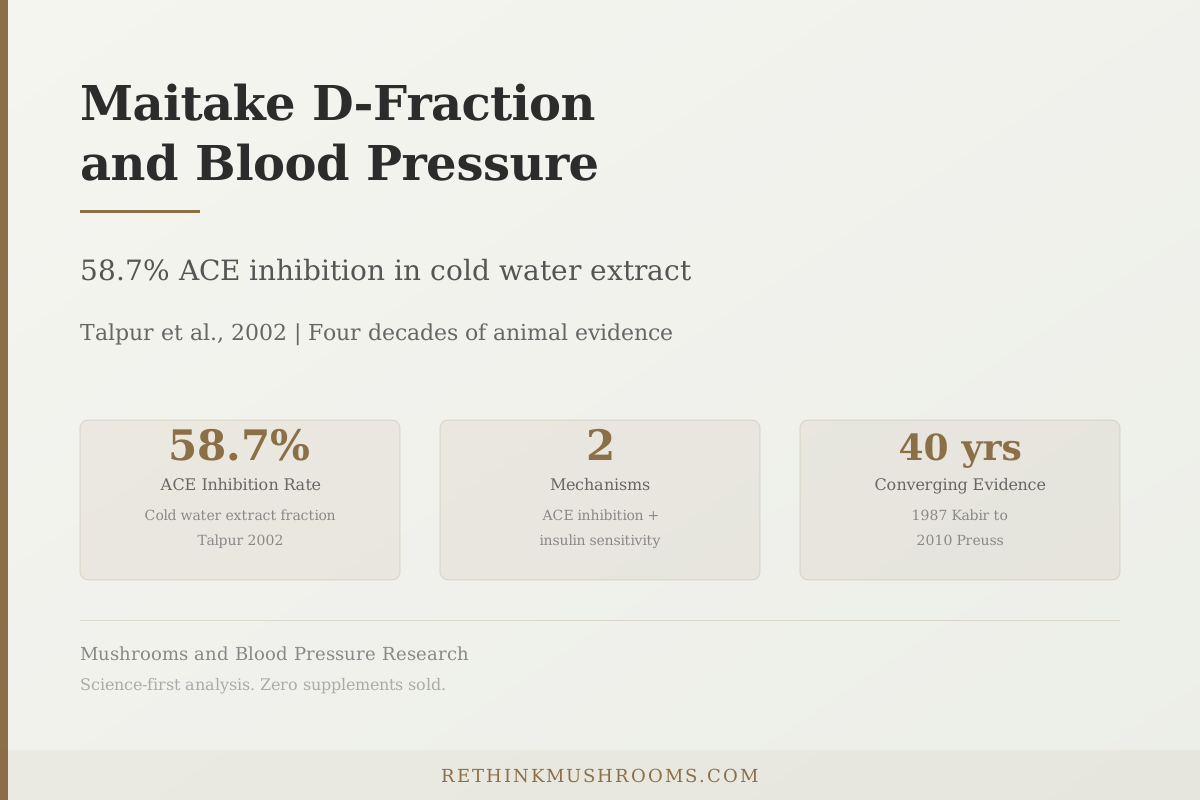
58.7% ACE inhibition
Maitake's cold water extract blocked 58.7% of ACE activity in Talpur's study, the same enzyme pathway targeted by blood pressure medications like lisinopril.
Talpur et al., Molecular and Cellular Biochemistry, 2002
4 decades
of converging animal research
2 mechanisms
ACE inhibition plus insulin sensitivity
Food-level
dietary intake showed effects in 1989
Talpur et al., Molecular and Cellular Biochemistry, 2002
 View as image ↗
Most blood pressure research focuses on one mechanism: block the enzyme that triggers blood vessel constriction, and pressure drops. Lisinopril, enalapril, and ramipril are ACE inhibitor drugs, among the most-prescribed medications globally, and they work exactly that way. What makes maitake mushroom unusual in the blood pressure research literature is that it appears to address the problem through two routes at once: ACE inhibition and improved insulin sensitivity. Insulin resistance quietly drives blood pressure up through sodium retention, increased nervous system activity, and overstimulation of the same hormonal cascade ACE inhibitors target. Maitake's D-fraction, a specific carbohydrate fraction extracted from the mushroom, appears to affect both pathways simultaneously. For a broader look at how multiple mushroom species affect blood pressure, see mushrooms and blood pressure research. For the full cardiovascular picture, see mushrooms and cardiovascular health.
Key Takeaways
- Talpur et al. (2002) found maitake cold water extract produced 58.7% ACE inhibition, the same molecular pathway targeted by lisinopril and enalapril
- Preuss et al. (2010) found maitake extracts slowed progressive hypertension in aging female rats while simultaneously improving glucose metabolism, insulin sensitivity, and lipid profiles
- Kabir and Kimura's 1987 study found maitake reduced blood pressure more strongly than shiitake in spontaneously hypertensive rats, with effects extending to plasma lipid reduction
- The 1989 Kabir study showed food-level dietary mushroom intake, not pharmaceutical doses, was sufficient to reduce blood pressure in hypertensive animal models
- Rauf et al.'s 2023 Phytotherapy Research review positions mushrooms including maitake within DASH diet and Mediterranean diet frameworks, both of which have strong human evidence for blood pressure control
- The entire controlled evidence base for maitake and blood pressure comes from animal studies; no human clinical trials have tested maitake specifically for hypertension
What Maitake D-Fraction Actually Is (and Why the Standardization Matters)
D-fraction is a proteoglycan fraction isolated from maitake mushrooms (Grifola frondosa). A proteoglycan is a protein bonded to long carbohydrate chains. In maitake's case, the carbohydrate portion is a beta-glucan, which is a type of fiber-like molecule made of chains of glucose units with specific branching points. The "D" designation came from early Japanese research that separated maitake extracts into several fractions, labeled A through D, and tested each for biological activity. D-fraction showed the most consistent activity across immune function and metabolic assays, so subsequent research focused on it.
The structural specificity matters here. Not all beta-glucans are the same. Oat beta-glucan is a linear chain with different connection points than maitake D-fraction. Reishi polysaccharides have a different branching pattern still. The specific three-dimensional shape of a beta-glucan determines which receptors it activates in the body, which is why mushrooms with superficially similar "beta-glucan" content can have quite different effects.
Commercial maitake supplements typically standardize to D-fraction content. Raw maitake powder has variable D-fraction levels depending on the mushroom's growth conditions, harvest timing, and post-harvest processing. A bag of raw mushroom powder from two different batches might have substantially different D-fraction concentrations even if the label shows the same weight. Standardized extracts address this variability.
When evaluating the blood pressure research, this matters practically: studies that used D-fraction or a standardized extract are more directly relevant to what a supplement buyer would actually be taking. Studies using whole mushroom powder or raw dietary incorporation reflect what someone might get from cooking with maitake mushrooms.
The 58.7% ACE Inhibition Finding
ACE stands for angiotensin-converting enzyme. It is one key step in how the body raises blood pressure. When the kidneys sense reduced blood flow, they release renin, a hormone that starts a chain reaction. Renin produces a molecule called angiotensin I. ACE converts angiotensin I into angiotensin II, a much more potent molecule that constricts blood vessels and signals the adrenal glands to release a hormone called aldosterone. Aldosterone tells the kidneys to retain sodium and water. Both the vessel constriction and the fluid retention push blood pressure up. Block ACE, and this whole cascade stalls at the conversion step.
Talpur and colleagues tested maitake mushroom powder and several isolated fractions in two different strains of hypertensive rats in 2002.[1] The cold water extract fraction produced 58.7% ACE inhibition in enzyme assay testing. Critically, the study also documented direct blood pressure reductions in the living animals, not just in isolated biochemical tests. That second step, moving from test tube to living organism, is an important methodological threshold.
The 58.7% figure is pharmacologically meaningful. ACE inhibitor drugs work by the same mechanism on the same enzyme. The maitake data does not claim equivalent efficacy to medication, and the animal-to-human translation gap is significant. But it establishes that maitake contains compounds that interact directly with the same biological target.
The Talpur study also documented metabolic improvements alongside the blood pressure effects: changes in insulin sensitivity and lipid profiles. This multi-parameter response foreshadows what the Preuss 2010 study would document more systematically eight years later.
For comparison, reishi has also been studied specifically for ACE inhibitory peptides. Tran's 2014 research identified 11 ACE-inhibitory compounds and characterized four of them with specific potency measurements in the 73.1 to 162.7 micromolar range, which is a standard way of expressing how strongly a compound inhibits an enzyme. Animal studies showed blood pressure effects comparable to losartan at seven weeks. The reishi and hypertension research covers those findings in depth.
Why Maitake Targets Blood Pressure Two Ways at Once
Insulin resistance is a condition where cells throughout the body stop responding properly to insulin's signals. It is the defining metabolic defect in type 2 diabetes and metabolic syndrome, but it is present at subclinical levels in a much larger portion of the population. What is less commonly discussed outside of research is that insulin resistance independently elevates blood pressure through at least three mechanisms.
First, the kidneys: insulin normally promotes sodium excretion, and when that signal is blunted by insulin resistance, the kidneys retain more sodium, which raises blood volume and pressure. Second, the sympathetic nervous system (the system responsible for the "fight or flight" response) stays more tonically active when insulin resistance is present, chronically tightening blood vessels and elevating heart rate. Third, the renin-angiotensin system (the same hormonal cascade ACE inhibitors target) gets overstimulated under insulin-resistant conditions. People with metabolic syndrome or prediabetes often have blood pressure that is harder to control with medication because the drug addresses one pathway while insulin resistance keeps pushing through the others.
Preuss and colleagues published a 2010 study testing maitake extracts in aging female rats with progressive hypertension, meaning hypertension that worsens over time rather than remaining stable.[2] Aging with metabolic disturbance is one of the closest animal models available for the metabolic syndrome-associated hypertension common in older adults.
Maitake did not simply slow the blood pressure progression. It also improved glucose metabolism and insulin sensitivity simultaneously, along with lipid profiles. This multi-factor response is consistent with an intervention acting on metabolic pathways upstream of both the ACE system and the insulin resistance-driven pressure elevation. A narrowly focused ACE inhibitor would lower blood pressure without touching glucose metabolism. Maitake affected both.
This is the connection that commercial maitake content almost entirely misses. The story is not just "maitake inhibits ACE." It is that maitake may interrupt the metabolic conditions that make blood pressure hard to control in the first place, particularly for the large population where insulin resistance and hypertension occur together.
Four Decades of Animal Evidence: 1987 to 2010
The oldest data point in this research pool comes from Kabir and Kimura in 1987, testing both shiitake (Lentinus edodes) and maitake (Grifola frondosa) in spontaneously hypertensive rats.[3] Spontaneously hypertensive rats are a standard animal model where rats develop high blood pressure through genetic inheritance, which provides some parallel to hereditary hypertension in humans.
Both mushrooms reduced blood pressure compared to control-fed rats. Maitake produced a stronger antihypertensive effect than shiitake. The study also documented reductions in plasma lipids, establishing early evidence that maitake's cardiovascular effects extend beyond blood pressure alone. For the comparison between shiitake and maitake on cholesterol specifically, see shiitake and maitake for high cholesterol.
Two years later, the same researchers published a follow-up asking a different question: does food-level dietary incorporation of mushrooms, eating them as part of the diet rather than taking a concentrated extract, produce measurable blood pressure effects?[4] The answer was yes. This matters for an important practical reason. Most medicinal mushroom studies use concentrated extracts, which raises a legitimate question about whether simply eating maitake mushrooms for dinner is biologically relevant or whether the effect only appears at pharmaceutical concentrations. The 1989 Kabir data suggests food-level intake does carry some effect, at least in hypertensive animal models.
Then in 2002, Talpur quantified the ACE inhibition mechanism with specific inhibition data. In 2010, Preuss extended the evidence to chronic, progressive hypertension in aging animals, adding the insulin resistance dimension. Four separate research groups, across four decades, using different animal models and different extract preparations, arrived at consistent conclusions. That convergence across time and methodology provides more confidence than any single large-scale study.
Whole Mushroom vs. Extract: What the 2023 Review Adds
Rauf and colleagues published the most comprehensive review of mushrooms and hypertension yet produced in Phytotherapy Research in 2023.[5] The review covers all studied mushroom species and all identified antihypertensive mechanisms.
Two aspects of the Rauf 2023 framing are particularly relevant here. First, the review explicitly positions mushrooms within DASH diet and Mediterranean diet frameworks. The DASH diet (Dietary Approaches to Stop Hypertension) is the most rigorously studied dietary pattern for blood pressure reduction, with decades of randomized trial evidence showing it lowers systolic blood pressure by 8 to 14 mmHg in hypertensive individuals. Mushrooms appear in the DASH framework as part of the food pattern, not as isolated supplements. This contextualizes maitake as a component of an overall dietary approach that already has human evidence, rather than as a standalone therapeutic agent.
Second, the Rauf review identifies the multiple bioactive contributors to antihypertensive effects across mushroom species: amino acids, dietary fiber, proteins, sterols, B vitamins, and minerals including potassium. Potassium promotes sodium excretion through the kidneys and supports vasodilation. Dietary fiber, particularly beta-glucans, reduces arterial stiffness over time. These compounds are present in whole mushrooms at food-level quantities, which helps explain why the Kabir 1989 study found dietary mushroom incorporation effective, not just concentrated extracts.
For standardized D-fraction supplements: they deliver the specific polysaccharide fraction most directly studied for blood pressure effects in a consistent dose. For whole maitake mushrooms as food: the evidence supports measurable effects at dietary intake levels. The two approaches have different reliability profiles, not different mechanisms.
The connection between blood pressure and vascular disease runs in one direction: chronic elevated pressure damages the arterial wall lining, which initiates plaque buildup. For how mushrooms affect that downstream process, see mushrooms and atherosclerosis prevention.
ACE Inhibitory Compounds and Medication Interactions
Because maitake contains compounds that inhibit ACE, combining it with prescription ACE inhibitor drugs (lisinopril, enalapril, benazepril, ramipril, and others) or angiotensin receptor blockers (ARBs such as losartan, valsartan, and olmesartan, which work on a closely related step in the same hormonal pathway) creates the potential for additive blood pressure lowering.
At normal dietary intake levels, meaning eating maitake mushrooms as food, this interaction is unlikely to be clinically meaningful. With high-dose standardized D-fraction extracts, the cumulative ACE inhibitory effect is worth factoring in, particularly for people whose resting blood pressure already runs on the lower end of normal or who experience dizziness when standing up quickly (a sign of orthostatic blood pressure drops).
The Rauf 2023 review notes this interaction potential in its discussion of mushrooms as functional foods for hypertension management. It is practical information for anyone combining high-dose maitake extracts with antihypertensive medication, not a contraindication.
The Bottom Line
Maitake D-fraction has consistently reduced blood pressure in animal models across four decades of research, with a specifically characterized mechanism of 58.7% ACE inhibition documented in Talpur's 2002 study. What distinguishes maitake from other ACE-inhibiting mushrooms is the simultaneous improvement in insulin sensitivity and metabolic parameters found by Preuss in 2010, making it particularly relevant to the metabolic syndrome-associated hypertension that affects a large portion of people with elevated blood pressure. The entire controlled evidence base is from animal studies; no human clinical trials have tested maitake specifically for blood pressure. The 2023 Rauf review positions mushrooms including maitake within DASH dietary frameworks that do carry human evidence for blood pressure reduction.
Frequently Asked Questions
Sources & References
- 1RTHM-00053·Talpur, Nadeem A et al. (2002). “Antihypertensive and metabolic effects of whole Maitake mushroom powder and its fractions in two rat strains..” Molecular and cellular biochemistry.Study breakdown →PubMed →↩
- 2RTHM-00196·Preuss, Harry G et al. (2010). “Maitake mushroom extracts ameliorate progressive hypertension and other chronic metabolic perturbations in aging female rats..” International journal of medical sciences.Study breakdown →PubMed →↩
- 3RTHM-00007·Kabir, Y et al. (1987). “Effect of shiitake (Lentinus edodes) and maitake (Grifola frondosa) mushrooms on blood pressure and plasma lipids of spontaneously hypertensive rats..” Journal of nutritional science and vitaminology.Study breakdown →PubMed →↩
- 4RTHM-00024·Kabir, Y et al. (1989). “Dietary mushrooms reduce blood pressure in spontaneously hypertensive rats (SHR)..” Journal of nutritional science and vitaminology.Study breakdown →PubMed →↩
- 5RTHM-01774·Rauf, Abdur et al. (2023). “Edible mushrooms as potential functional foods in amelioration of hypertension..” Phytotherapy research : PTR.Study breakdown →PubMed →↩