Mushrooms & Atherosclerosis Prevention
86% smaller
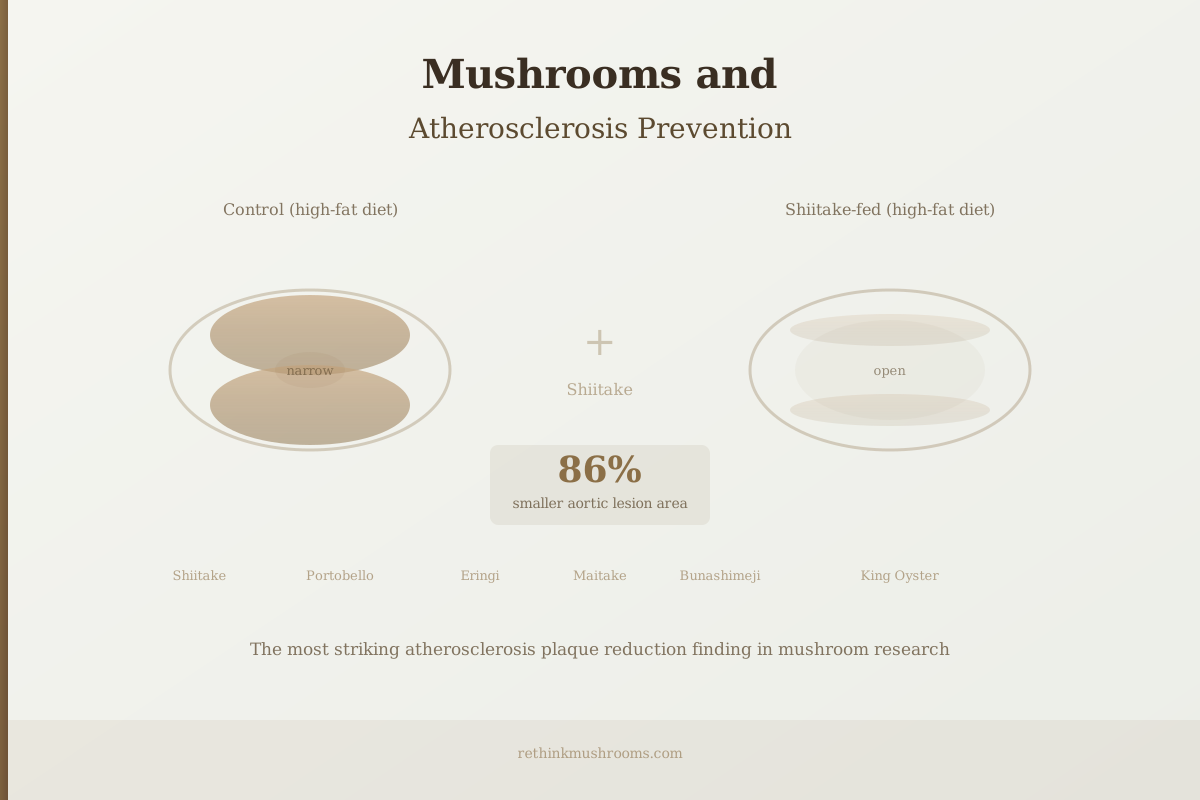
Mice fed shiitake mushrooms on a high-fat diet developed aortic lesions 86% smaller than high-fat controls, with VCAM-1 levels 31–48% lower — the most striking atherosclerosis plaque reduction finding in mushroom research.
Kim et al., Journal of Nutrition, 2019
70%
portobello-fed mice also showed 70% smaller aortic lesion area vs. controls
3 mechanisms
antioxidant, anti-inflammatory, and hypolipidemic — all documented in mushroom research
5+ species
shiitake, portobello, eringi, maitake, bunashimeji all reduce lesions in mouse models
Kim et al., Journal of Nutrition, 2019
 View as image ↗
Mushrooms and atherosclerosis prevention is a combination that consumer health content has almost entirely ignored. That gap is strange, because the animal model data is among the most specific in mushroom cardiovascular research. A 2019 study in the Journal of Nutrition found that mice on a high-fat diet who were also fed shiitake mushrooms developed aortic lesions 86% smaller than controls — and their VCAM-1 levels (the adhesion molecule that recruits immune cells to arterial walls) were 31 to 48% lower. The same study found portobello mushrooms reduced lesion area by 70%.[1]
Atherosclerosis is the buildup of plaque inside arteries — the underlying process behind most heart attacks and strokes. It begins with oxidative damage to the cells lining arterial walls and progresses through a well-characterized cascade: oxidized LDL triggers endothelial cells to display adhesion molecules, immune cells dock and migrate into the artery wall, and they transform into cholesterol-filled foam cells that accumulate into plaque. Multiple mushroom compounds act on this cascade at multiple steps.
This article maps those mechanisms, covers the landmark animal model studies, and connects them to the population data that adds human context. For the broader picture of mushroom cardiovascular research, including cholesterol-lowering data and clinical trial evidence, Mushrooms That Lower Cholesterol: What the Research Shows is the pillar article for this cluster.
Key Takeaways
- Shiitake-fed mice on a high-fat diet had aortic lesions 86% smaller than high-fat controls, with VCAM-1 levels 31–48% lower; portobello reduced lesions 70% (Kim et al., Journal of Nutrition, 2019)
- A 2018 systematic review identified three convergent mechanisms: antioxidant LDL protection, anti-inflammatory adhesion molecule suppression, and hypolipidemic effects (Amirullah et al., Food Research International, 2018)
- ApoE-deficient mice fed eringi, maitake, or bunashimeji all had significantly smaller atherosclerotic lesion areas than controls, with accompanying lipid profile improvements (Mori et al., Nutrition, 2008)
- Ergothioneine blocks monocyte adhesion to endothelial cells and inhibits foam cell formation in cell studies — a mechanism acting at the two earliest steps of plaque development (Zhu et al., 2010)
- Regular mushroom consumers had significantly lower all-cause and CVD mortality in two NHANES cohorts, providing the only human-level signal in the current evidence base (Ba et al., 2021)
- All direct atherosclerosis data — plaque size, lesion area — comes from animal models; no human trial has tested whether eating mushrooms reduces arterial plaque
What Mushrooms and Atherosclerosis Prevention Means in Practice
Atherosclerosis prevention through diet means interrupting the plaque-formation cascade before arterial damage becomes irreversible. The three mechanisms that mushroom research has documented doing this are: protecting LDL from the oxidative modification that initiates endothelial damage, suppressing the adhesion molecules that allow immune cells to dock on arterial walls, and inhibiting the foam cell formation that physically builds plaque.
A 2018 systematic review by Amirullah et al. in Food Research International synthesized the evidence across species and concluded that mushrooms attenuate atherosclerosis through all three of these pathways.[2] The review identified anti-oxidative, anti-inflammatory, and hypolipidemic mechanisms operating simultaneously in different compounds within the same species.
This three-pronged action is mechanistically significant. Statins lower cholesterol but do not directly protect LDL from oxidation or suppress endothelial adhesion molecule expression. Aspirin is anti-inflammatory but does not lower lipids or protect LDL. Mushrooms appear to hit all three targets through different compounds — polysaccharides for immune modulation, polyphenols and ergothioneine for antioxidant LDL protection, and triterpenes for anti-inflammatory activity.
The Kim 2019 Study: 86% Smaller Lesions in Shiitake-Fed Mice
Kim et al. 2019 in the Journal of Nutrition used Ldlr-knockout mice — animals that lack the receptor that clears LDL from blood and develop atherosclerosis readily on high-fat diets — to test whether edible mushrooms could interrupt plaque development.[1]
The mice were divided into groups: high-fat diet alone, high-fat diet with shiitake, and high-fat diet with portobello. At the end of the study, researchers measured aortic lesion area — the surface area of atherosclerotic plaque in the aorta. Shiitake-fed mice had lesion areas 86% smaller than the high-fat control group. Portobello-fed mice had lesion areas 70% smaller.
Concurrent with the plaque data, VCAM-1 expression was 31 to 48% lower in the mushroom-fed groups. VCAM-1 is the adhesion molecule that damaged endothelial cells use to recruit monocytes from the blood — the cellular docking station that initiates plaque formation. Reduced VCAM-1 alongside reduced plaque area provides mechanistic context: less adhesion molecule expression means fewer immune cells recruited, means less foam cell accumulation, means less plaque.
This study is cited extensively in academic literature but appears in no consumer health article about mushrooms. The 86% reduction number is the most striking quantitative finding in mushroom atherosclerosis research.
The limitation: Ldlr-knockout mice are a very aggressive model. These animals cannot clear LDL from their blood without the receptor, and they develop atherosclerosis far faster and more severely than healthy humans on any diet. The magnitude of effect in humans on mushroom supplementation would almost certainly be smaller. But the direction of the effect — reduced plaque — is what the study establishes.
The Full Mechanism Chain: How Mushrooms Interrupt Plaque at Each Step
Atherosclerosis follows a sequence. Understanding where mushroom compounds intervene helps clarify what the research is actually showing.
Step 1: LDL Oxidation. Unoxidized LDL does not directly trigger endothelial damage. When LDL particles are oxidized — by free radicals, metal ions, or enzymatic activity — they become a signal of tissue danger. Multiple mushroom compounds protect LDL from this oxidation. Ergothioneine chelates the metal ions that catalyze oxidative reactions and scavenges singlet oxygen — making it an upstream protector of LDL. Lam-Sidun et al. 2021 reviewed the preclinical evidence and identified LDL protection, endothelial preservation, and foam cell inhibition as the three core cardiovascular mechanisms for ergothioneine in mushrooms.[11]
Step 2: Endothelial Adhesion Molecule Expression. Once LDL is oxidized, endothelial cells express VCAM-1, ICAM-1, and E-selectin. Martin et al. 2010 found that white button, shiitake, oyster, and maitake mushrooms each independently reduced VCAM-1 and ICAM-1 expression in human aortic endothelial cells, cutting monocyte adhesion by up to 60%.[3] This is the step that Kim 2019 measured indirectly through VCAM-1 levels in the mouse aortas. For more detail on this mechanism, Mushroom Antioxidants and Endothelial Damage covers the cell-level data across nine studies.
Step 3: Monocyte Adhesion and Infiltration. Ergothioneine — found almost exclusively in mushrooms — directly inhibits monocyte adhesion to human aortic endothelial cells in cell studies, as Zhu et al. 2010 established.[4] This is the immune cell docking step that bridges endothelial activation and plaque formation. The 21-year cohort data connecting plasma ergothioneine to lower CVD mortality is covered in detail in the ergothioneine and cardiovascular disease article.
Step 4: Foam Cell Formation. After monocytes enter the artery wall, they absorb oxidized LDL and become foam cells. King oyster mushroom polysaccharide reduced lipid accumulation in macrophage-derived foam cells in cell studies — acting directly on this step.[5] Ergothioneine also reduced macrophage-to-foam cell conversion in the Zhu 2010 model.
Step 5: Inflammatory Amplification. Foam cells secrete cytokines that amplify the inflammatory environment, accelerating plaque growth. Ganoderic acids from reishi suppressed NF-κB and AP-1 signaling and reduced TNF-α, IL-6, and IL-8 secretion in cell studies, directly targeting this amplification loop.[9] The reishi triterpene data is covered in detail in How Reishi Triterpenes Protect Against Arterial Plaque Buildup.
Multiple Species in ApoE Mouse Models: The Mori 2008 Data
The Kim 2019 study is the most recent and most striking, but Mori et al. 2008 in Nutrition established earlier that multiple mushroom species independently reduce atherosclerotic lesion area in a different model — ApoE-deficient mice.[6] ApoE mice lack a protein that helps clear lipoproteins from the bloodstream and develop progressive atherosclerosis on a standard diet.
Mori's group fed these mice diets supplemented with eringi (Pleurotus eryngii, king oyster), maitake (Grifola frondosa), or bunashimeji (Hypsizygus marmoreus) and measured atherosclerotic lesion area alongside lipid profiles. All three species significantly reduced lesion area compared to unsupplemented ApoE-deficient controls. Lipid profiles improved as well — an effect that is likely separate from the direct plaque inhibition, since lipid lowering and adhesion molecule suppression are distinct mechanisms operating through different compounds.
A third ApoE mouse study — Yang et al. 2017 in Environmental Toxicology — found that antrodia camphorata extract significantly reduced atherosclerotic plaque in ApoE-deficient mice also exposed to cigarette smoke, while simultaneously reducing ROS production in vascular smooth muscle cells.[12] This extends the species evidence beyond shiitake, portobello, eringi, maitake, and bunashimeji to a medicinal species with a distinct antioxidant mechanism.
The consistency across species in three independent mouse model studies strengthens the conclusion that anti-atherosclerotic activity is a general property of edible and medicinal mushrooms rather than a trait of one specific species.
The Human Mortality Signal: From Mouse Arteries to Population Data
Animal models show plaque reduction. What do human-level data show? Two NHANES studies from Ba et al. in 2021 provide the only population-level signal currently available.
The first Ba study used NHANES III, a US prospective cohort, and found that regular mushroom consumers had significantly lower all-cause mortality and lower CVD mortality compared to non-consumers.[7] The second expanded to NHANES 2003-2014 and incorporated a meta-analysis, finding consistent mortality associations across the larger and more recent cohort.[8]
These dietary studies cannot attribute the effect to anti-atherosclerotic activity specifically — people who eat more mushrooms differ from those who eat fewer in many ways. But the Smith 2020 Swedish cohort, which directly measured plasma ergothioneine (a mushroom-exclusive antioxidant) in 3,236 adults and tracked cardiovascular outcomes for 21.4 years, found a significant association between higher ergothioneine and lower coronary disease and CVD mortality.[10]
Taken together: animal models show 70-86% reductions in atherosclerotic lesion area; cell studies identify the specific molecular mechanisms involved; a mushroom-exclusive compound shows a prospective epidemiological signal over 21 years; and two NHANES cohorts show lower CVD mortality in mushroom eaters. The evidence base is preclinical-heavy but unusually consistent in direction.
What the Evidence Does and Doesn't Show
The evidence for mushrooms and atherosclerosis prevention has a clear limitation: there are no human atherosclerosis trials. The Kim 2019 86% plaque reduction is in mice with a genetic mutation that causes extreme LDL accumulation. The Mori 2008 data is in mice that cannot clear lipoproteins due to ApoE deficiency. These are useful research models, but they are not healthy humans eating shiitake mushrooms.
No study has measured arterial plaque — via CT angiography, carotid intima-media thickness, or any other imaging method — in humans randomly assigned to eat or not eat mushrooms for an extended period. That study does not exist. The mechanistic evidence from cell models and the mortality associations from population studies suggest that such a trial would be worth doing, but it has not been done.
What the evidence establishes is that the biological mechanisms for mushroom-mediated atherosclerosis protection exist and are pharmacologically specific. Multiple compounds act on multiple steps of the plaque-formation cascade. Multiple species show consistent activity in mouse models. A mushroom-exclusive compound shows a prospective epidemiological signal in humans. That is a coherent evidence base for a dietary intervention. It is not proof of clinical efficacy in humans.
The Bottom Line
Shiitake-fed mice developed atherosclerotic lesions 86% smaller than high-fat controls; portobello-fed mice showed 70% reduction. Multiple mushroom species reduce plaque in ApoE mouse models, and cell studies identify the specific mechanisms — LDL oxidation protection, adhesion molecule suppression, and foam cell inhibition. All direct plaque data is from animal models; no human atherosclerosis trial exists.
Frequently Asked Questions
Sources & References
- 1RTHM-01075·Kim, Sharon H et al. (2019). “Edible Mushrooms Reduce Atherosclerosis in Ldlr-/- Mice Fed a High-Fat Diet..” The Journal of nutrition.Study breakdown →PubMed →↩
- 2RTHM-00937·Amirullah, Nur Amalina et al. (2018). “The potential applications of mushrooms against some facets of atherosclerosis: A review..” Food research international (Ottawa.Study breakdown →PubMed →↩
- 3RTHM-00354·Martin, Keith R (2010). “Both common and specialty mushrooms inhibit adhesion molecule expression and in vitro binding of monocytes to human aortic endothelial cells in a pro-inflammatory environment..” Nutrition journal.Study breakdown →PubMed →↩
- 4. Source details for this reference are not yet available.
- 5RTHM-00534·Wei, Hua et al. (2018). “Lipid-Lowering Effect of the Pleurotus eryngii (King Oyster Mushroom) Polysaccharide from Solid-State Fermentation on Both Macrophage-Derived Foam Cells and Zebrafish Models..” Polymers.Study breakdown →PubMed →↩
- 6RTHM-00267·Mori, Koichiro et al. (2008). “Antiatherosclerotic effect of the edible mushrooms Pleurotus eryngii (Eringi), Grifola frondosa (Maitake), and Hypsizygus marmoreus (Bunashimeji) in apolipoprotein E-deficient mice..” Nutrition research (New York.Study breakdown →PubMed →↩
- 7RTHM-00673·Ba, Djibril M et al. (2021). “Association of mushroom consumption with all-cause and cause-specific mortality among American adults: prospective cohort study findings from NHANES III..” Nutrition journal.Study breakdown →PubMed →↩
- 8RTHM-00674·Ba, Djibril M et al. (2021). “Prospective study of dietary mushroom intake and risk of mortality: results from continuous National Health and Nutrition Examination Survey (NHANES) 2003-2014 and a meta-analysis..” Nutrition journal.Study breakdown →PubMed →↩
- 9RTHM-00152·Dudhgaonkar, Shailesh et al. (2009). “Suppression of the inflammatory response by triterpenes isolated from the mushroom Ganoderma lucidum..” International immunopharmacology.Study breakdown →PubMed →↩
- 10RTHM-00655·Smith, Einar et al. (2020). “Ergothioneine is associated with reduced mortality and decreased risk of cardiovascular disease..” Heart (British Cardiac Society).Study breakdown →PubMed →↩
- 11RTHM-00696·Lam-Sidun, Daniel et al. (2021). “Mushroom-Derived Medicine? Preclinical Studies Suggest Potential Benefits of Ergothioneine for Cardiometabolic Health..” International journal of molecular sciences.Study breakdown →PubMed →↩
- 12RTHM-00500·Yang, Hsin-Ling et al. (2017). “Antrodia camphorata attenuates cigarette smoke-induced ROS production, DNA damage, apoptosis, and inflammation in vascular smooth muscle cells, and atherosclerosis in ApoE-deficient mice..” Environmental toxicology.Study breakdown →PubMed →↩