Mushrooms & Atherosclerosis Prevention
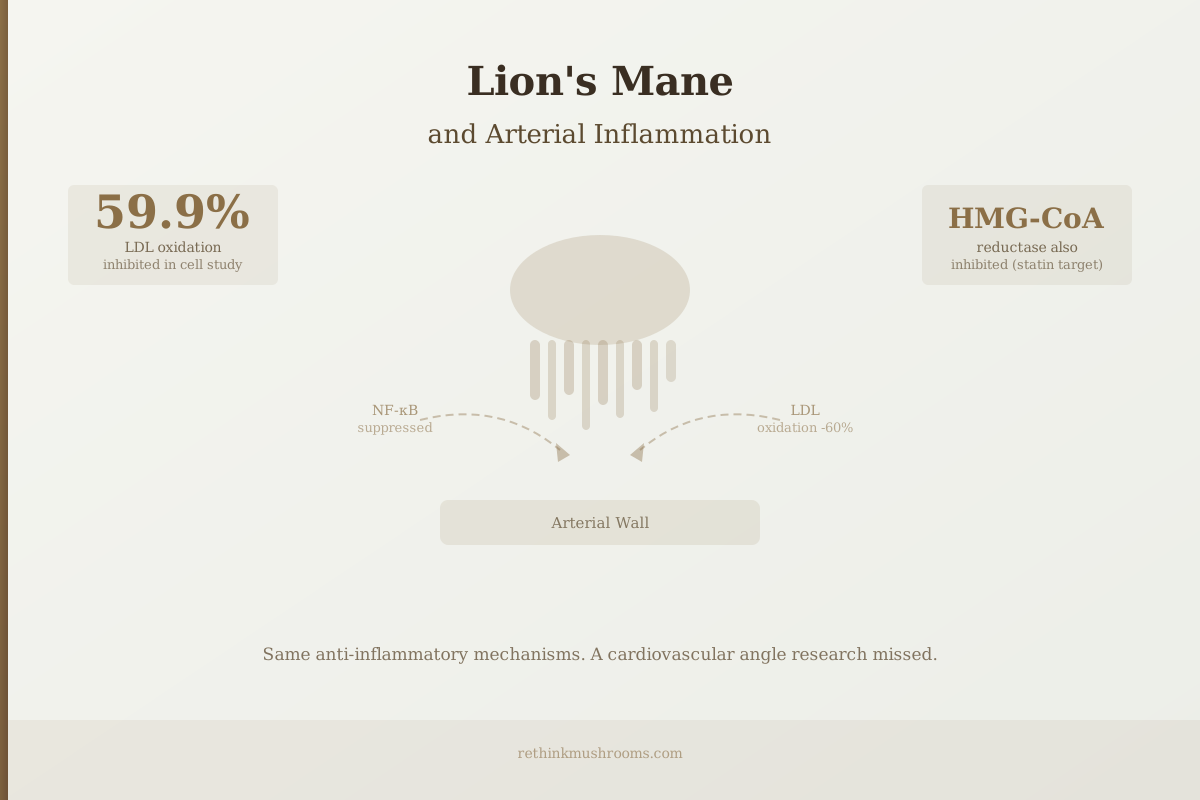
59.91%
A 2014 cell study found that a lion's mane hexane fraction inhibited human LDL oxidation by 59.91% — the most specific cardiovascular mechanism data on record for this species, absent from every consumer health article.
Rahman et al., BioMed Research International, 2014
NF-κB
inflammation pathway suppressed by lion's mane compounds across multiple studies
HMG-CoA
reductase activity also inhibited in the same 2014 cell study
2025
two systematic reviews confirm multi-target anti-inflammatory mechanisms
Rahman et al., BioMed Research International, 2014
 View as image ↗
Most people who have heard of lion's mane know it for nerve growth factor and brain health. That reputation is earned. But the same compounds that act on neurological inflammation — hericenones, erinacines, and polysaccharides — also target the inflammatory pathways driving arterial plaque development. The research on lion's mane and heart disease is entirely preclinical, but the mechanism data is specific enough to be worth understanding on its own terms.
This is not a reframing exercise. The cardiovascular angle on lion's mane is genuinely underexplored. The 2014 study showing nearly 60% inhibition of LDL oxidation and direct suppression of HMG-CoA reductase activity does not appear in any consumer health article on this species. Neither does the adipocyte-macrophage coculture study from 2015 showing lion's mane reducing the cytokines that drive arterial inflammation under metabolic conditions.
For the broader view of how mushrooms prevent plaque formation through antioxidant, anti-inflammatory, and hypolipidemic mechanisms, Mushrooms That Lower Cholesterol: What the Research Shows is the pillar article for this cluster. This article goes deep on lion's mane specifically.
Key Takeaways
- A 2014 cell study found lion's mane hexane fraction inhibited human LDL oxidation by 59.91% and also suppressed HMG-CoA reductase activity — two mechanisms directly relevant to atherosclerotic plaque initiation (Rahman et al., 2014)
- In an adipocyte-macrophage coculture model mimicking metabolic inflammation, lion's mane reduced secretion of TNF-α, IL-6, and MCP-1 from macrophages — the same cytokines that drive plaque development in arterial walls (Mori et al., 2015)
- Lion's mane compounds suppress NF-κB activation, the molecular switch that turns on pro-inflammatory gene expression throughout the cardiovascular system (Qin et al., 2016)
- Friedman's 2015 comprehensive review identified COX-2 and iNOS as specific targets of hericenone inhibition, and pro-atherogenic cytokine suppression as a documented action of lion's mane polysaccharides
- Two 2025 systematic reviews confirm lion's mane has consistent anti-inflammatory and antioxidant mechanisms including NF-κB inhibition and cytokine suppression, though cardiovascular applications remain at the preclinical stage
- No human clinical trial has tested lion's mane specifically for arterial inflammation or cardiovascular disease outcomes
Why Lion's Mane's Anti-Inflammatory Profile Is Relevant to Arterial Walls
Arterial inflammation and neurological inflammation share the same molecular machinery. Both involve NF-κB, the central switch that turns on genes for inflammation. Both involve elevated TNF-α, IL-6, and IL-1β — cytokines that signal tissue damage and recruit immune cells to the site. Both involve oxidative stress generating reactive oxygen species that damage surrounding cells.
The reason lion's mane has been researched so heavily for neurological inflammation is partly historical: the nerve growth factor connection made it a uniquely interesting candidate for Alzheimer's and cognitive decline research, which attracts funding. But hericenones and erinacines that suppress NF-κB in brain cells suppress the same pathway in macrophages. Polysaccharides that reduce cytokine secretion in neuroimmune studies reduce the same cytokines that drive arterial plaque development.
This does not mean lion's mane is equivalent to a cardiovascular drug. It means the biological overlap is real, the mechanism data exists, and the reason competitors do not cover it is not because the evidence is weak — it is because the cardiovascular angle has not been the primary research focus.
The Coculture Study Competitors Don't Cover
The most directly cardiovascular-relevant lion's mane study is Mori et al. 2015, published in the International Journal of Medicinal Mushrooms.[1] The experimental model was a coculture of 3T3-L1 adipocytes and RAW264 macrophages — two cell types that, when cultured together under lipid-loading conditions, recreate the inflammatory crosstalk that occurs in metabolically inflamed fat tissue.
This coculture model is relevant to cardiovascular disease because metabolic inflammation in fat tissue is a major driver of the systemic low-grade inflammation that accelerates arterial plaque formation. Inflamed adipocytes and activated macrophages secrete TNF-α, IL-6, and MCP-1 into the bloodstream. Those cytokines reach the arterial wall and promote the endothelial activation, monocyte adhesion, and foam cell formation that build plaque.
In Mori's system, lion's mane extract reduced the secretion of all three: TNF-α, IL-6, and MCP-1 from the macrophages in the coculture. This is not a generic anti-inflammatory result. Reducing MCP-1 (monocyte chemoattractant protein-1) specifically is notable because MCP-1 is one of the primary signals that draws monocytes toward atherosclerotic lesions in arterial walls.
The 2025 systematic review by Menon et al. in Frontiers in Nutrition reviewed clinical and preclinical evidence for lion's mane supplementation across multiple body systems and concluded that anti-inflammatory and antioxidant benefits are consistently observed across studies, while noting that direct cardiovascular applications remain at the preclinical stage.[5]
How Lion's Mane Reduces Arterial Inflammation: Five Documented Mechanisms
The 2015 comprehensive review by Friedman in the Journal of Agricultural and Food Chemistry mapped the specific bioactive compounds and their inflammatory targets.[6] Here is what the research has established:
- Hericenone inhibition of COX-2 and iNOS. These enzymes drive prostaglandin production and nitric oxide signaling under inflammatory conditions. Both are upregulated in arterial plaque lesions.
- Polysaccharide suppression of pro-atherogenic cytokines. Specifically TNF-α, IL-6, and IL-1β — the same cytokines elevated in patients with atherosclerosis.
- NF-κB pathway suppression. NF-κB is the master switch for pro-inflammatory gene expression. When lion's mane extract is present, NF-κB activation is reduced (Qin et al., 2016).
- LDL oxidation inhibition. The hexane fraction of lion's mane inhibited human LDL oxidation by 59.91% in cell studies — preventing the conversion of LDL into the oxidized form that initiates plaque (Rahman et al., 2014).
- HMG-CoA reductase activity inhibition. The same Rahman 2014 study found suppression of this enzyme, which is the molecular target of statin drugs for cholesterol management.
The convergence of these five mechanisms on the atherosclerosis pathway is what makes lion's mane a legitimate cardiovascular research candidate. Each mechanism hits a different step of the same cascade.
The LDL Oxidation Data: A Finding No Competitor Has Covered
Rahman et al. 2014 in BioMed Research International is the most pharmacologically specific lion's mane cardiovascular study, and it appears in none of the consumer health content about this mushroom.[2] The researchers tested liquid-liquid partitioned fractions of lion's mane fruiting body against two specific cardiovascular targets: human LDL oxidation and HMG-CoA reductase activity.
The hexane fraction showed 59.91% inhibition of LDL oxidation under a copper-catalyzed assay — a standardized model for how LDL becomes atherogenic in the presence of metal ions. This matters because oxidized LDL is not just a correlation with plaque; it is the substrate that macrophages absorb to become foam cells, the structural unit of arterial plaque. Reducing LDL oxidation interrupts plaque initiation.
The same fraction inhibited HMG-CoA reductase, the enzyme that controls cholesterol synthesis in the liver. This is the pathway that statin drugs target. A 60% reduction in LDL oxidation and measurable HMG-CoA reductase inhibition from a single fraction of an edible mushroom is pharmacologically meaningful data. The study is in vitro, so direct translation to eating lion's mane requires considerable caution. But the molecular target specificity is real.
For comparison, the ergothioneine research covered in the companion article on ergothioneine and cardiovascular disease shows a different mechanism: blocking monocyte adhesion to arterial walls. Lion's mane appears to act further upstream, at LDL oxidation, while also sharing the NF-κB suppression pathway. These mechanisms are complementary, not redundant.
NF-κB and the Animal Data
Qin et al. 2016 in the International Journal of Medicinal Mushrooms tested lion's mane ethanol extract in a mouse colitis model and found that it significantly reduced TNF-α, IL-1β, and IL-6 in the colon, while inhibiting NF-κB activation.[3] The study was designed for inflammatory bowel disease, not cardiovascular disease. But NF-κB inhibition is not tissue-specific. It operates the same way in gut tissue, brain tissue, and arterial tissue — wherever inflammation is being driven by this pathway.
The 2025 narrative review by Contato and Conte-Junior in Nutrients synthesized lion's mane bioactive evidence through 2024 and confirmed that NF-κB inhibition and cytokine suppression are the best-characterized anti-inflammatory mechanisms, with antioxidant activity documented across multiple model systems.[4] The review also flagged the gap: cardiovascular evidence is mechanistically coherent but has not yet been tested in human cardiovascular disease models.
For how these NF-κB-mediated inflammatory mechanisms connect specifically to arterial plaque — including the VCAM-1 and ICAM-1 adhesion molecule data from other mushroom species — Mushroom Antioxidants and Endothelial Damage: Stopping Atherosclerosis at the Source covers the endothelial damage cascade across species.
What the Evidence Honestly Cannot Say
Every cardiovascular mechanism study on lion's mane is in vitro or in animal models unrelated to atherosclerosis specifically. There is no human trial of lion's mane for arterial inflammation markers. There is no mouse atherosclerosis study using lion's mane comparable to the shiitake and portobello studies in ApoE-deficient or Ldlr-deficient models. The closest is the colitis model, which used NF-κB as a readout — a relevant pathway, but not a cardiovascular endpoint.
Menon et al. 2025 confirmed this in their systematic review: benefits are consistently seen across multiple body systems in preclinical models, but cardiovascular-specific human evidence does not yet exist.[5]
The honest framing is this: lion's mane has documented activity on the specific molecular pathways that drive arterial inflammation and plaque formation. That activity is real and pharmacologically specific. Whether eating lion's mane mushrooms or taking lion's mane supplements translates to measurable reduction in arterial inflammation in humans is an open question that current evidence cannot answer.
For species with published atherosclerosis data in animal models — shiitake, portobello, eringi, maitake — see Mushrooms and Atherosclerosis Prevention: Anti-Plaque Research, which covers those direct plaque studies.
The Bottom Line
Lion's mane contains compounds that inhibit NF-κB, suppress pro-atherogenic cytokines in macrophages, block LDL oxidation by nearly 60%, and inhibit HMG-CoA reductase activity — all documented in cell and animal studies. The cardiovascular evidence is mechanistically specific and consistently underreported. No human trial has tested lion's mane against arterial inflammation or heart disease outcomes directly.
Frequently Asked Questions
Sources & References
- 1RTHM-00726·Mori, Koichiro et al. (2015). “The Anti-Inflammatory Effects of Lion's Mane Culinary-Medicinal Mushroom, Hericium erinaceus (Higher Basidiomycetes) in a Coculture System of 3T3-L1 Adipocytes and RAW264 Macrophages..” International journal of medicinal mushrooms.Study breakdown →PubMed →↩
- 2RTHM-00639·Rahman, Mohammad Azizur et al. (2014). “Inhibitory effect on in vitro LDL oxidation and HMG Co-A reductase activity of the liquid-liquid partitioned fractions of Hericium erinaceus (Bull.) Persoon (lion's mane mushroom)..” BioMed research international.Study breakdown →PubMed →↩
- 3RTHM-00442·Qin, Mingming et al. (2016). “Anti-Inflammatory Effects of Ethanol Extract of Lion's Mane Medicinal Mushroom, Hericium erinaceus (Agaricomycetes), in Mice with Ulcerative Colitis..” International journal of medicinal mushrooms.Study breakdown →PubMed →↩
- 4RTHM-00921·Contato, Alex Graça et al. (2025). “Lion's Mane Mushroom (Hericium erinaceus): A Neuroprotective Fungus with Antioxidant, Anti-Inflammatory, and Antimicrobial Potential-A Narrative Review..” Nutrients.Study breakdown →PubMed →↩
- 5RTHM-00943·Menon, Arya et al. (2025). “Benefits, side effects, and uses of Hericium erinaceus as a supplement: a systematic review..” Frontiers in nutrition.Study breakdown →PubMed →↩
- 6RTHM-00371·Friedman, Mendel (2015). “Chemistry, Nutrition, and Health-Promoting Properties of Hericium erinaceus (Lion's Mane) Mushroom Fruiting Bodies and Mycelia and Their Bioactive Compounds..” Journal of agricultural and food chemistry.Study breakdown →PubMed →↩