Mushrooms & Atherosclerosis Prevention
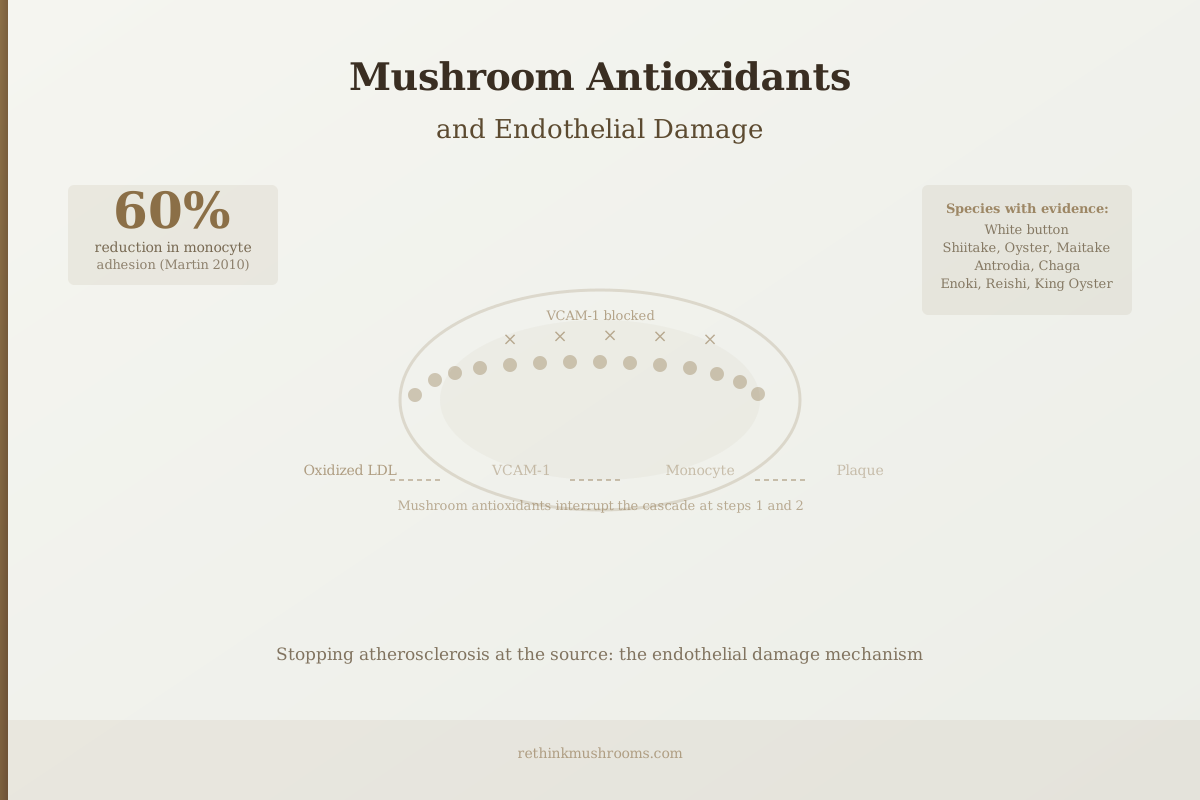
60% reduction
White button, shiitake, oyster, and maitake mushrooms each cut monocyte adhesion to human aortic endothelial cells by up to 60% in cell studies, directly targeting the first step of atherosclerotic plaque formation.
Martin et al., Nutrition Journal, 2010
VCAM-1
adhesion molecule blocked by multiple mushroom species in human cell studies
4 species
white button, shiitake, oyster, and maitake all independently reduced monocyte docking
Antrodia
Taiwan's most-studied hepatoprotective mushroom also protects endothelial cells directly
Martin et al., Nutrition Journal, 2010
 View as image ↗
Mushroom antioxidants and endothelial damage — the combination of those two phrases describes one of the most specific and underreported mechanistic findings in mushroom cardiovascular research. The endothelium is a single-cell-thick layer lining every artery in the body. When it is damaged by oxidative stress, it changes: it starts displaying molecular docking stations on its surface that recruit immune cells from the bloodstream. Those immune cells build arterial plaque. Blocking the docking stations before they appear is the earliest possible intervention in atherosclerosis — and a 2010 cell study found that four common culinary mushrooms do exactly this.
Martin et al. tested common and specialty mushrooms against human aortic endothelial cells in a pro-inflammatory environment. White button mushrooms reduced expression of VCAM-1, ICAM-1, and E-selectin-1 — the three primary adhesion molecules that damaged endothelial cells use to recruit monocytes — and cut monocyte adhesion to those cells by up to 60%. Shiitake, oyster, and maitake produced significant reductions in adhesion molecule expression as well.[1]
This data comes from human aortic endothelial cells, not animal tissue. The cells are the actual cells that line the arteries where atherosclerosis begins. No consumer health article has translated this finding for a general audience.
For the broader landscape of how mushrooms fight atherosclerosis — including plaque size reduction in mouse models and mortality data from population studies — Mushrooms That Lower Cholesterol: What the Research Shows covers the full picture across mechanisms and species.
Key Takeaways
- White button mushrooms reduced VCAM-1, ICAM-1, and E-selectin-1 expression in human aortic endothelial cells, cutting monocyte adhesion by up to 60%; shiitake, oyster, and maitake showed significant effects too (Martin et al., 2010)
- Antrodia camphorata extracts directly protected human endothelial cells from hydrogen peroxide-induced oxidative damage and reduced lipid peroxidation in cell studies (Hseu et al., 2008)
- Antrodia camphorata also protected human LDL from copper-catalyzed oxidative modification, increasing the time before LDL became atherogenic (Yang et al., 2006)
- In ApoE-deficient mice, antrodia camphorata extract significantly reduced atherosclerotic plaque formation while decreasing ROS production in vascular smooth muscle cells (Yang et al., 2017)
- Ergothioneine — found almost exclusively in mushrooms — inhibits monocyte adhesion to endothelial cells and blocks foam cell conversion, a mechanism detailed in the companion ergothioneine article
- Chaga extract attenuated leukocyte rolling, adhesion, and emigration in rat mesenteric microvessels, pointing to microvascular anti-inflammatory activity relevant to early atherosclerosis (Javed et al., 2019)
What Endothelial Damage Is and Why Atherosclerosis Starts There
The inner surface of every artery is coated with endothelial cells. These cells do more than form a smooth barrier; they actively regulate inflammation, control what molecules cross into the artery wall, and signal to immune cells in the blood. When everything is working, endothelial cells present a slippery, non-reactive surface that keeps blood moving freely.
Oxidative stress disrupts this. When LDL cholesterol in the blood becomes oxidized — converted into a more reactive form by free radicals or metal ion catalysis — the endothelium detects the change and responds. Endothelial cells begin expressing surface proteins called VCAM-1 (vascular cell adhesion molecule-1), ICAM-1 (intercellular adhesion molecule-1), and E-selectin. These proteins act as molecular Velcro. Monocytes in the bloodstream have matching receptors and stick to these activated endothelial cells.
Once stuck, monocytes migrate through the endothelium into the artery wall, transform into macrophages, and absorb the oxidized LDL that triggered the alarm in the first place. As they fill with lipid, macrophages become foam cells — the physical building blocks of plaque. The entire cascade begins with endothelial oxidative damage and the appearance of VCAM-1 and ICAM-1.
Blocking those adhesion molecules before monocytes can dock is the earliest possible intervention. This is why the Martin 2010 finding matters: common grocery store mushrooms reduced the specific signals that initiate plaque.
White Button, Shiitake, Oyster, Maitake: The Martin 2010 Study
Martin et al. 2010 in the Nutrition Journal tested both common and specialty mushrooms against human aortic endothelial cells incubated in a pro-inflammatory environment that included TNF-α, a cytokine that mimics conditions in inflamed arterial tissue.[1]
White button mushrooms produced the most pronounced results in the study. They reduced VCAM-1 expression, ICAM-1 expression, and E-selectin-1 expression — all three adhesion molecules simultaneously. In the monocyte binding assay, monocyte adhesion to the endothelial cells dropped by up to 60%. This is not a modest reduction. A 60% decrease in monocyte docking would meaningfully slow the initiation phase of atherosclerosis if the effect held in living arterial tissue.
Shiitake, oyster mushrooms, and maitake independently reduced adhesion molecule expression as well, though the reductions varied by species and were in some cases less pronounced than white button. The finding that multiple species produced significant results is important: this is not a property of one exotic or specialized mushroom. These are grocery-store species acting on the specific molecular triggers of plaque formation in human cells.
The limitation is that this is a cell study. Endothelial cells in a dish respond to mushroom compounds under controlled conditions, but the same compounds must survive digestion, be absorbed, and reach arterial endothelial cells at sufficient concentrations to produce equivalent effects in a living person. That translation has not been tested in human vascular trials.
Antrodia Camphorata: Direct Endothelial Cell Protection
Antrodia camphorata is a rare Taiwanese mushroom studied extensively for liver health, but two early studies establish it as a direct endothelial protector as well.
Hseu et al. 2008 in the Journal of Ethnopharmacology tested antrodia camphorata extract against human umbilical vein endothelial cells (HUVECs) exposed to hydrogen peroxide — a reactive oxygen species that models the oxidative damage that initiates endothelial dysfunction.[2] The extract significantly reduced cell death, decreased lipid peroxidation, and restored antioxidant enzyme activity in the stressed cells. This is not a general antioxidant result — hydrogen peroxide-induced HUVEC damage is a validated model for the kind of oxidative insult that precedes endothelial VCAM-1 expression.
Yang et al. 2006 in the American Journal of Chinese Medicine approached the same problem from the LDL side.[3] Antrodia camphorata submerged-culture extract protected human LDL against copper-catalyzed oxidative modification and increased the lag time before LDL oxidation began. Extended lag time means more time before LDL becomes atherogenic — the form that triggers endothelial VCAM-1 expression in the first place. Protecting LDL from oxidation upstream reduces the signal that causes endothelial cells to activate adhesion molecules downstream.
Together, these two antrodia studies establish protection at two points: the endothelial cell itself and the LDL particle that damages it.
Antrodia in Living Mice: The Yang 2017 Atherosclerosis Study
The cell studies on antrodia are informative, but Yang et al. 2017 in Environmental Toxicology went further: they tested antrodia camphorata extract in ApoE-deficient mice, which develop atherosclerotic plaques spontaneously.[4] The mice in this study were exposed to cigarette smoke, which accelerates vascular oxidative damage and atherosclerosis progression. Antrodia camphorata extract reduced ROS production, DNA damage, and apoptosis in vascular smooth muscle cells exposed to the smoke. More significantly, it also attenuated atherosclerotic plaque formation in the ApoE-deficient mice.
This is the only antrodia study where the endpoint is actual atherosclerotic plaque in a living animal model. The mechanism — reduced ROS production in vascular cells — connects directly to the endothelial oxidative damage pathway. Less oxidative damage to vascular cells means less VCAM-1 expression, less monocyte adhesion, and less plaque.
Ergothioneine: The Monocyte Adhesion Mechanism
Ergothioneine deserves mention here because Zhu et al. 2010 established one of the most mechanistically specific findings in this area: ergothioneine directly inhibits monocyte adhesion to human aortic endothelial cells and reduces the conversion of macrophages into foam cells.[6] Since ergothioneine is found almost exclusively in mushrooms, every culinary mushroom consumed contributes to this protection.
The ergothioneine mechanism was covered in detail in the earlier article on ergothioneine and cardiovascular disease, including the 21-year Swedish cohort data and the transporter biology that concentrates ergothioneine in arterial tissue. The short version here: ergothioneine inhibits the monocyte docking step directly, which is the same step that VCAM-1 facilitates. Mushrooms that reduce VCAM-1 expression (Martin 2010) and ergothioneine that inhibits monocyte binding (Zhu 2010) are acting on the same bottleneck from two different angles.
Chaga's Microvascular Data
Javed et al. 2019 in PLoS ONE took a different approach to vascular inflammation.[7] Rather than testing adhesion molecule expression in cultured cells, they used an intravital microscopy model of rat mesenteric microvessels — a preparation that allows real-time observation of immune cell behavior in living blood vessels. They induced microvascular inflammation with histamine and then applied chaga (Inonotus obliquus) extract.
The chaga extract significantly attenuated leukocyte rolling, adhesion, and emigration in the inflamed microvessels. These three behaviors — rolling along the vessel wall, sticking to it, and crossing through it — are the same sequence that monocytes follow in atherosclerotic arteries during plaque initiation. The rat mesentery is not an aorta, and histamine-induced inflammation is not atherosclerosis. But observing this effect in a living vascular preparation is a step beyond cell culture models, and the mechanism points directly to endothelial activation.
Enoki and Reishi: Extending Species Coverage
Rahman et al. 2015 in Oxidative Medicine and Cellular Longevity tested polyphenolic fractions from enoki (Flammulina velutipes, golden needle mushroom) against human LDL oxidation and radical scavenging activity.[5] The enoki polyphenol fractions inhibited LDL oxidation and demonstrated DPPH radical scavenging capacity, establishing polyphenol-mediated LDL protection as an atherosclerosis-prevention mechanism in this common culinary species.
For a deep dive specifically on enoki and endothelial vascular protection, Enoki and Endothelial Health: Vascular Protection Research covers those mechanisms in detail.
Rahman et al. 2018 in the International Journal of Medicinal Mushrooms found that reishi (Ganoderma lucidum) demonstrated concentration-dependent inhibition of human LDL oxidation in vitro and hypo-cholesterolemic effects in hyperlipidemic animal models, linking reishi's triterpene and polysaccharide content to two distinct atherogenic mechanisms.[9]
Wei et al. 2018 in Polymers found that king oyster mushroom (Pleurotus eryngii) polysaccharide reduced lipid accumulation in macrophage-derived foam cells — the cells that constitute arterial plaque — and showed antiatherosclerotic effects in a zebrafish model.[8] This polysaccharide-mediated foam cell inhibition is a complementary mechanism to the ergothioneine-mediated foam cell inhibition covered earlier, suggesting multiple compounds within the same species act at the same endpoint.
For how cordyceps supports endothelial function through nitric oxide pathways, that cross-cluster article covers a distinct vascular protection mechanism in a different mushroom genus.
What These Studies Can and Cannot Prove
The evidence across these nine studies establishes that multiple mushroom species, compounds, and extracts act on the specific molecular machinery of endothelial damage and atherosclerosis initiation. The mechanisms are specific: VCAM-1 reduction in human aortic endothelial cells, LDL oxidation protection, foam cell inhibition, direct endothelial cell protection from oxidative stress, and microvascular anti-inflammatory activity in living tissue.
What this evidence does not establish: that eating culinary mushrooms prevents atherosclerosis in humans. Every study in this cluster is in vitro or animal-based. The compounds tested — polysaccharides, polyphenols, antrodia extracts — need to survive digestion, reach arterial tissue in effective concentrations, and produce the same effects in a living cardiovascular system under human physiological conditions. None of these steps have been tested in controlled human vascular studies.
The mechanism picture is unusually coherent across species. That coherence is scientifically meaningful — it suggests the cardiovascular activity of mushrooms is a genuine biological phenomenon rather than noise. But coherent preclinical mechanisms do not automatically translate to clinical outcomes.
The Bottom Line
Multiple culinary and medicinal mushroom species block the specific molecular signals that initiate atherosclerotic plaque. Common varieties reduced monocyte adhesion to human aortic endothelial cells by up to 60%; antrodia protected endothelial cells and LDL directly; chaga reduced microvascular leukocyte adhesion in living tissue. All evidence is preclinical, and human vascular trials have not been conducted.
Frequently Asked Questions
Sources & References
- 1RTHM-00354·Martin, Keith R (2010). “Both common and specialty mushrooms inhibit adhesion molecule expression and in vitro binding of monocytes to human aortic endothelial cells in a pro-inflammatory environment..” Nutrition journal.Study breakdown →PubMed →↩
- 2RTHM-00135·Hseu, You-Cheng et al. (2008). “Antioxidant activity of Antrodia camphorata on free radical-induced endothelial cell damage..” Journal of ethnopharmacology.Study breakdown →PubMed →↩
- 3RTHM-00109·Yang, Hsin-Ling et al. (2006). “Antrodia camphorata in submerged culture protects low density lipoproteins against oxidative modification..” The American journal of Chinese medicine.Study breakdown →PubMed →↩
- 4RTHM-00500·Yang, Hsin-Ling et al. (2017). “Antrodia camphorata attenuates cigarette smoke-induced ROS production, DNA damage, apoptosis, and inflammation in vascular smooth muscle cells, and atherosclerosis in ApoE-deficient mice..” Environmental toxicology.Study breakdown →PubMed →↩
- 5RTHM-00729·Rahman, Mohammad Azizur et al. (2015). “Antioxidative Effects and Inhibition of Human Low Density Lipoprotein Oxidation In Vitro of Polyphenolic Compounds in Flammulina velutipes (Golden Needle Mushroom)..” Oxidative medicine and cellular longevity.Study breakdown →PubMed →↩
- 6. Source details for this reference are not yet available.
- 7RTHM-00562·Javed, Sumreen et al. (2019). “Inonotus obliquus attenuates histamine-induced microvascular inflammation..” PloS one.Study breakdown →PubMed →↩
- 8RTHM-00534·Wei, Hua et al. (2018). “Lipid-Lowering Effect of the Pleurotus eryngii (King Oyster Mushroom) Polysaccharide from Solid-State Fermentation on Both Macrophage-Derived Foam Cells and Zebrafish Models..” Polymers.Study breakdown →PubMed →↩
- 9RTHM-00997·Rahman, Mohammad Azizur et al. (2018). “Evaluation of the Antioxidative and Hypo-cholesterolemic Effects of Lingzhi or Reishi Medicinal Mushroom, Ganoderma lucidum (Agaricomycetes), in Ameliorating Cardiovascular Disease..” International journal of medicinal mushrooms.Study breakdown →PubMed →↩