Enoki & Cardiovascular Health
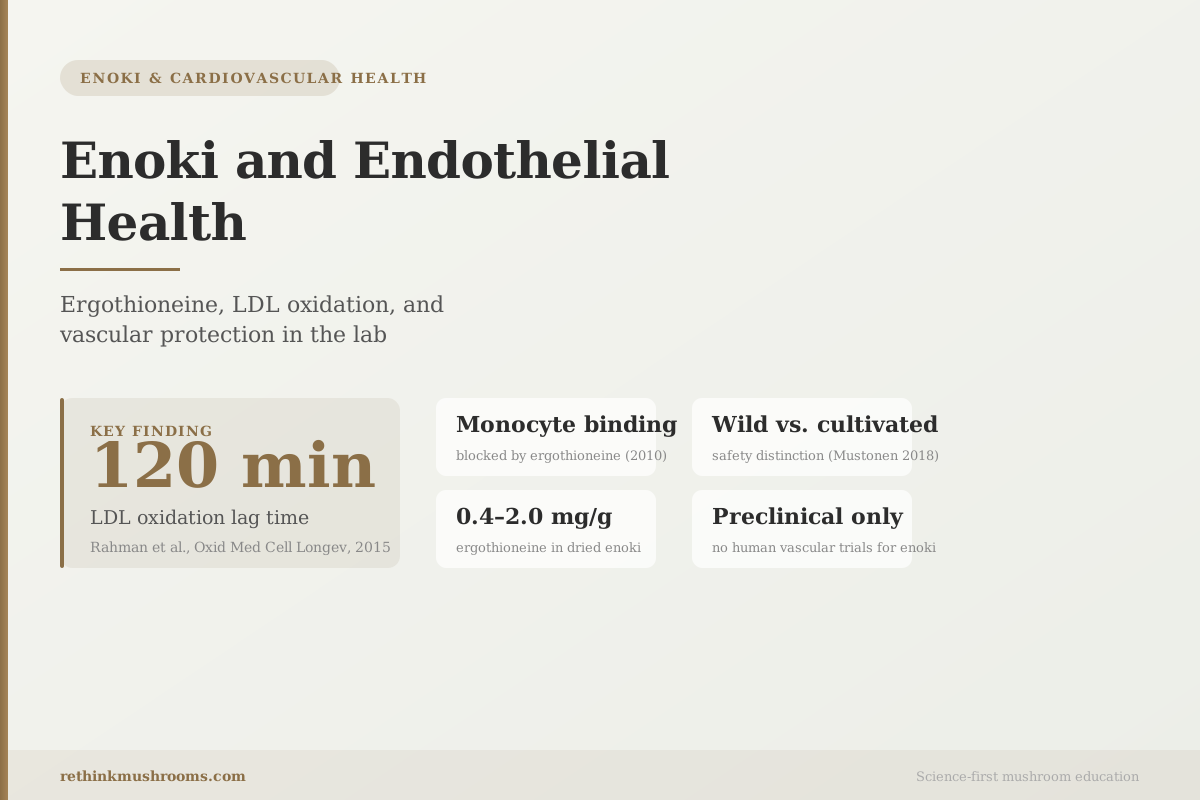
120 min LDL oxidation protection
Polyphenolic compounds from enoki mushrooms extended the LDL oxidation lag time by up to 120 minutes in vitro, addressing the initiating step in atherosclerotic plaque formation.
Rahman et al., Oxidative Medicine and Cellular Longevity, 2015
0.4–2.0 mg/g
ergothioneine in dried enoki, among the highest of any common food source
Monocyte adhesion blocked
ergothioneine suppressed endothelial adhesion molecule expression in human aortic cells (Martin et al., 2010)
Preclinical only
all enoki endothelial findings are in vitro or animal studies; no human trials exist
Rahman et al., Oxidative Medicine and Cellular Longevity, 2015
 View as image ↗
Most cardiovascular disease doesn't start with a blocked artery. It starts with a cell.
The cells lining the inside of every blood vessel, called endothelial cells, are the first point of contact between circulating blood and the vessel wall. When these cells become inflamed, they begin expressing adhesion molecules on their surface, proteins that make the endothelial surface sticky for circulating immune cells called monocytes. When monocytes start binding to inflamed endothelium, the cascade that eventually produces arterial plaques and atherosclerosis begins.
This is why endothelial health is considered upstream of cardiovascular disease rather than simply a symptom of it. Protecting the endothelium at the adhesion stage is different from lowering cholesterol or blood pressure after the process is already underway. It addresses the first molecular event in the sequence.
Enoki mushrooms contain compounds that have been shown, in laboratory conditions, to intervene at exactly this stage. This article covers the specific research on enoki mushroom endothelial health, the key finding on monocyte adhesion, the LDL oxidation data, what animal studies show about vascular inflammation, and an important safety distinction between cultivated and wild forms. For the broader species overview, what is enoki mushroom covers the full context.
Key Takeaways
- Ergothioneine at concentrations present in enoki mushrooms suppressed adhesion molecule expression on human aortic endothelial cells and reduced monocyte binding in a 2010 lab study (Martin et al., Journal of Agricultural and Food Chemistry)
- Enoki polyphenols extended the LDL oxidation lag time by up to 120 minutes in vitro; because oxidized LDL is the initiating trigger of plaque formation, this is a mechanistically relevant upstream effect (Rahman et al., 2015)
- Dried enoki mushrooms contain 0.4–2.0 mg/g ergothioneine by dry weight, placing enoki among the significant dietary sources of this vascular-protective compound
- Enoki mycorrhizae (the root-like filaments) reduced oxidative stress markers and inflammatory signaling in liver and fat tissue of high-fat diet mice, suggesting the vascular protective activity extends beyond the fruiting body (Luo et al., 2022)
- Wild Flammulina velutipes contains compounds that caused cardiac muscle toxicity in mice; commercially cultivated white enoki does not carry this risk and is safe at dietary amounts (Mustonen et al., 2018)
- All endothelial protection evidence for enoki is in vitro or animal; no human clinical trials have measured enoki's effects on endothelial function, arterial stiffness, or atherosclerosis progression
What Endothelial Cells Are, and Why Their Health Is the Upstream Cause of Heart Disease
Endothelial cells line every surface that contacts blood in the vascular system, from the aorta to the smallest capillary. A single layer of these cells separates the flowing blood from the vessel wall tissue beneath. In a healthy vessel, the endothelial surface is smooth, non-sticky, and chemically inert relative to circulating cells.
The problem begins when the endothelium gets inflamed. Inflammation triggers changes in gene expression inside endothelial cells, leading them to produce adhesion molecules on their surface: ICAM-1 (a surface protein that attracts immune cells) and E-selectin (a surface protein that slows circulating monocytes down so they can adhere). When these molecules appear on the endothelial surface, monocytes in the blood start binding to the vessel wall rather than flowing past.
Monocytes that attach to the endothelium migrate into the vessel wall tissue and transform into macrophages, which then consume oxidized LDL cholesterol particles that have crossed the endothelium. The macrophages become "foam cells" laden with fat. Foam cells accumulate into fatty streaks, then plaques, then the hardened arterial narrowing of atherosclerosis.
This sequence is one of the most studied processes in cardiovascular medicine. It is also the reason that endothelial health is considered the key upstream variable: stop the monocyte adhesion stage, and the rest of the cascade doesn't follow. Anti-inflammatory interventions that reduce ICAM-1 and E-selectin expression on the endothelial surface are a recognized strategy for cardiovascular prevention.
Enoki mushrooms are a significant dietary source of ergothioneine, a sulfur-containing amino acid compound that humans cannot make internally. Ergothioneine concentrates in tissues that experience high oxidative stress, including endothelial cells and other cells lining blood vessels. Research has directly tested whether ergothioneine can influence the monocyte adhesion stage of atherosclerosis initiation.
The Martin 2010 Finding: Ergothioneine Blocked Monocyte Adhesion to Human Aortic Cells
Martin and colleagues published the most directly relevant study on ergothioneine and endothelial function in 2010, testing whether ergothioneine at concentrations achievable from dietary sources could affect the adhesion molecule expression that triggers monocyte binding.[1]
The researchers used human aortic endothelial cells, the actual cell type lining the major arteries where atherosclerosis typically begins. They first induced inflammation in the cells using TNF-alpha (a cytokine that triggers adhesion molecule expression) and then treated with ergothioneine. They measured ICAM-1 expression, E-selectin expression, and the number of monocytes that actually bound to the endothelial surface.
Ergothioneine treatment suppressed the inflammation-stimulated expression of both ICAM-1 and E-selectin. Monocyte binding to the endothelial surface decreased accordingly. The mechanism appeared to involve reduced activation of the NF-κB signaling pathway (a molecular switch inside cells that turns on inflammatory gene programs) inside the endothelial cells.
The study also documented enoki's ergothioneine content: 0.4 to 2.0 mg per gram of dry weight. This range varies by strain and growing conditions but places enoki among the higher ergothioneine-containing culinary mushrooms accessible at grocery stores. The amount needed to achieve biologically relevant effects in the test cells is not directly translatable to dietary intake, because tissue concentrations after digestion and absorption differ from concentrations added directly to cell culture. However, the mechanistic finding establishes that ergothioneine is active in the specific cell type and pathway relevant to atherosclerosis initiation.
No competitor content connects this study to enoki specifically. The Martin 2010 research has been cited extensively in ergothioneine literature but has not appeared in consumer-facing writing about enoki mushrooms. This is the research gap this article fills.
The LDL Oxidation Story: 120 Minutes of Extended Protection
Rahman and colleagues specifically studied what happens when LDL cholesterol is exposed to free radicals in the presence of polyphenolic compounds from F. velutipes.[2]
LDL oxidation is the chemical process by which LDL particles (low-density lipoprotein, the blood fat most associated with cardiovascular risk) are damaged by reactive oxygen species in circulation. Unoxidized LDL is not particularly harmful to the vessel wall. Oxidized LDL is: it triggers the macrophage and foam cell formation described above. Preventing or slowing LDL oxidation is therefore an upstream cardiovascular intervention.
The standard way to measure this in a laboratory is the LDL oxidation lag time: how long does it take for a standardized oxidative challenge to begin producing measurable LDL oxidation products? A longer lag time means the compound being tested is providing protection.
Rahman's team found that polyphenolic fractions from enoki mushrooms extended the LDL oxidation lag time by up to 120 minutes under their conditions. The fraction with the best performance achieved an IC50 (the concentration needed to provide half-maximal antioxidant effect) of 0.86 mg/mL. The study identified the specific flavonoids in the active fraction: arbutin, epicatechin, phillyrin, apigenin, kaempferol, and formononetin.
The study authors noted explicitly that since LDL oxidation is the initiating step in atherosclerotic pathogenesis, inhibiting this process represents a direct upstream cardiovascular intervention. This framing matters because it moves the enoki polyphenol finding out of the general "has antioxidants" category and into a mechanistically specific claim about the arterial plaque formation sequence.
What Animal Research Shows About Enoki and Vascular Inflammation
Luo and colleagues provided in vivo context for enoki's vascular-relevant effects in a 2022 study on high-fat diet mice.[3]
High-fat diet feeding in rodents produces systemic oxidative stress and inflammation in metabolically active tissues, particularly the liver and adipose (fat) tissue surrounding the kidneys and organs. These are the same tissues where early cardiovascular disease processes manifest at the systemic level.
The study used the root-like mycelial fraction of F. velutipes (called mycorrhizae), not the fruiting body. At 4 percent supplementation, this fraction reduced liver triglyceride levels, decreased inflammatory markers in the liver and perirenal fat tissue, lowered oxidative stress indicators (including MDA, a marker of lipid peroxidation that reflects how much free radical damage is occurring to fats), and increased the activity of protective antioxidant enzymes including SOD (superoxide dismutase, the enzyme that neutralizes superoxide radicals inside cells) and CAT (catalase, which breaks down hydrogen peroxide).
The significance of Luo's finding for the endothelial health story is indirect but real: systemic oxidative stress and lipid peroxidation in tissues are the same processes that drive endothelial inflammation. When circulating oxidized fats and inflammatory signals reach the endothelium, they trigger the adhesion molecule expression that Martin 2010 showed ergothioneine can suppress. The Luo 2022 data provides in vivo evidence that enoki compounds can reduce these upstream stressors at the tissue level, which is a step closer to the whole-organism cardiovascular picture than cell-culture data alone provides.
Wild vs. Cultivated Enoki: The Cardiotoxicity Safety Distinction
Any comprehensive article on enoki cardiovascular health must address a finding that most consumer content ignores: wild Flammulina velutipes is not the same as commercially cultivated white enoki mushroom.
Mustonen and colleagues published a 2018 animal study showing that wild F. velutipes caused cardiac muscle toxicity in mice.[4] The compound responsible for this toxicity in the wild form is a specific compound (flammulin) that is either absent or present at much lower concentrations in the commercially cultivated white variety grown indoors without light exposure.
Commercial white enoki mushrooms (the thin, pale, bundled variety sold in sealed plastic bags at grocery stores) are cultivated under controlled conditions that produce a phenotypically distinct product from the wild brown-capped forest mushroom. The growing conditions suppress production of the specific compounds responsible for the toxicity documented in the wild form.
This safety distinction is directly relevant to the cardiovascular health discussion because cardiotoxicity and cardiovascular protection are opposite outcomes. The Mustonen finding does not mean enoki mushrooms are dangerous. It means wild-harvested Flammulina velutipes is different from cultivated white enoki, and the cardiovascular research covered in this article used cultivated materials. Readers using enoki mushrooms for any health purpose should use commercially cultivated product rather than wild-harvested mushrooms.
For a full treatment of enoki's cardiovascular research across all five mechanisms (cholesterol, LDL oxidation, blood pressure, antiplatelet activity, and endothelial protection), see enoki and heart health: cardiovascular research review.
For the ergothioneine cardiovascular research specifically, see ergothioneine and cardiovascular disease: the mushroom-exclusive antioxidant.
For the enoki cholesterol and lipid research, see enoki and cholesterol reduction: lipid-lowering evidence.
The Bottom Line
The endothelial protection research for enoki mushrooms identifies two mechanistically distinct upstream interventions: ergothioneine suppresses the adhesion molecule expression that triggers monocyte binding to artery walls (Martin 2010), and polyphenols extend LDL oxidation lag time by up to 120 minutes (Rahman 2015). Animal research shows reduced vascular inflammatory markers with enoki mycelial supplementation (Luo 2022). An important safety note: wild Flammulina velutipes contains compounds causing cardiac muscle toxicity in mice; this does not apply to commercially cultivated white enoki. All endothelial evidence is preclinical; no human trials have measured enoki's effects on endothelial function.
Frequently Asked Questions
Sources & References
- 1. Source details for this reference are not yet available.
- 2RTHM-00729·Rahman, Mohammad Azizur et al. (2015). “Antioxidative Effects and Inhibition of Human Low Density Lipoprotein Oxidation In Vitro of Polyphenolic Compounds in Flammulina velutipes (Golden Needle Mushroom)..” Oxidative medicine and cellular longevity.Study breakdown →PubMed →↩
- 3RTHM-01575·Luo, Zhen et al. (2022). “Flammulina velutipes Mycorrhizae Attenuate High Fat Diet-Induced Lipid Disorder, Oxidative Stress and Inflammation in the Liver and Perirenal Adipose Tissue of Mice..” Nutrients.Study breakdown →PubMed →↩
- 4. Source details for this reference are not yet available.