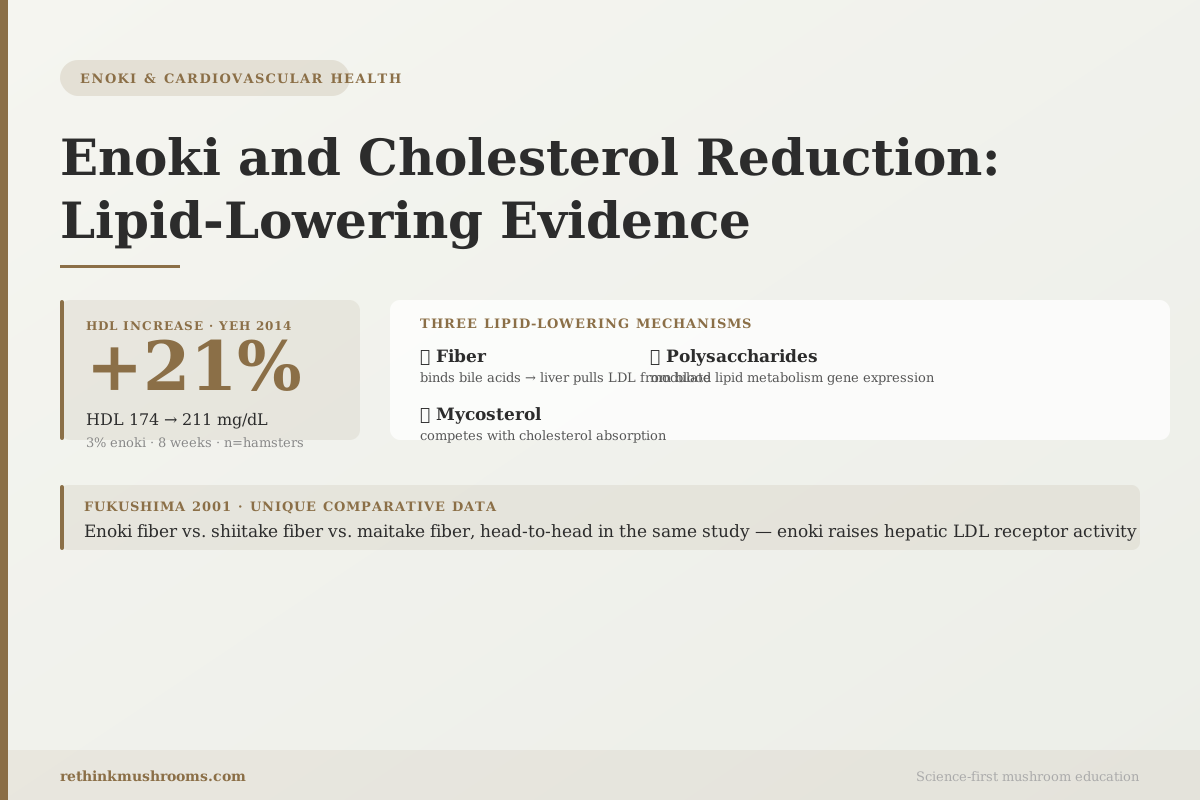
Enoki & Cardiovascular Health
+21% HDL increase
Male hamsters fed 3% enoki mushroom powder for 8 weeks had HDL rise from 174 to 204-211 mg/dL, alongside significant reductions in total cholesterol, LDL, and triglycerides. No adverse effects were reported.
Yeh et al., BioMed Research International, 2014
3 mechanisms
fiber bile acid binding, polysaccharide lipid gene modulation, mycosterol absorption competition
Fukushima 2001
enoki fiber compared head-to-head with shiitake and maitake fiber in the same study
0 human RCTs
no controlled human trials exist specifically on enoki and cholesterol
Yeh et al., BioMed Research International, 2014
 View as image ↗
Most coverage of enoki mushrooms and cholesterol covers the same single study, reports the same headline numbers, and stops there. The result is accurate but thin: yes, enoki lowers LDL in animals. Missing from this picture: the head-to-head comparison of enoki fiber against shiitake and maitake fiber (a study from 2001 that almost no consumer article has cited), the HDL increase that is more impressive than the LDL decrease, the finding that even the root-like tissue of enoki has lipid-modulating activity, and the honest acknowledgment that human trial data doesn't exist for enoki specifically.
For background on enoki's full spectrum of documented bioactive compounds, see What Is Enoki Mushroom? The Tiny Mushroom with Big Research.
Key Takeaways
- Male hamsters fed 3% enoki mushroom powder or extract for 8 weeks had significantly lower total cholesterol, LDL, and triglycerides, with HDL rising from 174 mg/dL (control) to 204-211 mg/dL, a 17-21% increase (Yeh et al., 2014)
- A 2001 head-to-head comparison of enoki, shiitake, and maitake fibers found that enoki fiber significantly reduced serum total cholesterol and increased hepatic LDL receptor activity, comparable to the other species (Fukushima et al., 2001)
- Three mechanisms drive enoki's lipid-lowering effects: dietary fiber binding bile acids (forcing the liver to convert more cholesterol to replace them), polysaccharides modulating lipid metabolism gene expression, and mycosterol competing with cholesterol for intestinal absorption
- Even enoki mycorrhizae (the root-like structures, not the fruiting body mushroom) reduced plasma triglycerides and liver lipid accumulation in high-fat-diet mice (Luo et al., 2022)
- A 2024 study characterized a specific enoki polysaccharide fraction with dual lipid-lowering and immunomodulatory activity, showing ongoing research into which fractions drive which effects (Jia et al., 2024)
- No human randomized controlled trials have tested enoki mushroom consumption specifically against cholesterol outcomes; the available evidence is animal and in vitro only
The Cholesterol Study: What Happened When Hamsters Ate 3% Enoki
Yeh and colleagues fed male hamsters enoki mushroom powder or extract at a 3% dietary inclusion rate for 8 weeks, then measured lipid profiles.[1] The results across the lipid panel:
- Total cholesterol: significantly decreased
- LDL cholesterol: significantly decreased
- Triglycerides: significantly decreased
- HDL cholesterol: increased from 174 mg/dL (control group) to 204-211 mg/dL in enoki-fed groups
That last finding deserves more attention than it typically receives. HDL is the so-called "good cholesterol" because it carries cholesterol from peripheral tissues back to the liver for processing and excretion. A 17-21% increase in HDL alongside reductions in the other three lipid markers represents a favorable shift across the entire lipid profile, not just a reduction in one number.
The study also documented reduced oxidative stress markers in the enoki-fed hamsters, consistent with the hypothesis that polyphenols in enoki mushroom act as free radical scavengers alongside the fiber and sterol mechanisms that directly affect cholesterol metabolism.
The limitation: hamsters are a standard lipid-research model because their cholesterol metabolism is closer to humans than rats or mice, but it's still an animal model. The translation to human lipid profiles requires human trials that haven't been conducted for enoki specifically.
The Fiber Comparison No Consumer Article Has Used: Enoki vs. Shiitake vs. Maitake
In 2001, Fukushima and colleagues conducted a direct head-to-head comparison of dietary fibers from three mushroom species: enokitake (enoki), Lentinus edodes (shiitake), and Grifola frondosa (maitake).[2] Rats were fed a cholesterol-free diet supplemented with one of the three mushroom fibers and measured for lipid changes.
Enoki fiber significantly reduced serum total cholesterol compared to control. The study also measured hepatic LDL receptor activity, the liver's mechanism for pulling LDL out of the bloodstream: enoki fiber increased LDL receptor activity, providing a specific cellular pathway for the observed cholesterol reduction. This is the same mechanism that pharmaceutical statins enhance, though through an entirely different route.
In Fukushima 2001's specific data, maitake fiber and enoki fiber significantly lowered serum total cholesterol versus the cellulose-fed control; the shiitake fiber arm did not show a statistically significant total cholesterol reduction in this study, though all three mushroom fibers increased fecal cholesterol excretion. Enoki fiber's hepatic LDL receptor mRNA upregulation is notable because it directly addresses LDL clearance from circulation, not just cholesterol production or absorption.
No consumer article on enoki and cholesterol has cited this comparison study as of this writing. It provides both the mechanistic specificity (LDL receptor activity) and the competitive context (enoki fiber performs alongside shiitake and maitake in a directly controlled experiment) that makes the lipid-lowering claim more credible than a single-species animal study alone.
For comparison with how shiitake handles cholesterol through a different mechanism (eritadenine-mediated SAHH inhibition), see Daily Shiitake Consumption and Cardiovascular Biomarkers.
Three Mechanisms: How Enoki Fiber and Polysaccharides Lower Cholesterol
The cholesterol-lowering effects of enoki mushroom operate through three distinct pathways, which is why the full lipid panel (not just LDL) shifts.
Mechanism 1: Bile acid binding. Dietary fiber in enoki, like other sources of soluble fiber, binds bile acids in the small intestine. Bile acids are synthesized from cholesterol in the liver. When fiber traps bile acids and carries them out in stool rather than allowing them to be reabsorbed, the liver compensates by pulling more cholesterol from the bloodstream to make new bile acids. This reduces circulating LDL through increased demand rather than reduced production. The Fukushima 2001 data showing increased hepatic LDL receptor activity is consistent with this mechanism: the liver upregulates LDL uptake to source cholesterol for bile acid synthesis.
Mechanism 2: Polysaccharide modulation of lipid metabolism genes. Enoki polysaccharides interact with lipid metabolism at the gene expression level. Jia and colleagues characterized a specific polysaccharide fraction from Flammulina velutipes (designated FVPT1) and confirmed dual lipid-lowering and immunomodulatory activity.[4] The lipid-lowering activity from polysaccharides is distinct from the fiber bile acid binding mechanism: polysaccharides appear to influence how the liver regulates fatty acid oxidation and cholesterol biosynthesis genes, working upstream of cholesterol production itself.
Mechanism 3: Mycosterol absorption competition. Enoki mushrooms contain mycosterol (ergosterol and related compounds) that, when consumed, compete with dietary cholesterol for intestinal absorption. Cholesterol and plant/fungal sterols use the same transporter proteins in the small intestine, meaning that when more sterols are present, less cholesterol is absorbed per meal. This mechanism is similar to how plant sterol supplements work, though the concentration in a food-level serving of enoki is lower than in therapeutic doses of plant sterols.
For a deeper look at the specific bioactive compounds responsible, see Enoki Bioactive Compounds: Flammulin, Proflamin, and Polysaccharides.
Beyond the Fruiting Body: Enoki Root Tissue and Lipid Metabolism
Most research on enoki's cardiovascular effects uses the mushroom itself, the white capped fruiting body that appears in grocery stores. Luo and colleagues investigated what happens when the mycorrhizae, the root-like structures of Flammulina velutipes that are typically discarded, are fed to mice on a high-fat diet.[3]
The findings were notable. At a 4% dietary inclusion rate, enoki mycorrhizae supplementation reduced plasma triglycerides and attenuated liver lipid accumulation. The study measured fatty acid profiles and found altered gene expression for lipid metabolism enzymes in the liver, consistent with the polysaccharide mechanism described above. Liver weight, which increases during fatty liver disease as lipids accumulate, was also reduced.
The practical implication of this research isn't that consumers should seek out enoki root tissue (which is rarely available for purchase). The value is mechanistic: it demonstrates that lipid-modulating activity is distributed across the entire enoki organism rather than concentrated in the fruiting body. This distribution of activity across different tissue types makes it less likely that the lipid-lowering evidence is an artifact of a specific compound that might be absent from commercial preparations.
The HDL Finding: Why It Matters More Than the LDL Number
When people worry about cholesterol, they tend to focus on LDL, because that's the number their doctor tracks and the target of cholesterol-lowering medications. But the Yeh 2014 data's most distinctive finding is the HDL increase, not the LDL decrease.
HDL performs a different function than LDL. Rather than carrying cholesterol out from the liver to peripheral tissues (which is LDL's role), HDL performs "reverse cholesterol transport," picking up cholesterol from peripheral tissues and arterial walls and returning it to the liver for processing. High HDL is associated with lower cardiovascular disease risk independently of LDL levels, and many pharmaceutical efforts to raise HDL have failed because the drug-induced HDL didn't perform this transport function correctly.
Food-sourced changes in HDL, like those observed in the Yeh 2014 hamster study, are considered more likely to reflect functional HDL changes than drug-induced HDL changes because they operate through normal metabolic pathways rather than drug mechanisms that can artificially raise HDL numbers without improving function.
A rise from 174 to 211 mg/dL in 8 weeks (at the higher enoki dose) represents a meaningful shift. Whether this translates proportionally to human consumption at food-level doses is the open question. But the direction is favorable in a way that competing cholesterol discussions of enoki have consistently failed to highlight.
What a Cardiovascular Systematic Review Says About Mushroom Evidence Generally
Krittanawong and colleagues (2021) systematically reviewed observational studies of mushroom consumption and cardiovascular health, screening 1,479 studies and identifying 7 prospective cohort studies eligible for inclusion.[5]
Their overall conclusion: edible mushroom consumption has not been shown to conclusively affect cardiovascular risk factors to date, though potential benefits may exist — including favorable alterations of lipid profiles and blood pressure reduction. The review found directionally favorable data for LDL, HDL, total cholesterol, triglycerides, and blood pressure across the included studies, but inconsistent effects on overall cardiovascular risk, stroke risk, and coronary artery disease.
This honest framing applies to enoki specifically. The animal data is consistent: multiple independent studies show cholesterol improvement through multiple mechanisms. What's absent is human trial data specifically on enoki and lipid profiles. This gap doesn't invalidate the animal data, but it does mean the translation from hamster to human hasn't been formally tested.
For a broader perspective on cardiovascular effects across the full spectrum of enoki's documented compounds, see Enoki and Heart Health: Cardiovascular Research Review. For comparison with the LDL evidence in oyster mushrooms, which have more human trial data, see Oyster Mushroom and LDL Cholesterol: Clinical Evidence and Mechanisms.
The Bottom Line
Enoki mushrooms lower total cholesterol, LDL, and triglycerides in animal research while raising HDL by up to 21%. Three mechanisms account for the lipid-lowering effects: dietary fiber binding bile acids and increasing hepatic LDL receptor activity, polysaccharides modulating lipid metabolism gene expression, and mycosterol competing with cholesterol for intestinal absorption. A 2001 head-to-head comparison found enoki fiber performs similarly to shiitake and maitake fiber on cholesterol reduction. Even enoki mycorrhizae (root tissue) attenuates liver lipid accumulation in high-fat-diet models. No human randomized controlled trials exist specifically on enoki and cholesterol outcomes.
Frequently Asked Questions
Sources & References
- 1RTHM-00663·Yeh, Ming-Yei et al. (2014). “Hypolipidemic and antioxidant activity of enoki mushrooms (Flammulina velutipes)..” BioMed research international.Study breakdown →PubMed →↩
- 2RTHM-00075·Fukushima, M et al. (2001). “Cholesterol-lowering effects of maitake (Grifola frondosa) fiber, shiitake (Lentinus edodes) fiber, and enokitake (Flammulina velutipes) fiber in rats..” Experimental biology and medicine (Maywood.Study breakdown →PubMed →↩
- 3RTHM-01575·Luo, Zhen et al. (2022). “Flammulina velutipes Mycorrhizae Attenuate High Fat Diet-Induced Lipid Disorder, Oxidative Stress and Inflammation in the Liver and Perirenal Adipose Tissue of Mice..” Nutrients.Study breakdown →PubMed →↩
- 4RTHM-01910·Jia, Wei et al. (2024). “Structural Elucidation of a Polysaccharide from Flammulina velutipes and Its Lipid-Lowering and Immunomodulation Activities..” Polymers.Study breakdown →PubMed →↩
- 5RTHM-01376·Krittanawong, Chayakrit et al. (2021). “Mushroom Consumption and Cardiovascular Health: A Systematic Review..” The American journal of medicine.Study breakdown →PubMed →↩