Shiitake & Cardiovascular Health
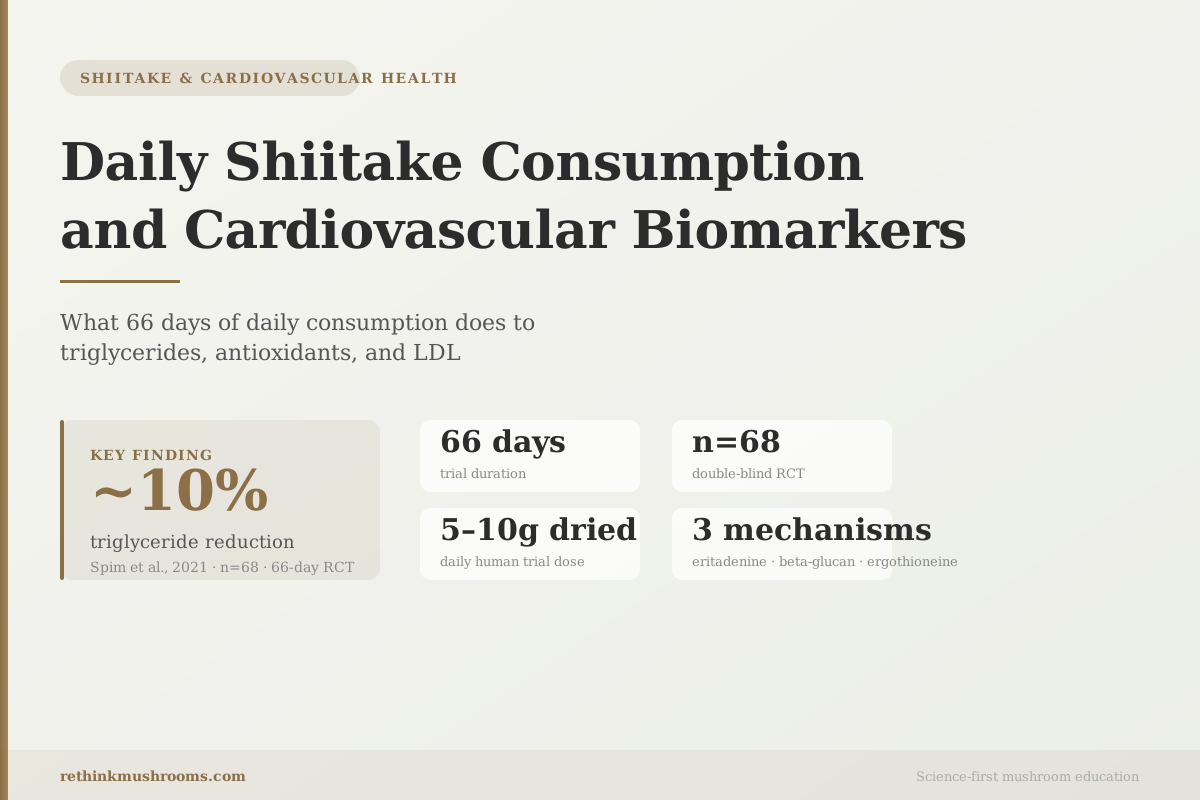
~10% triglyceride reduction
The only double-blind RCT targeting borderline-high cholesterol found daily shiitake consumption reduced triglycerides and improved antioxidant status after 66 days, but did not significantly move LDL.
Spim et al., International Journal of Medicinal Mushrooms, 2021
n=68
double-blind RCT, borderline-high cholesterol adults
66 days
consumption period with checkpoints at day 0, 33, and 66
5–10g dried
daily dose established as safe in the Dai 2015 tolerability trial
Spim et al., International Journal of Medicinal Mushrooms, 2021
 View as image ↗
In 2021, a research team in Brazil enrolled 68 adults with borderline-high cholesterol and had them eat shiitake-based food bars every day for 66 days. Nobody in the study knew which group was eating the real product. At three checkpoints (day 0, day 33, and day 66), researchers measured blood fat levels, LDL cholesterol, and markers of oxidative stress.
The results were more nuanced than a simple yes or no. Daily shiitake consumption moved some cardiovascular biomarkers meaningfully and left others statistically unchanged. Triglycerides, a type of fat in the blood measured alongside cholesterol in standard cardiovascular panels, dropped roughly 10 percent. The body's main internal antioxidant defense strengthened. LDL, the blood fat particle that cardiovascular medicine targets most aggressively, did not show a statistically significant change in this trial.
That honest picture is harder to fit in a headline but more accurate than most coverage of shiitake and heart health provides. This article covers what the clinical data found when people ate shiitake consistently, along with the practical questions most coverage ignores: what dose, what form, how long before effects appear, and whether cooking method changes what the mushrooms deliver. For a broader overview of shiitake as a species and the full range of bioactive compounds it contains, the shiitake overview article provides fuller context.
Key Takeaways
- The only human RCT targeting cardiovascular biomarkers with daily shiitake (Spim et al., 2021, n=68, 66 days) found triglycerides fell roughly 10% and antioxidant defenses improved, but LDL cholesterol did not change significantly
- Antioxidant improvements were already visible at day 33, the trial's midpoint, suggesting the body's oxidative protection responds faster to daily shiitake than its lipid metabolism does
- Dai et al. (2015) established 5–10g of dried shiitake daily as safe and well tolerated in a 4-week trial, which is the dose reference most cardiovascular shiitake research relies on
- Dried shiitake concentrates eritadenine significantly per gram compared to fresh; content also varies meaningfully by strain (Enman et al., 2007)
- Eritadenine and other shiitake bioactives are sensitive to cooking method and time. In Yao et al. 2023, steaming, boiling, and air frying for 5–20 min all decreased phenolics, flavonoids, polysaccharides, and eritadenine; short oven baking (5–15 min) preserved the most. Sautéing was not tested.
- The largest prospective US cohort study to date (Lee et al., 2019, n=110,680 across the Nurses' Health Study and Health Professionals Follow-up Study) found NO association between habitual mushroom intake and plasma lipid, insulin, or inflammation biomarkers, and no association with CVD or type 2 diabetes risk — meaning broad mushroom consumption at typical population intake levels has not translated into a measurable cardiometabolic signal at the cohort level
The 66-Day Verdict: What Daily Shiitake Changed, and What It Left Unchanged
Spim and colleagues recruited 68 adults with borderline-high cholesterol into a double-blind, randomized trial and had them consume shiitake food bars daily for 66 days.[1] This was the population where a dietary intervention would matter most: people with elevated risk who weren't yet on medication.
Blood was drawn at baseline, at the one-month mark (day 33), and at the trial's end (day 66). This three-point structure mattered because it revealed a timeline, not just a final result.
By day 66, three cardiovascular markers had changed significantly. Triglycerides fell by roughly 10 percent. Reduced glutathione (the primary antioxidant the body makes internally, present in nearly every cell) increased. Malondialdehyde, a marker tracking how much oxidative damage was accumulating in circulating lipid particles, decreased. These are real cardiovascular signals: elevated triglycerides are an independent heart disease risk factor, and oxidative damage to blood lipids plays a role in arterial plaque development.
What didn't change significantly was LDL cholesterol.
This distinction matters. Some consumer sources cite older animal research or mechanistic hypotheses and suggest shiitake will lower LDL. The Spim 2021 trial gives a more precise answer: daily whole-food shiitake consumption, in a population with borderline-high cholesterol, over 66 days, produced measurable triglyceride and antioxidant improvements without statistically significant LDL reduction.
That is not evidence that shiitake cannot affect LDL under any circumstances. It is evidence that this specific intervention, in this population, over this timeframe, did not produce that result. Longer trials, different doses, or isolated eritadenine extracts might yield different findings, but that research does not yet exist. For a detailed look at what the clinical LDL evidence does and doesn't show, see how shiitake lowers LDL cholesterol: clinical evidence.
The Dose That Trials Used, Translated to Real Food
The clearest whole-food dose reference for daily shiitake consumption comes from a 2015 RCT in which healthy young adults consumed 5–10g of dried shiitake per day for four weeks.[2] Dai and colleagues designed the trial around immune outcomes (they found significant immune cell improvements), and the study also confirmed that this dose level is safe and well tolerated without adverse effects over a sustained period.
Dried shiitake is substantially more concentrated per gram than fresh. When shiitake is dried, water is removed without proportionally reducing the compound content, which means bioactives including eritadenine become denser per gram. Enman and colleagues specifically measured eritadenine content in dried shiitake fruiting bodies and confirmed both that this concentration effect is real and that the amount of eritadenine per gram varies considerably across shiitake strains and growing conditions.[3]
Eritadenine is the water-soluble compound in shiitake most closely linked to cholesterol metabolism. Enman's strain variation data means the eritadenine dose in a given serving depends partly on which variety was cultivated, how it was grown, and how it was processed. None of this is typically labeled on commercially available products, and standardization of eritadenine content in consumer shiitake remains limited.
In practical food terms: fresh shiitake is roughly 90 percent water by weight. The 5–10g dried dose used in the Dai trial is roughly equivalent to 50–100g of fresh mushrooms, or about one to two medium shiitake mushrooms per day, which is a standard portion in a stir-fry or soup.
Animal research adds dose-response context, though it can't substitute for human trial data. Asada and colleagues (2019) fed shiitake to rats on high-fat diets with different fat sources and found that both serum cholesterol and triglycerides decreased, with the magnitude of effect varying depending on the type of dietary fat present alongside the shiitake.[4] That fat-type interaction is one reason direct translation to humans is complicated: people's background diets differ substantially, which may modulate how much cardiovascular response daily shiitake produces.
The Spim 2021 trial used standardized food bars rather than whole mushrooms, which allowed reproducible dosing in a clinical setting but means the precise eritadenine content of the consumed product is unknown.[1] This is an honest limitation of the current evidence base.
Cooking Method Matters: Oven Baking Preserved the Most Eritadenine in the Tested Methods
Eritadenine is water-soluble. That single property has a direct practical consequence: when shiitake is cooked in water, eritadenine migrates from the mushroom tissue into the cooking liquid.
Yao and colleagues (2023) systematically tested four cooking methods (steaming, boiling, air frying, and oven baking) at five time points (0, 5, 10, 15, 20 min) and measured total phenolics, total flavonoids, crude polysaccharides, and eritadenine in shiitake mushrooms.[5] Steaming, boiling, and air frying for 5–20 min all decreased the contents of all four bioactive components. Oven baking was the best-performing method overall: oven baking for 5 min preserved the highest total phenolics and lowest crude-polysaccharide losses, while oven baking for 15 min showed the lowest eritadenine losses. Steaming preserved color (brightness) better than the other methods, but it did not protect bioactive content the way oven baking did.
The practical implications from Yao's work:
Shiitake boiled in soups or broths releases eritadenine into the liquid. Consuming the broth recovers a meaningful portion of what leached out. The loss occurs when the cooking liquid is discarded.
Of the four methods Yao tested, short oven baking (5–15 min) preserved more bioactive content in the mushroom tissue than steaming, boiling, or air frying did. Sautéing was not among the methods tested in this study, so its effect on eritadenine retention cannot be inferred from this work.
Heat affects eritadenine through a second pathway as well. Zhang and colleagues (2021) found that temperature stress during shiitake cultivation and fermentation alters how much eritadenine accumulates, with the enzymatic pathway that produces the compound showing sensitivity to heat conditions.[6] This research was conducted under production conditions rather than kitchen scenarios, but it reinforces that eritadenine is a temperature-sensitive compound whose concentration can be affected at multiple points between cultivation and the kitchen.
The structural fiber components in shiitake (beta-glucans) are considerably more robust and survive boiling much better than eritadenine does. So cooking method matters most for the eritadenine content specifically.
For a full comparison of how preparation method affects the bioactive profile of fresh versus dried shiitake across all major compounds, see dried vs. fresh shiitake: how cooking method affects bioactive compound availability.
What Years of Habitual Mushroom Eating Does to Cardiovascular Numbers
Clinical trials measure controlled exposures over weeks. A different kind of evidence asks what people who eat mushrooms habitually, as an ordinary part of their diet over years, look like in terms of cardiovascular biomarkers — and the most rigorous answer to that question, in a US population, is null.
Lee and colleagues (2019) prospectively followed 67,139 women in the Nurses' Health Study and 43,541 men in the Health Professionals Follow-up Study from 1986 to 2012, totaling more than 2 million person-years of observation.[7] Mushroom consumption was assessed by food-frequency questionnaire, and plasma biomarkers (lipids, insulin, inflammation) were measured in subpopulations of the two cohorts.
The result was a clear null. Participants who consumed at least 5 servings of mushrooms per week had no significantly different risk of total cardiovascular disease (HR: 1.02), coronary heart disease (HR: 1.00), stroke (HR: 1.05), or type 2 diabetes (HR: 1.04) than participants who ate mushrooms less than once a month. Mushroom consumption was also not associated with plasma biomarkers of lipids, insulin, or inflammation. The authors' own conclusion was that they found "no association of mushroom consumption with biomarkers and risks of CVD and T2D in US adults."
Two things are worth noting about this null result. First, the cohort measured mushroom consumption broadly across species and would not detect a shiitake-specific signal if one existed at typical US dietary intakes (the typical "mushrooms" consumed in this cohort are most likely white button and crimini, not shiitake). Second, typical US habitual mushroom intake (a few servings per week of low-eritadenine species) is a very different exposure from the 5–10g of dried shiitake per day used in the Spim 2021 and Dai 2015 trials.
The honest synthesis: a controlled daily-shiitake intervention shifts triglycerides and antioxidant markers in adults with borderline-high cholesterol; broad habitual mushroom intake at population-typical levels does not show a detectable cardiometabolic signal in the largest prospective cohort to test it. These are not contradictions — they describe different exposures at different doses in different populations.
For a cross-species view of mushroom consumption and cardiovascular risk, see mushrooms that lower cholesterol: what the research shows.
The Antioxidant Effect That Shows Up Before the Cholesterol Changes Do
One of the more informative findings from the Spim 2021 trial was that antioxidant improvements were measurable at day 33, the midpoint, before the full 66-day triglyceride changes had fully accumulated.[1]
Reduced glutathione increased and lipid peroxidation decreased on a faster timeline than the triglyceride reduction. This temporal pattern makes biological sense. Antioxidant compounds act by neutralizing reactive molecules before they cause damage. That is a relatively rapid effect that shows up as soon as the compounds are present and active in tissues. Changing how the body handles lipid metabolism involves shifting enzyme activity and membrane composition in liver cells, which takes longer.
Shiitake's antioxidant contribution to cardiovascular biomarkers likely runs through ergothioneine as well as through the effects measured in the Spim trial. Ergothioneine is a sulfur-containing compound that humans cannot synthesize internally and must obtain from food; shiitake is among the richest dietary sources. Lam-Sidun and colleagues (2021) reviewed animal and cell-based studies on ergothioneine and found evidence that it contributes to protection against oxidative damage in cardiovascular and metabolic tissues.[8]
The Lam-Sidun review was entirely based on animal studies and cell models, not human trials. The evidence that shiitake's ergothioneine content contributes to human cardiovascular outcomes is mechanistically plausible but not yet confirmed by clinical data. This is an honest gap in what the research currently supports.
What the Spim antioxidant data and the ergothioneine research together suggest is that daily shiitake consumption may affect cardiovascular biomarkers through at least two parallel channels on different timescales: antioxidant protection effects appearing faster, and lipid metabolism effects developing more slowly. The Spim trial captured both in a single study, which is what makes the day-33 midpoint data worth examining separately from the day-66 final outcomes.
The full cardiovascular picture for shiitake, covering eritadenine, beta-glucans, and ergothioneine working through distinct pathways, is covered in shiitake and heart disease prevention: research review.
For the deep-dive on eritadenine as a compound, including how it differs from statins at the enzymatic level, see eritadenine in shiitake: the unique cholesterol-lowering nucleoside.
The Bottom Line
The strongest human evidence for daily shiitake consumption and cardiovascular biomarkers comes from a 66-day double-blind RCT (n=68) that found significant triglyceride reduction (roughly 10%, p = 0.0352) and improved antioxidant markers (reduced glutathione up, lipid peroxidation down), but no statistically significant LDL change. The largest US prospective cohort (Lee 2019, n>110,000) found NO association between habitual mushroom consumption and CVD, type 2 diabetes, or plasma lipid biomarkers — but that exposure is broad mushroom intake at typical US dietary levels, not 5–10g of dried shiitake daily. The practical reference dose from controlled trials is 5–10g dried shiitake daily (roughly 50–100g fresh). In Yao 2023's cooking comparison, short oven baking (5–15 min) preserved more bioactives than steaming, boiling, or air frying; sautéing was not tested.
Frequently Asked Questions
Sources & References
- 1RTHM-01436·Spim, Sara Rosicler Vieira et al. (2021). “Effects of Shiitake Culinary-Medicinal Mushroom, Lentinus edodes (Agaricomycetes), Bars on Lipid and Antioxidant Profiles in Individuals with Borderline High Cholesterol: A Double-Blind Randomized Clinical Trial..” International journal of medicinal mushrooms.Study breakdown →PubMed →↩
- 2RTHM-00368·Dai, Xiaoshuang et al. (2015). “Consuming Lentinula edodes (Shiitake) Mushrooms Daily Improves Human Immunity: A Randomized Dietary Intervention in Healthy Young Adults..” Journal of the American College of Nutrition.Study breakdown →PubMed →↩
- 3RTHM-00211·Enman, Josefine et al. (2007). “Quantification of the bioactive compound eritadenine in selected strains of shiitake mushroom (Lentinus edodes)..” Journal of agricultural and food chemistry.Study breakdown →PubMed →↩
- 4RTHM-01030·Asada, Norihiko et al. (2019). “Effects of Shiitake Intake on Serum Lipids in Rats Fed Different High-Oil or High-Fat Diets..” Journal of dietary supplements.Study breakdown →PubMed →↩
- 5RTHM-00859·Yao, Fen et al. (2023). “Effect of Different Cooking Methods on the Bioactive Components, Color, Texture, Microstructure, and Volatiles of Shiitake Mushrooms..” Foods (Basel.Study breakdown →PubMed →↩
- 6RTHM-00734·Zhang, Jing et al. (2021). “Effects of Heat Stress and the Addition of Different Purines on the Synthesis of Eritadenine in Liquid Fermentation of Shiitake Culinary-Medicinal Mushroom, Lentinula edodes (Agaricomycetes)..” International journal of medicinal mushrooms.Study breakdown →PubMed →↩
- 7RTHM-00567·Lee, Dong Hoon et al. (2019). “Mushroom consumption, biomarkers, and risk of cardiovascular disease and type 2 diabetes: a prospective cohort study of US women and men..” The American journal of clinical nutrition.Study breakdown →PubMed →↩
- 8RTHM-00696·Lam-Sidun, Daniel et al. (2021). “Mushroom-Derived Medicine? Preclinical Studies Suggest Potential Benefits of Ergothioneine for Cardiometabolic Health..” International journal of molecular sciences.Study breakdown →PubMed →↩