Shiitake Preparation and Nutrition
24% lost before cooking
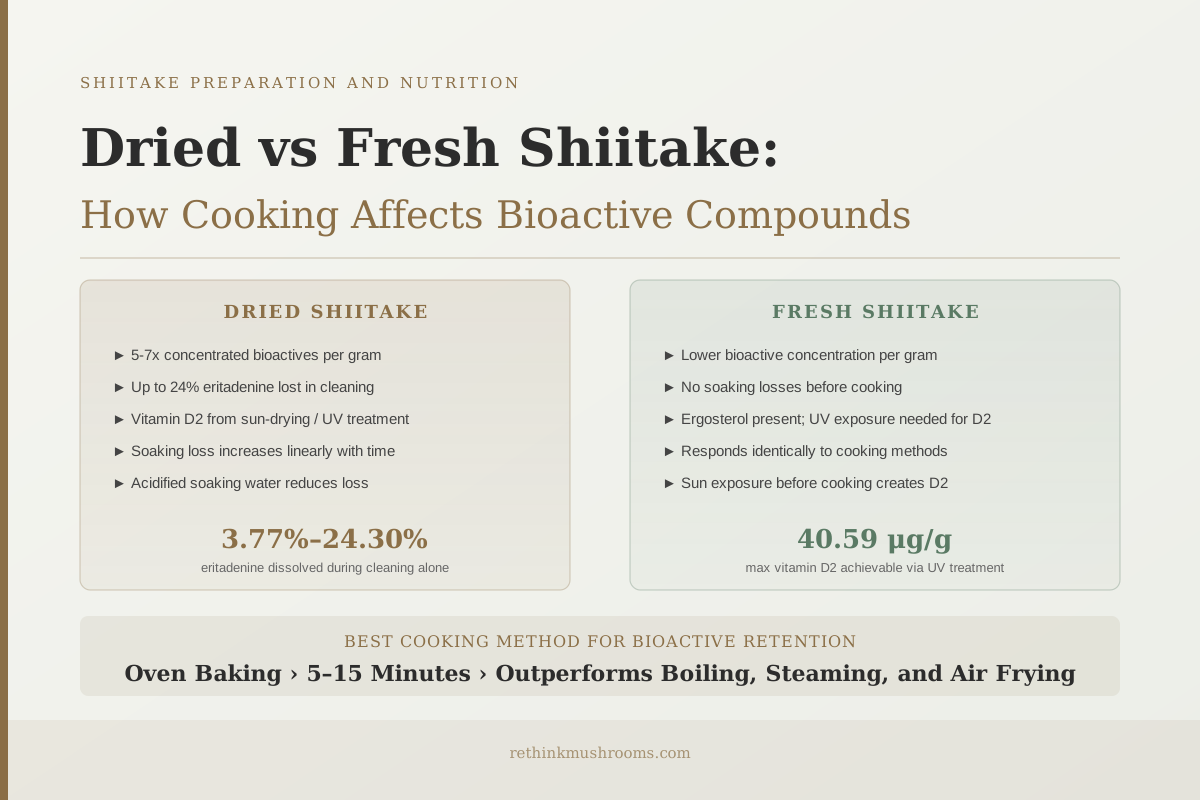
Up to 24% of eritadenine dissolves from dried shiitake during cleaning alone, before any heat is applied, according to a 2019 dissolution analysis.
Zhu et al., International Journal of Medicinal Mushrooms, 2019
4 bioactives
all reduced by boiling and steaming
5-min bake
preserves the most phenolics
5g/day
dose used in the human immunity trial
Zhu et al., International Journal of Medicinal Mushrooms, 2019
 View as image ↗
Choosing between dried and fresh shiitake feels like a culinary decision. In most kitchens, it is. But whether you start with dried or fresh, and how you cook either form, changes how much beta-glucan, eritadenine, and total phenolics survive to the plate. A 2023 study testing four household cooking methods on shiitake found that steaming, boiling, and air frying all decreased every measured bioactive compound class, while oven baking at short durations preserved more across all four fractions.[1] An earlier study tracking what happens to dried shiitake during cleaning and soaking found meaningful compound losses before any heat is applied.[2]
For preparation, the two forms start from different baselines, lose compounds at different rates during soaking, and respond similarly to the same cooking methods. This article tracks what happens at each stage. For a full comparison of the two forms before any cooking, see Fresh vs. Dried Shiitake: Nutritional and Bioactive Differences.
Key Takeaways
- Oven baking shiitake for 5 minutes preserved the highest total phenolics of any tested cooking method, and the lowest crude polysaccharide loss (Yao et al., 2023)
- Boiling, steaming, and air frying for 5-20 minutes decreased all four bioactive compound classes including polysaccharides and eritadenine without exception (Yao et al., 2023)
- Cleaning dried shiitake with tap water dissolved 3.77-24.30% of eritadenine and purine compounds before soaking or cooking began (Zhu et al., 2019)
- 52 healthy adults consuming 5-10g of dried shiitake daily for 4 weeks showed improved γδ-T cell function, increased secretory IgA, and reduced CRP levels (Dai et al., 2015)
- UV irradiation converts ergosterol in dried shiitake to vitamin D2, reaching up to 40.59 μg/g in dry powder under optimal UV-A conditions (Hu et al., 2020)
- Polysaccharide and purine compound dissolution from dried shiitake increases linearly with soaking time, so every additional minute of soaking removes a measurable additional fraction (Zhu et al., 2019)
The Four Bioactive Fractions That Preparation Affects Most
Knowing which specific compounds are at stake shapes how to interpret the preparation research. Shiitake contains four compound classes with documented cooking-dependent behavior:
Lentinan and crude polysaccharides. Shiitake's signature beta-1,3/1,6-glucan, lentinan, is water-soluble and part of the crude polysaccharide fraction measured in laboratory analyses. Water solubility is the key vulnerability: boiling submerges the tissue in the best possible solvent for leaching polysaccharides out of the mushroom.
Eritadenine. This adenosine analogue is unique to shiitake among common culinary mushrooms. It inhibits an enzyme involved in converting dietary methionine to homocysteine, a pathway linked to cholesterol metabolism. Eritadenine is both heat-labile and water-soluble, making it doubly sensitive to moist-heat cooking.
Total phenolics and flavonoids. These antioxidant compounds contribute to shiitake's DPPH radical scavenging activity. They are somewhat more heat-stable than eritadenine but still respond predictably to cooking method and duration.
Ergosterol. The precursor to vitamin D2 is stable and present in both fresh and dried shiitake. Unlike the other three fractions, ergosterol is not primarily affected by cooking but by pre-cooking UV exposure, which triggers the photochemical conversion to vitamin D2.
A 2015 randomized trial conducted by Dai and colleagues enrolled 52 healthy young adults who consumed whole dried shiitake mushrooms at either 5g or 10g per day for 4 weeks.[3] Compared to baseline, participants showed improved γδ-T cell proliferation and activation, increased secretory IgA production, and reduced serum CRP levels. That trial used the dried form specifically, establishing a human endpoint context for why these compound fractions matter beyond in vitro measurements.
For broader coverage of shiitake's nutritional composition, see Shiitake Nutritional Profile: Vitamins, Minerals, and Macros.
What Drying Does Before You Cook
Fresh shiitake is roughly 90% water. Drying removes that water, which means dried shiitake concentrates most compounds at a roughly 5-7x ratio per gram of dry weight compared to fresh. But drying is not a passive concentration step. The process triggers enzymatic activity, changes protein structure, and at higher temperatures initiates Maillard reactions that alter the amino acid and antioxidant profile.
A 2023 investigation by Chaipoot and colleagues examined the effects of dry-moist-heat aging on dried shiitake at four temperatures (50, 60, 70, and 80°C) maintained at 75% relative humidity for 20 days.[4] Glutamic acid, the primary free amino acid and the main driver of shiitake's umami flavor, ranged from 90.29 to 467.42 mg/100g across conditions, decreasing significantly at higher aging temperatures. Despite this amino acid decline, antioxidant activity increased with temperature, measured at 65.01-81.39 μg TE/mL by DPPH, 87.04-258.33 μg GAE/mL by ABTS, and 184.50-287.68 μg FeSO4/mL by FRAP. The pattern suggests Maillard-derived antioxidant compounds form during high-temperature drying, offsetting some of the lost free amino acids.
The practical implication is that drying temperature controls which compounds are emphasized in the final product. Low-temperature drying preserves enzymatic activity and free amino acids such as glutamic acid; higher-temperature drying reduces umami compounds but may increase some antioxidant fractions. Two packages of dried shiitake labeled identically may have meaningfully different bioactive starting points depending on how they were processed.
Soaking Dried Shiitake: What Dissolves Before the Pan
The first liquid contact after drying initiates compound loss. A 2019 study by Zhu and colleagues directly quantified the dissolution of bioactive compounds from dried shiitake fruiting bodies during cleaning, soaking, and cooking.[2]
During cleaning alone with tap water, the dissolution rates of eritadenine, adenosine, guanosine, guanosine monophosphate, adenosine monophosphate, xanthine, and adenine ranged from 3.77% to 24.30%. The range reflects differences in compound solubility, contact time, and water volume used during cleaning. These losses precede any soaking or cooking step.
Once soaking begins, polysaccharide and purine compound dissolution increases linearly with time. Each additional minute in water removes a predictable incremental fraction. The study tested two additives that significantly altered this dynamic:
- Acetic acid (vinegar) in the soaking or cooking water inhibited dissolution, keeping more eritadenine and polysaccharides within the mushroom tissue.
- Sodium bicarbonate (baking soda) promoted dissolution, releasing more compounds into the surrounding liquid.
This creates a decision point based on intended use. If retaining compounds in the mushroom tissue is the priority, shorter soaking in slightly acidified water reduces loss. If the soaking liquid will be used as a broth or added to the dish, the dissolved compounds remain available and discarding the soaking water becomes the actual loss.
The Zhu 2019 study also measured dissolution of purine compounds, which the authors noted as relevant for gout patients who need to limit purine intake. Longer soaking in plain water reduces purine content in the mushroom tissue by transferring it to the liquid.
Cooking Method Comparison: What the Research Found
The most systematic comparison of cooking method effects on shiitake bioactives comes from Yao and colleagues in 2023.[1] The study tested four methods at five durations each (0, 5, 10, 15, and 20 minutes) and measured total phenolics, total flavonoids, crude polysaccharides, and eritadenine in the cooked mushroom tissue.
Boiling produced the most aggressive compound losses. All four bioactives decreased at every tested duration. Boiling at 5 minutes also produced the lowest volatile compound content of any condition, indicating that flavor and bioactive losses track together at short durations.
Steaming decreased all four bioactives consistently across durations, though generally at a lesser rate than boiling because the tissue is not submerged in the solvent directly. Steaming produced the highest retained lightness (brightness) compared to other methods, an advantage where color presentation matters.
Air frying decreased all four bioactives across tested durations. Air frying at 20 minutes produced the most extensive microstructure damage to mushroom tissue, which affects texture and potentially alters how cell wall polysaccharides behave during digestion.
Oven baking was the most favorable method for preserving bioactives. Oven baking at 5 minutes produced the highest total phenolics of any condition tested. Oven baking at 10 minutes produced the highest total flavonoids. The lowest crude polysaccharide loss occurred at 5 minutes; the lowest eritadenine loss at 15 minutes.
The pattern across all methods shows that dry heat at short to moderate durations outperforms moist heat for retaining water-soluble compounds, and that duration control matters more with dry-heat methods because at longer durations they eventually reduce compounds through thermal degradation.
| Cooking Method | Total Phenolics | Total Flavonoids | Crude Polysaccharides | Eritadenine |
|---|---|---|---|---|
| Oven baking (5 min) | Best retention | High | Best retention | Good |
| Oven baking (10-15 min) | High | Best retention | Good | Best retention |
| Steaming (any duration) | Decreased | Decreased | Decreased | Decreased |
| Air frying (any duration) | Decreased | Decreased | Decreased | Decreased |
| Boiling (any duration) | Decreased | Decreased | Decreased | Decreased |
The Yao 2023 study used fresh shiitake. The water solubility and heat lability principles apply similarly to rehydrated dried shiitake, but with one compounding difference: dried shiitake that has been soaked already carries soaking-related losses before any cooking begins. The starting concentration per dry weight is higher, but compounds lost during soaking are subtracted before the cooking comparison applies.
For how these findings compare across mushroom species, see Best Cooking Methods for Medicinal Mushrooms: How Heat Affects Bioactive Compounds. For practical application specifically to shiitake preparation, see Cooking Shiitake for Maximum Bioactive Retention.
Vitamin D2: Why Sun-Dried Shiitake Stands Apart
Ergosterol is a membrane sterol present in both fresh and dried shiitake. On its own, it does not function as vitamin D2. The conversion requires ultraviolet photons to cleave the B ring of the ergosterol molecule. This is a photochemical reaction, not a thermal one.
A 2020 study by Hu and colleagues tested UV irradiation in shiitake powder at different wavelengths and exposure times.[5] Under optimal conditions, vitamin D2 concentration increased from undetectable to 40.59 ± 1.16 μg/g in dry shiitake powder. UV-A wavelength produced greater D2 accumulation than UV-B or UV-C. As D2 concentrations increased, ergosterol concentrations decreased proportionally, confirming the direct conversion relationship. In ethanol suspension, the conversion was even more efficient, reaching 677.28 ± 40.42 μg/g.
Shiitake dried under sunlight or artificial UV exposure can therefore accumulate meaningful vitamin D2 before any cooking step. Conventionally dried or indoor-grown shiitake does not, regardless of how carefully it is cooked afterward. Cooking does not generate D2 from ergosterol; once formed through UV exposure, vitamin D2 is relatively heat-stable and survives most cooking methods adequately.
This is one area where the preparation history before purchase or cooking is the determining factor. Sun-drying or deliberate UV treatment is the only preparation step that meaningfully increases vitamin D2 content, and it must occur before cooking, not during it.
Fresh Shiitake: The Same Rules Apply Differently
Fresh shiitake skips the soaking step, so the pre-cooking compound losses from cleaning and rehydration that affect dried shiitake do not apply. The trade-off is a lower per-gram bioactive baseline due to water content. Both forms respond to cooking method in the same directional pattern: oven baking preserves more, boiling removes the most.
Where fresh shiitake has a structural advantage is in UV-accessible ergosterol. If fresh shiitake is sun-exposed or briefly UV-treated before cooking, it can accumulate meaningful vitamin D2 that then survives the cooking step. Combined with oven baking rather than boiling, this allows fresh shiitake to deliver both the preserved phenolic and polysaccharide fractions and an elevated vitamin D2 content in a single preparation path.
For applications specifically focused on beta-glucan intake and its effects on satiety and metabolic markers, the compound-specific evidence is covered in Beta-Glucans from Shiitake and Satiety: Appetite Research.
The evidence base for shiitake's bioactive effects, including the Dai 2015 human trial, primarily used dried whole mushroom, so the compounds measured in dried form have the most direct connection to human outcome data. That does not mean fresh shiitake is ineffective, but the human intervention literature leans on the dried form.
The Bottom Line
Preparation decisions for dried shiitake compound across drying, soaking, and cooking stages, with measurable losses at each step. Fresh and dried shiitake respond similarly to cooking methods, with oven baking at 5-15 minutes consistently outperforming boiling, steaming, and air frying for phenolics, polysaccharides, and eritadenine. Vitamin D2 accumulation through UV exposure is the one preparation factor that cooking cannot replicate, and it must occur before any heat is applied.
Frequently Asked Questions
Sources & References
- 1RTHM-00859·Yao, Fen et al. (2023). “Effect of Different Cooking Methods on the Bioactive Components, Color, Texture, Microstructure, and Volatiles of Shiitake Mushrooms..” Foods (Basel.Study breakdown →PubMed →↩
- 2RTHM-01158·Zhu, Lina et al. (2019). “Dissolution of Bioactive Components from Dried Fruiting Bodies of the Culinary-Medicinal Shiitake Mushroom, Lentinus edodes (Agaricomycetes), during Cleaning, Soaking, and Cooking..” International journal of medicinal mushrooms.Study breakdown →PubMed →↩
- 3RTHM-00368·Dai, Xiaoshuang et al. (2015). “Consuming Lentinula edodes (Shiitake) Mushrooms Daily Improves Human Immunity: A Randomized Dietary Intervention in Healthy Young Adults..” Journal of the American College of Nutrition.Study breakdown →PubMed →↩
- 4RTHM-01667·Chaipoot, Supakit et al. (2023). “Changes in Physicochemical Characteristics and Antioxidant Activities of Dried Shiitake Mushroom in Dry-Moist-Heat Aging Process..” Foods (Basel.Study breakdown →PubMed →↩
- 5RTHM-00621·Hu, Daihua et al. (2020). “Ultraviolet Irradiation Increased the Concentration of Vitamin D2 and Decreased the Concentration of Ergosterol in Shiitake Mushroom (Lentinus edodes) and Oyster Mushroom (Pleurotus ostreatus) Powder in Ethanol Suspension..” ACS omega.Study breakdown →PubMed →↩