Shiitake & Weight Management
17% higher GLP-1
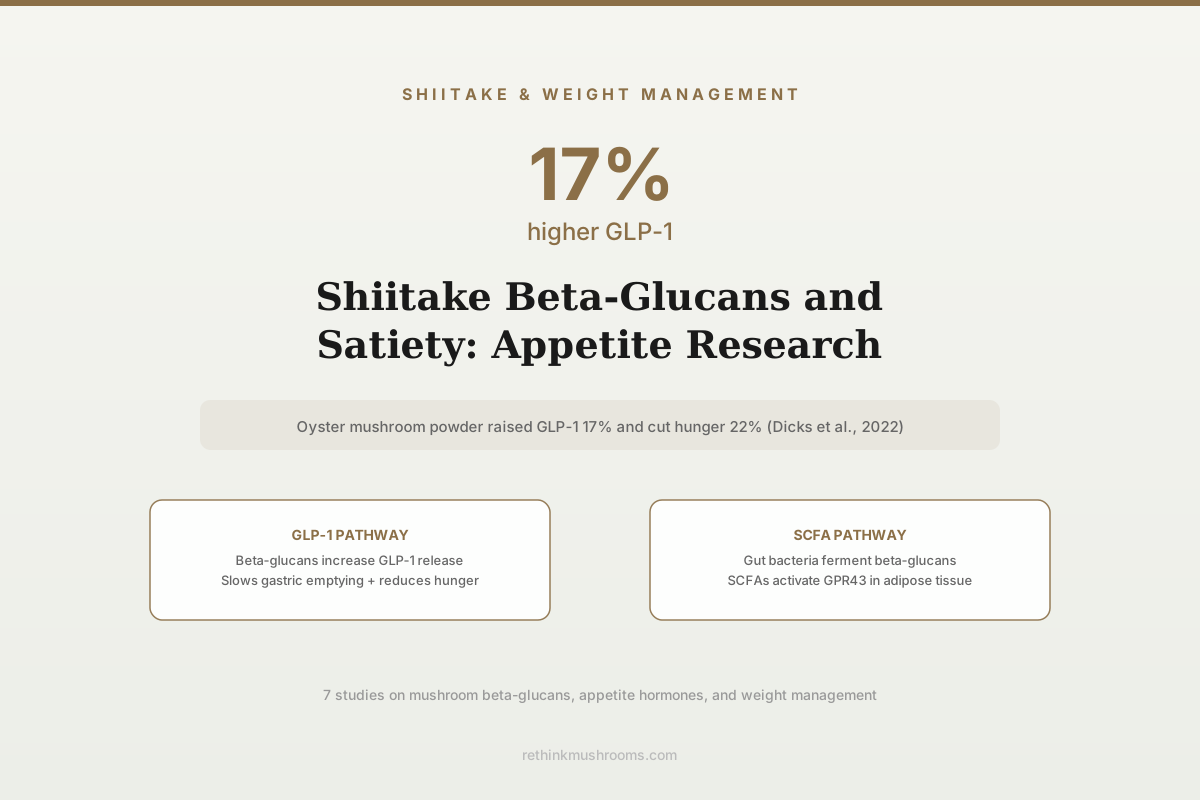
Fortifying a meal with 20 g oyster mushroom powder (8.1 g beta-glucans) increased the satiety hormone GLP-1 by 17% and reduced hunger by 22% in a human RCT.
Dicks et al., European Journal of Nutrition, 2022
22% Less Hunger
postprandial hunger AUC in human trial
5% P. eryngii
reduced body weight gain in HFD mice
SCFA Pathway
gut fermentation drives appetite signaling
Dicks et al., European Journal of Nutrition, 2022
 View as image ↗
Mushroom beta-glucans influence appetite and body weight through at least two pathways: direct effects on gut hormones and indirect effects through short-chain fatty acid production via microbiome fermentation. The strongest human evidence comes from a 2022 double-blind randomized controlled crossover trial in which 20 g of oyster mushroom powder (containing 8.1 g beta-glucans) increased postprandial GLP-1 by 17% (P = 0.001) and reduced hunger sensation by 22% (P = 0.031) in adults with impaired glucose tolerance.[1] In animal models, Pleurotus eryngii polysaccharides at 5% of diet reduced body weight gain, mesenteric fat, and serum LDL cholesterol in high-fat-diet mice while reshaping gut microbiota composition.[2]
For how mushroom beta-glucans affect cholesterol through related mechanisms, see beta-glucans and cholesterol absorption. For broader weight management research, see shiitake and weight management.
Key Takeaways
- Oyster mushroom powder (8.1 g beta-glucans) increased GLP-1 by 17% (P = 0.001) and reduced hunger AUC by 22% (P = 0.031) in a 22-person human RCT (Dicks et al., 2022)
- Pleurotus eryngii polysaccharides at 5% of diet reduced body weight gain and mesenteric fat in high-fat-diet mice over 16 weeks (Nakahara et al., 2020)
- Whole king oyster mushroom increased cecal short-chain fatty acids and enriched Akkermansia, Lactobacillus, and Bifidobacterium in obese mice (Du et al., 2024)
- Mushrooms may reduce obesity risk through antioxidant, anti-inflammatory, and lipid metabolism pathways across multiple species (Ganesan & Xu, 2018)
- Daily shiitake consumption (5-10 g) for 4 weeks improved immune markers but satiety effects of shiitake-specific beta-glucans have not been isolated in human trials (Dai et al., 2015)
- Appetite sensations besides hunger (satiety, fullness, desire to eat) did not differ between mushroom-enriched and control meals, suggesting beta-glucan effects on appetite hormones are more nuanced than simple fullness (Dicks et al., 2022)
The GLP-1 Connection: Human Trial Evidence
GLP-1 (glucagon-like peptide-1) is a gut hormone that suppresses appetite, slows gastric emptying, and enhances insulin secretion. It is the target of blockbuster weight-loss drugs like semaglutide (Ozempic/Wegovy). The question for mushroom research: can dietary beta-glucans increase GLP-1 naturally?
Dicks et al. (2022) tested this directly. In a double-blind, randomized controlled crossover trial, 22 subjects with impaired glucose tolerance consumed a meal either enriched with 20 g powder of oven-dried Pleurotus ostreatus (oyster mushroom, containing 8.1 g beta-glucans) or without enrichment. Blood was collected before and repeatedly within 4 hours after the meal.[1]
Results:
- GLP-1 area under the curve was 17% higher after the mushroom-enriched meal (P = 0.001)
- Non-esterified free fatty acids (NEFAs) AUC was 14% lower (P = 0.026)
- Hunger AUC was 22% lower (P = 0.031)
- Postprandial glucose, insulin, triglycerides, GIP, and ghrelin did not differ between meals
- Appetite ratings for satiety, fullness, and desire to eat did not differ[1]
The dissociation between hormonal changes and subjective appetite sensations is notable. GLP-1 rose and hunger dropped, but overall satiety and fullness scores were unchanged. This suggests that mushroom beta-glucans affect appetite through hormonal signaling rather than by creating a physical sensation of fullness.
The study used oyster mushroom, not shiitake. Shiitake beta-glucans (primarily lentinan) have a different branching pattern than Pleurotus beta-glucans, and their GLP-1 effects have not been tested in an equivalent trial. The biological plausibility for shiitake is strong given the shared 1,3/1,6 linkage architecture, but direct evidence is lacking. For the structural comparison, see beta-glucans from mushrooms vs. yeast vs. oats.
Anti-Obesity Effects in Animal Models
Pleurotus eryngii Polysaccharides
Nakahara et al. (2020) investigated P. eryngii polysaccharides in C57BL/6J mice fed a high-fat diet for 16 weeks. The high-dose group (5% polysaccharide fraction) showed lower body weight gain and reduced mesenteric fat tissue compared to the high-fat control group. Serum total cholesterol and LDL cholesterol decreased. Fecal lipid and total bile acid excretion increased, confirming that the polysaccharides were driving bile acid and lipid clearance through the gut.[2]
At the molecular level, the polysaccharides upregulated LDLR (LDL receptor) gene expression in the liver and GPR43 (a short-chain fatty acid receptor) in adipose tissue. GPR43 activation by SCFAs inhibits fat accumulation. The gut microbiota composition also shifted, with increased abundance of SCFA-producing bacteria.[2]
Whole King Oyster Mushroom
Du et al. (2024) used whole P. eryngii rather than extracted polysaccharides. Dietary intake of whole king oyster mushroom inhibited abnormal body weight gain and adipose tissue weight, improved glucose tolerance, and ameliorated serum biochemical parameters in high-fat-diet mice. The mushroom modulated hepatic lipid metabolism genes and increased cecal short-chain fatty acid levels. Gut microbiota analysis revealed increased Akkermansia, Lactobacillus, Bifidobacterium, and Sutterella and decreased Dorea, Coprococcus, and Ruminococcus.[3]
The histological finding was striking: the severity of non-alcoholic fatty liver induced by the high-fat diet was reduced by whole mushroom consumption. This connects weight management to liver health through a single dietary intervention.[3]
For related evidence on fat cell formation, see shiitake and adipogenesis inhibition. For metabolic syndrome research, see shiitake and metabolic syndrome.
The Gut Microbiome-Appetite Axis
The connection between mushroom beta-glucans and appetite runs through the gut microbiome. Beta-glucans resist digestion in the upper GI tract and reach the colon, where bacteria ferment them into short-chain fatty acids (SCFAs), primarily acetate, propionate, and butyrate. Murphy et al. (2020) reviewed how these SCFAs modulate appetite through multiple mechanisms: they activate GPR41 and GPR43 receptors on enteroendocrine L-cells, which stimulate GLP-1 and PYY secretion; they signal to the hypothalamus via vagal afferents; and they alter hepatic lipid metabolism.[4]
Both Nakahara et al. (2020) and Du et al. (2024) found that mushroom polysaccharides increased SCFA-producing bacteria and upregulated GPR43 expression, providing a mechanistic link between mushroom consumption and appetite regulation. The enrichment of Akkermansia muciniphila observed by Du et al. is particularly relevant: this bacterium is inversely correlated with obesity and metabolic syndrome in human studies.[3]
What About Shiitake Specifically?
The article title names shiitake, so the evidence gap must be addressed directly. No published human trial has isolated shiitake beta-glucan's effects on satiety hormones or appetite.
Dai et al. (2015) conducted the most relevant human intervention with whole shiitake. Fifty-two healthy adults consumed 5 or 10 g of dried Lentinula edodes daily for 4 weeks. The study focused on immune outcomes: gamma-delta T cell proliferation increased 60% (P < 0.0001), NK-T cell proliferation doubled (P < 0.0001), sIgA increased (gut immunity), and CRP decreased (inflammation). The study did not measure appetite, satiety, body weight, or metabolic hormones.[5]
The rationale for expecting shiitake satiety effects rests on structural biology. Shiitake's primary beta-glucan (lentinan) shares the 1,3/1,6 linkage pattern with Pleurotus beta-glucans. Both resist digestion and undergo microbial fermentation to SCFAs. Both bind Dectin-1 on gut-associated immune cells. Whether lentinan produces the same GLP-1 elevation as Pleurotus beta-glucans remains untested.
Ganesan and Xu (2018) reviewed anti-obesity effects across mushroom species and identified multiple mechanisms: antioxidant protection against obesity-related oxidative stress, anti-inflammatory effects that reduce adipose tissue inflammation, and modulation of lipid and glucose metabolism pathways. These mechanisms are not specific to beta-glucans. Mushrooms contain ergothioneine, eritadenine (in shiitake specifically), and other compounds that may contribute to metabolic effects independently of fiber content.[6]
Cerletti et al. (2021) summarized the state of evidence: mushroom beta-glucans "may protect the cardiovascular system, ameliorating glucose, lipid metabolism, and blood pressure," but these activities "require confirmation in human studies with mushroom beta-glucans." The same caveat applies to satiety and weight management.[7]
Where the Evidence Stands
One human RCT (Dicks et al., 2022) provides direct evidence that oyster mushroom beta-glucans increase GLP-1 and reduce hunger in a single meal. Multiple animal studies show that Pleurotus polysaccharides reduce body weight gain, fat deposition, and liver steatosis through gut microbiome modulation and SCFA production. The mechanisms are biologically plausible for shiitake based on shared structural chemistry, but shiitake-specific satiety data does not exist. For shiitake as a low-calorie food option, see shiitake as a low-calorie protein source.
The Bottom Line
Mushroom beta-glucans affect appetite through GLP-1 elevation and SCFA-mediated gut signaling. The strongest human evidence comes from a 22-person RCT showing oyster mushroom powder increased GLP-1 by 17% and reduced hunger by 22%. Animal studies with Pleurotus species show reduced body weight gain, less fat deposition, and favorable gut microbiota changes. Shiitake-specific satiety research has not been conducted, though the shared 1,3/1,6 beta-glucan structure provides biological plausibility. The field needs human trials with shiitake preparations measuring appetite hormones and body composition outcomes.
Frequently Asked Questions
Sources & References
- 1RTHM-00753·Dicks, Lisa et al. (2022). “Fortifying a meal with oyster mushroom powder beneficially affects postprandial glucagon-like peptide-1, non-esterified free fatty acids and hunger sensation in adults with impaired glucose tolerance: a double-blind randomized controlled crossover trial..” European journal of nutrition.Study breakdown →PubMed →↩
- 2RTHM-00643·Nakahara, Daiki et al. (2020). “Effect of mushroom polysaccharides from Pleurotus eryngii on obesity and gut microbiota in mice fed a high-fat diet..” European journal of nutrition.Study breakdown →PubMed →↩
- 3RTHM-00876·Du, Hengjun et al. (2024). “Dietary intake of whole king oyster mushroom (Pleurotus eryngii) attenuated obesity via ameliorating lipid metabolism and alleviating gut microbiota dysbiosis..” Food research international (Ottawa.Study breakdown →PubMed →↩
- 4RTHM-00639·Murphy, Emma J et al. (2020). “β-Glucan Metabolic and Immunomodulatory Properties and Potential for Clinical Application..” Journal of fungi (Basel.Study breakdown →PubMed →↩
- 5RTHM-00368·Dai, Xiaoshuang et al. (2015). “Consuming Lentinula edodes (Shiitake) Mushrooms Daily Improves Human Immunity: A Randomized Dietary Intervention in Healthy Young Adults..” Journal of the American College of Nutrition.Study breakdown →PubMed →↩
- 6RTHM-00508·Ganesan, Kumar et al. (2018). “Anti-Obesity Effects of Medicinal and Edible Mushrooms..” Molecules (Basel.Study breakdown →PubMed →↩
- 7RTHM-00676·Cerletti, Chiara et al. (2021). “Edible Mushrooms and Beta-Glucans: Impact on Human Health..” Nutrients.Study breakdown →PubMed →↩