Mushroom Cholesterol & Cardiovascular Health
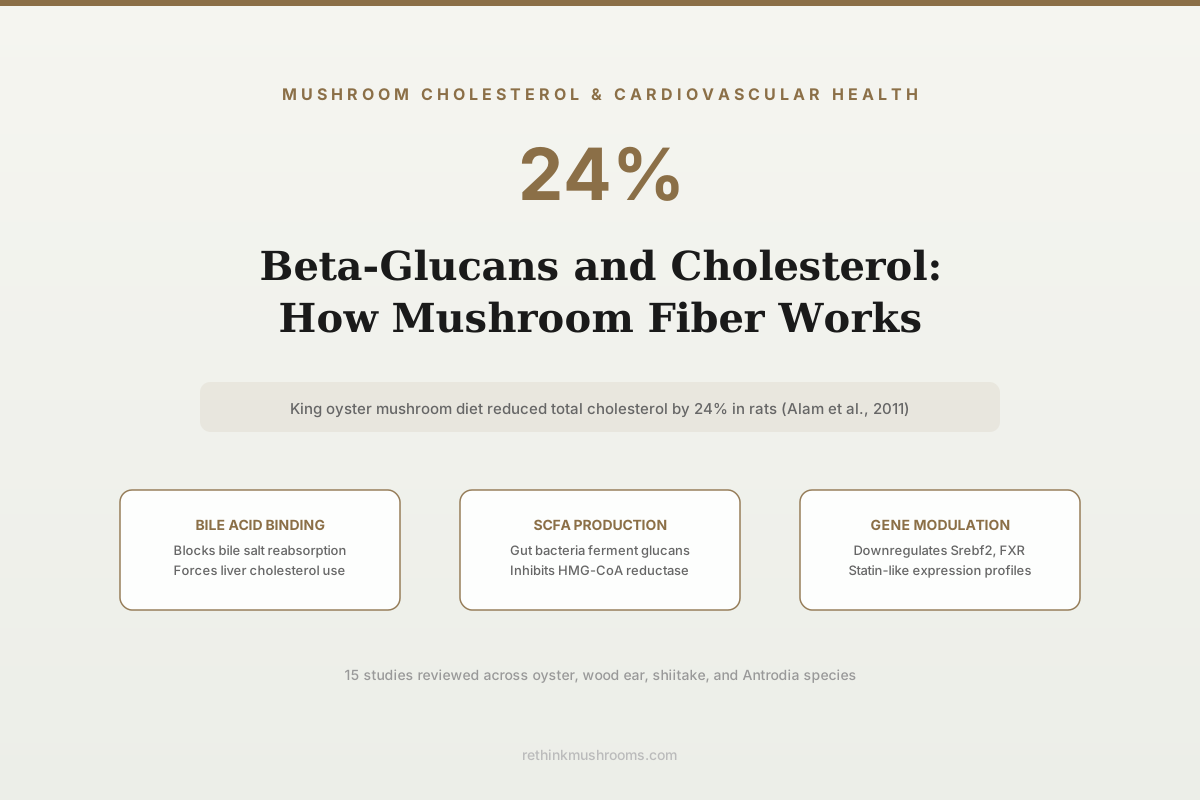
24% TC reduction
A 5% king oyster mushroom diet reduced total cholesterol by 24% and LDL by 62.5% in hypercholesterolemic rats over 8 weeks.
Alam et al., Saudi Journal of Biological Sciences, 2011
3 Mechanisms
bile acid binding, SCFA, gene regulation
1,3/1,6 Linkages
mushroom beta-glucan structure
5.7% Drop
total cholesterol in a human pilot
Alam et al., Saudi Journal of Biological Sciences, 2011
 View as image ↗
Mushroom beta-glucans reduce cholesterol through at least three distinct biological pathways: binding bile acids in the gut, generating short-chain fatty acids through microbial fermentation, and modulating cholesterol-related gene expression in the liver. A 2018 review in the International Journal of Molecular Medicine mapped these mechanisms, identifying beta-glucans as natural molecules that interact with lipids and biliary salts in the bowel and consequently reduce circulating cholesterol levels.[1] A 2011 animal study found that a 5% king oyster mushroom diet reduced total cholesterol by 24%, triglycerides by 46%, and LDL cholesterol by 62.5% in hypercholesterolemic rats.[2] The mechanisms behind those numbers are well-characterized in preclinical models, but human evidence for mushroom beta-glucans specifically remains thin compared to cereal sources.
For broader context on which mushroom species affect lipid levels, see mushrooms that lower cholesterol. For how beta-glucan structure influences bioactivity, see beta-glucan branching: mushroom vs. oat and yeast.
Key Takeaways
- Beta-glucans lower cholesterol through three mechanisms: bile acid sequestration, short-chain fatty acid production, and cholesterol gene modulation (Sima et al., 2018)
- King oyster mushroom diet reduced total cholesterol by 24%, triglycerides by 46.3%, and LDL by 62.5% in hypercholesterolemic rats (Alam et al., 2011)
- Pressurized water extracts from Agaricus bisporus, Lentinula edodes, and Pleurotus ostreatus showed bile acid-binding capacities comparable to cereal beta-glucan fractions (Palanisamy et al., 2014)
- Auricularia auricula polysaccharides lowered serum total cholesterol and LDL-C (P < 0.05) while improving antioxidant status and lipoprotein lipase activity in mice (Chen et al., 2008)
- An Antrodia cinnamomea pilot study in 32 healthy adults found a 5.7% reduction in total cholesterol over three months with no adverse events (Chen & Chang, 2020)
- Mushroom beta-glucans (1,3/1,6 linkages) differ structurally from cereal beta-glucans (1,3/1,4 linkages), and human clinical evidence for mushroom-specific cholesterol effects is still limited (Cerletti et al., 2021)
Three Mechanisms Behind the Cholesterol-Lowering Effect
Beta-glucans do not lower cholesterol through a single action. Sima et al. (2018) identified three primary pathways in their review of the evidence: bile acid sequestration, short-chain fatty acid production via gut microbial fermentation, and direct modulation of cholesterol-related gene expression.[1]
Bile Acid Binding
The most extensively documented mechanism. Beta-glucans form a gel-like layer on the mucosal surface of the bowel, inhibiting the reabsorption of bile salts. Because bile salts are synthesized from cholesterol in the liver, blocking their recycling forces the liver to pull more cholesterol from the bloodstream to make new bile acids. The net effect: lower circulating cholesterol.[1]
Palanisamy et al. (2014) demonstrated this directly with mushroom-derived beta-glucans. Using pressurized water extraction, they isolated beta-glucan-enriched fractions from Agaricus bisporus (button mushroom), Lentinula edodes (shiitake), and Pleurotus ostreatus (oyster mushroom). The bile acid-binding capacities of these mushroom extracts were comparable to those of cereal-derived beta-glucan fractions.[3] The extracts contained primarily beta-glucans along with chitooligosaccharides from chitin hydrolysis, and binding capacity varied by mushroom species and extraction temperature.[3]
Short-Chain Fatty Acid Production
Beta-glucans resist digestion in the upper GI tract and reach the colon intact, where gut bacteria ferment them into short-chain fatty acids (SCFAs), primarily acetate, propionate, and butyrate. Murphy et al. (2020) reviewed how these SCFAs inhibit cholesterol synthesis by suppressing HMG-CoA reductase, the same enzyme targeted by statin drugs. Additionally, SCFAs increase LDL-cholesterol catabolism, further reducing circulating levels.[4]
Du et al. (2024) confirmed this pathway using whole king oyster mushroom in high-fat-diet mice. Oral intake of Pleurotus eryngii increased cecal SCFA levels while modulating hepatic genes involved in lipid metabolism. The mushroom also enriched beneficial gut bacteria, including Akkermansia, Lactobacillus, and Bifidobacterium, all known SCFA producers.[5]
Cholesterol Gene Modulation
Gil-Ramirez et al. (2018) identified a third pathway that sets mushroom compounds apart from cereal beta-glucans: direct modulation of cholesterol-related gene expression. Fungal extracts from edible mushrooms downregulated Srebf2 (sterol regulatory element-binding factor 2, which controls cholesterol biosynthesis) and Nr1h4 (FXR, farnesoid X receptor, which regulates bile acid homeostasis). The transcriptional profiles induced by certain mushroom extracts resembled those of simvastatin and ezetimibe, two pharmaceutical cholesterol-lowering drugs.[6]
This means mushroom compounds can simultaneously inhibit cholesterol absorption and suppress endogenous cholesterol synthesis. Marketed functional foods (like phytosterols and cereal beta-glucans) only block absorption. Mushroom extracts appear to hit both targets.[6]
Mushroom vs. Cereal Beta-Glucans: Structure Matters
Not all beta-glucans are equivalent. Cerletti et al. (2021) described the structural difference: mushroom beta-glucans have beta-1,3 linear backbones with beta-1,6 side branches, while cereal beta-glucans (oat, barley) have mixed beta-1,3 and beta-1,4 linkages with no branching.[7]
This structural difference has functional consequences. Cereal beta-glucans are soluble fibers that increase the viscosity of chyme in the gut, physically trapping bile acids and cholesterol. Mushroom beta-glucans are partially insoluble and interact with lipids differently, primarily through direct binding rather than viscosity effects.[1]
The FDA authorized a health claim for cereal beta-glucans (3 g/day from oat or barley) reducing cardiovascular risk, based on consistent human trial data. No equivalent claim exists for mushroom beta-glucans. Cerletti et al. (2021) noted that while mushroom beta-glucans show cholesterol-lowering effects in cell and animal models, they "do not seem to beneficially affect lipid levels and glycemic responses in humans" based on the limited clinical evidence available.[7]
This does not mean mushroom beta-glucans are inactive. It means the human trial data is insufficient, not that it is negative. Most mushroom lipid studies are preclinical. For how molecular weight and branching affect beta-glucan bioactivity, see beta-glucan molecular weight and biological activity.
Species-Specific Lipid Evidence
Species Evidence Map
Mushroom Lipid Evidence, Ranked by Model Strength
Antrodia cinnamomea — Niu-chang-chih
Human (uncontrolled)Human pilot, n=32
Total cholesterol -5.7% (men) / -5.3% (women) over 3 months; no adverse events
ref 15
Pleurotus eryngii — King oyster
AnimalRat & mouse feeding
TC -24%, LDL -62.5% in hypercholesterolemic rats; ↑cecal SCFAs and gut shift in mice
refs 2, 5, 8
Auricularia auricula — Wood ear
AnimalRabbit & mouse feeding
TC↓ (P<0.01 rabbit; P<0.05 mice), ↑HDL, ↑fecal bile-acid excretion; reduced plaque
refs 10–14
Pleurotus ostreatus — Oyster
PreclinicalComposition & in vitro
23.9% beta-glucan (dry matter); bile-acid binding comparable to cereal fractions
refs 3, 9
Mixed edible extracts — Button, shiitake, oyster
MechanisticCell / gene expression
Downregulated Srebf2 & Nr1h4 (FXR); transcriptional profile resembling simvastatin/ezetimibe
refs 3, 6
Ordered by the strength of the study design behind each result. Every species with a measured lipid effect sits at the animal level or below — the lone human evidence is a single uncontrolled pilot on a compound (Antrodia cinnamomea) whose active fraction extends well beyond beta-glucans.
Sources: Alam et al. (2011) [ref 2]; Palanisamy et al. (2014) [ref 3]; Du et al. (2024) [ref 5]; Gil-Ramirez et al. (2018) [ref 6]; Wei et al. (2018) [ref 8]; Lam & Okello (2015) [ref 9]; Fan et al. (1989) [ref 10]; Chen et al. (2008, 2011) [refs 11–12]; Reza et al. (2015) [ref 13]; Shu et al. (2023) [ref 14]; Chen & Chang (2020) [ref 15].
Oyster Mushrooms (Pleurotus)
The strongest preclinical evidence for mushroom-driven cholesterol reduction comes from oyster mushroom species. Alam et al. (2011) fed hypercholesterolemic rats a diet containing 5% Pleurotus eryngii (king oyster mushroom) powder for the experimental period. Total cholesterol dropped 24%, triglycerides 46.3%, LDL cholesterol 62.5%, and the LDL/HDL ratio decreased 57.1%. Fecal lipid and cholesterol excretion increased, confirming the bile acid pathway.[2]
Wei et al. (2018) showed that P. eryngii polysaccharide inhibited foam cell formation in macrophages induced by oxidized LDL. Foam cell formation is the first stage of atherosclerotic plaque development. The same polysaccharide reduced lipid accumulation during the absorption phase in a zebrafish hyperlipidemia model.[8]
Lam and Okello (2015) quantified the beta-glucan content in raw Pleurotus ostreatus at 23.9% of dry matter. Blanching did not measurably affect beta-glucan content, though it reduced polyphenol levels and antioxidant activity.[9] For clinical evidence on oyster mushrooms and LDL specifically, see oyster mushroom and LDL cholesterol.
Wood Ear Mushrooms (Auricularia)
Auricularia auricula (wood ear, black fungus) has one of the longest research records for cardiovascular effects. Fan et al. (1989) showed that feeding A. auricula to rabbits decreased total serum cholesterol (P < 0.01) and beta-lipoprotein compared to aspirin and control groups. Aortic atherosclerotic plaque and intramyocardial arterial stenosis were also reduced.[10]
Chen et al. (2008) isolated polysaccharides from A. auricula (AAP) and administered them to ICR mice on a cholesterol-enriched diet. After 8 weeks, AAP lowered serum total cholesterol and LDL-C (P < 0.05) while improving total antioxidant capacity and lipoprotein lipase activity.[11] Lipoprotein lipase breaks down triglycerides in lipoproteins, so its enhanced activity facilitates lipid clearance from the bloodstream.
In a follow-up study, Chen et al. (2011) tested an ethanol extract of A. auricula (AAE), which contained over 16% polyphenolic compounds with polysaccharides excluded. This extract still showed a remarkable hypocholesterolemic effect: it decreased total cholesterol and atherosclerosis index, increased HDL cholesterol, and boosted fecal bile acid excretion. This finding suggests that Auricularia's cholesterol-lowering effect involves both polysaccharides and polyphenols working through different mechanisms.[12]
Reza et al. (2015) added mechanistic depth. Their study of A. auricula-judae ethanol extract in C57BL/6 mice showed dose-dependent reductions in plasma lipids and liver enzymes. At the molecular level, the extract suppressed adipogenic and lipogenic genes (PPARgamma, C/EBPalpha, FAS) in 3T3-L1 cells without cytotoxicity.[13] For a head-to-head comparison of mushroom species, see shiitake and maitake for high cholesterol.
The Gut Microbiome Connection
The relationship between mushroom beta-glucans and cholesterol is not just about direct fiber effects. Gut bacteria mediate a substantial portion of the lipid-lowering activity.
Shu et al. (2023) showed that A. auricula polysaccharides alleviated non-alcoholic fatty liver disease in mice through a gut-liver axis mechanism. The polysaccharides enriched Lactobacillus and Bifidobacterium populations, which altered bile acid profiles, increasing deoxycholic acid (DCA). DCA activated the farnesoid X receptor (FXR), which regulates bile acid metabolism and protected against cholestasis and hepatic inflammation.[14]
Du et al. (2024) found a similar pattern with whole king oyster mushroom. Dietary P. eryngii increased Akkermansia, Lactobacillus, Bifidobacterium, and Sutterella while decreasing Dorea, Coprococcus, and Ruminococcus. These microbiome shifts correlated with improved serum lipid parameters and reduced hepatic fat accumulation.[5]
This microbiome-mediated pathway may explain why whole mushroom consumption often shows stronger lipid effects than isolated beta-glucan fractions. Whole mushrooms deliver beta-glucans alongside chitin, ergothioneine, and other prebiotic fibers that collectively reshape the gut environment. For how beta-glucans reach and interact with the gut, see beta-glucan bioavailability.
Human Evidence: One Pilot Study
The elephant in the room: nearly all mushroom beta-glucan cholesterol research is preclinical. Animal and cell studies dominate, and the human data is sparse.
Chen and Chang (2020) conducted the most relevant human trial. In an open-label, single-arm pilot study, 32 healthy men and women ingested Antrodia cinnamomea solid-state cultivated mycelium capsules for three months. Total cholesterol decreased 5.7% in men and 5.3% in women compared to baseline. No adverse events occurred, and liver and renal function indices remained unchanged.[15]
The limitations are substantial: no placebo control, no blinding, a small sample of healthy (not hypercholesterolemic) participants, and Antrodia cinnamomea contains triterpenoids and other bioactive compounds beyond beta-glucans. The cholesterol reduction cannot be attributed to beta-glucans alone.[15]
Cerletti et al. (2021) summarized the state of evidence: a small number of clinical trials reported that consumption of mushroom species lowered fasting cholesterol, but the evidence is "limited and of low quality, with studies having significant weaknesses including lack of control groups, short intervention periods, and poor control of confounding variables."[7]
This stands in contrast to cereal beta-glucans, where dozens of randomized controlled trials support the FDA's health claim. The biological mechanisms for mushroom beta-glucans are well-characterized; what is missing is the human trial infrastructure to confirm them at clinical doses. For species-specific cholesterol research on Antrodia, see Antrodia and lipid metabolism. For reishi's triterpene-mediated approach, see reishi and cholesterol management.
- Cell & in vitro studiescompleted
Bile-acid binding comparable to cereal fractions, foam-cell inhibition, and statin-like downregulation of Srebf2/Nr1h4 (Palanisamy 2014; Wei 2018; Gil-Ramirez 2018).
- Animal studiescompleted
Consistent lipid reduction across rats, rabbits, mice, and zebrafish — TC down 24%, LDL down 62.5% in the strongest model (Alam 2011; Chen 2008; Du 2024).
- Small human trialcurrent
One open-label, single-arm pilot (n=32) showed a 5.3–5.7% total-cholesterol drop with Antrodia cinnamomea — no control group, healthy participants, non-beta-glucan compounds present (Chen & Chang 2020).
- Randomized controlled trialmissing
No RCT has tested mushroom beta-glucans for lipid outcomes at defined doses.
- Meta-analysis / health claimmissing
No pooled analysis; cereal beta-glucan holds an FDA heart-health claim, mushroom beta-glucan does not.
The preclinical case is strong and mechanistically detailed, but human evidence stops at a single uncontrolled pilot. The gap to a clinical claim is randomized trials, not biological plausibility.
Palanisamy et al. (2014); Alam et al. (2011); Gil-Ramirez et al. (2018); Chen & Chang (2020); Cerletti et al. (2021) [refs 2, 3, 6, 7, 8, 11, 15]
Safety
ModerateMushroom beta-glucans are not a substitute for prescribed cholesterol therapy
Concern
The only human evidence — one uncontrolled pilot — showed a 5–6% total-cholesterol reduction, an order of magnitude smaller than the 30–50% LDL reduction statins achieve across hundreds of trials. Replacing prescribed lipid-lowering medication with mushrooms could leave cardiovascular risk untreated.
What the research says
Treat culinary and supplemental mushrooms as a possible adjunct to, not a replacement for, evidence-based care. Medication decisions for high cholesterol belong with a clinician who knows your full risk profile.
Particularly relevant for: People with diagnosed high cholesterol or cardiovascular disease.
What to do
Do not stop or reduce prescribed cholesterol medication based on mushroom research. This article is educational and is not medical advice.
Chen & Chang (2020) [ref 15]; Cerletti et al. (2021) [ref 7]
The Bottom Line
Mushroom beta-glucans lower cholesterol through bile acid sequestration, SCFA-mediated HMG-CoA reductase suppression, and direct modulation of lipid metabolism genes. The preclinical evidence is extensive across multiple mushroom species, with king oyster and wood ear mushrooms showing the strongest and most consistent lipid-lowering effects in animal models. Human evidence, however, is limited to a single uncontrolled pilot study showing a modest 5.3-5.7% cholesterol reduction with Antrodia cinnamomea. The biological rationale is solid; the clinical confirmation is not yet there.
Frequently Asked Questions
Sources & References
- 1RTHM-00531·Sima, Petr et al. (2018). “β-glucans and cholesterol (Review)..” International journal of molecular medicine.Study breakdown →PubMed →↩
- 2RTHM-00204·Alam, Nuhu et al. (2011). “Dietary effect of Pleurotus eryngii on biochemical function and histology in hypercholesterolemic rats..” Saudi journal of biological sciences.Study breakdown →PubMed →↩
- 3RTHM-00342·Palanisamy, Marimuthu et al. (2014). “Pressurized water extraction of β-glucan enriched fractions with bile acids-binding capacities obtained from edible mushrooms..” Biotechnology progress.Study breakdown →PubMed →↩
- 4RTHM-00639·Murphy, Emma J et al. (2020). “β-Glucan Metabolic and Immunomodulatory Properties and Potential for Clinical Application..” Journal of fungi (Basel.Study breakdown →PubMed →↩
- 5RTHM-00876·Du, Hengjun et al. (2024). “Dietary intake of whole king oyster mushroom (Pleurotus eryngii) attenuated obesity via ameliorating lipid metabolism and alleviating gut microbiota dysbiosis..” Food research international (Ottawa.Study breakdown →PubMed →↩
- 6RTHM-00510·Gil-Ramírez, Alicia et al. (2018). “Molecular actions of hypocholesterolaemic compounds from edible mushrooms..” Food & function.Study breakdown →PubMed →↩
- 7RTHM-00676·Cerletti, Chiara et al. (2021). “Edible Mushrooms and Beta-Glucans: Impact on Human Health..” Nutrients.Study breakdown →PubMed →↩
- 8RTHM-00534·Wei, Hua et al. (2018). “Lipid-Lowering Effect of the Pleurotus eryngii (King Oyster Mushroom) Polysaccharide from Solid-State Fermentation on Both Macrophage-Derived Foam Cells and Zebrafish Models..” Polymers.Study breakdown →PubMed →↩
- 9RTHM-00384·Lam, Yu Shan et al. (2015). “Determination of Lovastatin, β-glucan, Total Polyphenols, and Antioxidant Activity in Raw and Processed Oyster Culinary-Medicinal Mushroom, Pleurotus ostreatus (Higher Basidiomycetes)..” International journal of medicinal mushrooms.Study breakdown →PubMed →↩
- 10RTHM-00009·Fan, Y M et al. (1989). “The effect of edible black tree fungus (Auricuaria auricula) on experimental atherosclerosis in rabbits..” Chinese medical journal.Study breakdown →PubMed →↩
- 11RTHM-00128·Chen, G et al. (2008). “Effect of polysaccharide from Auricularia auricula on blood lipid metabolism and lipoprotein lipase activity of ICR mice fed a cholesterol-enriched diet..” Journal of food science.Study breakdown →PubMed →↩
- 12RTHM-00208·Chen, Gang et al. (2011). “Hypocholesterolemic effects of Auricularia auricula ethanol extract in ICR mice fed a cholesterol-enriched diet..” Journal of food science and technology.Study breakdown →PubMed →↩
- 13RTHM-00399·Reza, Md Ahsanur et al. (2015). “Hypolipidemic and Hepatic Steatosis Preventing Activities of the Wood Ear Medicinal Mushroom Auricularia auricula-judae (Higher Basidiomycetes) Ethanol Extract In Vivo and In Vitro..” International journal of medicinal mushrooms.Study breakdown →PubMed →↩
- 14RTHM-00852·Shu, Yifan et al. (2023). “The polysaccharides from Auricularia auricula alleviate non-alcoholic fatty liver disease via modulating gut microbiota and bile acids metabolism..” International journal of biological macromolecules.Study breakdown →PubMed →↩
- 15RTHM-00612·Chen, Wan-Jing et al. (2020). “A Pilot Study to Assess Food Safety and Potential Cholesterol-Lowering Efficacy of Antrodia cinnamomea Solid-State Cultivated Mycelium in Healthy Adults..” Evidence-based complementary and alternative medicine : eCAM.Study breakdown →PubMed →↩