Mushroom Bioavailability
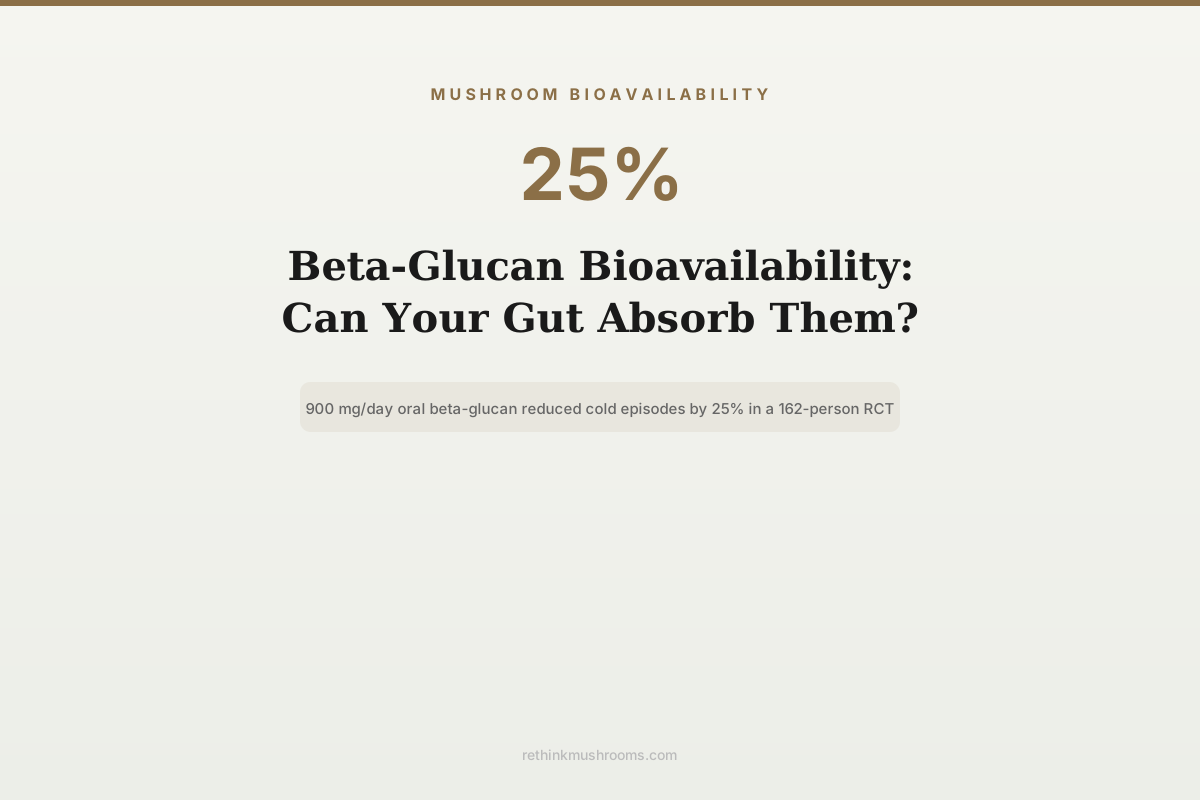
25% fewer colds
Oral yeast beta-glucan (900 mg/day) reduced common cold episodes by 25% over 16 weeks in a double-blind RCT.
Auinger et al., European Journal of Nutrition, 2013
M Cell Uptake
Peyer's patches transport particles
Dectin-1 Receptor
primary immune recognition
Trained Immunity
oral mushroom beta-glucans reprogram bone marrow
Auinger et al., European Journal of Nutrition, 2013
 View as image ↗
Beta-glucans from mushrooms are glucose polymers far too large to cross the intestinal epithelium through standard nutrient absorption pathways. They are not broken down by human digestive enzymes, they are not absorbed through enterocytes like amino acids or simple sugars, and they reach the lower gut largely intact.[1] Yet oral beta-glucans produce measurable immune effects in both animal models and human clinical trials, from reducing common cold infections by 25% to reprogramming bone marrow progenitor cells.[2][3] The resolution to this apparent paradox lies in a specialized uptake system that has nothing to do with conventional nutrient absorption.
For a broader look at absorption challenges across all mushroom compounds, see how well your body absorbs mushroom compounds. For how beta-glucan size affects activity, see beta-glucan molecular weight and biological activity.
Key Takeaways
- Beta-glucans are not digested by human enzymes and reach the lower gut intact, bypassing standard nutrient absorption (Cerletti et al., 2021)
- M cells in Peyer's patches physically transport insoluble beta-glucan particles into gut-associated lymphoid tissue (Batbayar et al., 2012)
- Dectin-1, the primary beta-glucan receptor on immune cells, responds differently based on glucan structure, not just binding affinity (Anaya et al., 2023)
- Oral mushroom beta-glucans reprogrammed bone marrow progenitor cells toward myeloid lineage in mice, demonstrating trained immunity (Case et al., 2024)
- 900 mg/day of oral yeast beta-glucan reduced common cold episodes by 25% over 16 weeks in a 162-person RCT (Auinger et al., 2013)
- Beta-1,6-glucan from Pleurotus eryngii increased butyric and acetic acid in the cecum, acting as a prebiotic (Wang et al., 2022)
Bioavailability Without Absorption
Two Routes to a Systemic Effect — Neither Is Normal Absorption
Beta-glucans are too large to cross the gut lining like a vitamin or a drug, and human enzymes cannot break them down. Yet oral doses produce measurable immune effects. The resolution is that they act through two non-absorptive routes: the immune system samples them at the Peyer’s patches, and gut bacteria ferment whatever is left. “Bioavailable” here means biologically active, not absorbed.
M cells hand the particle to the immune system
M cells in the Peyer’s patches lack the thick mucus and dense microvilli of normal gut lining, so intact beta-glucan particles reach the cell surface and are transcytosed into the lymphoid tissue beneath. Waiting dendritic cells and macrophages recognize them through Dectin-1 — and whether that receptor fires depends on the glucan’s particulate structure, not just binding. In mice, oral mushroom powder reprogrammed bone-marrow progenitors toward myeloid output (trained immunity).
Batbayar 2012 [4] (M cell transcytosis) · Anaya 2023 [7] (structure-dependent Dectin-1 signaling) · Case 2024 [3] (oral mushroom powder → myeloid reprogramming, mice)
What the immune system skips, gut bacteria ferment
Beta-glucans not taken up by Peyer’s patches continue to the colon, where gut bacteria ferment them into short-chain fatty acids such as butyrate and acetate. These metabolites modulate immune function indirectly — no absorption of the glucan itself required. In mice, beta-1,6-glucan from king trumpet mushroom raised cecal butyrate and acetate, shifted the microbiota, and increased NK-cell activity.
Wang 2022 [10] (β-1,6-glucan, Pleurotus eryngii → ↑butyrate/acetate, ↑NK activity, altered microbiota, mice)
A mechanism map, not an efficacy claim. Route 1 rests on M cell transcytosis, receptor biophysics, and an animal trained-immunity study; Route 2 on a single animal study. Human trials confirm oral beta-glucans produce systemic immune outcomes, but the relative contribution of these two routes in people is not yet quantified.
Mechanism synthesis; routes from refs [1][3][4][7][10] (see references)
Beta-Glucans Are Not Absorbed Like Other Nutrients
Standard nutrient absorption happens in the small intestine: enzymes break food into small molecules, which cross the epithelial lining through transporters or passive diffusion. Beta-glucans do not follow this pathway. They are polysaccharides with beta-(1,3) backbones and beta-(1,6) branches, and human digestive enzymes lack the capacity to cleave these bonds.[1]
A 2021 review in Nutrients confirmed that mushroom beta-glucans reach the bowel virtually unchanged, forming a gel at the mucosal surface that modulates biliary salt resorption.[1] Small and large fragments of beta-glucans have been found in serum, indicating that some absorption does occur, but not through the conventional absorptive enterocyte route.[1]
This distinction matters because it means beta-glucan bioavailability cannot be evaluated using the same pharmacokinetic framework applied to vitamins, minerals, or drug molecules. The immune effects of oral beta-glucans operate through a fundamentally different mechanism. For a deeper explanation of why this distinction matters, see why mushroom bioavailability differs from drug bioavailability.
The Peyer's Patch Pathway: How Beta-Glucans Enter the Immune System
The key mechanism for beta-glucan uptake was detailed in a 2012 review by Batbayar et al. in Biomolecules & Therapeutics. Fungal and particulate beta-glucans, despite their large molecular size, are taken up by M cells (microfold cells) in the Peyer's patches of the small intestine.[4]
M cells are specialized epithelial cells that lack the thick mucus layer and dense microvilli of regular intestinal cells. This structural difference allows particles, including beta-glucan microparticles, to contact the cell surface directly. M cells transcytose (transport across the cell) these particles into the subepithelial dome of the Peyer's patch, where dendritic cells and macrophages are waiting.[4]
Once inside the Peyer's patch, the beta-glucan particles interact with macrophages and dendritic cells, activating systemic immune responses.[4] The sampled beta-glucans function as pathogen-associated molecular patterns (PAMPs), recognized by pattern recognition receptors (PRRs) on innate immune cells.[4]
This is not passive absorption. It is active immune surveillance. The gut is using the same system it uses to sample and respond to potential pathogens, which makes biological sense given that beta-glucans are structural components of fungal cell walls, something the immune system has evolved to detect.
Dectin-1: How Immune Cells Recognize Beta-Glucans
Once beta-glucans reach the immune cells beneath the Peyer's patches, recognition happens primarily through the receptor Dectin-1. Brown et al. (2007) determined the crystal structure of dectin-1 and showed that it forms higher-order complexes when binding natural beta-glucans, a structural basis for the clustering that triggers downstream signaling.[5]
Goodridge et al. (2009) reviewed the broader landscape of beta-glucan recognition, confirming that neutrophils, macrophages, and dendritic cells all express receptors capable of recognizing beta-glucans. Dectin-1 stands out because it translates recognition into intracellular signaling, stimulates cellular responses, and helps orchestrate the adaptive immune response.[6]
A 2023 biophysical study by Anaya et al. added an important nuance: Dectin-1's signaling response depends on beta-glucan structure, not just binding affinity. High molecular weight, structured beta-glucans drove receptor clustering and downstream signaling, while low molecular weight glucans bound the receptor with similar affinity but produced weaker signaling.[7] Denaturation experiments confirmed that it was the tertiary and quaternary structure of the glucan, not simply its chemical identity, that determined whether it could activate the immune response.[7]
This has direct implications for bioavailability. A beta-glucan that reaches immune cells in its structured, particulate form will trigger a different response than one that arrives as a fragmented, soluble molecule. Extraction methods, processing, and mushroom species all affect which form reaches the gut.
The Anaya team measured Dectin-1A diffusion coefficients and found that stimulation with structured glucans decreased receptor mobility, with fluorescence measurements providing direct evidence of ligation-induced receptor aggregation. These molecular aggregates remained relatively small (under 15 nm clusters of a few engaged receptors), but the degree of aggregation positively correlated with glucan structure content.[7] At fungal particle contact sites, Dectin-1A aggregation increased in proportion to the degree of exposed glucan on the particle surface.[7]
For more on how structure varies across species, see mushroom polysaccharide absorption and the gut immune connection.
Does Molecular Weight Affect Bioavailability?
Yes, and in more complex ways than simply "bigger is better" or "smaller is better." The Anaya et al. (2023) findings showed that structured, high molecular weight beta-glucans produced the strongest Dectin-1 clustering and signaling, while lower molecular weight glucans showed rapid clearance but improved tissue penetration.[7]
Jin et al. (2018) reviewed the structure-activity relationship in detail, documenting how molecular weight, branching degree, and solubility all influence both immune recognition and biological outcomes.[8] The receptor recognition mechanism itself varies: particulate, insoluble beta-glucans trigger a phagocytic synapse through Dectin-1 that soluble glucans cannot replicate.
McCleary (2016) developed standardized methods for measuring beta-glucan content in mushroom products, noting that different extraction and quantification methods can yield different results for the same product.[9] This means that the beta-glucan content listed on a supplement label may not reflect the amount that reaches the gut in a biologically active, structured form. The gap between measured beta-glucan content and functional bioavailability is one of the least understood aspects of mushroom supplementation.
Trained Immunity: Oral Beta-Glucans Reprogram the Immune System
The most striking recent evidence for oral beta-glucan bioavailability comes from Case et al. (2024), published in Frontiers in Nutrition. The team gave mice whole mushroom powder from Agaricus bisporus by oral gavage and then examined bone marrow progenitor cells. They found alterations in hematopoietic stem and progenitor cell dynamics, with a shift toward myeloid-committed multipotent progenitor cells.[3]
Macrophages derived from the bone marrow of these mushroom-fed mice displayed enhanced responses to restimulation, particularly to TLR2 ligands.[3] This is trained immunity: a long-lasting reprogramming of innate immune cells that persists beyond the initial exposure.
The study also showed that in vitro simulated digestion of mushroom powder retained beta-glucans (confirmed by NMR analysis) and preserved the capacity to train human monocytes.[3] Enriching for beta-glucan content through chemical fractionation boosted the trained response further, supporting the conclusion that beta-glucans are the active component driving the effect.[3]
Case et al. (2024) · Frontiers in Nutrition
- Population
- C57BL/6 mice (500 mg/kg oral whole mushroom powder for 7 days), plus mouse bone-marrow macrophages and human donor monocytes trained ex vivo
- Intervention
- Whole Agaricus bisporus (white button) mushroom powder by oral gavage; beta-glucan content confirmed by NMR after simulated digestion
- Comparator
- Untreated controls; purified yeast whole glucan particles (WGP) as a benchmark
- Finding
- Oral mushroom powder skewed bone-marrow progenitors toward myeloid output and produced macrophages with enhanced restimulation responses, especially to TLR2 ligands. Enriching the beta-glucan fraction strengthened the trained response.
preliminary Preclinical: mice plus ex-vivo human monocytes, no clinical outcomes. The button-mushroom signal was modest and preparation-sensitive — weaker than particulate yeast WGP and clearest only after beta-glucan enrichment. Establishes plausibility of an oral, non-absorptive route, not proof that eating mushrooms trains immunity in people.
Case et al., Frontiers in Nutrition, 2024;11:1346706
This study is notable because it used common grocery store mushrooms, not purified pharmaceutical-grade beta-glucan. The oral route was sufficient to produce systemic immune reprogramming, even though the beta-glucans were never "absorbed" in the traditional pharmacological sense.
The Gut Microbiome Route: Beta-Glucans as Prebiotics
Beta-glucans that are not taken up by Peyer's patches continue to the colon, where they serve as fermentable substrate for gut bacteria. Wang et al. (2022) demonstrated this in a study on beta-1,6-glucan from Pleurotus eryngii (king trumpet mushroom). Oral supplementation increased the relative abundance of Lachnospiraceae and Rikenellaceae families in the gut microbiota and raised concentrations of acetic and butyric acid in cecum contents.[10]
The same glucan also increased splenic lymphocyte proliferation, NK cell activity, and phagocytic capacity of peritoneal macrophages, as well as CD4+ and CD8+ T cell proportions in the intestinal lamina propria.[10] The authors concluded that the immune effects may be partially mediated through the gut microbiota, creating a dual pathway: direct immune activation through Peyer's patches and indirect modulation through microbial metabolites like short-chain fatty acids.
This means beta-glucans that "fail" to reach immune cells through the M cell pathway still contribute to immune function indirectly. The gut microbiome route adds a second layer of bioactivity that does not require beta-glucan absorption at all. For related research on gut modulation by mushroom polysaccharides, see auricularia and gut microbiome modulation.
Clinical Evidence for Oral Beta-Glucan Efficacy
If oral beta-glucans were not bioavailable in any functional sense, clinical trials would show no effects. They do show effects.
Auinger et al. (2013) conducted a double-blind, randomized, placebo-controlled trial in healthy adults with recurrent colds. Participants received either 900 mg/day of insoluble yeast (1,3)-(1,6)-beta-glucan or placebo for 16 weeks. The headline result — a 25% reduction in symptomatic common cold episodes (p = 0.041) — came from the per-protocol population (146 completers). In the larger intention-to-treat population (162 analyzed), the reduction was a more modest 19% and did not reach statistical significance (p = 0.117). The active group did, however, have significantly fewer participants with a severe episode (17.6% vs 31.1%, p = 0.028) and fewer sleep difficulties during colds (p = 0.028).[2] This is a real but narrow respiratory-infection signal, strongest in the completers and softer under the more conservative intention-to-treat analysis.
Auinger et al. (2013) · European Journal of Nutrition
- Population
- Healthy adults aged 18-70 with recurrent colds (≥3 in the prior 6 months); 162 analyzed (ITT), 146 per-protocol completers
- Intervention
- 900 mg/day insoluble yeast (1,3)-(1,6)-beta-glucan for 16 weeks
- Comparator
- Placebo, double-blind randomization
- Finding
- 25% fewer symptomatic cold episodes in the per-protocol population (p = 0.041); 19% in the intention-to-treat population but not significant (p = 0.117). Fewer severe episodes (17.6% vs 31.1%, p = 0.028). Episode duration was unchanged (p = 0.470).
positive Yeast-derived, not mushroom-derived — the (1,3)-(1,6) backbone is shared, but molecular weight, branching, and particle size differ, so this does not translate one-to-one to mushroom beta-glucans. The cleanest efficacy number is per-protocol; the intention-to-treat incidence result did not clear significance.
Auinger A et al., European Journal of Nutrition, 2013;52(8):1913-8
- Mechanism (uptake & receptor)completed
M cell transcytosis at Peyer's patches (Batbayar 2012) and structure-dependent Dectin-1 signaling (Anaya 2023) are well characterized.
- Animal modelscompleted
Oral mushroom powder reprogrammed bone-marrow progenitors toward myeloid output in mice (Case 2024); beta-1,6-glucan raised cecal SCFAs and NK activity (Wang 2022).
- Human ex-vivo / mechanisticcurrent
Digested mushroom powder still trained human donor monocytes in culture (Case 2024) — biological activity in human cells, but not an in-vivo outcome.
- Human RCTs (surrogate outcomes)current
Yeast beta-glucan cut symptomatic colds in a 162-person RCT (Auinger 2013); adjuvant trials show enhanced immune parameters (Steimbach 2021).
- Large mushroom-specific human RCTsmissing
No large RCT using mushroom-derived beta-glucan with hard clinical endpoints. The strongest human trial used yeast glucan.
- Meta-analyses of clinical endpointsmissing
No pooled clinical-endpoint meta-analysis specific to oral mushroom beta-glucan bioavailability.
The uptake mechanism and animal evidence are solid, and human data exist — but the strongest randomized trial used yeast, not mushroom, beta-glucan, and no large mushroom-specific RCT with clinical endpoints has been run.
Batbayar 2012; Anaya 2023; Case 2024; Wang 2022; Auinger 2013; Steimbach 2021
Steimbach et al. (2021) systematically reviewed clinical trials of fungal beta-glucans as cancer treatment adjuvants, finding evidence across multiple trial designs for enhanced immune parameters in patients receiving beta-glucan supplementation alongside conventional chemotherapy.[11]
These clinical outcomes do not prove that beta-glucans are "absorbed" in the way a drug molecule is absorbed. They demonstrate that oral administration produces systemic biological effects, which is a functionally meaningful definition of bioavailability even if the pharmacokinetic pathway is unconventional.
A caveat: the Auinger trial used yeast-derived beta-glucans, not mushroom-derived. Yeast and fungal beta-glucans share the (1,3)-(1,6) backbone structure, but they differ in molecular weight, branching patterns, and particle size. Translating yeast beta-glucan clinical results directly to mushroom beta-glucans requires caution. The Case et al. (2024) mouse study using actual mushroom powder helps bridge this gap, but large human RCTs with mushroom-specific beta-glucans remain limited.
The Batbayar review (2012) noted that beta-glucan immunostimulatory activity has been exploited in cancer treatments to enhance systemic immune function, with Dectin-1 on macrophages and dendritic cells performing dual functions: internalizing beta-glucan-containing particles and transmitting signals into the nucleus.[4] This dual capacity is what enables the clinical effects observed in both immune defense and oncology contexts. For species-specific immune effects, see agaricus blazei bioactive compounds.
What This Means for Mushroom Supplements and Cooking
The bioavailability picture for beta-glucans is fundamentally different from what most people assume. They are not absorbed like vitamins. They are sampled by the immune system through a specialized surveillance pathway, and they feed gut bacteria that produce immunomodulatory metabolites. Both routes produce measurable effects.
Fact Check
Are oral mushroom beta-glucans useless because your gut can't absorb them?
The claim
“Beta-glucans are too big to be absorbed and aren't broken down by digestion, so swallowing them can't do anything systemically.”
Applying the drug/vitamin model of bioavailability — where 'absorbed into the bloodstream' equals 'active' — to a molecule that doesn't work that way
What research shows
MisleadingOral beta-glucans produce measurable systemic immune effects without conventional absorption. M cells at the Peyer's patches sample intact particles for the immune system, and unsampled glucan is fermented by gut bacteria into immunomodulatory short-chain fatty acids.
This does not mean every product 'works.' Effect depends on the glucan reaching the gut in a structured, particulate form, and the strongest human trial used yeast rather than mushroom beta-glucan. 'Bioavailable' here means biologically active, not absorbed into the blood.
Cerletti 2021; Batbayar 2012; Wang 2022; Case 2024; Auinger 2013
Several practical implications follow from the research:
Particulate form matters. Structured, insoluble beta-glucan particles drive stronger Dectin-1 clustering and signaling than soluble fragments.[7] Hot water extracts, which solubilize beta-glucans, may alter their structure in ways that affect immune activation. Whole mushroom products and minimally processed powders retained their training capacity in the Case et al. study.[3]
Cooking does not destroy beta-glucans. As reviewed elsewhere on this site in our guide to cooking methods for medicinal mushrooms, beta-glucans are heat-stable polysaccharides that survive standard cooking temperatures. Cooking does break down chitin in mushroom cell walls, potentially making beta-glucans more accessible to the M cell uptake pathway.
Label claims may not reflect functional bioavailability. McCleary's (2016) work on beta-glucan measurement showed that different quantification methods yield different numbers.[9] A product with a high beta-glucan percentage by one assay method may contain mostly fragmented, low-structure glucans with reduced immune-activating potential.
For more on why standard bioavailability metrics do not apply well to mushroom compounds, see why mushroom bioavailability differs from drug bioavailability. For solutions to poor bioavailability in mushroom compounds generally, see improving mushroom compound bioavailability.
Context, Not Medical Advice
ModerateImmune activation is not automatically desirable for everyone
Concern
Beta-glucans work by engaging and activating the innate immune system. Much of the supporting evidence involves immune stimulation, and some clinical work sits in cancer-adjuvant settings. Deliberately revving immune signaling can be counterproductive for people with autoimmune conditions, those on immunosuppressant medication, or organ-transplant recipients.
What the research says
Nothing here is a recommendation to treat, prevent, or cure any condition. This article explains a mechanism — how oral beta-glucans reach the immune system — not a dosing protocol or a reason to start supplementing.
Particularly relevant for: People with autoimmune disease, those taking immunosuppressants, transplant recipients, and anyone who is pregnant, breastfeeding, or undergoing active medical treatment
What to do
Talk to a qualified healthcare provider before starting a beta-glucan or mushroom supplement, especially alongside prescription medication or active treatment.
General pharmacovigilance guidance; Steimbach et al. (2021)
The Bottom Line
Beta-glucans from mushrooms are not absorbed through standard digestive pathways. Instead, M cells in Peyer's patches physically transport particulate beta-glucans to immune cells, where Dectin-1 recognition triggers innate immune activation and, in mouse models, long-term trained immunity. Beta-glucans that bypass this route reach the colon where they act as prebiotics, producing short-chain fatty acids that indirectly modulate immune function. Clinical trials confirm that oral beta-glucan administration produces measurable immune outcomes, even though the absorption mechanism is fundamentally different from conventional nutrient uptake.
Frequently Asked Questions
Sources & References
- 1RTHM-00676·Cerletti, Chiara et al. (2021). “Edible Mushrooms and Beta-Glucans: Impact on Human Health..” Nutrients.Study breakdown →PubMed →↩
- 2RTHM-00278·Auinger, Annegret et al. (2013). “Yeast (1,3)-(1,6)-beta-glucan helps to maintain the body's defence against pathogens: a double-blind, randomized, placebo-controlled, multicentric study in healthy subjects..” European journal of nutrition.Study breakdown →PubMed →↩
- 3RTHM-00867·Case, Sarah et al. (2024). “β-glucans from Agaricus bisporus mushroom products drive Trained Immunity..” Frontiers in nutrition.Study breakdown →PubMed →↩
- 4RTHM-00244·Batbayar, Sainkhuu et al. (2012). “Immunomodulation of Fungal β-Glucan in Host Defense Signaling by Dectin-1..” Biomolecules & therapeutics.Study breakdown →PubMed →↩
- 5RTHM-00111·Brown, James et al. (2007). “Structure of the fungal beta-glucan-binding immune receptor dectin-1: implications for function..” Protein science : a publication of the Protein Society.Study breakdown →PubMed →↩
- 6RTHM-00154·Goodridge, Helen S et al. (2009). “Beta-glucan recognition by the innate immune system..” Immunological reviews.Study breakdown →PubMed →↩
- 7RTHM-00814·Anaya, Eduardo U et al. (2023). “Dectin-1 multimerization and signaling depends on fungal β-glucan structure and exposure..” Biophysical journal.Study breakdown →PubMed →↩
- 8RTHM-00513·Jin, Yiming et al. (2018). “β-glucans as potential immunoadjuvants: A review on the adjuvanticity, structure-activity relationship and receptor recognition properties..” Vaccine.Study breakdown →PubMed →↩
- 9RTHM-00438·McCleary, Barry V et al. (2016). “Measurement of β-Glucan in Mushrooms and Mycelial Products..” Journal of AOAC International.Study breakdown →PubMed →↩
- 10RTHM-00801·Wang, Xue et al. (2022). “β-1,6-Glucan From Pleurotus eryngii Modulates the Immunity and Gut Microbiota..” Frontiers in immunology.Study breakdown →PubMed →↩
- 11RTHM-00719·Steimbach, Laiza et al. (2021). “Fungal beta-glucans as adjuvants for treating cancer patients - A systematic review of clinical trials..” Clinical nutrition (Edinburgh.Study breakdown →PubMed →↩