Mushroom Bioavailability
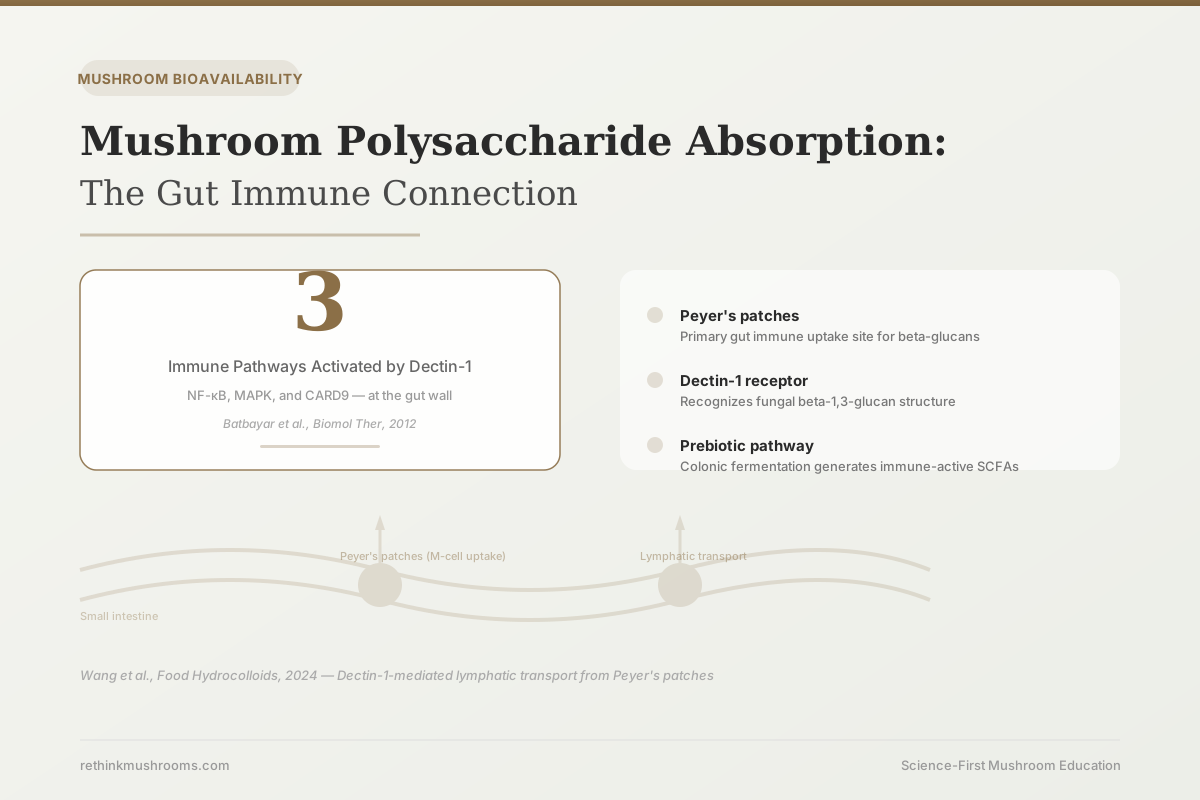
3 immune pathways
When beta-glucan binds Dectin-1 at the gut wall, it simultaneously triggers NF-κB, MAPK, and CARD9 signaling, producing cytokines, phagocytic activity, and reactive oxygen species without any compound entering the bloodstream.
Batbayar S et al., Biomol Ther, 2012
Peyer's patches
specialized gut immune tissue where polysaccharide uptake begins
Dectin-1 receptor
recognizes fungal beta-glucan structure on gut macrophages and dendritic cells
Prebiotic route
a second pathway via colonic fermentation generating systemic immune metabolites
Batbayar S et al., Biomol Ther, 2012
 View as image ↗
In 2024, Wang and colleagues published a detailed map of what happens to oral lentinan after ingestion. Lentinan is the beta-glucan from shiitake mushrooms, and for decades researchers measured its "bioavailability" by looking at how much reached the bloodstream. The answer was: not much. Wang's team tracked the polysaccharide through the gut and found the real story was happening somewhere else entirely.[1]
Lentinan was being taken up by specialized immune surveillance tissue in the small intestine wall, clusters of lymphoid cells called Peyer's patches. Once inside that tissue, it bound to a receptor called Dectin-1, which sits on the surface of macrophages and dendritic cells and is specifically designed to recognize fungal cell wall structures. The polysaccharide was then transported via the lymphatic system, triggering immune activation throughout the body.
This is the gut immune connection in mushroom polysaccharide absorption. The target is not the bloodstream. The target is the gut immune system itself. Understanding this mechanism is how you make sense of a compound that has low blood levels and measurable immune effects at the same time.
For an overview of how extraction methods affect what polysaccharide forms the gut receives, see Mushroom Extraction Methods Explained: Hot Water, Alcohol, and Dual.
Key Takeaways
- Oral lentinan reaches Peyer's patches of the small intestine, is carried across by M cells, and is then taken up by Dectin-1-bearing mononuclear phagocytes and moved through the lymphatic system rather than the bloodstream (Wang et al., Carbohydrate Polymers, 2024)
- Dectin-1 performs a dual function: it internalizes beta-glucan-containing particles and transmits signals into the nucleus, so a single binding event drives both uptake and immune activation (Batbayar et al., Biomol Ther, 2012)
- Water-insoluble, particulate beta-glucans have stronger immunostimulating activity than their water-soluble counterparts, so the physical form that reaches the gut matters, not just the total quantity (Lee et al., Int J Med Mushrooms, 2014)
- Molecular weight does not change how tightly beta-glucan binds Dectin-1: affinity is similar across sizes. What differs is signaling. Medium- and high-molecular-weight glucans are highly structured and drive receptor clustering; low-molecular-weight glucan is much less structured and signals weakly (Anaya et al., Biophys J, 2023)
- A second, distinct pathway routes polysaccharides that pass through to the colon, where gut bacteria ferment them and the microbiome composition shifts toward beneficial metabolite production (Liu et al., Int J Med Mushrooms, 2020)
- "Unabsorbed" polysaccharides that escape Peyer's patch uptake are not wasted: they act as prebiotic substrates for gut bacteria, and short-chain fatty acid fermentation products such as butyrate and propionate have well-described roles in gut barrier and immune regulation (Liu et al., 2020)
Where Absorption Actually Happens
Oral Lentinan Takes the Lymphatic Route, Not the Bloodstream
A pharmacokinetic blood draw is the wrong instrument for this compound. Lentinan is handed across the gut wall by M cells into Peyer’s patch tissue, picked up there by Dectin-1 on mononuclear phagocytes, and distributed through lymphatics. Low blood levels are a description of the route, not a verdict on the effect.
Survives digestion
Human enzymes cannot cleave beta-1,3/1,6-glucan linkages, and the triple-helix structure resists hydrolysis. The polysaccharide reaches the lower small intestine largely intact.
Background beta-glucan biochemistry
M cells carry it across
Near-infrared imaging confirmed accumulation within Peyer’s patches after oral dosing. Tissue imaging identified M cells as the main cells transporting lentinan into the patch.
Wang 2024 [1]
Dectin-1 uptake
An M cell model plus in vitro and in vivo work showed Dectin-1 mediates uptake of lentinan by the mononuclear phagocytes waiting inside the patch.
Wang 2024 [1]
Lymphatic distribution
Lentinan promoted proliferation and differentiation of those phagocytes, activating immune responses that travel via lymphatics rather than the bloodstream.
Wang 2024 [1]
A mechanism map, not an efficacy claim, and deliberately unquantified. Wang et al. traced transport and showed immune-cell activation in cell and animal models; they did not report a bioavailability fraction, so none is shown here. Stage 1 is general beta-glucan biochemistry rather than a finding of that study, which is why it is drawn as background. Human pharmacokinetic confirmation of this route remains limited.
Stages 2–4: Wang K et al., Carbohydrate Polymers (2024) [ref 1]
The Measurement Problem: Why Blood Levels Tell the Wrong Story
The standard test of how well a compound works is pharmacokinetic: you dose a person or animal, draw blood at intervals, and plot how much of the compound appears in systemic circulation. The area under that curve tells you the compound's bioavailability. For a drug, this is the right measurement. Drugs are designed to enter blood, travel to a target organ, and act there.
Mushroom beta-glucans are not designed to enter blood. They are large, branched polysaccharides with a triple-helix structure that resists digestion by intestinal enzymes. This resistance is not a formulation failure. It keeps the polysaccharide intact long enough to reach the immune tissue that recognizes it.
The gut immune system is not a passive bystander to what passes through the intestine. The small intestine wall contains Peyer's patches: dense clusters of lymphoid tissue with macrophages, dendritic cells, and B-cells positioned to sample and evaluate whatever is in the gut. Their job is continuous immune surveillance. And among the receptors on the macrophages inside Peyer's patches is Dectin-1, a C-type lectin receptor that evolved specifically to detect fungal cell wall structures.
This architecture means that when a mushroom beta-glucan reaches the small intestine intact, it encounters an immune detection system that was built for it. The measurement of how much reaches the blood misses this entirely, because the mechanism happens at the gut wall, not downstream in the circulation.
Step-by-Step: How Oral Lentinan Moves Through the Small Intestine
Wang et al. (2024) provided the most detailed map yet of oral lentinan's journey through the gut. They fluorescently labeled the polysaccharide and used near-infrared imaging, tissue imaging, an M-cell culture model, and both in vitro and in vivo experiments to trace where it went after oral dosing.[1] This is animal and cell-model work; direct confirmation in human pharmacokinetic studies remains limited. Combining their findings with established beta-glucan biology gives four stages that explain how a polysaccharide with low blood levels still produces immune activation:
Stage 1: Surviving digestion intact. Human digestive enzymes are not equipped to cleave the beta-1,3/1,6-glucan linkages that make up lentinan's backbone, and its triple-helix structure further resists hydrolysis. Unlike simple sugars and most starches, lentinan arrives at the lower small intestine largely intact. This enzyme resistance is a prerequisite for everything that follows: a fully degraded polysaccharide cannot bind Dectin-1. This step is general beta-glucan biochemistry rather than a specific finding of the Wang experiments, which began downstream at the point of intestinal absorption.
Stage 2: M-cell uptake at Peyer's patches. The surface of Peyer's patches is lined with specialized cells called microfold cells, or M-cells. These flat, non-secretory cells are distinct from the absorptive cells that line the rest of the intestine. M-cells are built for one purpose: they transport particles, pathogens, and antigens from the gut interior into the lymphoid tissue underneath. Wang et al. identified M-cell uptake as the primary route for lentinan entry into Peyer's patch tissue.
Stage 3: Dectin-1-mediated uptake by mononuclear phagocytes. Once inside the Peyer's patch, lentinan makes contact with mononuclear phagocytes, the macrophage and dendritic-cell population that carries Dectin-1 on its surface. Wang et al. established an M-cell model specifically to test Dectin-1's involvement, and their in vitro and in vivo experiments showed that Dectin-1 mediates this uptake step. Dectin-1 recognizes the beta-1,3-glucan linkages in lentinan's backbone structure. The team also found that lentinan promoted proliferation and differentiation of these phagocytes, linking uptake to an actual immune response rather than passive accumulation.
Stage 4: Lymphatic transport and immune activation. After Dectin-1 binding and cellular internalization, the immune signal travels via the lymphatic system outward from the Peyer's patches to regional lymph nodes and broader lymphoid tissue. This transport route, through lymphatics rather than blood vessels, is why blood concentration of beta-glucan remains low even as immune effects propagate.
The low blood levels are not evidence that lentinan failed to absorb. They are a feature of where the absorption happens.
Wang et al. (2024) · Carbohydrate Polymers
- Population
- Animal model dosed orally, plus an M cell culture model and mononuclear phagocytes from Peyer's patches
- Intervention
- Fluorescently labeled lentinan given by oral administration, tracked by near-infrared imaging and tissue imaging
- Comparator
- Dectin-1 involvement probed in the M cell model across in vitro and in vivo experiments
- Finding
- Lentinan accumulated in Peyer's patches after oral dosing. M cells were the main cells transporting it into the patch, and Dectin-1 mediated subsequent uptake by mononuclear phagocytes, which then proliferated and differentiated.
preliminary Preclinical. Cell models plus animal work, no human pharmacokinetic or clinical outcome data. It establishes the route and shows immune-cell activation along it; it does not quantify what fraction of an oral dose takes that route, and does not demonstrate a health outcome.
Wang K et al., Carbohydrate Polymers, 2024;346:122586
What Happens When Dectin-1 Binds a Beta-Glucan
Dectin-1 does two things simultaneously when it encounters a beta-glucan particle. It pulls the particle inside the cell, and it fires a signaling cascade that transforms the cell from passive surveillance to active immune response.
Batbayar et al. (2012) described this explicitly: Dectin-1 on macrophages and dendritic cells performs dual functions, internalizing beta-glucan-containing particles and transmitting signals into the nucleus.[2] Their review traces the downstream signal transduction, which runs through three well-characterized arms of the canonical Dectin-1 cascade.
NF-κB signaling. NF-κB is a master switch for inflammation. When Dectin-1 fires it, the cell begins producing pro-inflammatory cytokines. Lee et al. (2014) note that beta-glucan binding to Dectin-1 leads innate immune cells to secrete interleukins such as IL-4 and IL-6 along with tumor necrosis factor-alpha, which recruit additional immune cells and activate adaptive immune cells including B and T lymphocytes and natural killer cells.[3]
MAPK signaling. The MAPK (mitogen-activated protein kinase) pathway regulates how immune cells survive, proliferate, and differentiate. In macrophages, MAPK activation contributes both to cytokine production and to the cell's ability to generate reactive oxygen species that kill engulfed particles. Reactive oxygen species are a primary mechanism by which macrophages destroy pathogens once they are internalized.
CARD9 signaling. CARD9 is an adapter protein that sits downstream of Dectin-1 and is central to antifungal immunity. It connects Dectin-1 activation to additional immune pathways that evolved for defense against fungal pathogens. This arm is what ties beta-glucan recognition to the antifungal defense program specifically, rather than to generic inflammation.
These three cascades are not sequential. They fire in parallel from a single binding event. The result is a macrophage that is simultaneously producing cytokines, engaging in phagocytosis, and generating reactive oxygen species: a full antimicrobial activation program, all triggered at the gut wall.
Why Particle Size and Form Determine What Dectin-1 Can Do
Not all beta-glucan preparations activate Dectin-1 with equal strength, and the reason is one of the most commonly misstated points in this field. The intuitive assumption is that binding strength is what varies. It is not.
Correcting a Common Error
Binding and Activating Are Two Different Events
It is often claimed that smaller beta-glucan fragments bind Dectin-1 more tightly. Measured directly, they do not. Affinity is comparable across molecular weights. What changes is whether the receptor gets organized once bound — and that depends on the glucan’s three-dimensional structure.
Medium / high MW
Highly structured — helical, higher-order conformation
Low MW
Much less structured
Denatured
Structure deliberately unfolded in the lab
Bar lengths are schematic, not measured potency values. Anaya et al. report that signaling correlates with degree of glucan structure and that denaturation abolishes agonistic potential while leaving binding affinity intact; they do not publish a single normalized potency figure, so none is invented here. This is live-cell biophysics on Dectin-1A, not a clinical outcome — it explains why preparation and form matter, not what any product will do for a person.
Anaya BJ et al., Biophysical Journal (2023) [ref 5]; particulate-versus-soluble corroboration from Lee DH et al., Int J Med Mushrooms (2014) [ref 3]
Binding affinity is not the variable. Structure is. Anaya et al. (2023) tested this directly using biophysical measurements of Dectin-1A on live cells. Beta-glucans of different molecular weights bound the receptor with similar affinity. What differed was the ability to actually trigger signaling, and that tracked with the degree of three-dimensional structure the glucan retained.[5] Denaturation experiments settled the question: unfolding a glucan destroyed its agonistic potential while leaving receptor binding affinity intact.[5] Binding and activating are separable events, and only the second one is structure-dependent.
Molecular weight matters through structure, not affinity. Medium- and high-molecular-weight fungal beta-glucans are highly structured, adopting the helical and higher-order conformations that make them recognizable as an intact fungal signal. Low-molecular-weight glucan is much less structured.[5] This is why fragmenting a polysaccharide into smaller pieces tends to weaken immune signaling rather than strengthen it. The fragments still occupy the receptor; they simply fail to organize it.
The mechanism is receptor clustering. Anaya's team found that stimulation with structured glucans reduced Dectin-1A mobility in the membrane and produced direct evidence of ligation-induced receptor aggregation, with the degree of aggregation rising in proportion to how much structure the glucan retained. These clusters stayed small, under about 15 nanometers, representing a handful of engaged receptors rather than a large patch.[5] At the surface of actual fungal particles, receptor aggregation increased in proportion to how much glucan was exposed on that surface.[5]
Anaya et al. (2023) · Biophysical Journal
- Population
- Live-cell biophysical measurement of Dectin-1A, the C-type lectin receptor for beta-(1,3;1,6)-glucan
- Intervention
- Fungal beta-glucans spanning low to high molecular weight, in solution structures ranging from random coil to insoluble fiber, plus deliberately denatured glucan
- Comparator
- Binding affinity measured against signaling output and receptor aggregation for each glucan state
- Finding
- Glucans of differing molecular weight bound Dectin-1A with similar affinity, but signaling tracked degree of structure. Denaturation destroyed agonistic potential while leaving binding affinity intact. Receptor aggregation rose with glucan structure content and, at fungal particle surfaces, with the amount of exposed glucan.
narrow-scope Strong, direct biophysics on the receptor mechanism, and the denaturation arm cleanly separates binding from activation. But this is beta-(1,3;1,6)-glucan studied on Dectin-1A in cell systems, not mushroom extracts in a human gut. It explains why preparation and form should matter; it does not establish that any particular supplement performs better in people.
Anaya BJ et al., Biophysical Journal, 2023;122(18):3749-3767
Particulate versus soluble form. This is the practical expression of the same principle, and it is where the review literature agrees. Lee et al. (2014) state it plainly: water-insoluble beta-glucans have stronger immunostimulating activities than their water-soluble counterparts.[3] An insoluble particle presents a dense, ordered array of exposed glucan to the cell surface, which is precisely the condition that drives the receptor clustering Anaya measured. A dissolved molecule does not.
The practical consequence is that extraction method affects not just how much beta-glucan reaches the gut, but what form it arrives in and how potently it can activate Dectin-1 on contact. Hot water extraction preserves a polysaccharide structure closer to the native particulate form of the fungal cell wall. Processes that fully solubilize or fragment the beta-glucan may reduce Dectin-1 signaling even if the total beta-glucan quantity on the label remains high.
Fermentation is a genuinely open case. It breaks high-molecular-weight polysaccharides into shorter chains, which on the structure-signaling evidence above would be expected to reduce Dectin-1 activation, while simultaneously generating microbial metabolites that act through the separate prebiotic route described below. Which effect dominates has not been resolved. For an analysis of how fermentation alters mushroom bioactives, see Fermented Mushrooms: Do They Have Enhanced Bioactivity?.
For a direct comparison of how extraction methods affect beta-glucan delivery, see Hot Water Extract vs. Dual Extract vs. Raw Powder: Which Delivers More Beta-Glucans?.
The Second Pathway: Polysaccharides as Gut Microbiome Food
Not every beta-glucan that enters the small intestine reaches Peyer's patches. A portion passes through without M-cell uptake and arrives at the colon intact. Liu et al. (2020) reviewed what happens at this stage and found a second, distinct absorption pathway operating through the gut microbiome.[4]
Colonic bacteria ferment mushroom polysaccharides, using them as a carbon source and releasing short-chain fatty acids as byproducts. The principal short-chain fatty acids produced by carbohydrate fermentation in the human colon are butyrate, propionate, and acetate. This is general microbiome biochemistry rather than a mushroom-specific finding, and the specific bacterial genera that respond vary by polysaccharide and by study.
Short-chain fatty acids are not passive metabolic waste. Butyrate is the dominant energy source for colonocytes, the cells that line the colon, and plays a direct role in maintaining gut barrier integrity. Propionate travels from the gut through the portal vein to the liver, where it influences metabolic signaling. Both have immune-regulatory properties: they suppress certain pro-inflammatory pathways and support regulatory T-cell development.
What Liu et al. contribute is the link between mushrooms specifically and this machinery. Their review concludes that mushrooms can change the composition of the gut microbiota and promote the secretion of beneficial metabolites, drawing on prebiotic effects reported across immunological, metabolic, neurological, and cancer-related contexts.[4] The authors frame this as a direction for further mechanistic study rather than a settled account, and they explicitly flag host gene expression in the gut as an unresolved variable.
This creates a situation where polysaccharides that were not "absorbed" in the conventional sense, those that escaped Peyer's patch uptake, still produce systemic immune effects through a downstream fermentation pathway. The two pathways, Dectin-1 activation in the small intestine and prebiotic fermentation in the colon, are complementary rather than competing.
For a deeper look at the specific bacteria involved and what mushroom polysaccharides feed, see How Mushroom Prebiotics Feed Probiotic Bacteria.
Evaluating Mushroom Products Through This Lens
The standard way consumers evaluate mushroom supplements is by checking beta-glucan percentage on the label. That number matters, but it captures only one dimension of a more complex picture.
Fact Check
Do low blood levels mean oral mushroom polysaccharides don't work?
The claim
“Beta-glucans barely show up in the bloodstream after an oral dose, so they can't be doing anything systemically.”
Applying the drug model of bioavailability — where 'reaches the blood' equals 'active' — to a molecule whose target receptor is stationed in the gut wall rather than in circulation
What research shows
MisleadingThe receptor that recognizes beta-glucan, Dectin-1, sits on immune cells inside the intestinal wall. Wang et al. traced oral lentinan into Peyer's patches via M cells and showed Dectin-1 mediates uptake by mononuclear phagocytes there, with distribution through lymphatics rather than blood. Low plasma levels describe the route taken, not the absence of an effect.
This is not a claim that any given product works. The mechanism evidence is preclinical, no bioavailability fraction has been quantified, and there are no clinical outcome data behind the studies cited here. It also cuts both ways: because signaling depends on the glucan arriving structured and particulate, a product can contain plenty of beta-glucan by assay and still signal poorly.
Wang 2024; Batbayar 2012; Anaya 2023; Lee 2014
The questions that the Dectin-1/Peyer's patch mechanism actually calls for:
Does the polysaccharide arrive at the small intestine in a form that can be taken up by M-cells? This requires surviving upper GI digestion largely intact, which most high-MW beta-glucans do.
Is the beta-glucan structured and particulate enough to cluster Dectin-1 rather than merely occupy it? This depends on extraction method, molecular weight profile, and how much the processing dissolved or fragmented the native polysaccharide structure. Recall that binding is not the bottleneck; organizing the receptor is.
Is there enough total beta-glucan quantity to produce meaningful Peyer's patch contact at the doses used? This is where the percentage-by-weight figure becomes relevant, but in context: on the structure-signaling evidence, a highly solubilized, fragmented extract at a high dose could plausibly signal less effectively than an intact particulate extract at a lower one. That comparison has not been tested head-to-head in people, so it remains an inference from mechanism rather than a demonstrated result.
The prebiotic pathway adds a second consideration: any polysaccharide that passes through to the colon still serves a function. The question is whether the product is optimized for the Dectin-1 route, the prebiotic route, or both, and whether that matches the user's purpose.
- Cell and receptor biophysicscompleted
Dectin-1's dual internalization-and-signaling function is characterized (Batbayar 2012); structure-dependent receptor clustering is measured directly on live cells, with denaturation cleanly separating binding from activation (Anaya 2023); water-insoluble beta-glucans outperform soluble ones (Lee 2014).
- Animal transit mappingcurrent
Fluorescent labeling and near-infrared imaging traced oral lentinan into Peyer's patches, identified M cells as the main transporter, and showed Dectin-1 mediates uptake by mononuclear phagocytes that then proliferate (Wang 2024). Mushroom-specific prebiotic effects are review-level (Liu 2020).
- Human observational evidencemissing
No human observational or case data tying this specific absorption route to any measured immune or clinical outcome.
- Small human trialsmissing
No human pharmacokinetic study quantifying what fraction of an oral dose takes the Peyer's patch route, and no confirmation of lymphatic transport in people.
- Large randomized trialsmissing
No large RCT testing outcomes attributable to this mechanism.
- Meta-analysesmissing
Nothing to pool — there is no body of clinical-endpoint trials specific to this absorption pathway.
The receptor biology and the transit route are well characterized in cell and animal models, and the structure-versus-affinity question has been settled biophysically. What does not yet exist is human pharmacokinetic confirmation or any clinical endpoint attached to this pathway.
Batbayar 2012; Lee 2014; Liu 2020; Anaya 2023; Wang 2024
Context, Not Medical Advice
ModerateActivating gut immunity is not universally desirable
Concern
Everything described here is a mechanism for stimulating innate immune signaling — Dectin-1 engagement, cytokine production, phagocyte proliferation. Deliberately amplifying that signaling is not neutral for everyone. It can be counterproductive for people with autoimmune conditions, people taking immunosuppressant medication, and organ transplant recipients, whose treatment goals may run in the opposite direction.
What the research says
This article explains how a polysaccharide reaches the immune system and why blood levels are the wrong measurement. It is not a dosing protocol, a product recommendation, or a reason to begin supplementing. The underlying studies are preclinical and report no clinical outcomes.
Particularly relevant for: People with autoimmune disease, those taking immunosuppressants or biologics, transplant recipients, people undergoing active medical treatment, and anyone pregnant or breastfeeding
What to do
Talk to a qualified healthcare provider before starting any mushroom or beta-glucan supplement, particularly alongside prescription medication or ongoing treatment.
General pharmacovigilance guidance; mechanism context from Batbayar 2012 and Wang 2024
The Bottom Line
Mushroom beta-glucans produce immune effects primarily by activating Dectin-1 receptors on mononuclear phagocytes in the gut's Peyer's patches, not by entering the bloodstream in quantity. Wang et al. (2024) traced oral lentinan through M-cell transport into Peyer's patches, Dectin-1-mediated uptake, and lymphatic distribution using fluorescent labeling in cell and animal models. A second route delivers polysaccharides to the colon, where microbial fermentation generates short-chain fatty acids with systemic immune effects. Structure, not binding affinity, governs how strongly a given preparation signals: glucans of different molecular weights bind Dectin-1 comparably, but only well-structured, particulate forms cluster the receptor enough to activate it. All five studies cited here are preclinical, biophysical, or mechanistic reviews; this is the foundational science for the mechanism, not clinical outcome data. Low blood levels of beta-glucan reflect where the mechanism operates, at the gut wall and in the lymphatics, rather than a failure of absorption.
Frequently Asked Questions
Sources & References
- 1RTHM-02013·Wang, Kaiping et al. (2024). “Insights into oral lentinan immunomodulation: Dectin-1-mediated lymphatic transport from Peyer's patch M cells to mononuclear phagocytes..” Carbohydrate polymers.Study breakdown →PubMed →↩
- 2RTHM-00244·Batbayar, Sainkhuu et al. (2012). “Immunomodulation of Fungal β-Glucan in Host Defense Signaling by Dectin-1..” Biomolecules & therapeutics.Study breakdown →PubMed →↩
- 3RTHM-00333·Lee, Dong Hee et al. (2014). “Innate immunity induced by fungal β-glucans via dectin-1 signaling pathway..” International journal of medicinal mushrooms.Study breakdown →PubMed →↩
- 4RTHM-01242·Liu, Xiaoxiao et al. (2020). “A Review on Linking the Medicinal Functions of Mushroom Prebiotics with Gut Microbiota..” International journal of medicinal mushrooms.Study breakdown →PubMed →↩
- 5RTHM-00814·Anaya, Eduardo U et al. (2023). “Dectin-1 multimerization and signaling depends on fungal β-glucan structure and exposure..” Biophysical journal.Study breakdown →PubMed →↩