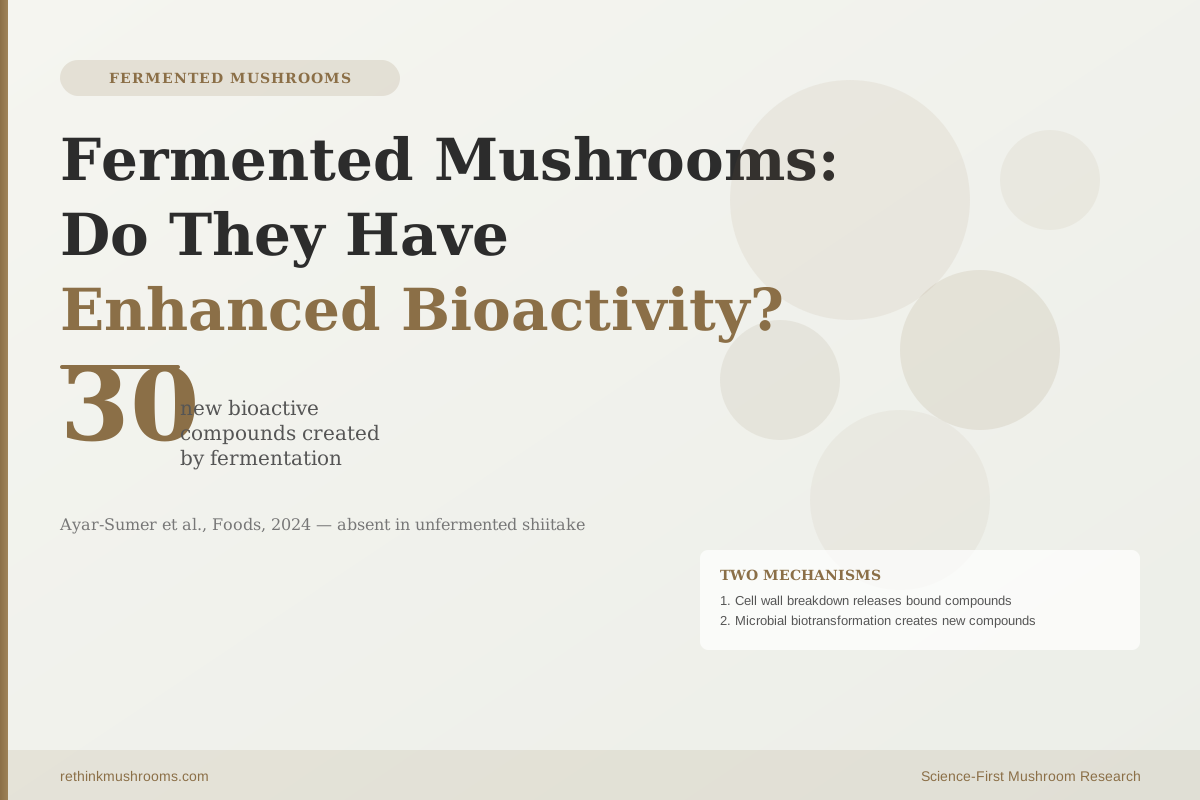
Fermented Mushrooms
30 compounds mapped
Lactic acid bacteria fermentation of shiitake significantly raised free phenolic content by liberating compounds bound in the cell-wall matrix, with 30 bioactive compounds mapped by mass spectrometry.
Ayar-Sümer et al., Foods, 2024
Liberation
the best-documented mechanism is releasing bound compounds, not creating new ones
Not always
in a P. eryngii three-way test, mycelia beat the fermented product on antioxidants
7 studies
reviewed across shiitake, king oyster, turkey tail, reishi, and more
Ayar-Sümer et al., Foods, 2024
 View as image ↗
The supplement industry sells fermented mushrooms on "enhanced bioavailability." The phrase is doing a lot of work. The research does support a real, mechanistic benefit from fermentation, but it is more specific, and more qualified, than the marketing suggests. Fermentation can increase the fraction of a mushroom's bioactive compounds that your gut can actually absorb, primarily by dismantling the tough cell wall that keeps those compounds locked away.
A 2024 study fermented shiitake (Lentinula edodes) with lactic acid bacteria and tracked the phenolic compounds before and after. Fermentation significantly increased the free (readily absorbable) phenolic content, while the bound phenolic fraction dropped, exactly the signature of compounds being released from the cell-wall matrix rather than newly created.[1]
That is a genuine advantage. But the same body of research also contains a set of honest counterpoints the marketing leaves out: in a head-to-head test, a fermented product can actually rank last on a key compound, and a wild fruiting body can outperform every fermented form. This article works through both sides with the actual studies.
For a broader look at how mushroom processing affects what compounds survive extraction, see the overview on extraction methods: hot water, alcohol, and dual.
Key Takeaways
- The best-documented mechanism is liberation, not creation: LAB fermentation of shiitake significantly raised free phenolic content while bound phenolics fell, indicating release from the cell-wall matrix (Ayar-Sümer et al., Foods, 2024)
- A comprehensive 2024 review confirms fermented mushrooms can show enhanced antioxidant, antimicrobial, anticancer, anti-glycemic, and immunomodulatory activity, with outcomes depending heavily on species and method (Sivamaruthi et al., 2024)
- "Fermented equals better" is oversimplified: in a direct three-way comparison of king oyster mushroom, Hi-Ergo mycelia led on ergothioneine and antioxidant activity while the fermented products ranked lowest on ergothioneine (Liang et al., 2013)
- Fermentation can add value through the substrate itself: turkey tail mycelium and its fermented grain substrate each showed potent, complementary immune activity, and the fermented substrate carried bioactivity absent from the raw substrate (Benson et al., 2019)
- Method matters more than the word "fermented": for Antrodia camphorata anti-inflammatory potency, wild fruiting body ranked above solid-state culture, which ranked above liquid fermentation (Liu et al., 2007)
- Mycelium and fruiting bodies simply have distinct metabolite profiles; neither is comprehensively superior, so the starting material still matters (Berger et al., 2022)
What "Enhanced Bioactivity" Actually Means: Breaking Down the Cell Wall
When supplement brands say fermented mushrooms have enhanced bioactivity, the mechanism they are usually describing is real: fermentation breaks down the tough cell wall, releasing compounds that would otherwise pass through your gut without being absorbed.
Mushrooms are unusual among foods in that their cell wall is built largely of chitin, the same structural material found in insect exoskeletons and crustacean shells. Human digestive enzymes cannot break chitin down. A meaningful portion of mushroom phenolics, beta-glucans, and other bioactives are physically trapped in this matrix, bound to cell-wall structural components and simply unavailable without a processing step. Fermenting microorganisms secrete enzymes (cellulases, laccases, and related activities) that dissolve this matrix and liberate the trapped compounds.
The 2024 shiitake study is the clearest single demonstration. Researchers fermented shiitake and saffron milk cap (Lactarius deliciosus) with Lactiplantibacillus plantarum and measured both the free and bound phenolic fractions over 72 hours. Free phenolic content rose significantly, particularly within the first 24 hours, while the bound fraction declined, the direct fingerprint of compounds being released from the matrix rather than synthesized from scratch.[1] Using high-resolution mass spectrometry, the team catalogued 30 bioactive compounds in the fermented products. The authors' own conclusion is explicit: fermentation of high-phenolic mushrooms leads to the liberation of bound phenolics, enhancing their bioactivity and bioaccessibility.
This is an important nuance to get right. "Fermentation creates entirely new molecules that never existed in the mushroom" is a stronger claim than this study makes. What it demonstrated is release and increased accessibility, which is exactly the mechanism that would improve absorption. For context on what shiitake's baseline compound profile looks like before any fermentation, see the article on shiitake bioactive compounds: lentinan, eritadenine, and beyond.
A 2024 comprehensive review by Sivamaruthi and colleagues situates this in the wider literature. Across multiple fermented mushroom species, the review documents enhanced antioxidant, antimicrobial, anticancer, anti-glycemic, and immunomodulatory activity, driven mechanistically by suppression of free radicals, strengthened antioxidant defenses, and modulation of immune responses.[2] Critically, the review also stresses that which activities are enhanced depends heavily on which organism does the fermenting and what format the fermentation takes. That dependency is where the marketing and the evidence part ways.
The Honest Three-Way Test: When Fermented Did Not Win
One of the most-cited pieces of "fermented is better" evidence is a 2013 study by Liang and colleagues, because it did something rare: it put three forms of the same mushroom head-to-head. Read carefully, it is actually a cautionary tale.
The study prepared king oyster mushroom (Pleurotus eryngii) as fruiting bodies, mycelia (a standard strain and a high-ergothioneine "Hi-Ergo" strain), and solid-state fermented products grown on adlay and buckwheat. It then measured ergothioneine content and a panel of antioxidant properties, including DPPH radical scavenging and reducing power.[3]
The fermented products did not come out on top. They came out on the bottom for ergothioneine, one of the mushroom compounds most often used to justify a "fermented and enhanced" label.
Ergothioneine by Form · King Oyster Mushroom
The Fermented Product Had the Lowest Ergothioneine, Not the Highest
Marketing implies fermented mushroom products win on every measure. In Liang et al. (2013)’s direct comparison of Pleurotus eryngii forms, the solid-state fermented products ranked last on ergothioneine, while “Hi-Ergo” mycelia led on both ergothioneine content and antioxidant activity. The starting material and cultivation method mattered more than fermentation itself.
Hi-Ergo mycelia
Fruiting body (fresh)
Regular mycelia
Fermented product
Why it matters: Ergothioneine is one of the mushroom compounds most often used to justify “enhanced” fermented products. Here, fermentation reduced it. Fermentation can raise the free, absorbable fraction of some compounds, but it does not universally increase every bioactive — and it is not automatically superior to a good mycelial or fruiting-body preparation.
Source: Liang C-H et al. (2013), International Journal of Medicinal Mushrooms — “Antioxidant properties of fruiting bodies, mycelia, and fermented products of the culinary-medicinal king oyster mushroom, Pleurotus eryngii” [ref 3]. Values are ergothioneine concentrations (mg/g) as reported in the study.
The Hi-Ergo mycelia led on ergothioneine (5.76 mg/g) and was the most effective form across the antioxidant measures. Fresh fruiting bodies (2.05 mg/g) outperformed regular mycelia (1.68 mg/g), and the solid-state fermented products trailed everything at roughly 0.79 to 0.80 mg/g.[3]
The lesson is not that fermentation is useless. It is that the starting strain and cultivation method drove the result far more than the presence or absence of fermentation. A well-chosen mycelial strain beat a fermented product decisively. This is the single clearest reason to be skeptical of a blanket "fermented mushrooms have enhanced bioactivity" claim: sometimes they measurably do not.
The mechanistic details of how fermentation transforms mushroom compounds, and when it helps versus hurts, are covered in depth in the companion article on mushroom biotransformation and how fermentation creates new compounds.
Where Fermentation Genuinely Adds Something: The Substrate Itself
If a fermented product can lose to plain mycelia, is there a case where fermentation clearly adds bioactivity that was not there before? A 2019 study by Benson and colleagues found one, in a place most fermentation research ignores: the fermented growing medium.
In solid-state fermentation (SSF), mushroom mycelium grows through a grain substrate for weeks, secreting enzymes and metabolizing the grain. Benson's team separated turkey tail (Trametes versicolor) mycelium from its fermented rice substrate and tested each independently for immune activity in human blood-cell cultures, using the uncolonized substrate as a control.[4]
The two fractions behaved differently, and complementarily:
- The mycelium robustly switched on the CD69 immune-activation marker across lymphocytes and monocytes, with its water-soluble fraction more active than its solid fraction.
- The fermented substrate drove large, dose-dependent increases in immune signaling molecules, including pro-inflammatory cytokines (IL-2, IL-6), anti-inflammatory regulators (IL-1 receptor antagonist, IL-10), antiviral interferon-gamma, and growth factors such as G-CSF.
The decisive control was the uncolonized starting substrate, which had essentially no activity. That means the immune-active compounds in the fermented substrate were generated by the fermentation process itself, not carried over from the grain. The authors concluded that the bioactivity of a mycelial mushroom preparation is a combination of the mycelium and the metabolically transformed substrate, activity "not present in the initial substrate."[4]
This is the strongest evidence in the set that fermentation can add genuinely new bioactivity, and it is worth being precise about what it shows: distinct immune-signaling activity generated in the substrate, demonstrated in cell culture. Whether that translates into a measurable clinical advantage in commercial myceliated-grain supplements, which sell the mycelium and spent substrate together, remains an open question. For readers interested in turkey tail's specific compounds (PSK, PSP, and beta-glucans) in a non-fermented context, see the article on turkey tail bioactive compounds. How SSF generates these compounds through mycelial enzyme activity is covered in the companion piece on solid-state fermentation and mushroom bioactivity.
SSF vs. Liquid Fermentation: The Method Decides the Outcome
"Fermented" on a label does not tell you how the product was made, and the method meaningfully changes the result.
Solid-state fermentation (SSF) is low-moisture fermentation where mycelium grows through a solid substrate such as grain, sawdust, or bran, roughly mimicking the mushroom's natural growing environment.
Liquid (submerged) fermentation grows mycelium in liquid media, typically optimized for biomass or a single target compound. It is faster and more scalable, but the environment changes the compound profile.
A 2007 study by Liu and colleagues compared all three forms of Taiwanofungus camphoratus (Antrodia camphorata), wild fruiting body, solid-state culture, and liquid-state fermentation, for anti-inflammatory activity in microglial cells, measuring suppression of inducible nitric oxide synthase.[5] The potency ranking was unambiguous: wild fruiting body outperformed solid-state culture, which outperformed liquid-state fermentation.
Two lessons come out of that ranking. First, among the cultivated forms, SSF retained more of the anti-inflammatory activity than liquid fermentation, likely because low-moisture stress signals the mycelium to produce protective secondary compounds that submerged culture does not elicit as strongly. Second, and easy to miss, the wild fruiting body still beat both fermented forms. Fermentation was the better cultivation choice, not a route to surpassing the wild mushroom.
Liquid fermentation is not universally inferior. It can be precisely tuned for a specific compound target in ways SSF cannot, which is why CS-4 Cordyceps production relies on it. But for a broad-spectrum profile resembling the wild mushroom, SSF has the better comparative record. The full trade-off analysis across species is covered in the companion article on solid-state vs. liquid fermentation for mushroom products.
The Baseline Still Matters: Mycelium vs. Fruiting Body
Underneath the fermentation question sits a more basic one: is mycelium even the right starting material? A 2022 systematic review by Berger and colleagues compared the metabolite profiles of mycelium and fruiting bodies across popular edible fungi.[6]
The finding was that mycelium and fruiting bodies carry distinct profiles of proteins, polysaccharides, and smaller metabolites, and that neither form is comprehensively "better." Fruiting bodies are generally richer in the structural polysaccharides many consumers are buying mushrooms for; mycelium offers different enzymatic and metabolic content and is easier to produce at scale.
This is the frame that keeps the fermentation research honest. Fermentation acts on whatever it starts with. A fermented mycelial product begins from a different baseline than a concentrated fruiting-body extract, and fermentation may narrow that gap on some measures without closing it on others. The practical consequences for absorption are explored in the article on beta-glucan bioavailability: can your gut actually absorb them.
Fermented Mushroom Beverages: Reishi Kombucha Has Real Data
Fermented mushroom drinks are a fast-growing category dominated by recipes and wellness blogs. One peer-reviewed study stands out as genuine food science.
A 2018 study by Sknepnek and colleagues used a hot-water extract of reishi (Ganoderma lucidum) as the base for a kombucha and characterized the result.[7] The sweetened reishi extract supported healthy yeast and acetic acid bacteria growth over an 11-day fermentation, and the finished beverage carried a mix of polysaccharides, phenolics, proteins, and lipids. It showed measurable antioxidant activity (DPPH radical scavenging) and, notably, antibacterial activity, with the liquid beverage most effective against Staphylococcus epidermidis and Rhodococcus equi and bactericidal against Bacillus cereus and others.
What the study establishes is that reishi's compounds survived the kombucha fermentation and contributed measurable functional activity in the lab. What it does not establish is any clinical outcome from drinking it; this is early-stage food science, not medicine. For the full picture on fermented mushroom beverages across formats, see the companion article on fermented mushroom beverages: kombucha, beer, and beyond.
The Honest Bottom Line
Do fermented mushrooms have enhanced bioactivity? Sometimes, and for a specific, well-understood reason: fermentation can break down the chitin cell wall and liberate bound compounds, raising the fraction your body can absorb. That mechanism is real and reproducible. Fermentation can also generate distinct bioactivity in the substrate itself, as the turkey tail work shows.
But "fermented" is not a guarantee of superiority. A fermented product can rank last on a key compound, a wild fruiting body can beat every fermented form, and the fermentation method changes the outcome. The useful question is never "is it fermented?" but "what was fermented, how, and measured against what?"
This article summarizes published research for educational purposes and is not medical advice. Talk to a qualified healthcare professional before using mushroom supplements, particularly if you take medication or have a health condition.
The Bottom Line
Fermented mushrooms can show enhanced bioactivity, but the mechanism is more specific than marketing implies: the best-documented effect is the liberation of bound compounds when microbial enzymes break down the chitin cell wall, raising the free, absorbable phenolic fraction (Ayar-Sümer 2024). A 2024 review confirms enhanced antioxidant and immunomodulatory activity is achievable but species- and method-dependent (Sivamaruthi 2024). The honest counterpoints are substantial: in a three-way king oyster comparison, Hi-Ergo mycelia led on ergothioneine and antioxidants while fermented products ranked lowest (Liang 2013), and wild-fruiting-body Antrodia beat both solid-state and liquid fermentation on anti-inflammatory potency (Liu 2007). Where fermentation clearly adds value is the substrate itself, which developed immune activity absent from the raw grain (Benson 2019). "Fermented equals better" is not supported; the starting material and method decide the outcome.
Frequently Asked Questions
Sources & References
- 1RTHM-01854·Ayar-Sümer, Eda Nur et al. (2024). “Impact of Lactic Acid Bacteria Fermentation Based on Biotransformation of Phenolic Compounds and Antioxidant Capacity of Mushrooms..” Foods (Basel.Study breakdown →PubMed →↩
- 2RTHM-01994·Sivamaruthi, Bhagavathi Sundaram et al. (2024). “A concise review of the nutritional profiles, microbial dynamics, and health impacts of fermented mushrooms..” Journal of food science.Study breakdown →PubMed →↩
- 3RTHM-00538·Liang, Chih-Hung et al. (2013). “Antioxidant properties of fruiting bodies, mycelia, and fermented products of the culinary-medicinal king oyster mushroom, Pleurotus eryngii (higher Basidiomycetes), with high ergothioneine content..” International journal of medicinal mushrooms.Study breakdown →PubMed →↩
- 4RTHM-01034·Benson, Kathleen F et al. (2019). “The mycelium of the Trametes versicolor (Turkey tail) mushroom and its fermented substrate each show potent and complementary immune activating properties in vitro..” BMC complementary and alternative medicine.Study breakdown →PubMed →↩
- 5RTHM-00119·Liu, Der-Zen et al. (2007). “Comparative anti-inflammatory characterization of wild fruiting body, liquid-state fermentation, and solid-state culture of Taiwanofungus camphoratus in microglia and the mechanism of its action..” Journal of ethnopharmacology.Study breakdown →PubMed →↩
- 6RTHM-00743·Berger, Ralf G et al. (2022). “Mycelium vs. Fruiting Bodies of Edible Fungi-A Comparison of Metabolites..” Microorganisms.Study breakdown →PubMed →↩
- 7RTHM-01007·Sknepnek, Aleksandra et al. (2018). “Novel Kombucha Beverage from Lingzhi or Reishi Medicinal Mushroom, Ganoderma lucidum, with Antibacterial and Antioxidant Effects..” International journal of medicinal mushrooms.Study breakdown →PubMed →↩