Mushroom Pharmacology & Bioavailability
2–5% systemic bioavailability of high-MW beta-glucans
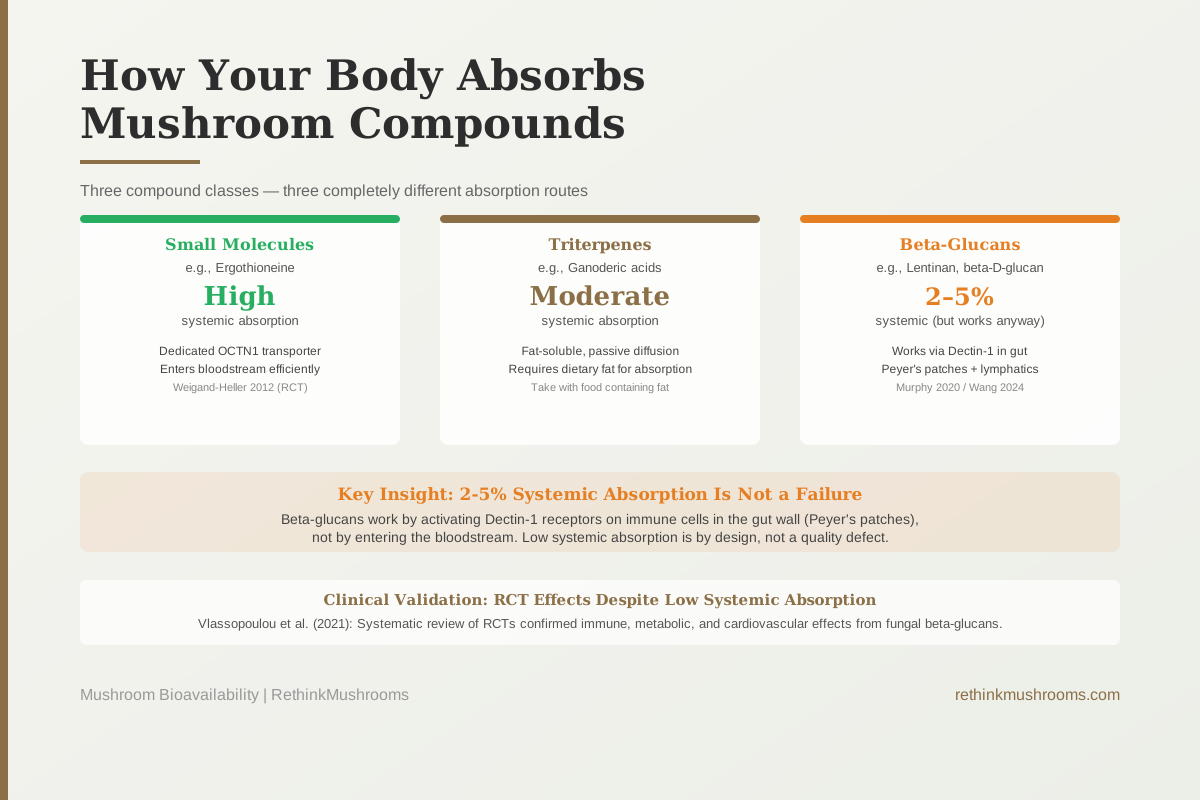
High-molecular-weight beta-glucans from mushrooms reach systemic circulation at only 2-5%, yet produce documented clinical effects in human RCTs. Their primary mechanism does not require entering the bloodstream.
Murphy et al., International Journal of Molecular Sciences, 2020
Dectin-1 receptor
how beta-glucans activate gut immunity
RCT-validated
clinical effects despite low systemic absorption (Vlassopoulou 2021)
ergothioneine
small mushroom molecule with high systemic absorption
Murphy et al., International Journal of Molecular Sciences, 2020
 View as image ↗
The standard way to measure how well a compound is absorbed is to measure how much of it reaches the bloodstream. By that measure, mushroom polysaccharides like beta-glucans look like they have a problem: only 2 to 5 percent of high-molecular-weight beta-glucans cross the gut wall into systemic circulation.
But clinical trials consistently show that beta-glucan supplements produce measurable immune effects in humans. If only 2 to 5 percent enters the bloodstream, how is this possible?
The answer is that beta-glucans are not drugs. They do not need to enter the bloodstream to do their job. Understanding how they actually work in the body changes what "good absorption" means for mushroom compounds.
For context on mushroom extraction methods and how they affect what you get from a product, see Mushroom Extraction Methods Explained: Hot Water, Alcohol, and Dual.
Key Takeaways
- Mushroom compounds fall into three absorption categories: small molecules (ergothioneine, cordycepin) with efficient systemic absorption; triterpenes with moderate fat-dependent absorption; and polysaccharides (beta-glucans) with 2-5% systemic bioavailability but a distinct gut-immune mechanism
- A systematic review of RCTs on fungal beta-glucans (Vlassopoulou et al., Food Reviews International, 2021) confirmed clinical effects across immune, metabolic, and cardiovascular outcomes; despite low systemic absorption, the compounds clearly work
- Ergothioneine from mushrooms is efficiently absorbed in humans: an RCT by Weigand-Heller and colleagues (2012) found acute mushroom intake increased plasma ergothioneine and reduced oxidative stress markers, confirming efficient systemic uptake of this small molecule
- Beta-glucans' primary absorption route is through specialized cells (M-cells) in Peyer's patches of the small intestine, where they bind Dectin-1 receptors and activate local and lymphatic immune signaling (Wang et al., Food Hydrocolloids, 2024)
- Molecular weight matters: Murphy and colleagues (2020) found that lower-molecular-weight and more soluble beta-glucan forms show better Dectin-1 binding and some systemic uptake, compared to high-molecular-weight insoluble forms
- Polysaccharides that bypass Peyer's patch uptake reach the colon intact and function as prebiotics, selectively feeding beneficial bacteria and producing short-chain fatty acids with systemic immune effects. This is a second absorption pathway that most consumers don't know about
The Three Absorption Categories
Mushroom compounds are not a monolithic group. Their absorption characteristics differ by chemical class, and understanding this prevents a significant amount of confusion about whether mushroom supplements "work."
Small molecules (high systemic absorption): Ergothioneine is a naturally occurring amino acid that mushrooms produce in unusually high concentrations. Because of its small size and because humans have a dedicated transporter for it (called OCTN1), ergothioneine is efficiently absorbed from the gut into systemic circulation and distributed to tissues throughout the body.
Weigand-Heller and colleagues tested this directly in a human study, giving participants mushrooms (Agaricus bisporus) and measuring plasma ergothioneine and oxidative stress markers. Plasma ergothioneine increased significantly and oxidative stress markers decreased, confirming efficient systemic absorption and demonstrable biological effects.[1]
Other small molecules in mushrooms, including certain terpenoids, follow similar efficient absorption patterns.
Triterpenes (moderate, fat-dependent absorption): The ganoderic acids and other lanostane-type triterpenes found in Reishi are fat-soluble. They can cross gut epithelial cells through passive diffusion, but their absorption is significantly affected by whether food containing fat is present in the gut at the same time. Without dietary fat, fat-soluble compounds are less efficiently absorbed. This is the practical reason to take triterpene-rich supplements with a meal.
Polysaccharides (low systemic, high gut-immune activity): Beta-glucans are large, water-soluble molecules. High-molecular-weight beta-glucans (above 100 kDa) cross the gut wall into systemic circulation at only 2 to 5 percent, a figure Murphy and colleagues documented in a comprehensive 2020 review.[2] This is where most consumer confusion arises.
The Beta-Glucan Paradox: Low Systemic Absorption, Clear Clinical Effects
A systematic review of randomized controlled trials by Vlassopoulou and colleagues, published in Food Reviews International in 2021, covered the clinical evidence base for fungal beta-glucans.[4] The review confirmed effects across multiple health outcomes: immune function, lipid profiles, blood glucose management, and other metabolic markers.
These are controlled human trials, not laboratory experiments. The effects are real. But only 2 to 5 percent of the administered beta-glucan reached systemic circulation.
This is not a contradiction once you understand the mechanism. Beta-glucans do not need to reach the bloodstream to do their job. Their primary target is immune cells that are already located in the gut wall.
Where Beta-Glucans Actually Go: The Peyer's Patch Mechanism
The gut wall contains specialized structures called Peyer's patches. These are clusters of immune tissue embedded in the lining of the small intestine, and their function is to sample what is passing through the digestive tract. They contain specialized cells called M-cells (microfold cells) that actively take up particles and molecules from the gut and deliver them to macrophages and dendritic cells on the other side.
This is where beta-glucans do most of their work.
Wang and colleagues published a 2024 study specifically tracking how oral lentinan (the beta-glucan from shiitake mushrooms) moves through the body.[3] They found that lentinan is taken up by M-cells in Peyer's patches and then bound by Dectin-1 receptors on macrophages, which activates immune signaling pathways and triggers lymphatic transport of the activated immune cells.
Dectin-1 is a receptor that sits on the surface of macrophages, dendritic cells, and neutrophils. It was evolutionarily designed to recognize and respond to fungal cell wall components, including beta-glucans. When a beta-glucan molecule binds Dectin-1, the immune cell activates: it starts producing cytokines (signaling molecules), increases its ability to detect and engulf pathogens, and triggers downstream immune signaling through NF-κB, MAPK, and CARD9 pathways.
All of this happens in the gut wall, through the lymphatic system, and in gut-associated immune tissue. Very little of it requires the beta-glucan molecule to actually reach the bloodstream. The 2 to 5 percent systemic absorption is real, but it is not the mechanism of action.
Molecular Weight Changes the Picture
Not all beta-glucans are equivalent. Molecular weight affects how they behave at Dectin-1 receptors and how much enters systemic circulation.
Murphy and colleagues found that lower-molecular-weight beta-glucan fractions (below 100 kDa) show both better Dectin-1 binding affinity and measurably higher systemic absorption compared to the large insoluble forms.[2] This has practical implications: products using fermented mushrooms or extracts that break down large polysaccharides into smaller fragments may produce different absorption patterns than products using high-molecular-weight whole extracts.
Solubility also matters. More soluble beta-glucans interact more readily with Dectin-1 at the gut surface. Highly insoluble forms may pass through the small intestine without making effective contact with M-cells or Dectin-1, ending up in the colon where a different set of effects begin.
The Prebiotic Pathway: A Second Mechanism
Beta-glucans that pass through the small intestine without being taken up by Peyer's patches do not simply leave the body unused. They arrive in the colon intact and are fermented by the gut microbiome.
Research on mushroom polysaccharides and gut microbiota has found that beta-glucans selectively feed beneficial bacteria including Lactobacillus and Bifidobacterium. The bacteria ferment the polysaccharides and produce short-chain fatty acids, including butyrate and propionate, which have systemic effects: they reduce gut inflammation, support the gut barrier, and influence immune cell behavior throughout the body.
This is a legitimate second pathway by which "unabsorbed" mushroom polysaccharides produce biological effects. The prebiotic activity of mushroom beta-glucans is not a consolation mechanism for compounds that failed to absorb. It is a distinct and clinically relevant pathway.
For more on how mushroom polysaccharides interact with the gut microbiome, see How Mushroom Prebiotics Feed Probiotic Bacteria.
What Actually Determines Absorption
Several practical variables affect how much of each compound class is absorbed:
Molecular weight: Lower-MW beta-glucan fractions absorb better systemically and bind Dectin-1 more effectively. Hot water extraction preserves the polysaccharide structure that Dectin-1 recognizes.
Product form: Raw dried mushroom powder contains beta-glucans locked inside cell walls (protected by chitin). Hot water extraction ruptures the cell walls, making beta-glucans available for gut immune interaction. Unextracted raw powder delivers less bioavailable beta-glucan than a water-extracted product at the same dose.
Food timing: Fat-soluble compounds (triterpenes, ergothioneine to some degree) absorb better with food. For polysaccharides, food timing is less critical because the absorption mechanism does not depend on dietary fat, though taking supplements with food may reduce mild gastrointestinal side effects.
Cooking: Heat and water treatment during cooking break down cell walls and increase the availability of beta-glucans from whole mushrooms. This is part of why cooked mushrooms deliver more bioavailable compounds than raw.
For more on how extraction method affects what reaches your gut, see Hot Water Extract vs. Dual Extract vs. Raw Powder: Which Delivers More Beta-Glucans?. For fermentation's role in improving bioavailability, see Fermented Mushrooms: Do They Have Enhanced Bioactivity?.
The Right Frame: Not Bloodstream Levels, But Mechanism
Most discussions of mushroom bioavailability import the drug framework: how much gets into the bloodstream, how quickly, and how long it stays there. This framework is designed for small molecules that need to reach target organs via circulation, like a painkiller reaching nerve cells in the spine or an antibiotic reaching a systemic infection.
Mushroom beta-glucans do not work like this. Their targets are immune cells at the gut wall. The relevant question is not "how much beta-glucan reached plasma levels" but "how effectively did the beta-glucan engage Dectin-1 receptors in the gut, and how much immune activation resulted?"
The clinical answer, from the Vlassopoulou 2021 systematic review of human RCTs, is that sufficient gut immune activation is occurring to produce measurable effects across multiple health outcomes. The mechanism works even with 2 to 5 percent systemic absorption, because systemic absorption is not required for the mechanism.
The Bottom Line
Mushroom compounds vary substantially in how they are absorbed. Ergothioneine is a small molecule with efficient systemic uptake, confirmed in a human RCT. Triterpenes absorb moderately with fat-dependent passive diffusion. Beta-glucans (polysaccharides) have only 2-5% systemic bioavailability, but a 2021 systematic review of RCTs confirms they produce clinical effects through gut immune activation (Dectin-1 receptor binding in Peyer's patches) and a prebiotic pathway in the colon. Low systemic absorption is not a failure for beta-glucans because the bloodstream is not their target.
Frequently Asked Questions
Sources & References
- 1RTHM-00270·Weigand-Heller, AuBrei J et al. (2012). “The bioavailability of ergothioneine from mushrooms (Agaricus bisporus) and the acute effects on antioxidant capacity and biomarkers of inflammation..” Preventive medicine.Study breakdown →PubMed →↩
- 2RTHM-00639·Murphy, Emma J et al. (2020). “β-Glucan Metabolic and Immunomodulatory Properties and Potential for Clinical Application..” Journal of fungi (Basel.Study breakdown →PubMed →↩
- 3RTHM-02013·Wang, Kaiping et al. (2024). “Insights into oral lentinan immunomodulation: Dectin-1-mediated lymphatic transport from Peyer's patch M cells to mononuclear phagocytes..” Carbohydrate polymers.Study breakdown →PubMed →↩
- 4RTHM-01451·Vlassopoulou, Marigoula et al. (2021). “Effects of fungal beta-glucans on health - a systematic review of randomized controlled trials..” Food & function.Study breakdown →PubMed →↩