Mushroom Prebiotics + Probiotic Synergy
12+ species
Mushroom species confirmed to modulate gut microbiota composition in research, increasing Bifidobacterium, Lactobacillus, and Akkermansia while reducing pathogens. Different polysaccharide structures feed different bacterial genera.
Yin C, et al. Carbohydrate Polymers. 2020
3
short-chain fatty acids produced when gut bacteria ferment mushroom fiber (butyrate, propionate, acetate)
2013
year the first human fecal microbiota study documented turkey tail's Bifidobacterium-boosting effect
2024
year a dedicated prebiotic journal assessed mushroom prebiotic potential, identifying oyster mushroom as highest probiotic growth stimulator
Yin C, et al. Carbohydrate Polymers. 2020
 View as image ↗
Mushrooms are prebiotics, not probiotics. This distinction matters for understanding what they actually do in the gut.
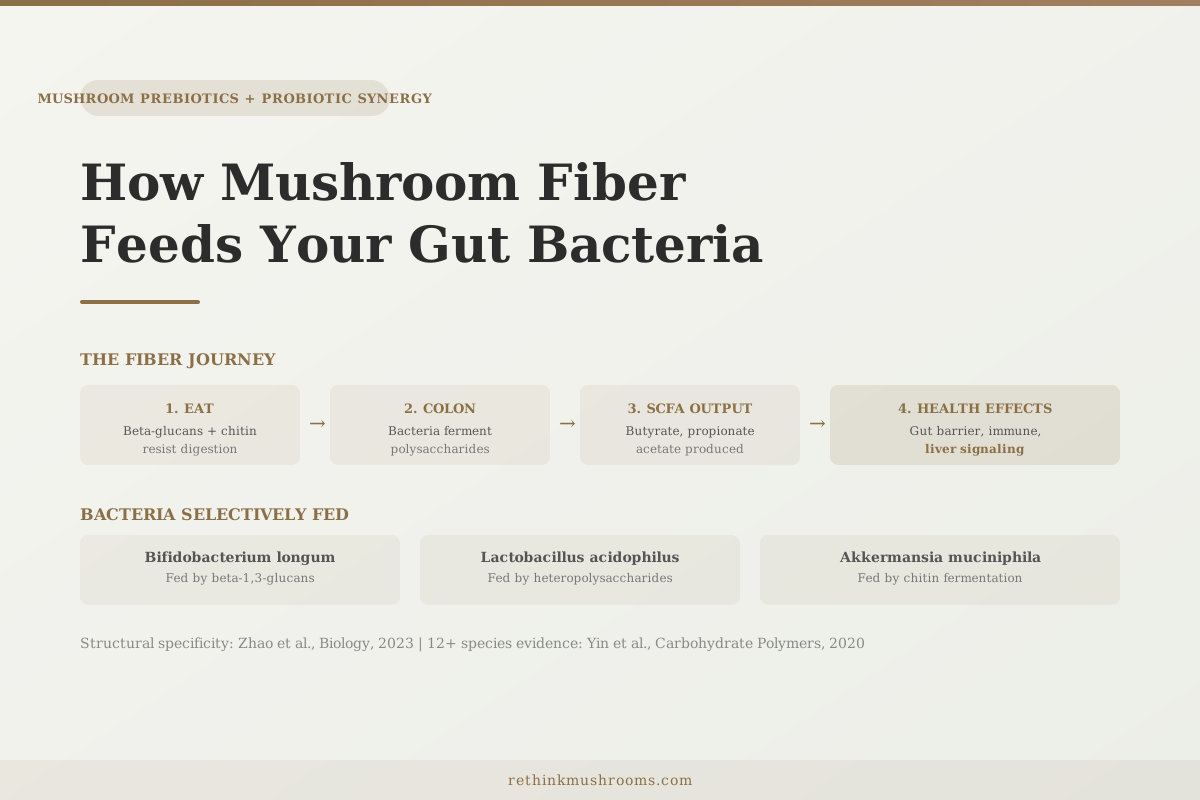
A probiotic is a live microorganism that you consume with the goal of it colonizing your intestinal tract. A prebiotic is food for microorganisms that already live there. Mushrooms fit the second category: they contain polysaccharides that your digestive enzymes cannot break down, which travel intact to the colon where resident bacteria ferment them and produce compounds that benefit the host.
The question this article answers is a more specific one: which polysaccharides in mushrooms resist digestion, which bacteria ferment them, and what do those bacteria produce that makes a difference to health? The answers involve more precision than most content on this topic provides.
For the broader overview of mushrooms and probiotic synergy, see Mushrooms + Probiotics: The Prebiotic-Probiotic Synergy. For how to combine mushrooms, probiotics, and fiber into a practical stack, see The Complete Gut Health Stack: Mushrooms, Probiotics, and Fiber. For the pillar guide on combining medicinal mushrooms generally, see Combining Medicinal Mushrooms: The Ultimate Stacking Guide.
Key Takeaways
- Mushrooms are prebiotics: they contain indigestible polysaccharides (primarily beta-glucans and chitin) that reach the colon intact and feed beneficial bacteria
- Different polysaccharide structures feed different bacterial genera. Beta-(1,3/1,6)-glucans and heteropolysaccharides each have distinct selectivity profiles (Zhao et al. 2023)
- The bacteria preferentially fed include Bifidobacterium longum, Lactobacillus acidophilus, and Akkermansia muciniphila, all associated with improved gut barrier function and metabolic health
- Colonic fermentation of mushroom polysaccharides produces three short-chain fatty acids: butyrate, propionate, and acetate, each with distinct downstream effects
- Turkey tail (Trametes versicolor) had the most concrete species-specific evidence: a 2013 human fecal microbiota study documented increased Bifidobacterium and Lactobacillus, decreased Clostridium
- Not all mushrooms have equal prebiotic potency; Pleurotus ostreatus (oyster mushroom) showed the highest probiotic growth stimulation in a 2024 dedicated prebiotic journal study
What Prebiotic Means (and Why Mushrooms Qualify)
The technical definition of a prebiotic is a substrate that is selectively utilized by host microorganisms and confers a health benefit. Three criteria matter: (1) the compound resists digestion in the upper GI tract; (2) it is fermented by gut bacteria; and (3) the fermentation selectively stimulates growth of beneficial bacteria over pathogens.
Mushrooms satisfy all three. Humans lack the specific enzymes needed to break the beta-1,3 and beta-1,6 glycosidic bonds that form the backbone of mushroom beta-glucans. Chitin, the structural polysaccharide in mushroom cell walls, also resists human digestive enzymes. Both travel through the stomach and small intestine largely intact.
Once in the colon, gut bacteria with the appropriate enzyme repertoire begin fermentation. Not all bacteria can ferment beta-glucans. This is the source of selectivity. Bacteria that can use these substrates grow; bacteria that cannot, do not. The result is a shift in microbiome composition toward the bacterial groups capable of mushroom polysaccharide fermentation.[3]
The Structural Key: Why Different Polysaccharides Feed Different Bacteria
A 2023 Biology review by Zhao and colleagues provided the most detailed mapping of mushroom polysaccharide structure to bacterial genus selectivity currently available in the published literature.[1]
The key finding: beta-(1,3/1,6)-glucans and heteropolysaccharides each display distinct selectivity for different bacterial genera. This is not a general "polysaccharides feed bacteria" relationship; it is structure-specific.
Beta-1,3-glucans with 1,6-branch points (the primary structural type in shiitake, reishi, maitake, and turkey tail) are preferentially fermented by Bifidobacterium species. The enzymes needed to cleave beta-1,3 linkages are widely distributed among Bifidobacterium but less common in other genera.
Heteropolysaccharides (polysaccharides made from multiple different sugar units, found in Tremella and wood ear mushrooms) have a different selectivity profile, supporting Lactobacillus and Akkermansia alongside Bifidobacterium.
Chitin (the structural polymer in all mushroom cell walls) is fermented slowly and preferentially by Ruminococcaceae family bacteria, including some Akkermansia muciniphila strains. Akkermansia has received significant research attention because of its association with gut barrier function and protection against metabolic disease.
The practical implication: different mushroom species with different polysaccharide compositions do not produce identical microbiome effects. Choosing mushrooms based on their documented polysaccharide structures allows some degree of targeted prebiotic selection.[1]
Which Bacteria Get Fed: The Specific Names from Research
Yin and colleagues, in a 2020 Carbohydrate Polymers review covering 12 mushroom species, mapped the microbiome changes associated with each species based on published studies.[3]
Bifidobacterium (multiple species, especially B. longum and B. breve): Consistently increased across multiple mushroom species in in vitro and animal studies. Bifidobacterium species produce acetate and lactate from fermentation, and are associated with production of short-chain fatty acids that signal to the immune system and intestinal epithelium.
Lactobacillus acidophilus and related species: Also consistently increased. Lactobacillus species are among the most commonly supplemented probiotics; mushroom polysaccharides appear to provide preferred fermentation substrate for these strains.
Akkermansia muciniphila: Increasingly recognized as a key indicator of gut health, particularly for metabolic conditions. Akkermansia is specialized for mucin (gut mucus layer) degradation and is found in reduced amounts in people with obesity, type 2 diabetes, and inflammatory bowel conditions. Mushroom polysaccharide fermentation appears to support Akkermansia populations, though the mechanism is more indirect (via chitin fermentation products) than the direct Bifidobacterium selectivity.
Reduced genera: The studies also consistently documented reductions in Clostridium perfringens and Fusobacterium, both associated with gut inflammation and potential disease promotion when present in excess. This suppression effect appears to occur largely through competitive exclusion: when beneficial bacteria increase their populations through mushroom polysaccharide fermentation, pathogenic bacteria have less substrate and ecological space available to them.
The Output: What Gut Bacteria Produce from Mushroom Fiber
The fermentation products are the mechanism by which gut bacteria translate mushroom fiber into health effects.
Short-chain fatty acids (SCFAs) are the primary output. Ma and colleagues' 2022 Critical Reviews in Food Science and Nutrition analysis documented the quantitative SCFA production from mushroom polysaccharide fermentation across multiple species.[2]
Butyrate is the most extensively studied SCFA for gut health. It is the primary energy source for colonocytes (the cells lining the colon), maintains the integrity of the gut epithelial barrier, and has anti-inflammatory properties through inhibition of histone deacetylase enzymes. Low butyrate production is associated with inflammatory bowel disease, colorectal cancer risk, and leaky gut syndrome. Mushroom polysaccharide fermentation consistently increases butyrate-producing bacteria.
Propionate is produced primarily by Bacteroidetes members and crosses from the colon into portal circulation, where it reaches the liver and participates in gluconeogenesis (the process of producing glucose from non-carbohydrate precursors). The gut-liver axis connection: when mushroom prebiotics increase propionate-producing bacteria, some of that propionate reaches the liver and helps regulate glucose metabolism.
Acetate is produced in the largest quantities and provides a carbon source for other colonic bacteria, including Bifidobacterium, which converts acetate to butyrate through cross-feeding.
The gut-liver axis connection from Nguepi and colleagues' 2020 review adds another layer to this story: SCFA production by microbiota fed with mushroom polysaccharides reduces hepatic inflammation through portal circulation signaling.[4] The benefit of mushroom prebiotic activity extends beyond the gut itself.
Turkey Tail: The Most Concrete Human-Adjacent Evidence
Yu and colleagues published the most concrete species-specific evidence in Plant Foods for Human Nutrition in 2013, using an in vitro fecal fermentation model with actual human fecal samples rather than animal models or pure culture systems.[5]
They incubated Trametes versicolor (turkey tail) extract with human fecal microbiota samples and measured microbiota composition before and after. The result: Bifidobacterium and Lactobacillus populations increased significantly; Clostridium populations decreased.
This study is notable because it used human-derived microbiota rather than mouse gut contents or pure cultures. The finding is still in vitro (not a human clinical trial), but it is closer to what would be expected in an actual human gut than most prebiotic research available.
For the full species-level review of turkey tail's prebiotic effects, see Turkey Tail and the Gut Microbiome: Prebiotic Effects.
Species by Species: Which Mushrooms Have the Strongest Evidence
Not all mushrooms have equal prebiotic potency. The 2020 review by Yin and colleagues identified the following species as having documented gut microbiota modulating activity:[3]
Turkey tail (Trametes/Trametes versicolor): Strongest human-adjacent evidence from Yu 2013. PSP and PSK extracts (which include beta-glucan-rich polysaccharides) show consistent Bifidobacterium and Lactobacillus increases.
Reishi (Ganoderma lucidum): Multiple animal studies documenting microbiome shifts toward SCFA-producing bacteria. Also documented Akkermansia modulation in some studies.
Shiitake (Lentinula edodes): Lentinan (the beta-1,3-glucan discussed in this site's lentinan cluster) and other shiitake polysaccharides show prebiotic activity, with documented effects on Bifidobacterium populations.
Maitake (Grifola frondosa): Beta-glucan-rich polysaccharides show prebiotic effects similar to reishi and turkey tail.
Oyster mushroom (Pleurotus ostreatus): Kulshreshtha and colleagues, reviewing mushroom prebiotic potential in the journal Probiotics and Antimicrobial Proteins in 2024, identified Pleurotus ostreatus as having the highest measured probiotic growth stimulation among assessed species.[6] This is a notable finding for a journal specifically focused on probiotic science.
Wood ear (Auricularia): Heteropolysaccharide-rich; documented activity on both Bifidobacterium and Lactobacillus, with some Akkermansia support.
For a full species comparison table, see Which Mushrooms Are the Best Prebiotics? A Species Comparison. For lion's mane specifically, which has gut-protective effects through additional mechanisms beyond prebiotic activity, see Lion's Mane for Gut Health: Gastroprotective Effects and Research.
Do All Mushrooms Have Prebiotic Properties?
Most edible mushrooms contain some combination of beta-glucans and chitin, which means most have at least some baseline prebiotic potential. The review by Anonymous and colleagues (2020) covering the connection between medicinal mushroom prebiotics and gut microbiota noted that the prebiotic function is not species-specific in the sense of being present in only a few mushrooms, but the magnitude and selectivity of the effect varies considerably.[7]
Factors that affect prebiotic potency in a mushroom product:
Extraction method. Hot-water extraction releases polysaccharides from cell walls more completely than raw powder. A 10:1 hot-water extract of turkey tail provides substantially more bioavailable prebiotic polysaccharide than the equivalent weight of dried raw turkey tail powder, because chitin cell walls in raw powder reduce accessibility.
Beta-glucan content. As covered in the beta-glucan testing article, verifiable beta-glucan content (measured by the Megazyme AOAC method rather than general polysaccharide colorimetry) is the best proxy for prebiotic potency.
Polysaccharide profile. Not all beta-glucans are equally fermented. The specific linkage patterns (1,3 vs. 1,6 branching frequency, chain length, molecular weight) affect both the rate of fermentation and which bacteria preferentially ferment them.
The honest answer: oyster, turkey tail, reishi, shiitake, and maitake have the strongest published evidence for meaningful prebiotic effects. Other edible mushrooms likely have some prebiotic activity but have been studied less systematically.
The Bottom Line
Mushroom polysaccharides (beta-glucans and chitin) resist human digestive enzymes and travel to the colon intact, where bacterial fermentation produces butyrate, propionate, and acetate. The prebiotic selectivity is structure-dependent: beta-(1,3/1,6)-glucans preferentially feed Bifidobacterium, heteropolysaccharides support Lactobacillus and Akkermansia (Zhao 2023). Turkey tail has the most concrete human-adjacent evidence (Yu 2013 fecal microbiota study). Oyster mushroom showed the highest probiotic growth stimulation in a dedicated prebiotic journal assessment (Kulshreshtha 2024). Across 12+ species, documented effects include increased Bifidobacterium and Lactobacillus, decreased Clostridium and Fusobacterium, with downstream SCFA production signaling to gut epithelium and liver.
Frequently Asked Questions
Sources & References
- 1. Source details for this reference are not yet available.
- 2. Source details for this reference are not yet available.
- 3. Source details for this reference are not yet available.
- 4. Source details for this reference are not yet available.
- 5. Source details for this reference are not yet available.
- 6. Source details for this reference are not yet available.
- 7. Source details for this reference are not yet available.