Turkey Tail & the Gut Microbiome
8 weeks
Pallav et al. (2014) found Turkey Tail's PSP caused clear, consistent prebiotic-pattern microbiome changes over 8 weeks in 24 healthy volunteers, the only human RCT on this topic.
Pallav et al., Gut Microbes, 2014
n=24
healthy volunteers in the only human RCT (Pallav 2014)
2024 data
Bai et al. identifies butyrate pathway and SCFA receptor upregulation
Prebiotic
PSP qualifies by ISAPP definition (Kulshreshtha 2024)
Pallav et al., Gut Microbes, 2014
 View as image ↗
Turkey tail mushroom affects the gut microbiome through its PSP (polysaccharopeptide) fraction, which behaves as a prebiotic: feeding beneficial gut bacteria, suppressing less beneficial species, and driving short-chain fatty acid production. The turkey tail gut microbiome research stack covers one human randomized trial, multiple animal studies, and in vitro fermentation work. Together, they build a coherent mechanistic picture that no competitor covers in full.
The search for probiotics is familiar. The prebiotic angle on Turkey Tail is less well-known, and the 2024 data adds new mechanistic specificity that didn't exist before.
For species-level background on Turkey Tail, see Turkey Tail: A Science-Based Introduction.
Key Takeaways
- Pallav et al. (2014) found PSP from Turkey Tail caused clear, consistent prebiotic-pattern microbiome changes in 24 healthy humans over 8 weeks
- By comparison, amoxicillin caused Escherichia/Shigella overgrowth in the same trial that persisted for the full 42-day follow-up after treatment ended
- Yu et al. (2013) showed Turkey Tail extract increased Bifidobacterium and Lactobacillus in cultured human fecal microbiota while reducing Clostridium and Staphylococcus
- Bai et al. (2024) found Turkey Tail polysaccharides enhanced butyrate-producing bacteria via the buk/but enzymatic pathways, with GPR43 receptor expression increasing 113.24% in mice
- Kulshreshtha et al. (2024) confirmed Turkey Tail meets the current ISAPP scientific definition of a prebiotic: non-digestible, selectively fermented, and health-conferring through microbiota modulation
- The evidence base is strong in the prebiotic direction but limited by one small human RCT (n=22 completed); no large-scale trial exists
Does Turkey Tail Actually Affect the Gut Microbiome?
Yes, and the evidence comes from three different experimental settings.
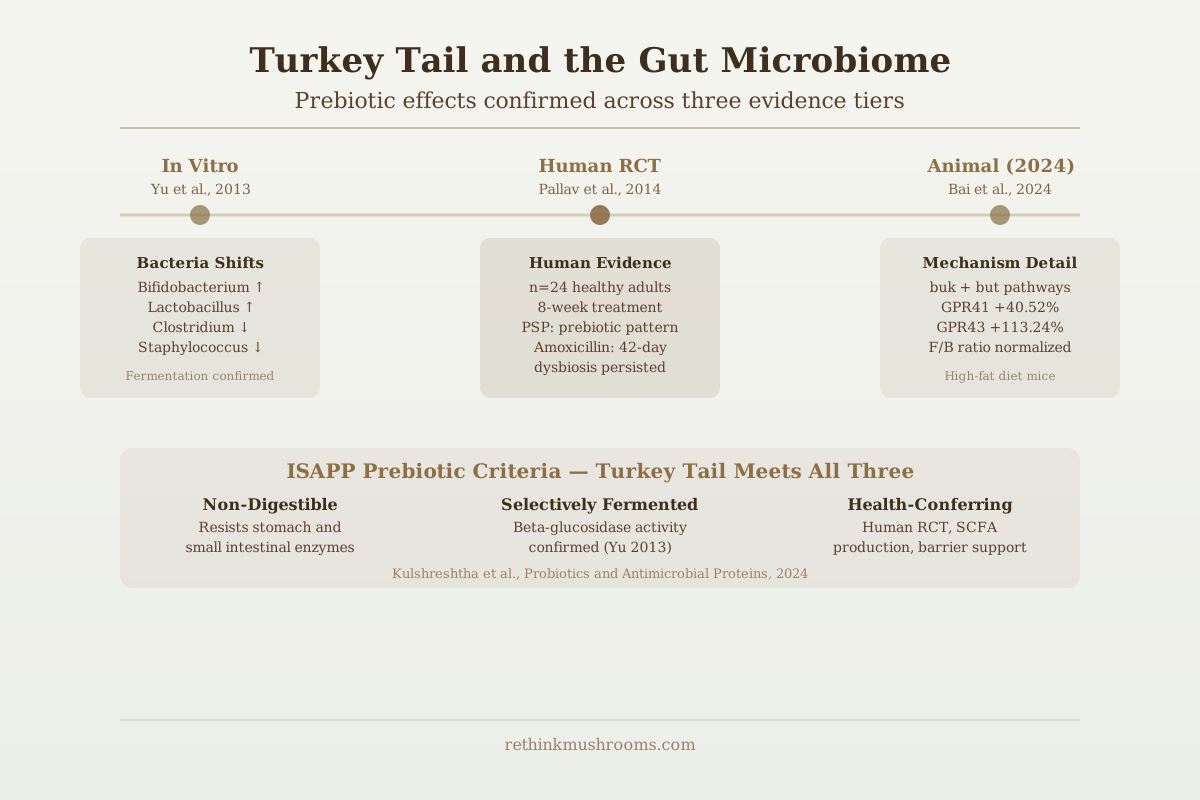
The most important piece is Pallav et al. (2014), an 8-week randomized trial with 24 healthy volunteers.[1] Participants took either PSP from Turkey Tail or amoxicillin (a broad-spectrum antibiotic), and researchers tracked microbiome changes through the study and for 42 days afterward. The PSP group showed what the researchers described as "clear, consistent prebiotic-pattern microbiome changes." The amoxicillin group showed disruption that hadn't fully resolved by the end of the study period.
That's the human evidence. Supporting it, Yu et al. (2013) cultured human fecal microbiota with Turkey Tail extract in vitro and documented specific bacterial shifts: Bifidobacterium and Lactobacillus increased, Clostridium and Staphylococcus decreased.[3] Bai et al. (2024) added the mechanism in mice: Turkey Tail polysaccharides enhanced butyrate-producing bacteria through the buk and but enzymatic pathways.[2]
The short answer to "does turkey tail affect the gut microbiome" is: yes, in a consistent prebiotic direction, confirmed across lab, animal, and human settings.
The One Human RCT: What Pallav 2014 Actually Found
Pallav et al. (2014) is the anchor study for Turkey Tail's gut microbiome effects in humans. Because it's the only controlled human trial available, understanding it well matters.
The study gave 24 healthy volunteers either PSP from Turkey Tail or amoxicillin for 8 weeks, followed by a 42-day observation period.[1] Amoxicillin was chosen as the comparison because antibiotic effects on the microbiome are well-documented; it serves as a positive-disruption control.
The PSP group's microbiomes showed consistent clustering changes, meaning the community-level pattern of their gut bacteria shifted in a coherent direction over the 8 weeks. This is the signature of prebiotic activity: the community reorganizes rather than any single species dominating.
The amoxicillin finding was the study's most striking result. The antibiotic caused Escherichia/Shigella overgrowth. That overgrowth persisted through the entire 42-day post-treatment observation period. By the time the study ended, the microbiomes of the antibiotic group still hadn't returned to baseline.
Two important caveats: 22 of the 24 volunteers completed the study, which is a small sample. And the Pallav paper measured community-level patterns rather than individual genus counts at the level of detail that the Yu 2013 in vitro work provides. The human data confirms the prebiotic direction; the species-level specificity comes from lab work.
For the full antibiotic comparison with practical guidance, see Turkey Tail for Gut Health After Antibiotics.
The 2024 Data: What PSP Does at the Molecular Level
Bai et al. (2024) published data that didn't exist when competitors wrote their Turkey Tail gut articles. High-fat diet mice received two forms of Turkey Tail polysaccharides (EPTV and IPTV) and the researchers tracked gut microbiome changes with more molecular precision than earlier studies.[2]
The key finding: Turkey Tail polysaccharides enhanced the growth of butyrate-producing bacteria. Those bacteria produce butyrate through two specific enzymes, butyrate kinase (buk) and butyryl-CoA transferase (but). These enzymes convert fiber fermentation products into butyrate, which is the primary fuel for colonocytes and a key signaling molecule for mucosal immunity.
Beyond the bacteria themselves, Bai 2024 measured what the butyrate production actually does to gut cell signaling:
- IPTV increased GPR41 receptor expression by 40.52% above the high-fat diet control
- IPTV increased GPR43 receptor expression by 113.24% above the control[2]
GPR41 and GPR43 are the receptors on gut epithelial cells that detect butyrate and other short-chain fatty acids. When activated, they trigger anti-inflammatory signaling and regulate gut motility and immune cell behavior. A 113% increase in GPR43 expression is substantial at the receptor level, though this is in mice with induced metabolic disease, not healthy people.
Bai 2024 also found the Firmicutes/Bacteroidetes ratio normalized in the Turkey Tail-treated mice. An elevated F/B ratio is a marker of obesity and metabolic dysbiosis. Normalization suggests Turkey Tail's polysaccharides are restructuring the microbial ecosystem, not just selectively feeding one or two species.
For more on the specific bacteria that shift and why, see How Turkey Tail Changes Gut Bacteria Composition.
The Fermentation Evidence: How Turkey Tail Works as a Prebiotic
For a compound to qualify as a prebiotic, it needs to meet three criteria: it must be non-digestible (resistant to human enzymes in the stomach and small intestine), selectively fermented by gut microorganisms, and the fermentation must benefit the host's health.
Turkey Tail's PSP and PSK polysaccharides clear all three bars.
Non-digestible: The branched beta-glucan structure of PSP and PSK resists pancreatic amylase and small intestinal brush border enzymes. Yu et al. (2013) confirmed this implicitly: the in vitro fermentation study worked because the polysaccharides arrived in the fecal culture intact and available for bacterial fermentation.[3]
Selectively fermented: Yu 2013 detected beta-galactosidase and beta-glucosidase enzyme activity in the fecal cultures, which are the bacterial enzymes produced to break down complex polysaccharides. Fermentation products (organic acids, reduced pH) were detected, providing chemical proof of selective bacterial metabolism.
Health-conferring: Pallav 2014 (human RCT) and Bai 2024 (mouse) both show health-relevant microbiome shifts. The downstream SCFA production is the primary mechanism.
Kulshreshtha et al. (2024) reviewed the prebiotic evidence for multiple mushroom species and confirmed Turkey Tail meets the International Scientific Association for Probiotics and Prebiotics (ISAPP) definition as updated in 2017.[6] The ISAPP definition is the current scientific standard; it requires non-digestibility, selective fermentation, and health benefit. Turkey Tail meets all three.
Where Turkey Tail Fits in the Broader Mushroom Prebiotic Picture
Turkey Tail is one of the better-studied mushrooms for gut microbiome effects, but the prebiotic effect is not unique to Turkey Tail. It is shared by other mushroom species with similar beta-glucan polysaccharide structures.
Yin et al. (2020) reviewed mushroom polysaccharides across species in Carbohydrate Polymers and found consistent patterns: beneficial microorganism stimulation, pathogen reduction, and downstream immune, metabolic, and anti-cancer effects through prebiotic fermentation and SCFA production.[4]
Liu et al. (2020) in the International Journal of Medicinal Mushrooms placed this in a broader physiological framework: mushroom polysaccharides functioning as prebiotics connect gut microbiota modulation to immune, metabolic, neurological, and cancer-related health outcomes.[5] The gut is the center of that mechanism.
Jayachandran et al. (2017) in International Journal of Molecular Sciences identified the consistent finding across edible mushroom species: Bifidobacterium and Lactobacillus enrichment plus pathogen reduction are the two reliable downstream effects of mushroom polysaccharide consumption.[7]
Turkey Tail sits within this broader class but has the advantage of being one of the few mushrooms with a human RCT specifically for gut microbiome effects, even if that trial was small.
For comparison with another mushroom with well-documented prebiotic gut effects, see Enoki for Gut Health: Prebiotic Fiber and Microbiome Effects.
Evidence Limits: What the Research Doesn't Yet Show
Honest about limitations means saying this clearly: the evidence for Turkey Tail's gut microbiome effects is strongest in preclinical settings. The human evidence is one study with 22 completers, measuring community-level patterns rather than species-level counts.
No large-scale randomized controlled trial has been published testing Turkey Tail supplementation against placebo with gut microbiome composition as the primary endpoint. No trial has measured individual bacterial genus changes in humans at the level of detail the Yu 2013 in vitro work provides.
The mechanism evidence from Bai 2024 is in mice with high-fat diet-induced dysbiosis. Receptor expression changes of 113% in that disease context don't automatically translate to equivalent changes in a healthy human gut.
The prebiotic direction of Turkey Tail's gut effects is well-supported by the existing evidence. The magnitude of that effect in diverse human populations remains understudied.
For the immune side of Turkey Tail's gut effects, see Turkey Tail and Gut-Immune Connection: Research Review. For the full prebiotic mechanism at the molecular level, see Turkey Tail Prebiotic Effects: Feeding Beneficial Gut Bacteria.
The Bottom Line
Turkey tail's PSP fraction acts as a prebiotic, confirmed in one 8-week human RCT (Pallav 2014, n=22 completed), in vitro fermentation studies, and 2024 mouse data identifying the butyrate enzymatic pathway. The evidence direction is consistent: Bifidobacterium and Lactobacillus increase, Clostridium and Staphylococcus decrease, and SCFA production rises. Kulshreshtha 2024 confirms Turkey Tail meets the current ISAPP prebiotic definition. The primary evidence limit is the absence of a large human trial with species-level bacterial resolution.
Frequently Asked Questions
Sources & References
- 1RTHM-00630·Pallav, Kumar et al. (2014). “Effects of polysaccharopeptide from Trametes versicolor and amoxicillin on the gut microbiome of healthy volunteers: a randomized clinical trial..” Gut microbes.Study breakdown →PubMed →↩
- 2RTHM-01857·Bai, Ming et al. (2024). “Polysaccharides from Trametes versicolor as a Potential Prebiotic to Improve the Gut Microbiota in High-Fat Diet Mice..” Microorganisms.Study breakdown →PubMed →↩
- 3RTHM-00573·Yu, Zhuo-Teng et al. (2013). “Trametes versicolor extract modifies human fecal microbiota composition in vitro..” Plant foods for human nutrition (Dordrecht.Study breakdown →PubMed →↩
- 4RTHM-01308·Yin, Chaomin et al. (2020). “The Impact of Mushroom Polysaccharides on Gut Microbiota and Its Beneficial Effects to Host: A Review..” Carbohydrate polymers.Study breakdown →PubMed →↩
- 5RTHM-01242·Liu, Xiaoxiao et al. (2020). “A Review on Linking the Medicinal Functions of Mushroom Prebiotics with Gut Microbiota..” International journal of medicinal mushrooms.Study breakdown →PubMed →↩
- 6RTHM-01921·Kulshreshtha, Shweta (2024). “Mushroom as Prebiotics: a Sustainable Approach for Healthcare..” Probiotics and antimicrobial proteins.Study breakdown →PubMed →↩
- 7RTHM-00878·Jayachandran, Muthukumaran et al. (2017). “A Critical Review on Health Promoting Benefits of Edible Mushrooms through Gut Microbiota..” International journal of molecular sciences.Study breakdown →PubMed →↩