Turkey Tail & the Gut Microbiome
42 days
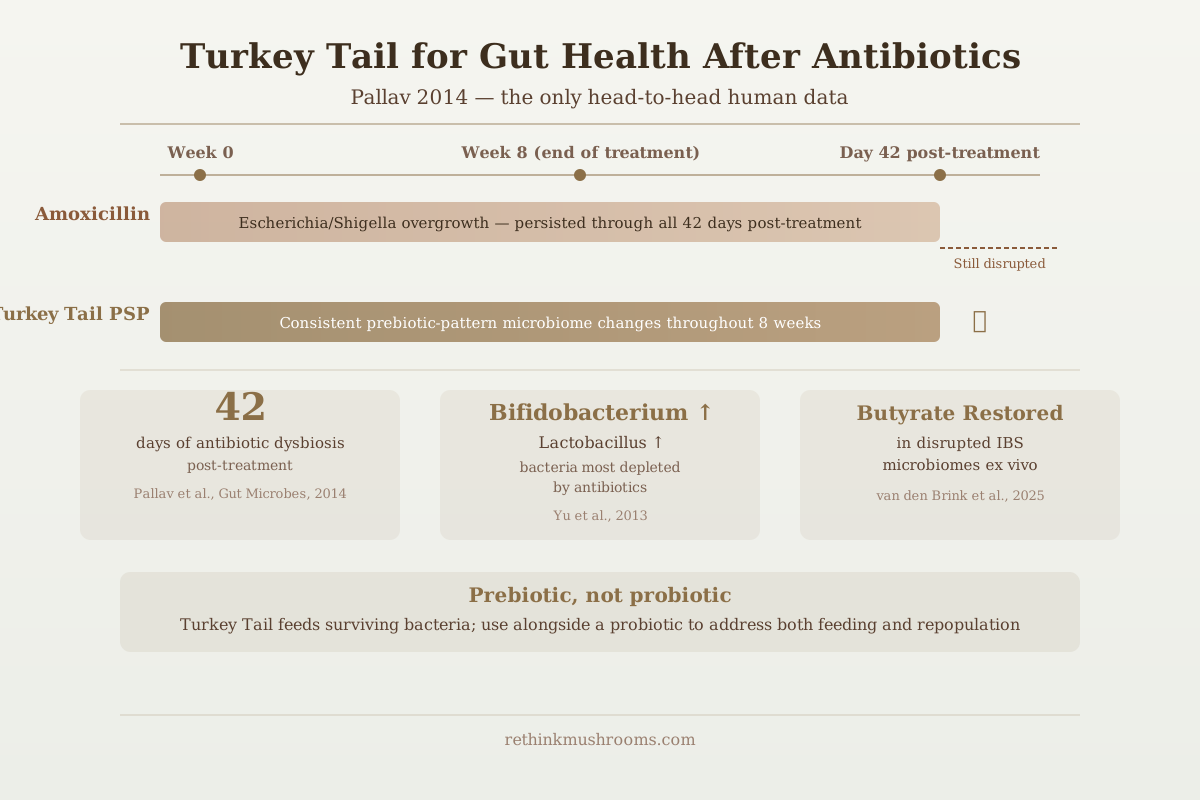
Amoxicillin caused Escherichia/Shigella overgrowth that persisted for 42 days after the 8-week antibiotic course ended, in the same trial where Turkey Tail's PSP caused prebiotic shifts.
Pallav et al., Gut Microbes, 2014
n=24
healthy volunteers in the Pallav 2014 human RCT
2025 data
mushroom blend restores butyrate in disrupted IBS microbiomes
Prebiotic
Turkey Tail feeds existing bacteria, not introduces new ones
Pallav et al., Gut Microbes, 2014
 View as image ↗
Antibiotics disrupt the gut microbiome. That disruption can last far longer than the treatment course itself. The one controlled human trial comparing Turkey Tail's PSP against amoxicillin found that antibiotic-driven microbiome disruption persisted for 42 days after treatment ended, while Turkey Tail's PSP caused consistent prebiotic-pattern changes. This is the specific data no competitor covers.
Turkey tail after antibiotics is a practical question people ask when they're already dealing with gut symptoms. This article covers what the research actually shows about the disruption, the prebiotic mechanism, and what a realistic recovery timeline looks like.
For background on Turkey Tail as a species and its key compounds, see Turkey Tail: A Science-Based Introduction.
Key Takeaways
- Pallav et al. (2014) found amoxicillin caused Escherichia/Shigella overgrowth that persisted through the entire 42-day post-treatment observation period; microbiomes hadn't recovered by study end
- In the same 8-week RCT, Turkey Tail's PSP caused consistent prebiotic-pattern microbiome changes (n=24 healthy volunteers)
- Yu et al. (2013) showed Turkey Tail extract increases Bifidobacterium and Lactobacillus in cultured human fecal microbiota, the bacteria most commonly depleted after antibiotic treatment
- Van den Brink et al. (2025) found a mushroom blend including Turkey Tail restored butyrate production in disrupted IBS microbiomes ex vivo and promoted intestinal barrier integrity
- Turkey tail works as a prebiotic, not a probiotic; it feeds existing bacteria rather than introducing new ones, making it complementary to probiotics rather than a replacement
- No human trial has specifically tested Turkey Tail supplementation starting immediately after an antibiotic course; timing guidance is extrapolated from the available evidence
The Problem: How Antibiotics Disrupt the Gut Microbiome
Antibiotics don't selectively kill only the pathogen they're targeting. They reduce bacterial diversity across the gut microbiome, disrupting populations of beneficial bacteria along with harmful ones.
Pallav et al. (2014) documented this precisely in a randomized trial.[1] Twenty-four healthy volunteers received either PSP from Turkey Tail or amoxicillin (a broad-spectrum antibiotic commonly used for respiratory, skin, and urinary tract infections) for 8 weeks. The researchers tracked gut microbiome composition through the treatment and for 42 days afterward.
The amoxicillin group developed Escherichia/Shigella overgrowth during treatment. That overgrowth persisted through the entire 42-day post-treatment observation period. By the time the study ended, the microbiomes of the amoxicillin group still hadn't returned to their pre-treatment baseline.
This is the number most articles never cite. Not "antibiotics disrupt the gut" in a vague way, but: in a controlled study with a specific antibiotic at standard doses, 42 days of post-treatment observation wasn't enough for microbiome recovery.
The implication is practical: the recovery window after antibiotics is longer than most people assume, and what you do in that window, including whether you use prebiotic or probiotic support, matters.
What Turkey Tail Did in the Same Trial
The PSP group in Pallav 2014 showed a different trajectory. Their microbiomes underwent consistent, directional shifts over the 8-week treatment period, which the researchers characterized as a prebiotic-pattern response.[1] The community reorganized toward beneficial bacteria rather than disrupting away from them.
The caveat is important: the trial gave PSP and amoxicillin to separate groups, not together. It isn't a test of Turkey Tail taken alongside or after an antibiotic course. It's a comparison of two different interventions on the same outcome (gut microbiome composition). The antibiotic disrupts; the prebiotic stabilizes. That's the contrast the study establishes.
What the trial doesn't tell you is whether taking Turkey Tail during or after an antibiotic course would accelerate microbiome recovery from the antibiotic damage. That specific test hasn't been done.
What a Prebiotic Recovery Looks Like at the Bacterial Level
If Turkey Tail's prebiotic effects apply during post-antibiotic recovery, Yu et al. (2013) provides the bacterial-level picture of what that means.[2]
Turkey Tail extract in cultured human fecal microbiota produced these shifts:
- Bifidobacterium: increased
- Lactobacillus: increased
- Clostridium: decreased
- Staphylococcus: decreased
Bifidobacterium and Lactobacillus are precisely the genera that antibiotics most commonly suppress. They are protective species associated with barrier integrity, immune regulation, and competitive exclusion of pathogens. The amoxicillin-driven Escherichia/Shigella overgrowth in Pallav 2014 is possible partly because the bacteria that would normally outcompete those species are reduced.
A prebiotic that selectively feeds Bifidobacterium and Lactobacillus addresses that gap directly: it doesn't introduce new bacteria (as a probiotic would), but it gives the surviving populations of beneficial bacteria a food source advantage over the opportunistic species that overgrow in antibiotic-disrupted environments.
Yu 2013 also confirmed the fermentation chemistry: beta-galactosidase and beta-glucosidase enzyme activity were detected, fermentation products (organic acids) increased, and pH dropped. This is chemical evidence that Turkey Tail's polysaccharides are being actively metabolized by gut bacteria, not just sitting inert.[2]
The 2025 Butyrate Data: Restoring What Antibiotics Damage
The most recent relevant data comes from a 2025 study by van den Brink et al., which tested whether a mushroom blend including Turkey Tail could restore butyrate production in disrupted microbiomes.[5]
The study used ex vivo IBS microbiomes, which are fecal microbiota from IBS patients cultured outside the body under conditions that replicate the gut environment. These microbiomes had impaired butyrate production, similar to what happens in antibiotic-disrupted microbiomes where butyrate-producing bacteria have been depleted.
The mushroom blend restored butyrate production in the disrupted microbiomes. It also promoted intestinal barrier integrity. The combination of triacetin (a glycerol ester used as an alternative butyrate substrate) with the mushroom blend was superior to fiber supplementation alone in restoring these outcomes.
Butyrate matters here for two reasons. First, it's the primary fuel for colonocytes (the cells lining your colon). Second, it signals through SCFA receptors (GPR41, GPR43) to maintain the tight junction proteins that form the intestinal barrier. A disrupted microbiome that produces less butyrate means a compromised gut barrier, which is part of why antibiotic-associated gut symptoms like diarrhea and increased intestinal permeability occur.
Turkey Tail's prebiotic effects on butyrate-producing bacteria (confirmed in Bai et al. 2024's animal data) make it a logical complement to post-antibiotic recovery strategies focused on barrier repair.[3]
Context on Antibiotic-Related Gut Disruption
Ma et al. (2022) reviewed the evidence for edible mushroom polysaccharides against conditions associated with gut dysbiosis, including inflammatory bowel disease, in Critical Reviews in Food Science and Nutrition.[4] The review found accumulating evidence that mushroom polysaccharides modulate gut microbiota in ways that show benefit against IBD and related inflammatory conditions, via gut microbiota modulation. IBD involves chronic dysbiosis with reduced Bifidobacterium and Lactobacillus, a similar microbiome pattern to what antibiotics produce acutely.
This doesn't mean Turkey Tail treats IBD, but it contextualizes the prebiotic mechanism within gut dysbiosis conditions more broadly.
Practical Guidance: What the Evidence Supports
No human trial has tested Turkey Tail taken during or immediately after an antibiotic course and measured recovery outcomes. The guidance below is extrapolated from what the existing research shows, not from a dedicated post-antibiotic recovery trial.
Timing: The Pallav 2014 trial used Turkey Tail's PSP as a standalone intervention over 8 weeks. There is no trial data on concurrent use with antibiotics. From a mechanistic standpoint, taking a prebiotic during antibiotic treatment might provide substrate for bacteria that survive the antibiotic, but could also compete with antibiotic activity in ways that aren't tested. Starting Turkey Tail at the end of an antibiotic course is the more conservative approach.
Duration: The Pallav 2014 trial ran for 8 weeks and showed consistent microbiome shifts over that period. The antibiotic-disrupted microbiomes in the same study hadn't recovered after 42 days. A minimum of 4-8 weeks of Turkey Tail supplementation after antibiotics is a reasonable extrapolation from this data.
Prebiotic vs. probiotic: Turkey Tail is a prebiotic. It feeds existing bacteria; it does not introduce new ones. After antibiotics, the surviving bacterial populations are smaller, and a prebiotic gives them a food advantage. But it cannot replace bacteria that have been completely eliminated. Combining Turkey Tail with a multi-strain probiotic (to restore lost bacterial populations) and a prebiotic (to feed them) addresses both gaps. This combination hasn't been specifically tested with Turkey Tail.
Dosage context: Pallav 2014 used approximately 2,600 mg of PSP per day. Product formulations vary widely in PSP/PSK content; this dose provides a reference point but commercial products may require reading extraction ratios and beta-glucan content carefully.
For safety information on Turkey Tail supplementation, see Turkey Tail Side Effects: What the Safety Research Shows. For dosage guidance, see Turkey Tail Dosage Guide: How Much Should You Take?.
The Prebiotic vs. Probiotic Distinction for Post-Antibiotic Recovery
Turkey Tail feeds your existing gut bacteria. A probiotic (like Lactobacillus or Bifidobacterium supplements) introduces new bacteria. After antibiotics, you need both mechanisms working.
The bacteria that survived the antibiotic course are the seed population for microbiome recovery. A prebiotic like Turkey Tail gives those surviving bacteria a competitive food advantage over the opportunistic species (like Escherichia/Shigella) that overgrew during the antibiotic course. A probiotic attempts to repopulate bacterial species that were significantly depleted.
Using both is sometimes called a synbiotic approach. Turkey Tail hasn't been tested in a formal synbiotic combination trial, but the mechanism aligns with what a synbiotic is designed to do.
For the full prebiotic mechanism explanation, see Turkey Tail Prebiotic Effects: Feeding Beneficial Gut Bacteria. For the broader gut microbiome evidence, see Turkey Tail and the Gut Microbiome: Prebiotic Effects and How Turkey Tail Changes Gut Bacteria Composition.
The Bottom Line
The Pallav 2014 human RCT provides the most specific data on antibiotics and Turkey Tail: amoxicillin caused Escherichia/Shigella overgrowth persisting 42 days post-treatment, while Turkey Tail's PSP caused prebiotic-pattern microbiome shifts in the same trial. The 2025 van den Brink study found a mushroom blend restored butyrate production in disrupted IBS microbiomes ex vivo. Turkey Tail works as a prebiotic, not a probiotic; combining it with a multi-strain probiotic after antibiotics addresses both population restoration and bacterial feeding, though this specific combination hasn't been tested in a dedicated trial.
Frequently Asked Questions
Sources & References
- 1RTHM-00630·Pallav, Kumar et al. (2014). “Effects of polysaccharopeptide from Trametes versicolor and amoxicillin on the gut microbiome of healthy volunteers: a randomized clinical trial..” Gut microbes.Study breakdown →PubMed →↩
- 2RTHM-00573·Yu, Zhuo-Teng et al. (2013). “Trametes versicolor extract modifies human fecal microbiota composition in vitro..” Plant foods for human nutrition (Dordrecht.Study breakdown →PubMed →↩
- 3RTHM-01857·Bai, Ming et al. (2024). “Polysaccharides from Trametes versicolor as a Potential Prebiotic to Improve the Gut Microbiota in High-Fat Diet Mice..” Microorganisms.Study breakdown →PubMed →↩
- 4RTHM-01577·Ma, Gaoxing et al. (2022). “Health benefits of edible mushroom polysaccharides and associated gut microbiota regulation..” Critical reviews in food science and nutrition.Study breakdown →PubMed →↩
- 5RTHM-02197·Van den Abbeele, Pieter et al. (2025). “Triacetin and a Mushroom Blend Restore Butyrate Production by IBS Microbiomes Ex Vivo, Thus Promoting Barrier Integrity..” International journal of molecular sciences.Study breakdown →PubMed →↩