Turkey Tail & the Gut Microbiome
42 days
Antibiotic-driven microbiome disruption persisted for 42 days after treatment ended, while Turkey Tail's PSP caused consistent beneficial shifts in the same human trial.
Pallav et al., Gut Microbes, 2014
Bifidobacterium ↑
confirmed in cultured human fecal microbiota
GPR43 +113%
SCFA receptor upregulation in mice (Bai 2024)
F/B ratio
normalized in high-fat diet dysbiosis (Bai 2024)
Pallav et al., Gut Microbes, 2014
 View as image ↗
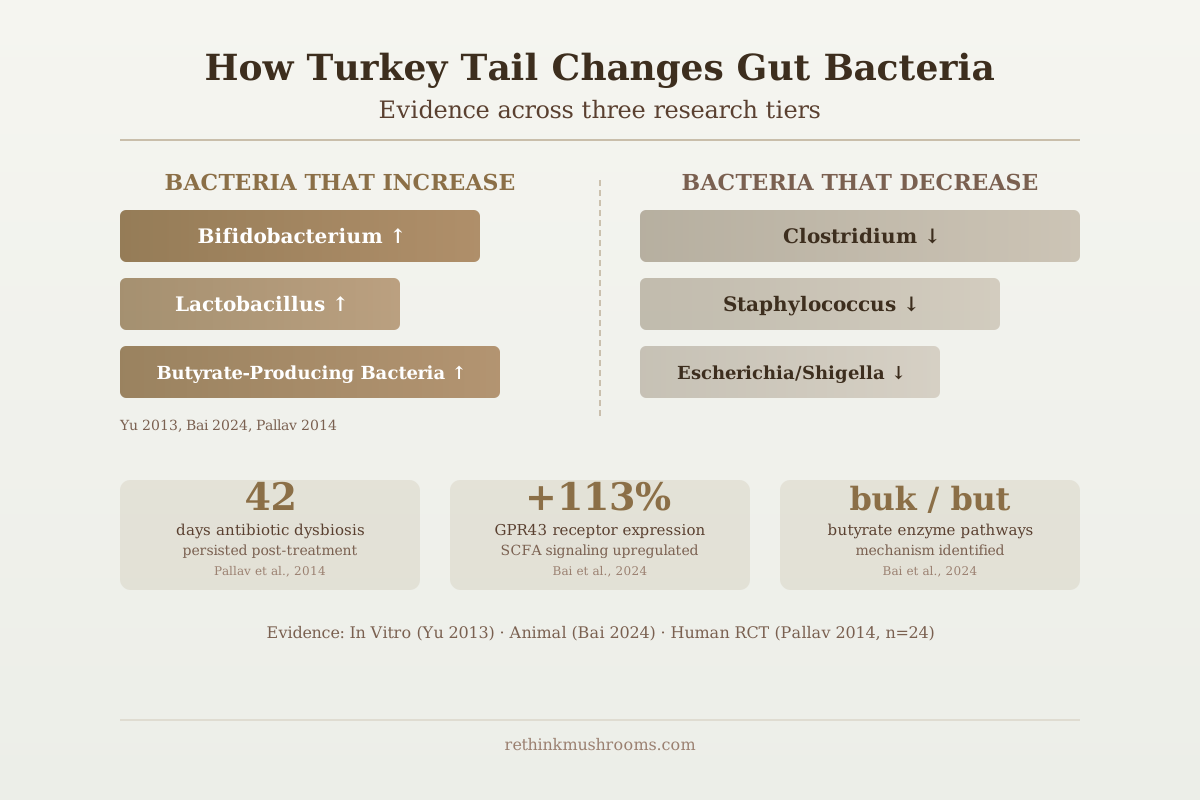
How turkey tail changes gut bacteria composition has been studied across three distinct evidence tiers, and the pattern that emerges is specific and consistent. Bifidobacterium and Lactobacillus populations increase. Clostridium and Staphylococcus decline. Butyrate-producing bacteria expand through identifiable enzymatic pathways. These changes appear across three distinct levels of evidence: cultured human fecal bacteria, mice with diet-induced dysbiosis, and one small human randomized trial.
What makes this topic worth understanding is the specificity of the mechanism. Competitors cite one study with no follow-through. The actual research stack tells a more complete story about how turkey tail changes gut bacteria composition, and where the evidence still has limits.
For background on Turkey Tail as a species, see Turkey Tail: A Science-Based Introduction.
Key Takeaways
- Yu et al. (2013) showed Turkey Tail extract increased Bifidobacterium and Lactobacillus in cultured human fecal microbiota while reducing Clostridium and Staphylococcus
- Fermentation was confirmed chemically: beta-galactosidase and beta-glucosidase activity, organic acid production, and pH drop all detected
- Bai et al. (2024) identified butyrate-producing bacteria as the specific group enhanced, via the buk and but enzymatic pathways in high-fat diet mice
- GPR41 expression increased 40.52% and GPR43 increased 113.24% in the same animal study
- Pallav et al. (2014) confirmed community-level microbiome shifts in 24 healthy humans over 8 weeks; amoxicillin caused dysbiosis that persisted 42 days post-treatment
- One important nuance: Bifidobacterium decreased in Bai 2024's dysbiotic mice; context matters, and the response differs between healthy and high-fat diet microbiomes
Three Evidence Tiers, Three Different Questions
Most articles on turkey tail and gut health cite one study and call it a day. The research actually covers three distinct levels, and each one answers a different question.
In vitro (cell culture): which bacteria respond to Turkey Tail when given human fecal material in a controlled lab setting? This gives the most granular bacterial-level data, but it doesn't capture the complexity of digestion, transit time, or a living immune system.
Animal studies: what happens when Turkey Tail polysaccharides pass through a living digestive system with an established dysbiotic condition? This reveals real-tissue effects and mechanistic pathways, but mice metabolize food differently than people.
Human trials: do these effects actually appear in people? One 8-week randomized trial with 24 participants is the current ceiling for human evidence. Small by clinical standards, but it's what exists.
Understanding which question each study answers prevents both overclaiming and underclaiming. The picture that emerges across all three tiers is more coherent than any single study suggests.
Three Evidence Tiers
Each Tier Answers a Different Question
The case for Turkey Tail’s microbiome effects is built bottom-up: detailed lab data on which bacteria change, animal work on why they change, and one small human trial confirming the effect is real in people. Bar width reflects how much direct evidence sits at each tier — narrower toward the top means closer to real-world human effects but less data.
In vitro (human fecal culture)
Which bacteria shift?Yu 2013
Most granular bacterial resolution: Bifidobacterium & Lactobacillus up, Clostridium & Staphylococcus down; β-galactosidase / β-glucosidase fermentation confirmed chemically
Animal models (in-vivo)
Why do they shift?Bai 2024
Mechanism in high-fat-diet mice: butyrate-producing bacteria enhanced via the buk / but pathways; GPR41 +40.52% and GPR43 +113.24% (IPTV); Firmicutes/Bacteroidetes ratio normalized
Human trial
Does it happen in people?Pallav 2014
One 8-week RCT — 22 of 24 completed — showing consistent community-level prebiotic shifts; the antibiotic arm’s dysbiosis persisted 42 days after treatment ended
Large human, species-level trial
The open questionDoes not yet exist
No trial yet measures genus-level counts (Bifidobacterium, Lactobacillus) in a large human cohort — the honest ceiling on the current evidence
How to read it: the three tiers agree on direction — beneficial, butyrate-producing bacteria rise and SCFA signaling increases. What each tier adds differs: the lab shows which genera move, the animal work shows the butyrate pathway behind it, and the human trial confirms a real prebiotic shift. The missing top tier — a large human study with species-level counts — is the honest limit of the claim, not a weakness in the tiers below it.
Sources: Pallav 2014 [1]; Yu 2013 [2]; Bai 2024 [3]. Bar widths are illustrative of evidence depth and human-relevance per tier, not quantitative effect sizes.
In Vitro: Which Bacteria Shift and How the Fermentation Works
Yu et al. (2013) cultured human fecal microbiota with Trametes versicolor extract for 24 hours and measured the bacterial response at the genus level.[2]
The directional findings were consistent:
| Bacteria | Change |
|---|---|
| Bifidobacterium | Increased |
| Lactobacillus | Increased |
| Clostridium | Decreased |
| Staphylococcus | Decreased |
Bifidobacterium and Lactobacillus are the genera most commonly associated with healthy gut function, mucosal immune regulation, and competitive exclusion of pathogens. Clostridium (in its non-beneficial strains) and Staphylococcus are associated with dysbiosis and opportunistic infections. The shift is in the right direction by any standard microbiome health framework.
What separates Yu 2013 from anecdote is the fermentation chemistry. The researchers detected beta-galactosidase and beta-glucosidase enzyme activity in the cultures. These enzymes are produced by colonic bacteria to break down complex polysaccharides; they are the enzymatic signature that fermentation is actually occurring, not just bacterial growth patterns. Organic acid concentrations (lactate and short-chain fatty acids) increased and pH dropped. These are measurable products of microbial metabolism.[2]
This tells you the bacteria are doing something with Turkey Tail's polysaccharides, actively metabolizing them rather than passively growing in their presence. The next question is what they produce from that fermentation.
A 2023 review by Yu et al. in the Journal of Fungi confirmed that SCFA production is the primary mechanism through which mushroom dietary fiber drives downstream health effects across species.[5] Short-chain fatty acids, particularly butyrate, propionate, and acetate, are the metabolic output of prebiotic fermentation and the signal that connects gut bacteria to systemic health outcomes.
Animal Research: Why Those Bacteria Shift (The Butyrate Pathway)
The Yu 2013 data answers "what changes." Bai et al. (2024) answers "why."
Bai's team fed high-fat diet mice two forms of Turkey Tail polysaccharides: EPTV (extracellular polysaccharides) and IPTV (intracellular polysaccharides). Both affected the gut microbiome, and both substantially upregulated the SCFA receptors measured in the study.[3]
The mechanism Bai 2024 identified is specific: Turkey Tail polysaccharides enhanced the growth of bacteria that produce butyrate. Those bacteria express two enzymes, butyrate kinase (buk) and butyryl-CoA transferase (but), that convert the products of fiber fermentation into butyrate. These enzymes are the molecular machinery at the end of the fermentation chain.
Butyrate is the primary energy source for colonocytes (the cells lining your colon). It also signals through SCFA receptors on gut epithelial cells. Bai et al. measured those receptors directly in the mice:
- IPTV increased GPR41 expression by 40.52% compared to the high-fat diet control group
- IPTV increased GPR43 expression by 113.24% compared to the same control group[3]
GPR41 and GPR43 are the receptors that detect butyrate and other SCFAs in the gut lining. When activated, they trigger anti-inflammatory signaling, regulate gut motility, and influence immune cell function. A 113% increase in GPR43 expression is a substantial receptor-level effect, though it's worth holding this number in context: these are mice with diet-induced obesity, not healthy people, and receptor expression changes don't automatically translate to equivalent functional changes in humans.
Bai et al. also found that Turkey Tail polysaccharides normalized the Firmicutes to Bacteroidetes ratio in the dysbiotic mice.[3] An elevated F/B ratio is a marker associated with obesity and metabolic disease. A normalized ratio after Turkey Tail intervention suggests the polysaccharides are doing more than selectively feeding individual bacteria; they appear to restructure the balance between the two dominant phyla in the gut.
A 2020 systematic review by Yin et al. in Carbohydrate Polymers placed these findings in the broader mushroom context: polysaccharides from mushrooms as a class selectively reduce pathogens and stimulate beneficial bacteria, with downstream immune, metabolic, and anti-cancer effects mediated through prebiotic fermentation and SCFA production.[4] Turkey Tail is one of the better-studied species within that framework.
Human Research: Does Any of This Happen in People?
Pallav et al. (2014) ran the one controlled human trial available on Turkey Tail's microbiome effects.[1] Twenty-four healthy volunteers received either PSP (polysaccharopeptide, the active fraction from Turkey Tail) or amoxicillin for 8 weeks. The goal was to compare a prebiotic mushroom compound against a broad-spectrum antibiotic in terms of microbiome impact.
The PSP group showed clear, consistent microbiome shifts over the 8-week period. The researchers tracked microbiome clustering (how similar each participant's gut bacterial community was to the others at each time point) and the PSP group's communities shifted together in a coherent direction. That's the pattern a prebiotic produces: not one bacterium spiking dramatically, but the community reorganizing in a coordinated, directional way.
The antibiotic arm was the study's most striking finding. Amoxicillin caused Escherichia/Shigella overgrowth, and that disruption persisted for the entire 42-day follow-up period after the 8-week antibiotic course ended.[1] By the study's end, the antibiotic-treated microbiomes still hadn't returned to baseline. This is the comparison no competitor covers with specific numbers.
Two honest limitations of Pallav 2014: 22 of the 24 participants completed the study, which is a small n. And unlike the Yu 2013 in vitro work, the Pallav study measured community-level diversity patterns rather than reporting species-level counts for Bifidobacterium or Lactobacillus specifically. The human data confirms that real microbiome changes occur in people, but the species resolution that in vitro work provides isn't replicated at the human trial level.
For the full antibiotic comparison story and practical guidance, see Turkey Tail for Gut Health After Antibiotics.
The Bifidobacterium Nuance Worth Understanding
There's a finding in Bai 2024 that looks like a contradiction at first: in high-fat diet mice, Bifidobacterium abundance decreased after Turkey Tail polysaccharide treatment.[3]
Yu 2013 showed Bifidobacterium increasing in healthy fecal cultures. Bai 2024 showed it decreasing in dysbiotic mice. What's happening?
The answer is context-specificity. The Bifidobacterium strains that decreased in Bai 2024 were bile salt hydrolase (BSH)-producing strains. BSH-producing bacteria play a role in deconjugating bile acids, which under high-fat diet conditions can contribute to lipid dysregulation. In a dysbiotic, obese-metabolic context, the reduction of those specific strains may represent microbiome normalization rather than harm.
In a healthy microbiome state (Yu 2013's cultured fecal bacteria), Bifidobacterium increases because its beneficial strains are selectively fed by Turkey Tail's polysaccharides.
The practical implication: Turkey Tail's effect on any individual genus isn't fixed. It depends on the starting state of the microbiome. What is consistent across all studies is the direction of the overall shift: butyrate-producing bacteria increase, SCFA production rises, and the community moves toward patterns associated with better metabolic and immune outcomes.
For comparison with another mushroom that has gut bacteria composition research, see Enoki and Gut Bacteria Composition: Research Review.
How Turkey Tail Changes Gut Bacteria: The Full Mechanistic Picture
Drawing the three evidence tiers together into a mechanistic picture:
Turkey Tail polysaccharides (primarily PSP and PSK, which are branched beta-glucan chains) resist enzymatic digestion in the stomach and small intestine. They arrive in the colon largely intact. There, colonic bacteria ferment them using beta-glucosidase and beta-galactosidase enzymes, the same fermentation activity Yu 2013 detected chemically. The fermentation products are SCFAs, especially butyrate.
This selective fermentation feeds bacteria that can break down beta-glucan polysaccharides: Bifidobacterium, Lactobacillus, and butyrate-producing Firmicutes. Bacteria that rely primarily on simple sugars and amino acids, including Clostridium and Staphylococcus, lose competitive advantage.
In dysbiotic conditions, the effect is more structural: the Firmicutes/Bacteroidetes ratio normalizes, SCFA receptors upregulate substantially, and the butyrate enzymatic pathway becomes more active. In a healthy gut, the effect appears as consistent community-level directional shifts over weeks.
Turkey Tail is doing what a prebiotic does: restructuring the competition among resident bacteria by providing a food source that favors specific beneficial species.
Prebiotic, Not Probiotic: Why It Matters Practically
Turkey tail feeds existing gut bacteria rather than introducing new ones. That classifies it as a prebiotic, not a probiotic.
Probiotics (like Lactobacillus supplements) add live bacteria. Prebiotics (like Turkey Tail's PSP) provide fermentable substrate that favors certain bacteria you already carry. The two mechanisms work through different routes and can complement each other. A prebiotic combined with a probiotic is sometimes called a synbiotic.
For the complete evidence on Turkey Tail as a prebiotic, including how its polysaccharides qualify by the ISAPP scientific definition, see Turkey Tail Prebiotic Effects: Feeding Beneficial Gut Bacteria. For the broader gut microbiome context and what the 2024 and 2025 research adds, see Turkey Tail and the Gut Microbiome: Prebiotic Effects.
The Bottom Line
Three evidence tiers show consistent directional changes in gut bacteria from Turkey Tail polysaccharides: Bifidobacterium and Lactobacillus increase in healthy fecal cultures, butyrate-producing bacteria are enhanced via the buk/but enzymatic pathways in mice, and community-level microbiome shifts appear in one small human RCT. The Bifidobacterium response is context-dependent and behaves differently between healthy and dysbiotic microbiome states. The primary evidence gap is the absence of a large human trial with species-level bacterial resolution.
Frequently Asked Questions
Sources & References
- 1RTHM-00630·Pallav, Kumar et al. (2014). “Effects of polysaccharopeptide from Trametes versicolor and amoxicillin on the gut microbiome of healthy volunteers: a randomized clinical trial..” Gut microbes.Study breakdown →PubMed →↩
- 2RTHM-00573·Yu, Zhuo-Teng et al. (2013). “Trametes versicolor extract modifies human fecal microbiota composition in vitro..” Plant foods for human nutrition (Dordrecht.Study breakdown →PubMed →↩
- 3RTHM-01857·Bai, Ming et al. (2024). “Polysaccharides from Trametes versicolor as a Potential Prebiotic to Improve the Gut Microbiota in High-Fat Diet Mice..” Microorganisms.Study breakdown →PubMed →↩
- 4RTHM-01308·Yin, Chaomin et al. (2020). “The Impact of Mushroom Polysaccharides on Gut Microbiota and Its Beneficial Effects to Host: A Review..” Carbohydrate polymers.Study breakdown →PubMed →↩
- 5RTHM-01829·Yu, Changxia et al. (2023). “The Effect of Mushroom Dietary Fiber on the Gut Microbiota and Related Health Benefits: A Review..” Journal of fungi (Basel.Study breakdown →PubMed →↩
- 6RTHM-01921·Kulshreshtha, Shweta (2024). “Mushroom as Prebiotics: a Sustainable Approach for Healthcare..” Probiotics and antimicrobial proteins.Study breakdown →PubMed →↩