Enoki Gut Health
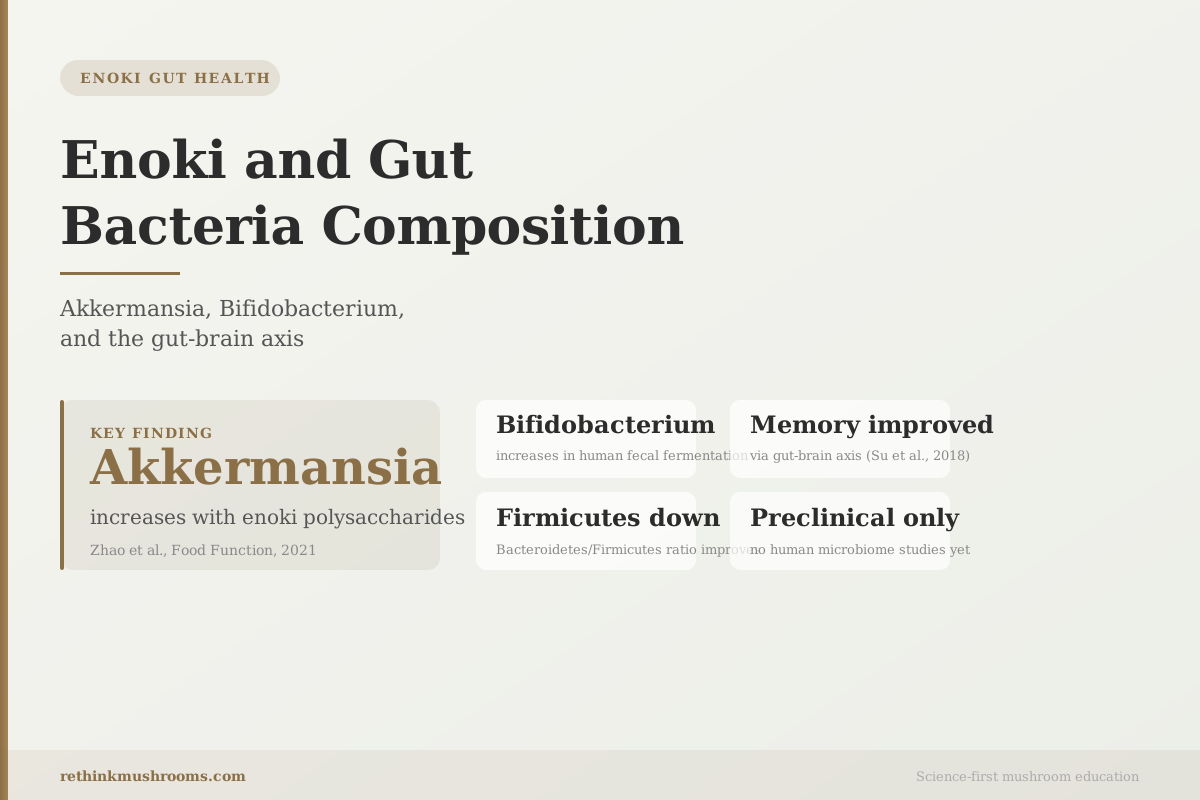
Akkermansia increases with enoki polysaccharides
Zhao et al. (2021) found enoki polysaccharides reversed diet-induced gut dysbiosis and increased Akkermansia, a bacteria associated with gut barrier integrity. No consumer health article has reported this specific connection.
Zhao et al., Food Function, 2021
Bifidobacterium up
specifically increased in in vitro human fecal fermentation with enoki polysaccharides (Su et al., 2023)
Firmicutes down
Firmicutes/Bacteroidetes ratio improved in metabolically stressed mice (Zhao et al., 2021)
Memory improved
gut bacteria shift from enoki polysaccharides improved memory in scopolamine-impaired mice (Su et al., 2018)
Zhao et al., Food Function, 2021
 View as image ↗
Most articles about mushrooms and gut health say the same thing: mushrooms have fiber, fiber feeds good bacteria, good bacteria are good for you. This framing is not wrong, but it is not specific. It does not tell you which bacteria change, by how much, in what direction, or with what downstream consequences.
Enoki mushrooms happen to have some of the most specific bacterial-change data of any culinary mushroom, across multiple independent research groups using different animal models and fermentation approaches. The genus-level data names the bacteria that increase and decrease when enoki polysaccharides reach the colon. One of the findings, the increase in a bacterium called Akkermansia, connects to the longevity and gut barrier research in ways that have not yet reached consumer health media.
This article covers that named-bacteria research. It also covers the gut-brain axis consequence: when mice got enoki polysaccharides and their gut bacteria shifted, their memory improved. That is the functional downstream consequence that makes the bacteria composition change biologically relevant beyond just "gut health." For the broader species context, what is enoki mushroom covers the full enoki research base.
Key Takeaways
- Enoki polysaccharides increased Bifidobacterium and Lactobacillus while decreasing pathogenic species in in vitro human fecal fermentation (Su et al., 2023), the closest available test to what happens when humans eat enoki
- In rats, enoki polysaccharides increased Bacteroidetes abundance and decreased Firmicutes, shifting the ratio associated with metabolic health; Bifidobacterium and Lactobacillus specifically increased (Ye et al., 2020)
- Enoki polysaccharides reversed diet-induced dysbiosis and increased Akkermansia (a bacteria linked to gut barrier integrity and metabolic health) in high-fat diet mice (Zhao et al., 2021)
- When the gut bacteria shifted in scopolamine-impaired mice given enoki polysaccharides, brain inflammatory cytokines (IL-1β, TNF-α, IL-6) decreased and memory test performance improved; fecal transplant from treated mice reproduced memory benefits in untreated mice (Su et al., 2018)
- Systematic reviews confirm F. velutipes polysaccharides as among the more active mushroom species for microbiota modulation, alongside effects on the gut-immune axis and antioxidant enzyme expression
- All enoki gut bacteria evidence is from animal models or in vitro fermentation; no human microbiome sequencing studies on enoki consumption exist
The Named Bacteria: What Changes When Enoki Polysaccharides Reach the Colon
Ye and colleagues administered isolated F. velutipes polysaccharide to rats and then sequenced the gut microbiota before and after.[1] The findings were specific: Bacteroidetes increased relative abundance while Firmicutes decreased. Within those broader categories, Bifidobacterium and Lactobacillus (two genera widely associated with gut health and the dominant targets of probiotic products) both increased.
The Firmicutes/Bacteroidetes ratio is a frequently used marker in microbiome research. In healthy individuals, Bacteroidetes typically make up a large portion of the gut community. In obesity and metabolic disease, Firmicutes become relatively more dominant, a pattern sometimes described as "dysbiosis." Shifting this ratio back toward more Bacteroidetes is considered a positive change in the context of metabolic health, although the research in this area is still evolving and the ratio is not universally accepted as a reliable health marker.
Su and colleagues (2023) tested this fermentation pattern using an in vitro human fecal fermentation model, which is methodologically more relevant to human dietary effects than rat colonization studies.[2] The setup: human fecal bacteria were incubated with F. velutipes polysaccharides. Sequencing of the microbial community afterward showed increases in Bifidobacterium and Lactobacillus, decreases in pathogenic species, and elevated total short-chain fatty acid (SCFA) production, the fermentation byproducts that provide much of the downstream health benefit.
This human fecal fermentation data is the closest available evidence to what actually happens in a human colon when enoki polysaccharides arrive after a meal. It does not prove what happens in a living person eating enoki mushrooms, because digestion, absorption, and gut motility all affect how much polysaccharide actually reaches the colon. But it is a more relevant test than isolated animal administration.
| Bacteria or Group | Direction | Source |
|---|---|---|
| Bifidobacterium | Increased | Ye 2020, Su 2023 |
| Lactobacillus | Increased | Ye 2020, Su 2023 |
| Akkermansia | Increased | Zhao 2021 |
| Bacteroidetes | Increased | Ye 2020, Zhao 2021 |
| Firmicutes | Decreased | Ye 2020, Zhao 2021 |
| Pathogenic species | Decreased | Su 2023 |
Akkermansia: The Gut Barrier Bacterium That Enoki May Boost
The Akkermansia finding from Zhao and colleagues' 2021 study deserves separate discussion because Akkermansia muciniphila has become one of the most intensively studied bacteria in microbiome research.[3]
Akkermansia makes up roughly 1–3% of the gut microbiome in healthy adults. It colonizes the mucus layer lining the intestine and is considered a key protector of gut barrier integrity. Lower Akkermansia abundance is associated with obesity, type 2 diabetes, and inflammatory bowel disease in population studies. Higher Akkermansia is associated with better metabolic profiles in multiple large cohort studies, and the bacterium is being actively studied as a next-generation probiotic.
Zhao's study used mice fed a high-fat diet, which induced obesity and dysbiosis (disrupted gut bacteria composition). F. velutipes polysaccharide supplementation reversed multiple markers of the diet-induced dysbiosis, and one of the most striking changes was an increase in Akkermansia abundance relative to the control group. The polysaccharide-supplemented mice also showed improved lipid profiles and reduced markers of metabolic dysfunction.
No consumer health article has connected enoki mushrooms to Akkermansia. This research sits entirely in the academic literature. Whether eating enoki mushrooms regularly increases Akkermansia in humans is not known; that would require a properly designed human feeding trial with microbiome sequencing. But the animal data establishes a mechanistically plausible pathway: enoki polysaccharides reach the colon, where they appear to preferentially support the bacteria that protect the gut lining, including Akkermansia.
When the Bacteria Changed, So Did Memory: The Gut-Brain Axis Consequence
The most functionally significant piece of the enoki gut bacteria research is not about gut symptoms. It is about brain function.
Su and colleagues (2018) gave enoki polysaccharides to mice whose memory had been experimentally impaired using scopolamine, a drug that blocks acetylcholine receptors.[4] The polysaccharides improved memory test performance. But the research team specifically traced the mechanism: the memory improvement came through gut microbiota modulation, not through direct neurological effects of the polysaccharides.
The gut microbiota shift (increased Bacteroidia and Erysipelotrichia, reduced Clostridia and Bacilli) was accompanied by reduced levels of neuroinflammatory cytokines in the brain: IL-1β, TNF-α, and IL-6 (inflammatory signaling proteins that, when elevated in the brain, are associated with cognitive decline and neurodegeneration) all decreased. The anti-inflammatory cytokine IL-10 increased.
The confirmatory experiment was a fecal microbiota transplant: the researchers transferred fecal matter from polysaccharide-treated mice to untreated impaired mice. The memory benefits partially reproduced in the recipient mice, without ever giving the recipients enoki polysaccharides directly. The transplanted microbiota alone was sufficient to reduce neuroinflammation and partially restore memory function.
This is the gut-brain axis in direct experimental demonstration: the bacteria composition in the gut was changed by enoki polysaccharides, and the downstream consequence of that bacteria change was reduced brain inflammation and improved cognitive performance. For readers interested in the full brain health research on enoki, see enoki and brain health: neuroprotective research.
What the Systematic Reviews and More Recent Studies Confirm
The individual studies above are supported by a broader research context.
Jayachandran and colleagues' 2017 review of edible mushroom gut microbiota effects established the foundational mechanism: mushroom polysaccharides resist digestion, reach the colon intact, selectively feed Bifidobacterium and Lactobacillus, and reduce pathogenic bacteria, while producing short-chain fatty acids as fermentation byproducts.[5] This prebiotic mechanism describes what has been specifically confirmed in enoki polysaccharide studies.
Liang and colleagues (2022) extended the analysis by looking at intestinal flora alongside proteomics, finding that F. velutipes polysaccharide altered intestinal flora composition while simultaneously upregulating antioxidant-related proteins in the gut and immune tissues.[6] This gut-immune axis connection suggests the bacteria composition changes triggered by enoki polysaccharides are not isolated microbial effects but part of a broader host immune response.
Ma and colleagues' 2022 systematic review of edible mushroom polysaccharides and gut microbiota identified F. velutipes as one of the species with documented and replicated effects across multiple study types, placing enoki within the broader mushroom prebiotic evidence base.[7]
The honest limitation that runs through all of this research: every study used extracted polysaccharide preparations or whole mushroom administered to rodents under specific controlled conditions. No human microbiome study has tracked gut bacteria changes in people eating enoki mushrooms as part of a regular diet. The human fecal fermentation data from Su 2023 provides the closest approximation, but in vitro fermentation conditions differ from the complex environment of a living human digestive tract. The research is consistently positive across independent groups; the translation to human dietary practice remains to be directly confirmed.
For the SCFA production side of this story, see enoki and short-chain fatty acid production in the gut. For the chitin-specific prebiotic mechanism, see enoki chitin and digestive health.
The Bottom Line
Research on enoki polysaccharides and gut bacteria composition consistently shows the same pattern: Bifidobacterium and Lactobacillus increase, Firmicutes decrease, and Akkermansia increases in one key study using high-fat diet mice. In vitro human fecal fermentation confirms Bifidobacterium increase and SCFA production from enoki polysaccharides. The most functionally significant finding is from Su 2018: gut bacteria changes from enoki polysaccharides reduced neuroinflammatory cytokines and improved memory in mice, with fecal transplant confirming the bacteria as the mechanism. All evidence is animal or in vitro; no human microbiome study on enoki consumption exists.
Frequently Asked Questions
Sources & References
- 1RTHM-01306·Ye, Jufeng et al. (2020). “A novel polysaccharide isolated from Flammulina velutipes, characterization, macrophage immunomodulatory activities and its impact on gut microbiota in rats..” Journal of animal physiology and animal nutrition.Study breakdown →PubMed →↩
- 2RTHM-01793·Su, Anxiang et al. (2023). “Effects of Flammulina velutipes polysaccharides on gut microbiota composition and metabolism in vitro fermentation..” Food science and biotechnology.Study breakdown →PubMed →↩
- 3RTHM-01472·Zhao, Ruiqiu et al. (2021). “Polysaccharide from Flammulina velutipes attenuates markers of metabolic syndrome by modulating the gut microbiota and lipid metabolism in high fat diet-fed mice..” Food & function.Study breakdown →PubMed →↩
- 4RTHM-01010·Su, Anxiang et al. (2018). “Flammulina velutipes polysaccharides improve scopolamine-induced learning and memory impairment in mice by modulating gut microbiota composition..” Food & function.Study breakdown →PubMed →↩
- 5RTHM-00878·Jayachandran, Muthukumaran et al. (2017). “A Critical Review on Health Promoting Benefits of Edible Mushrooms through Gut Microbiota..” International journal of molecular sciences.Study breakdown →PubMed →↩
- 6. Source details for this reference are not yet available.
- 7RTHM-01577·Ma, Gaoxing et al. (2022). “Health benefits of edible mushroom polysaccharides and associated gut microbiota regulation..” Critical reviews in food science and nutrition.Study breakdown →PubMed →↩