Enoki Gut Health
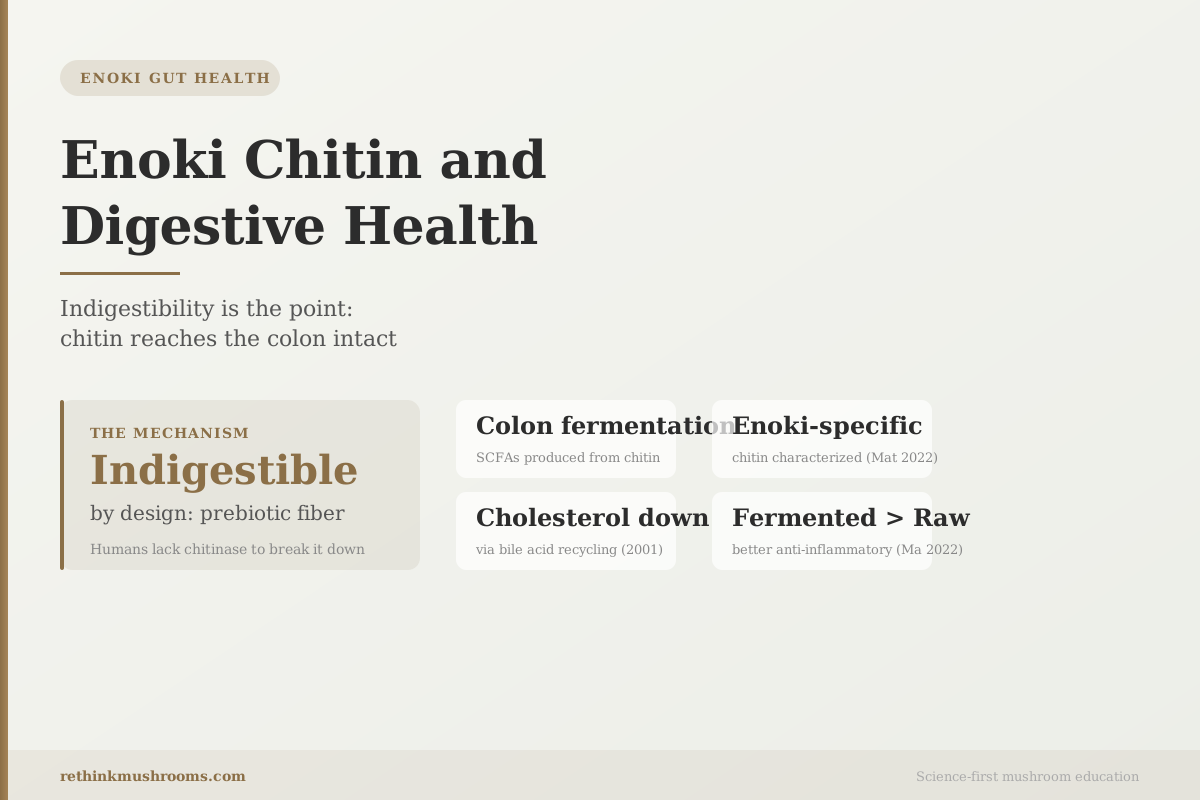
Indigestible by design
Chitin, the structural fiber in enoki mushroom cell walls, resists human digestion. That indigestibility is the proposed prebiotic mechanism: fiber that survives the small intestine reaches the colon and becomes fermentable substrate. In rats, enoki fiber raised cecal short-chain fatty acids. In humans, this has not been tested.
Nitschke et al., Carbohydrate Research, 2011; Mat Zin et al., Carbohydrate Polymers, 2022; Fukushima et al., Experimental Biology and Medicine, 2001
0.4–9.8 g
chitin per 100 g dry mass across the edible mushroom species measured by Nitschke and colleagues (2011)
Most crystalline
enoki chitin nanopaper was more crystalline and stronger than shiitake or oyster (Mat Zin et al. 2022) — a materials finding, not a digestion assay
Rodent only
cecal SCFA rose and serum cholesterol fell on enoki fiber in rats (Fukushima et al. 2001); no human trial exists
Nitschke et al., Carbohydrate Research, 2011; Mat Zin et al., Carbohydrate Polymers, 2022; Fukushima et al., Experimental Biology and Medicine, 2001
 View as image ↗
If you only read one thing
Chitin is the fiber in enoki cell walls that human digestive enzymes cannot meaningfully break down, so it arrives in the colon intact and becomes food for gut bacteria. The single best piece of evidence that this actually happens is a 2001 rat study in which enokitake fiber significantly raised cecal acetic acid, butyric acid and total short-chain fatty acids compared with cellulose — fermentation products measured in the place fermentation occurs. That study also found lower serum total cholesterol and higher hepatic LDL receptor mRNA, alongside a less-quoted result: HDL-cholesterol fell too. Everything in this chain has been shown in chemistry, materials science, or rodents. No cited study has fed enoki chitin to a human being.
If you have ever eaten enoki mushrooms and noticed them pass through your digestive system looking largely unchanged, you have met chitin. Unlike most carbohydrates, which are broken down in the small intestine and absorbed as glucose, the cell wall fiber of enoki mushrooms resists human digestive enzymes. This is not a digestive failure. It is the mechanism the entire prebiotic argument rests on.
Fiber that survives the stomach and small intestine arrives in the colon, where a dense bacterial community carries enzymes the human genome does not encode. Understanding what chitin is, why we cannot break it down, and what the research does and does not show about its fate in the colon is the foundation for understanding why enoki mushrooms get described as a prebiotic food.
This article covers the chitin-specific story: its structure, why it resists digestion, what enoki's chitin looks like at the molecular level, and — importantly — how far the evidence actually reaches. For the broader SCFA production story, see enoki and short-chain fatty acid production in the gut. For the species overview, what is enoki mushroom provides context.
Key Takeaways
- Chitin (pronounced KY-tin) is the structural polymer in mushroom cell walls, the same material that forms insect exoskeletons and crustacean shells; enoki mushrooms are a dietary source of it
- Humans do not produce chitinase in quantities sufficient to meaningfully digest food chitin during normal upper gastrointestinal transit, so it passes through the stomach and small intestine largely intact
- Nitschke and colleagues (2011) measured chitin at 0.4 to 9.8 g per 100 g of dry mass across the edible mushroom species they tested, and found no detectable chitosan in any sample[1]
- Mat Zin and colleagues (2022) characterized enoki chitin as the most crystalline of shiitake, enoki and oyster, with the highest modulus and tensile strength — a materials science result that never tested digestive conditions[2]
- The strongest evidence that enoki fiber is actually fermented comes from Fukushima and colleagues (2001): rats fed enokitake fiber had significantly higher cecal acetic acid, butyric acid and total SCFA than cellulose-fed controls[3]
- The same rat study found lower serum total cholesterol and higher hepatic LDL receptor mRNA on enoki fiber — but also significantly lower HDL-cholesterol than every other group, a result usually left out of summaries
- Fermented Flammulina velutipes polysaccharides reduced intestinal inflammation in mice more than unfermented ones (Ma et al., 2022), through NLRP3 pathway inhibition — but those are extracted polysaccharides, not chitin, and no SCFAs were measured[4]
- Every step in the chain has been studied in chemistry, materials science, rodents, or narrative review. None of the cited work is a human trial of enoki chitin
What Chitin Actually Is, and Why Humans Cannot Digest It
Chitin is a polysaccharide: a long-chain molecule built from repeating sugar units. It is one of the most abundant biopolymers on Earth, and it serves a structural role — it is what mushroom cell walls are made of, what insect exoskeletons are made of, and what crustacean shells are made of.
Structurally, chitin resembles cellulose in that it is a linear polymer of glucose-like sugars. The critical difference is that chitin's sugar units (N-acetylglucosamine) carry a nitrogen-containing acetamido group where cellulose's glucose units carry a simple hydroxyl. That substitution allows tight hydrogen bonding between adjacent chains, producing a dense, highly ordered polymer that is substantially harder to break down chemically and enzymatically.
Animals that digest chitin produce chitinase, an enzyme that cleaves the bonds between N-acetylglucosamine units. Insects produce chitinase to recycle their own shed exoskeletons. Some birds and fish that eat large amounts of chitin-containing prey produce meaningful amounts. Humans do produce chitinase enzymes, but not in quantities that meaningfully degrade food chitin during the time it spends in the stomach and small intestine. The practical outcome is that dietary chitin behaves as an insoluble fiber rather than as a digestible carbohydrate.
Nitschke and colleagues (2011) developed a new analytical method for quantifying chitin and chitosan in edible mushrooms, based on the specific reaction between polyiodide anions and chitosan.[1] Applying it to fruiting bodies and mycelia from several basidiomycetes and one ascomycete, they found chitin content varying between 0.4 and 9.8 g per 100 g of dry mass — a more than twentyfold spread between species. They also found no detectable chitosan in any mushroom sample, indicating the glucosamine units are mostly acetylated. In other words, what you eat in a mushroom is chitin, not its deacetylated cousin.
Measured Values · Not Estimates
How Much Chitin Is Actually in a Mushroom
Two of the cited papers report hard numbers for mushroom chitin. They measure different things — content in the intact mushroom versus yield from an extraction process — and are not interchangeable.
Chitin in edible mushrooms, whole fruiting bodies
0.4 – 9.8g per 100 g dry massMeasured across several basidiomycetes and one ascomycete using a polyiodide spot assay. A more than twentyfold spread between the lowest and highest species — which is why "mushrooms are high in chitin" is not a single fact.
Ref 1Chitin recovered by mild alkaline extraction, fungal source
23 – 35% of dry weightExtraction yield from shiitake, enoki and oyster fruiting bodies. This is a laboratory recovery figure from a purification process, not the amount of chitin you eat in a serving.
Ref 2Same extraction, crustacean shell source
9.7% of dry weightReported alongside the fungal figures in the same study as the comparison point. Mushroom fruiting bodies gave up more chitin per gram than shell did under identical mild alkaline conditions.
Ref 2
No enoki-specific chitin content in grams per 100 g appears here, because none of the sources cited in this article reports one. Nitschke and colleagues also found no detectable chitosan in any mushroom sample — the glucosamine units are mostly acetylated, so what you eat is chitin, not its deacetylated derivative.
Source: Nitschke et al. (2011), Carbohydrate Research; Mat Zin et al. (2022), Carbohydrate Polymers
Nitschke et al. (2011) · Carbohydrate Research
- Population
- Fruiting bodies and mycelia from several basidiomycete species and one ascomycete
- Intervention
- Polyiodide spot assay for chitosan, with deacetylation step to quantify chitin
- Finding
- Chitin content ranged from 0.4 to 9.8 g per 100 g of dry mass across species. Chitosan was not detectable in any mushroom sample, indicating glucosamine units are mostly acetylated.
narrow-scope An analytical chemistry paper. It establishes how much chitin is present and how to measure it. It involves no digestion model, no animals, and no gut.
Nitschke et al. (2011), Carbohydrate Research 346(11), 1307-10
What Enoki's Chitin Looks Like at the Structural Level
Mat Zin and colleagues (2022) published a detailed characterization of chitin extracted from enoki alongside shiitake and oyster mushrooms, evaluating the "nanopapers" that can be made from mushroom chitin fibers — thin films of nanoscale chitin fiber whose mechanical behavior reveals the properties of the chitin itself.[2]
Two results matter here. First, mild alkaline extraction recovered 23 to 35 percent chitin per dry weight from the fungal samples, compared with 9.7 percent from a crustacean source — mushroom fruiting bodies gave up more chitin per gram than shell did under identical conditions. Second, enoki nanopaper was found to be more crystalline than the other two, with a slightly higher modulus and tensile strength (2.83 GPa and 51 MPa) than oyster (2.28 GPa, 45 MPa) or shiitake (2.59 GPa, 43 MPa). Oyster nanopaper was tougher and stretched further before breaking, because its smaller fibers formed a denser network.
Crystallinity is the property with the clearest digestive relevance. Highly crystalline chitin is more resistant to enzymatic attack than amorphous chitin, because regular molecular packing leaves enzymes fewer accessible points of entry. On that basis, enoki's chitin has a structural profile consistent with strong resistance to breakdown.
Enoki's structural profile was distinct from shiitake's and oyster's, which suggests enoki chitin may behave differently in the gut from the chitin in other mushrooms — not necessarily better or worse for prebiotic purposes, but potentially with different fermentation kinetics. That remains a hypothesis generated by a materials study, not a finding.
Mat Zin et al. (2022) · Carbohydrate Polymers
- Population
- Chitin extracted from shiitake (L. edodes), enoki (F. velutipes) and oyster (P. ostreatus) fruiting bodies
- Intervention
- Mild alkaline extraction, defibrillation to 15–20 nm fibers, nanopaper formation and mechanical testing
- Comparator
- Crustacean-sourced chitin (extraction yield only)
- Finding
- Fungal chitin recovery was 23–35% of dry weight versus 9.7% from crustacean shell. Enoki nanopaper was the most crystalline, with the highest modulus (2.83 GPa) and tensile strength (51 MPa) of the three species.
narrow-scope Materials science, not gut science. No digestive, microbial or animal model appears anywhere in this study. It supports claims about enoki chitin's structure only.
Mat Zin et al. (2022), Carbohydrate Polymers 281, 119038
From Undigested Fiber to Colon Fermentation
When enoki fiber reaches the colon, it encounters a very different environment from the stomach and small intestine. The colon is populated by hundreds of bacterial species carrying a far wider range of carbohydrate-degrading enzymes than the human body produces, including bacteria capable of degrading chitin. Zhao and colleagues' 2023 review of edible mushroom polysaccharides frames the general principle directly: these fibers are resistant to human digestive enzymes and serve as a source of energy for the gut microbiome, promoting the growth of beneficial bacteria and shifting the community's composition.[5]
As bacteria ferment fiber, they produce short-chain fatty acids (SCFAs): principally acetate, propionate, and butyrate. Butyrate is the primary energy source for colonocytes, the cells lining the colon wall, and is the SCFA most associated with maintenance of the intestinal barrier.
Enoki also contains beta-glucan, a soluble polysaccharide with its own prebiotic properties. Soluble fibers are generally more accessible to bacterial enzymes than insoluble crystalline ones, so the combination of chitin and beta-glucan plausibly provides both slower and faster fermentation substrates across a longer stretch of the colon. It is worth being explicit that no study cited in this article separates chitin's fermentation contribution from beta-glucan's — the rodent evidence below used whole enokitake fiber, which contains both.
Claim Reach · Step by Step
How Far the Enoki Chitin Prebiotic Claim Actually Reaches
The prebiotic argument is a chain of six steps. Five of them have a cited study behind them. The sixth — the one about humans — does not.
- 1
Chitin is present, and quantifiable
Nitschke et al., 2011What was measured
A polyiodide spot assay put chitin at 0.4–9.8 g per 100 g dry mass across the mushroom species tested, and found no detectable chitosan in any sample.
What it does not show
Establishes that the substrate exists and how much of it there is. Says nothing about what happens to it after you swallow it.
Chemistry / materialsRef 1 - 2
Enoki chitin is structurally distinct
Mat Zin et al., 2022What was measured
Enoki chitin nanopaper was the most crystalline of the three species tested, with the highest modulus and tensile strength (2.83 GPa, 51 MPa) versus oyster (2.28 GPa, 45 MPa) and shiitake (2.59 GPa, 43 MPa).
What it does not show
This is a materials study. It never exposed enoki chitin to gastric acid, digestive enzymes, or gut bacteria. Crystallinity is a reasonable prior for enzymatic resistance, not a measurement of it.
Chemistry / materialsRef 2 - 3
Enoki fibre reaches the colon and is fermented
Fukushima et al., 2001What was measured
Rats fed 50 g/kg enokitake fibre for four weeks had significantly higher cecal acetic acid, butyric acid and total SCFA than controls fed cellulose. Fermentation products appeared where fermentation happens.
What it does not show
The strongest link in the chain, and the only one that measures the actual endpoint. It is a rat study of whole enoki fibre — chitin plus beta-glucan plus everything else — not of isolated chitin.
RodentRef 3 - 4
Fermentation has host consequences
Fukushima et al., 2001; Ma et al., 2022What was measured
Serum total cholesterol fell, hepatic LDL receptor mRNA rose and fecal cholesterol excretion rose in the enoki-fibre rats. Separately, fermented F. velutipes polysaccharides reduced IL-1β, IL-6, IL-18 and TNF-α in mice by inhibiting NLRP3 signalling.
What it does not show
Two different preparations in two different rodent models. HDL-cholesterol was also significantly lower in the enoki group than in every other group — an effect the "good for cholesterol" framing usually omits.
RodentRefs 3, 4 - 5
The general principle, stated in review
Zhao et al., 2023What was measured
A review of edible mushroom polysaccharides concludes they resist human digestive enzymes and act as an energy source for the gut microbiome, shifting its composition.
What it does not show
Reviews summarise; they do not generate evidence. This one covers mushroom polysaccharides broadly rather than enoki chitin specifically.
Narrative reviewRef 5 - 6
The same chain, demonstrated in people
—What was measured
Nothing. No cited study fed enoki or enoki chitin to human participants.
What it does not show
Everything above is chemistry, materials science, rodents, or review. The human step of this chain has not been run, so every statement in this article about what enoki chitin does in your colon is an extrapolation.
No study cited—
Step 3 is the load-bearing one, and it is worth being precise about what it used: whole enokitake dietary fibre, not purified chitin. No cited study isolates chitin’s contribution from beta-glucan’s.
Source: Nitschke et al. (2011); Mat Zin et al. (2022); Fukushima et al. (2001); Ma et al. (2022); Zhao et al. (2023)
The Best Evidence: Cecal SCFAs and Cholesterol in Rats
The most directly relevant study in this article's evidence base is also the oldest. Fukushima and colleagues (2001) ran a head-to-head comparison of dietary fibers from maitake (Grifola frondosa), shiitake (Lentinus edodes), and enokitake (Flammulina velutipes) in rats.[3] Four groups of rats were fed a cholesterol-free diet for four weeks, differing only in the 50 g/kg fiber source: cellulose powder as the control, or maitake, shiitake, or enokitake fiber.
The result that matters most for this article is the one about the cecum. Cecal acetic acid, butyric acid, and total SCFA concentrations in the shiitake and enokitake groups were significantly higher than in the other groups. This is the fermentation step of the prebiotic chain, measured directly, in the organ where it happens. Indigestible mushroom fiber went in; short-chain fatty acids came out.
The study also found metabolic effects downstream of that fermentation. Serum total cholesterol was significantly higher in the cellulose control group than in the maitake and enokitake groups. Fecal cholesterol excretion was significantly higher in all three mushroom fiber groups than in the control. And hepatic LDL receptor mRNA was significantly higher in the enokitake group than in the control — the liver was transcribing more of the receptor that clears LDL from circulation. The authors' own conclusion was that maitake and enokitake fiber lowered serum total cholesterol by enhancing fecal cholesterol excretion, and in the enokitake group in particular, by enhancing hepatic LDL receptor mRNA.
There is a result in this study that rarely survives into secondary summaries, and it deserves to. HDL-cholesterol in the enokitake group was significantly lower than in every other group at the end of the four-week feeding period. Enoki fiber did not simply improve the lipid panel; it moved total cholesterol and HDL in the same direction. Whether that matters clinically in a rat, let alone a person, is not something this study can answer — but reporting the total cholesterol drop without the HDL drop would be reporting half of the finding.
Fukushima et al. (2001) · Experimental Biology and Medicine
- Population
- Rats fed a cholesterol-free diet for 4 weeks
- Intervention
- 50 g/kg enokitake (F. velutipes) fiber
- Comparator
- 50 g/kg cellulose powder, maitake fiber, or shiitake fiber
- Finding
- Cecal acetic acid, butyric acid and total SCFA were significantly higher on enokitake and shiitake fiber than the other groups. Serum total cholesterol was lower, fecal cholesterol excretion higher, and hepatic LDL receptor mRNA higher than control — while HDL-cholesterol was significantly lower than in every other group.
mixed A genuinely on-target finding for the fermentation claim, with a lipid result that cuts both ways. Rats, four weeks, isolated fiber fraction — not people eating mushrooms.
Fukushima et al. (2001), Experimental Biology and Medicine 226(8), 758-65
Note what this study does and does not license. It shows that indigestible enoki fiber reaches the cecum and is fermented into SCFAs, which is the load-bearing claim of the whole prebiotic story. It does not isolate chitin: enokitake dietary fiber contains chitin, beta-glucan, and other cell wall components together. And it is a rodent study, which means the correct reading of the cholesterol finding is "this is a mechanism worth testing in humans," not "eat enoki to lower your cholesterol."
Interpretation
ModerateThe Cholesterol Finding Is a Rat Result, Not a Treatment
Concern
Enoki's cholesterol effect is frequently repeated as though it were a human finding. It comes from a single four-week rat study using an isolated fiber fraction at 50 g/kg of diet — a dose and a preparation that do not correspond to eating mushrooms — and in that study HDL-cholesterol fell alongside total cholesterol.
What the research says
Treat enoki as a food with a plausible fiber mechanism, not as a lipid-lowering intervention. Nothing in the cited evidence supports substituting it for prescribed cholesterol management.
Particularly relevant for: Anyone managing elevated cholesterol or cardiovascular risk
What to do
Discuss any dietary change intended to affect cholesterol with your physician, and do not adjust or stop prescribed medication based on mushroom research. This article is educational and is not medical advice.
Fukushima et al. (2001), Experimental Biology and Medicine 226(8), 758-65
- Cell and in vitro workcompleted
Chitin quantified chemically (Nitschke 2011); enoki chitin characterized structurally (Mat Zin 2022); FVP anti-inflammatory activity tested in vitro (Ma 2022).
- Animal studiescurrent
Rats: cecal SCFA up, serum cholesterol down, hepatic LDL receptor mRNA up, HDL down (Fukushima 2001). Mice: fermented FVP reduced intestinal inflammation via NLRP3 (Ma 2022).
- Human case reportsmissing
None cited.
- Small human trialsmissing
No cited study has fed enoki or enoki chitin to human participants and measured fermentation, SCFAs, or lipids.
- Large randomized trialsmissing
None.
- Meta-analysismissing
None. Zhao et al. (2023) is a narrative review of mushroom polysaccharides generally, not a quantitative synthesis of enoki chitin.
The mechanism is chemically coherent and has been demonstrated end-to-end in rats. It has never been demonstrated in a human being. Anyone describing enoki chitin's effects on your gut is extrapolating from rodents.
Nitschke et al. (2011); Mat Zin et al. (2022); Fukushima et al. (2001); Ma et al. (2022); Zhao et al. (2023)
Fermented vs. Unfermented Preparations: Does Pre-Processing Matter?
Ma and colleagues (2022) investigated whether fermenting F. velutipes polysaccharides before use changed their biological activity in the gut.[4] Using a solid anaerobic fermentation technique, they compared F. velutipes polysaccharides (FVP) with fermented FVP (FFVP) in vitro and in an LPS-induced mouse model.
Fermentation raised the extraction yield slightly, from 8.65 percent to 9.44 percent, and lowered the average molecular weight modestly, from 15,961 Da to 15,702 Da. In the mice, FFVP outperformed FVP at preventing diarrhea, enhancing antioxidant capacity, and reducing both secretion and mRNA expression of interleukin-1β, IL-6, IL-18 and tumor necrosis factor-α. The mechanism the authors identified was inhibition of NLRP3 inflammasome signaling.
Two things need saying clearly about how this fits the chitin story. First, FVP is an extracted polysaccharide fraction — the water-soluble material pulled out of the mushroom — not the insoluble chitin of the cell wall. Conclusions about FVP do not transfer to chitin without an argument nobody has made. Second, this study measured no short-chain fatty acids at all. Its endpoints were inflammatory cytokines and antioxidant markers, and the molecular weight reduction from fermentation was about 1.6 percent, not a wholesale depolymerization.
Product Claims
Do Fermented Enoki Supplements Deliver More SCFAs?
The claim
“Pre-fermenting enoki breaks its chitin into smaller pieces that gut bacteria can use more easily, so fermented enoki products produce more short-chain fatty acids per gram than plain dried enoki.”
A plausible-sounding extrapolation from Ma et al. (2022), which found fermented F. velutipes polysaccharides more anti-inflammatory than unfermented ones.
What research shows
UnsupportedMa and colleagues measured cytokines, antioxidant capacity and NLRP3 signaling. They did not measure short-chain fatty acids. The molecular weight difference between fermented and unfermented preparations was 15,961 Da versus 15,702 Da — roughly 1.6 percent — and the material tested was an extracted polysaccharide fraction, not cell wall chitin.
The anti-inflammatory advantage of the fermented preparation is a real finding in mice and worth taking seriously on its own terms. The SCFA claim is simply a different claim, and no cited study tests it.
Ma et al. (2022), Frontiers in Nutrition 9, 934073
None of this means that eating whole, unfermented enoki provides no prebiotic benefit — the rat fermentation data suggest the opposite. It means the specific claim that pre-fermentation increases SCFA yield has not been tested by any source cited here, and should not be repeated as though it has.
What Would Settle This
The gap in this literature is unusually well-defined. The chemistry is done, the structural characterization is done, and the rodent fermentation result exists and points the right way. What is missing is a single human study in which participants consume a known quantity of enoki, and fecal or plasma SCFAs are measured against a control fiber. Failing that, an in vitro human fecal fermentation of isolated enoki chitin — the standard first-pass method for assessing prebiotic potential — would at least establish whether human gut communities specifically ferment enoki chitin, and which taxa respond.
Until one of those exists, the accurate way to describe enoki chitin is: a structurally well-characterized insoluble fiber, demonstrated in rats to reach the colon and be fermented into short-chain fatty acids, with a plausible but untested equivalent process in humans.
The Bottom Line
Chitin is the structural fiber in enoki mushroom cell walls that humans cannot meaningfully digest, because we do not produce chitinase in useful quantities. That indigestibility is the prebiotic mechanism: fiber that survives the small intestine reaches the colon as bacterial substrate. Nitschke and colleagues (2011) measured mushroom chitin at 0.4 to 9.8 g per 100 g dry mass; Mat Zin and colleagues (2022) found enoki chitin the most crystalline of three species tested, though in a materials study that never modeled digestion. The strongest support comes from Fukushima and colleagues (2001), who found significantly higher cecal acetic acid, butyric acid and total SCFAs in rats fed enokitake fiber, along with lower serum total cholesterol, higher fecal cholesterol excretion, higher hepatic LDL receptor mRNA — and significantly lower HDL-cholesterol. Fermented F. velutipes polysaccharides reduced intestinal inflammation in mice via NLRP3 inhibition, but those are extracted polysaccharides rather than chitin, and no SCFAs were measured. No cited study has tested enoki chitin in humans.
Frequently Asked Questions
Sources & References
- 1RTHM-00424·Nitschke, Jörg et al. (2011). “A new method for the quantification of chitin and chitosan in edible mushrooms..” Carbohydrate research.Study breakdown →PubMed →↩
- 2RTHM-01583·Mat Zin, Mizan Izzati et al. (2022). “Physicochemical properties of fungal chitin nanopaper from shiitake (L. edodes), enoki (F. velutipes) and oyster mushrooms (P. ostreatus)..” Carbohydrate polymers.Study breakdown →PubMed →↩
- 3RTHM-00075·Fukushima, M et al. (2001). “Cholesterol-lowering effects of maitake (Grifola frondosa) fiber, shiitake (Lentinus edodes) fiber, and enokitake (Flammulina velutipes) fiber in rats..” Experimental biology and medicine (Maywood.Study breakdown →PubMed →↩
- 4RTHM-01578·Ma, Sheng et al. (2022). “Inhibitory Effect of Fermented Flammulina velutipes Polysaccharides on Mice Intestinal Inflammation..” Frontiers in nutrition.Study breakdown →PubMed →↩
- 5RTHM-01836·Zhao, Qilong et al. (2023). “The benefits of edible mushroom polysaccharides for health and their influence on gut microbiota: a review..” Frontiers in nutrition.Study breakdown →PubMed →↩