Enoki Gut Health
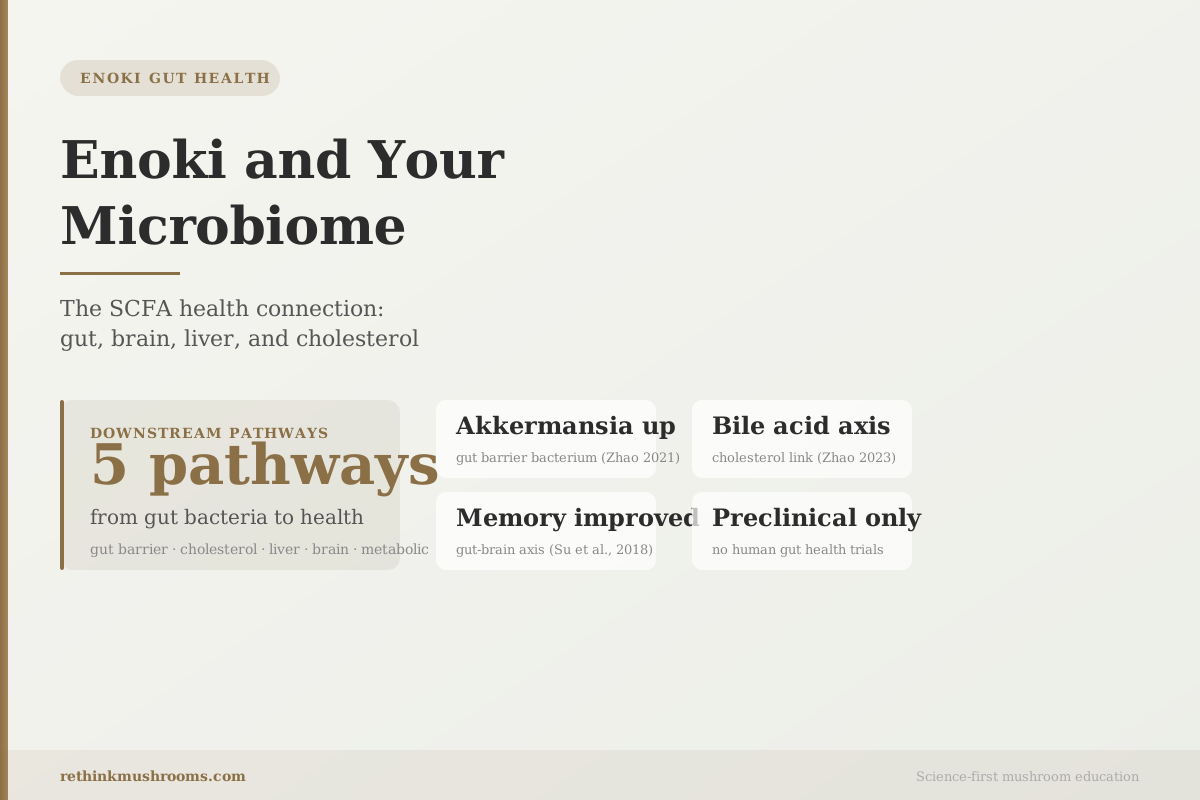
5 pathways from gut to health
Enoki polysaccharides feed specific gut bacteria that produce SCFAs, which in turn support gut barrier integrity, reduce cholesterol via bile acid recycling, protect the liver, and improve brain inflammation through the gut-brain axis.
Yin et al., Foods, 2020; Zhao et al., Food Function, 2021
Akkermansia up
gut barrier bacterium increased in high-fat diet mice given enoki polysaccharides (Zhao et al., 2021)
Cholesterol link
enoki polysaccharides improved lipid profiles via gut-liver bile acid metabolism (Zhao et al., 2023)
Memory improved
gut bacteria shift from enoki polysaccharides reduced neuroinflammation and restored memory in mice (Su et al., 2018)
Yin et al., Foods, 2020; Zhao et al., Food Function, 2021
 View as image ↗
The reason enoki mushrooms affect more than just your gut comes down to what your gut bacteria do with them.
When the fiber and polysaccharides in enoki reach the colon undigested, bacteria ferment them and produce short-chain fatty acids (SCFAs), which are small molecules that travel through the gut wall into the bloodstream and act as signals in tissues throughout the body. SCFAs from gut fermentation don't stay local. They reach the liver, the immune system, and the brain, which is why the downstream effects of enoki's prebiotic activity extend well beyond digestion.
This article covers five distinct health pathways that flow from enoki's gut microbiome effects: gut barrier protection, cholesterol management via bile acid recycling, liver protection, brain inflammation reduction, and metabolic support. For the detailed mechanistic picture of how SCFAs are produced from enoki fermentation, see enoki and short-chain fatty acid production in the gut. For the enoki species overview, what is enoki mushroom provides the full context.
Key Takeaways
- Enoki polysaccharides feed gut bacteria that produce three types of SCFAs (acetate, propionate, butyrate), each of which acts in different organs and through different pathways (Yin et al., 2020)
- SCFAs produced from mushroom fermentation bind to receptors on gut and immune cells (GPR41/43), suppressing the NF-κB inflammatory signaling pathway and reducing cytokine production (Zhao et al., 2023)
- Enoki polysaccharides increased Akkermansia, the gut barrier bacterium associated with metabolic health, in high-fat diet mice; this reversed multiple markers of diet-induced dysbiosis (Zhao et al., 2021)
- A gut-liver bile acid mechanism links enoki polysaccharides to cholesterol reduction: bacteria shift altered bile acid recycling, improving lipid profiles in high-fat diet mice (Zhao et al., 2023, Food Function)
- Enoki polysaccharides reduced neuroinflammatory cytokines in the brain via gut microbiota changes; fecal transplant from treated mice reproduced memory benefits in untreated mice (Su et al., 2018)
- All evidence is from animal and in vitro studies; no human clinical trials have tested enoki gut effects on any of these health outcomes
Why Gut Bacteria Make Enoki Health Effects Systemic
The basic prebiotic story (fiber reaches colon, bacteria ferment it, produce SCFAs) is well-documented for many foods. What makes enoki's prebiotic effects clinically interesting is the range of downstream outcomes the SCFA production appears to support.
Yin and colleagues' 2020 comprehensive review synthesized how mushroom polysaccharide-derived SCFAs produce health effects via receptor signaling.[1] The core mechanism: SCFAs bind to G protein-coupled receptors on the surfaces of intestinal and immune cells (GPR41, GPR43, and GPR109A), and this binding activates signaling cascades that suppress the NF-κB pathway (a central inflammatory gene activator inside cells) and reduce cytokine production. In practical terms: SCFAs produced from fermenting enoki polysaccharides can tone down inflammatory activity in gut tissue.
Nguepi and Song's 2020 review took this further, connecting mushroom prebiotic effects specifically to liver disease prevention.[2] SCFA-producing bacteria stimulated by mushroom polysaccharides reduce hepatic lipid accumulation, providing a pathway from gut microbiota activity to liver fat and metabolic health. This is not a localized gut effect. It is a systemic metabolic effect initiated in the colon and transmitted through the bloodstream to the liver.
These two reviews establish the framework. The downstream health pathways below each follow from this basic SCFA-receptor-signaling chain in different directions.
Akkermansia: The Gut Barrier Bacterium That Enoki Polysaccharides May Support
Akkermansia muciniphila is a bacterium that lives in the mucus layer lining the intestine. It produces compounds that strengthen the gut barrier and is associated with better metabolic health, lower obesity risk, and lower rates of type 2 diabetes in population studies. It has become one of the most studied bacteria in gut health research and is under active investigation as a next-generation probiotic.
Zhao and colleagues (2021) found that enoki polysaccharides reversed multiple markers of gut dysbiosis (disrupted microbiome composition caused by a high-fat diet) in mice, and one of the most notable changes was an increase in Akkermansia abundance.[3] The polysaccharide-supplemented mice also showed improved metabolic markers alongside the microbiome shift.
The mechanistic connection between enoki polysaccharides and Akkermansia is not fully established. It may operate through the prebiotic substrate availability: Akkermansia benefits when specific compounds it can ferment are present, and enoki polysaccharides may include structures that Akkermansia ferments preferentially. It may also operate through the broader microbiome shift enoki produces (increased Bacteroidetes, decreased Firmicutes), which creates ecological conditions where Akkermansia thrives.
No study has confirmed that eating enoki mushrooms as food increases Akkermansia in humans. The animal data establishes a plausible pathway. Whether it extends to human dietary practice requires a human feeding trial with microbiome sequencing.
The Gut-Cholesterol Connection: How Enoki's Bacteria Changes Affect Lipid Profiles
One of the more surprising downstream effects of enoki's microbiome activity is its connection to cholesterol management, operating through a pathway most people don't consider: bile acid recycling.
Zhao and colleagues' 2023 study (published in the International Journal of Biological Macromolecules) specifically traced how F. velutipes polysaccharides improved lipid profiles in high-fat diet mice through changes to the gut-liver bile acid axis.[4]
Bile acids are made from cholesterol in the liver and secreted into the gut to help absorb dietary fats. In a healthy cycle, most bile acids are reabsorbed in the intestine and recycled back to the liver. When gut bacteria and prebiotics disrupt this cycle (by binding bile acids or altering the intestinal bacteria that reabsorb them), more bile acids are lost in stool. The liver compensates by converting more cholesterol to make new bile acids, which lowers circulating cholesterol levels.
Enoki polysaccharides shifted the gut bacteria community in ways that altered this bile acid recycling, resulting in improved lipid profiles in the mice. This gut-liver pathway is separate from the direct fiber-binding mechanism that some foods (like oat beta-glucan) use to reduce cholesterol: enoki polysaccharides are working through their effect on the microbiome rather than physically binding bile acids themselves.
This microbiome-to-cholesterol pathway means enoki's gut effects and cardiovascular effects are not separate stories. For the direct cardiovascular research, see enoki and cholesterol reduction: lipid-lowering evidence.
The Gut-Brain Axis: How Bacteria Changes Reached the Brain
The most striking evidence for enoki's gut effects having distant systemic consequences comes from a 2018 study by Su and colleagues that showed memory improvement flowing from gut microbiota changes.[5]
In scopolamine-impaired mice (a standard model of acute memory disruption), enoki polysaccharide supplementation improved memory test performance. The research team traced the mechanism: the polysaccharides shifted gut bacteria composition, which reduced brain levels of inflammatory cytokines (IL-1β, TNF-α, and IL-6), and the reduction in brain inflammation corresponded to the memory improvement.
The fecal microbiota transplant experiment is the most compelling part of Su's study: when gut bacteria from polysaccharide-treated mice were transferred to untreated impaired mice, the memory benefits partially reproduced. The untreated recipient mice had never received enoki polysaccharides; they received only the transplanted bacteria from mice that did. The bacteria themselves, not a direct compound effect, were sufficient to reduce neuroinflammation and improve cognitive performance.
This is gut-brain axis research in its most direct demonstration. SCFAs produced from enoki fermentation are one mechanism for this cross-organ signaling: butyrate and propionate produced in the colon can cross the blood-brain barrier and modulate inflammation in neural tissue directly. The gut bacteria changes may also signal the brain through immune and vagal nerve pathways.
What the Data Shows About Dose and Consistency
Two pieces of evidence address what level of enoki intake would produce meaningful microbiome effects.
Ye and colleagues (2020) used isolated F. velutipes polysaccharide administered to rats and found significant bacteria composition changes: Bacteroidetes increased, Firmicutes decreased, Bifidobacterium and Lactobacillus specifically increased.[6] These studies used extracted polysaccharide preparations at supplementation doses, not whole mushroom. The dose that would produce equivalent microbiome effects from dietary enoki consumption is not established.
Zhang and colleagues (2024) confirmed that F. velutipes polysaccharides survived simulated gastrointestinal digestion and produced SCFA output when fermented with human fecal bacteria, which establishes that the prebiotic pathway is feasible in human digestive conditions.[7]
The honest practical gap: no study has quantified how much enoki mushroom consumption as whole food produces meaningful changes in gut bacteria or SCFA output in humans. The animal studies use extracted polysaccharide fractions. The relationship between eating 50-100g of enoki as part of a meal and achieving the doses used in research is not directly established.
Consistency likely matters more than single servings. Gut bacteria composition changes from dietary fiber require sustained dietary patterns rather than one-time doses. Population studies that find associations between mushroom consumption and health outcomes measure habitual dietary patterns, not single exposures. For what the population-level data shows, see enoki and gut bacteria composition: research review.
The Bottom Line
Enoki polysaccharides feed gut bacteria that produce SCFAs with downstream effects in five directions: gut barrier protection via Akkermansia and tight junction upregulation, cholesterol reduction through gut-liver bile acid metabolism, liver lipid protection, brain inflammation reduction through the gut-brain axis, and metabolic improvements via GPR receptor signaling. Fecal transplant from enoki-treated mice reproduced memory benefits in untreated mice, providing direct evidence that the bacteria shift rather than enoki compounds directly drives the brain effects. All evidence is animal and in vitro; human clinical trials on enoki gut and systemic health outcomes do not exist.
Frequently Asked Questions
Sources & References
- 1RTHM-01308·Yin, Chaomin et al. (2020). “The Impact of Mushroom Polysaccharides on Gut Microbiota and Its Beneficial Effects to Host: A Review..” Carbohydrate polymers.Study breakdown →PubMed →↩
- 2RTHM-00644·Nguepi, Tsopmejio Ivan Steve et al. (2020). “Mushrooms Bioactive as Prebiotics to Modulate Gut Microbiota in Relationships with Causes and Prevention of Liver Diseases (Review)..” International journal of medicinal mushrooms.Study breakdown →PubMed →↩
- 3RTHM-01472·Zhao, Ruiqiu et al. (2021). “Polysaccharide from Flammulina velutipes attenuates markers of metabolic syndrome by modulating the gut microbiota and lipid metabolism in high fat diet-fed mice..” Food & function.Study breakdown →PubMed →↩
- 4RTHM-01837·Zhao, Ruiqiu et al. (2023). “Flammulina velutipes polysaccharides regulate lipid metabolism disorders in HFD-fed mice via bile acids metabolism..” International journal of biological macromolecules.Study breakdown →PubMed →↩
- 5RTHM-01010·Su, Anxiang et al. (2018). “Flammulina velutipes polysaccharides improve scopolamine-induced learning and memory impairment in mice by modulating gut microbiota composition..” Food & function.Study breakdown →PubMed →↩
- 6RTHM-01306·Ye, Jufeng et al. (2020). “A novel polysaccharide isolated from Flammulina velutipes, characterization, macrophage immunomodulatory activities and its impact on gut microbiota in rats..” Journal of animal physiology and animal nutrition.Study breakdown →PubMed →↩
- 7RTHM-02037·Zhang, Yao et al. (2024). “Comprehensive evaluation of Flammulina velutipes residues polysaccharide based on in vitro digestion and human fecal fermentation..” International journal of biological macromolecules.Study breakdown →PubMed →↩