Enoki Gut Health: Prebiotic Fiber, Microbiome, Chitin & SCFA Production
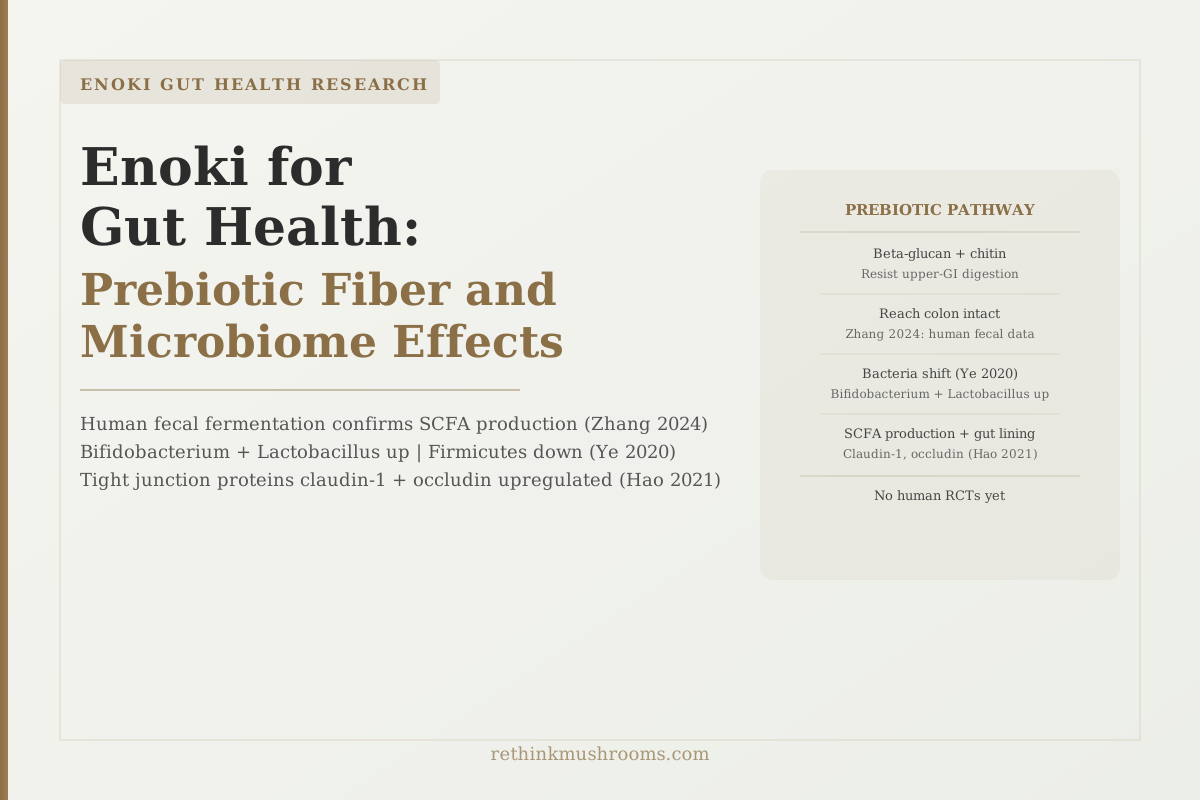
Human fecal fermentation data confirms enoki polysaccharides reach the colon intact and are converted to SCFAs by gut bacteria (Zhang et al., 2024)
Zhang et al. (2024) tested Flammulina velutipes polysaccharides through simulated gastrointestinal digestion followed by human fecal fermentation. The polysaccharides survived upper-GI digestion, reached the colon intact, and were fermented by human gut bacteria to produce short-chain fatty acids.
Zhang et al., International Journal of Biological Macromolecules, 2024
Bifidobacterium
and Lactobacillus increase when rats consume F. velutipes polysaccharides; Firmicutes abundance falls (Ye et al., 2020)
Claudin-1
and occludin (gut lining tight junction proteins) were upregulated by enoki polysaccharides in mice (Hao et al., 2021)
No human RCTs
no randomized controlled trial has tested enoki specifically for gut microbiota outcomes in people
Zhang et al., International Journal of Biological Macromolecules, 2024
 View as image ↗
Enoki mushrooms have more direct gut microbiome research behind them than most culinary mushrooms. While articles about enoki gut health typically say "high in fiber, good for digestion," the actual research goes considerably further: it names specific bacteria that enoki polysaccharides increase, documents changes to the gut lining at the protein level, and includes a 2024 study that tested enoki polysaccharides directly against human fecal bacteria rather than relying on animal models alone. This article explains what the enoki mushroom gut health evidence actually shows, at the level of specific bacteria and specific mechanisms, and where the evidence falls short of human clinical confirmation. For the broader overview of enoki research, see What Is Enoki Mushroom? The Tiny Mushroom with Big Research.
Key Takeaways
- Enoki contains two main fiber types with prebiotic potential: beta-glucan (soluble, forms a gel) and chitin (insoluble, structural), both of which resist digestion and reach the colon where gut bacteria ferment them
- Ye et al. (2020) documented specific bacterial shifts in rats given F. velutipes polysaccharides: Bifidobacterium and Lactobacillus increased while Firmicutes decreased and Bacteroidetes increased, improving the Firmicutes/Bacteroidetes ratio associated with gut health
- Hao et al. (2021) found that F. velutipes polysaccharide supplementation increased short-chain fatty acid (SCFA) production in mice and upregulated tight junction proteins claudin-1 and occludin, which strengthen the gut lining barrier
- Zhang et al. (2024) performed in vitro digestion followed by human fecal fermentation and found enoki polysaccharides survive upper-GI digestion and are converted to SCFAs by human gut bacteria, providing the most direct evidence available outside of a human clinical trial
- Nguepi and Song (2020) review links the SCFA-producing bacteria stimulated by mushroom polysaccharides to prevention of liver disease via the gut-liver axis, establishing that enoki's gut effects have downstream consequences beyond digestion
- No randomized controlled trial has tested enoki or F. velutipes polysaccharides specifically for gut microbiota composition or gut health outcomes in humans
What Makes Enoki's Fiber Prebiotic
A food earns the label "prebiotic" when it contains compounds that resist human digestion and selectively feed beneficial bacteria in the colon. Not all fiber qualifies: some fiber ferments too quickly and feeds a non-selective range of bacteria. True prebiotic fiber reaches the colon intact and preferentially promotes the genera associated with gut health.
Enoki contains two fiber types relevant to the prebiotic discussion. Beta-glucan is a soluble fiber that forms a viscous gel in the digestive tract. It slows gastric emptying, reduces the rate of nutrient absorption, and reaches the colon to be fermented by bacteria. Chitin is an insoluble structural polysaccharide, the same material found in insect exoskeletons, that makes up the cell walls of enoki and all edible mushrooms. Humans lack adequate amounts of the enzyme chitinase needed to break down chitin, so it passes through the small intestine undigested and reaches the colon intact.
The foundational review by Jayachandran et al. (2017) establishes the mechanism: edible mushroom polysaccharides resist digestion, reach the colon, and selectively promote Bifidobacterium and Lactobacillus while reducing pathogenic bacteria, with downstream effects on the immune system and metabolic health.[1] This applies to mushrooms broadly, but enoki's specific prebiotic profile has since been documented in species-specific studies that go beyond the general mushroom picture.
The 2022 and 2023 systematic reviews by Ma et al. and Peng et al. confirm that F. velutipes is among the key edible mushroom species with documented gut microbiota effects and situate enoki's prebiotic activity within the broader mushroom gut health literature.[2][3]
The Named Bacteria: What Enoki Actually Feeds
Generic fiber content data tells you that a food has fiber. The specific research on F. velutipes tells you which bacteria shift in what direction.
Ye et al. (2020) isolated a polysaccharide from Flammulina velutipes and fed it to rats, then measured gut bacterial composition via sequencing.[4] The results documented genus-level specificity. Bifidobacterium and Lactobacillus populations increased significantly. Bacteroidetes abundance increased while Firmicutes decreased, improving the Firmicutes/Bacteroidetes ratio. A lower Firmicutes/Bacteroidetes ratio is associated with leaner body composition and better metabolic health in both animal research and some human studies.
The Firmicutes/Bacteroidetes ratio matters because Firmicutes tend to be more efficient energy harvesters (extracting more calories from food) and elevated Firmicutes populations have been associated with obesity and metabolic syndrome in observational research. Bacteroidetes are associated with better fermentation of plant fibers and lower systemic inflammation. The enoki polysaccharide shifted the ratio in the direction associated with better metabolic health.
Liang et al. (2022) extended the bacterial picture by examining how F. velutipes polysaccharide administration altered both intestinal flora and the immune-related protein expression profile in mice.[5] The gut flora shifted toward a more immune-supporting composition, and the antioxidant proteome in gut tissue was upregulated. This finding connects the microbiome effect to gut tissue function, not just bacterial counts.
For the detailed breakdown of which bacteria change and how, see Enoki and Gut Bacteria Composition: Research Review.
Zhang 2024: The Human Fecal Fermentation Evidence
The study that brings the gut health evidence closest to human biology is Zhang et al. (2024).[6]
The researchers put F. velutipes residue polysaccharide through a simulation of human upper-gastrointestinal digestion. The simulation mimics the enzymes, pH levels, and conditions of the stomach and small intestine. The purpose: to test whether the polysaccharide survives the stomach and small intestine intact. The result: the polysaccharide showed very low digestibility in the upper GI simulation, meaning it passed through largely unchanged.
The second step was human fecal fermentation. The researchers collected gut bacteria from human fecal samples and incubated them with the enoki polysaccharide under conditions simulating the colon environment. The human gut bacteria fermented the enoki polysaccharide and produced measurable quantities of short-chain fatty acids, including acetate, propionate, and butyrate. The bacterial community also shifted: Bifidobacterium populations were selectively enriched during the fermentation.
The significance is methodological. Animal studies show bacteria shifting when mice eat enoki polysaccharides. This shows bacteria shifting when human fecal bacteria are exposed to enoki polysaccharides in conditions simulating the human colon. It is not a human clinical trial, and the amounts of polysaccharide used in the in vitro incubation exceed what a single serving of enoki delivers. But it is the most direct evidence available that the mechanism operates using human gut bacteria rather than only rodent bacteria.
This evidence gap between "human fecal bacteria respond to enoki polysaccharide" and "eating enoki changes your gut bacteria" is real. No study has enrolled human participants, fed them enoki for weeks, and sequenced their gut microbiome before and after. That research does not yet exist.
SCFA Production and Gut Lining Integrity
Short-chain fatty acids (SCFAs) are the primary output of bacterial fermentation of dietary fiber in the colon. The three main SCFAs are acetate, propionate, and butyrate. Butyrate is the primary energy source for colonocytes (the cells lining the colon) and has well-documented anti-inflammatory and gut-barrier-strengthening properties. Propionate travels to the liver where it signals insulin sensitivity and fatty acid metabolism. Acetate circulates systemically and provides the backbone for cholesterol and fatty acid synthesis.
Hao et al. (2021) documented that F. velutipes polysaccharide supplementation in C57BL/6 mice significantly improved gut microbial metabolic activity, increased SCFA production, and critically, upregulated two proteins central to gut barrier function: claudin-1 and occludin.[7] These proteins are the building blocks of tight junctions, the molecular seals between epithelial cells that prevent bacteria and food antigens from crossing the gut lining into systemic circulation. When tight junctions are compromised, the result is what is commonly called "leaky gut," associated with chronic inflammation and various disease states.
The Hao 2021 finding is significant because it connects the SCFA production to a specific structural outcome in the gut lining, going beyond "SCFAs are produced" to "the gut lining was measurably more intact." It is the only study directly linking enoki polysaccharide to tight junction protein upregulation alongside SCFA production.
The downstream consequences of SCFA production extend to the liver. Nguepi and Song's (2020) review specifically examines how mushroom polysaccharide-stimulated SCFA-producing bacteria reduce hepatic lipid accumulation through the gut-liver axis.[8] Butyrate and propionate produced by gut bacteria travel to the liver via the portal vein and affect hepatic fatty acid metabolism. The review positions mushroom prebiotic effects as preventively relevant to liver disease, connecting enoki's gut effects to organ-level consequences.
For the full picture of SCFA production from enoki fermentation, see Enoki and Short-Chain Fatty Acid Production in the Gut.
The Earliest Evidence: Enoki Fiber and Cholesterol in Rats
The foundational animal study on enoki dietary fiber comes from Mandeville et al. (2001), who compared the cholesterol-lowering effects of fiber from three mushroom species including Flammulina velutipes in rats.[9] Enoki fiber, like shiitake and maitake fiber, reduced serum cholesterol in the rat models. This 2001 study predates the microbiome sequencing era and couldn't identify which bacteria were involved. But it established that enoki fiber has measurable metabolic effects through gut interactions, providing the first animal evidence that informed subsequent research.
The mechanism behind cholesterol reduction from dietary fiber generally runs through two pathways. First, soluble fiber binds bile acids in the small intestine, reducing their reabsorption and forcing the liver to convert more cholesterol into new bile acids, thereby lowering serum cholesterol. Second, SCFAs produced from colonic fermentation, particularly propionate, suppress hepatic cholesterol synthesis directly. The Mandeville 2001 result in rats predated the full mechanistic picture but pointed to the gut-liver axis that later studies confirmed.
Enoki Compared to Other Well-Studied Culinary Mushrooms
Törős et al. (2023) compared prebiotic and antimicrobial properties of oyster mushroom (Pleurotus ostreatus), a well-studied culinary species, providing a benchmark for contextualizing enoki's prebiotic data.[10] The oyster mushroom review documents comparable patterns of microbiota-shift: increased Bifidobacterium and Lactobacillus, decreased Clostridiales and other potentially harmful species. The pattern of selective prebiotic feeding is consistent across edible mushroom species, but the specific polysaccharide structures that drive these shifts differ by species.
Enoki has a comparative advantage in the research literature: the Zhang 2024 human fecal fermentation study is specific to F. velutipes, while much of the oyster mushroom data comes from general mushroom polysaccharide experiments. The species specificity of the enoki gut microbiome research is stronger than most culinary mushrooms except lion's mane and turkey tail, which have their own dedicated fermentation research programs.
For how enoki compares to other mushroom species in prebiotic potency, see Which Mushrooms Are the Best Prebiotics? A Species Comparison and Mushrooms as Prebiotics: How Fungal Polysaccharides Feed Beneficial Bacteria.
What the Evidence Supports and What It Does Not
The enoki gut health research establishes biological plausibility at each stage of the prebiotic pathway: fiber identification, digestion resistance, specific bacterial selectivity in animal models, SCFA production, gut lining protein upregulation, and fermentation with actual human gut bacteria. The research covers all the mechanistic steps required to connect eating enoki to gut health benefits, without proving they connect in eating humans over time.
The gap is clear: no randomized controlled trial has tested enoki for gut microbiota outcomes in people. The human fecal fermentation data from Zhang 2024 uses extracted polysaccharide preparations rather than whole enoki consumed as food. The doses of polysaccharide used in research are often higher than what a typical culinary portion of enoki delivers. Whether regularly eating 50-200g of cooked enoki produces measurable changes in gut bacterial composition in humans is an open question.
What the evidence supports is that enoki fiber has the structural characteristics and in vitro/in vivo properties consistent with a meaningful prebiotic. The mechanistic case is robust for a food. The clinical case has not yet been made.
For the inflammation-specific angle on enoki's gut effects, see Enoki and Gut Inflammation: Colitis Research. For blood sugar connections through the gut-liver axis, see the cross-cluster discussion in Enoki and Cholesterol Reduction: Lipid-Lowering Evidence.
The Bottom Line
Enoki mushrooms contain beta-glucan and chitin that resist digestion and selectively feed beneficial gut bacteria. Ye et al. (2020) documented specific bacterial shifts (Bifidobacterium and Lactobacillus up, Firmicutes down). Hao et al. (2021) found SCFA production plus upregulated tight junction proteins claudin-1 and occludin in mice. Zhang et al. (2024) confirmed enoki polysaccharides survive upper-GI digestion and are fermented to SCFAs by human fecal bacteria, the most direct evidence available. No human RCTs exist for enoki gut health specifically.
Frequently Asked Questions
Sources & References
- 1RTHM-00878·Jayachandran, Muthukumaran et al. (2017). “A Critical Review on Health Promoting Benefits of Edible Mushrooms through Gut Microbiota..” International journal of molecular sciences.Study breakdown →PubMed →↩
- 2RTHM-01577·Ma, Gaoxing et al. (2022). “Health benefits of edible mushroom polysaccharides and associated gut microbiota regulation..” Critical reviews in food science and nutrition.Study breakdown →PubMed →↩
- 3. Source details for this reference are not yet available.
- 4RTHM-01306·Ye, Jufeng et al. (2020). “A novel polysaccharide isolated from Flammulina velutipes, characterization, macrophage immunomodulatory activities and its impact on gut microbiota in rats..” Journal of animal physiology and animal nutrition.Study breakdown →PubMed →↩
- 5. Source details for this reference are not yet available.
- 6RTHM-02037·Zhang, Yao et al. (2024). “Comprehensive evaluation of Flammulina velutipes residues polysaccharide based on in vitro digestion and human fecal fermentation..” International journal of biological macromolecules.Study breakdown →PubMed →↩
- 7RTHM-01363·Hao, Yuting et al. (2021). “Flammulina velutipes polysaccharide improves C57BL/6 mice gut health through regulation of intestine microbial metabolic activity..” International journal of biological macromolecules.Study breakdown →PubMed →↩
- 8RTHM-00644·Nguepi, Tsopmejio Ivan Steve et al. (2020). “Mushrooms Bioactive as Prebiotics to Modulate Gut Microbiota in Relationships with Causes and Prevention of Liver Diseases (Review)..” International journal of medicinal mushrooms.Study breakdown →PubMed →↩
- 9. Source details for this reference are not yet available.
- 10RTHM-00855·Törős, Gréta et al. (2023). “Modulation of the Gut Microbiota with Prebiotics and Antimicrobial Agents from Pleurotus ostreatus Mushroom..” Foods (Basel.Study breakdown →PubMed →↩