Enoki Gut Health
Human fecal fermentation confirmed
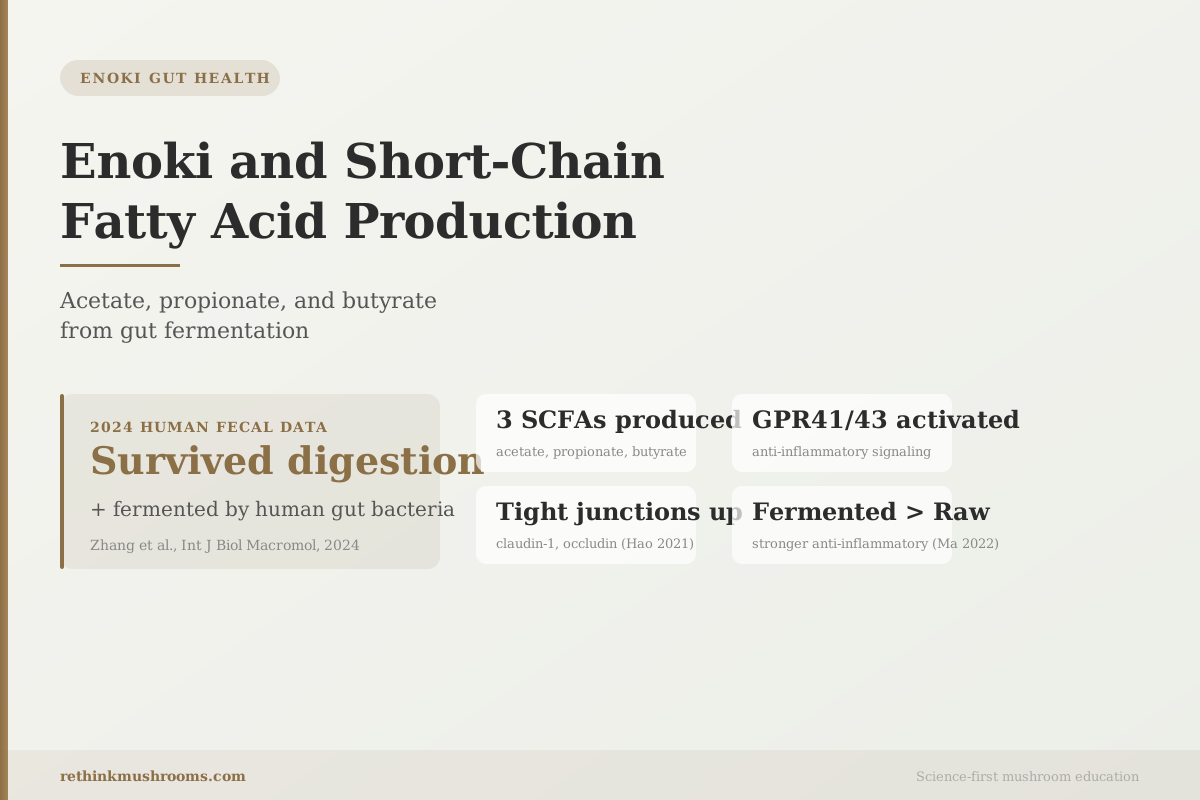
Zhang et al. (2024) showed F. velutipes polysaccharides survived simulated gastrointestinal digestion intact and were fermented by human fecal microbiota to produce SCFAs, making this the most human-relevant test of enoki's prebiotic activity available.
Zhang et al., International Journal of Biological Macromolecules, 2024
3 SCFAs produced
acetate, propionate, and butyrate all quantified from enoki polysaccharide fermentation (Que et al., 2024)
Tight junctions up
enoki polysaccharide increased claudin-1 and occludin, strengthening the gut barrier (Hao et al., 2021)
GPR41/GPR43 activated
SCFAs from enoki fermentation bind these receptors, triggering anti-inflammatory and metabolic signals (Zhao et al., 2023)
Zhang et al., International Journal of Biological Macromolecules, 2024
 View as image ↗
When gut bacteria break down the fiber and polysaccharides in enoki mushrooms, they produce a category of small molecules called short-chain fatty acids (SCFAs), which are fatty acids with fewer carbon atoms than the fats in typical food. These compounds are not waste products. They are biologically active signals that the body uses to regulate inflammation, seal the gut barrier, influence blood sugar, and even communicate with distant organs through the bloodstream.
The SCFA research on enoki mushrooms spans from basic fermentation chemistry to receptor-level signaling to a 2024 human fecal fermentation study that provides the closest thing to direct human evidence currently available. This article covers the full chain from enoki fiber entering the colon to SCFAs activating cell receptors, including what specific compounds are produced, how much, and what downstream effects follow.
For the gut bacteria composition changes that accompany SCFA production, see enoki and gut bacteria composition: research review. For the broader enoki species context, what is enoki mushroom covers the full profile.
Key Takeaways
- Enoki polysaccharides survived simulated upper gastrointestinal digestion intact and were fermented by human fecal microbiota to produce SCFAs in a 2024 study, the most human-relevant fermentation evidence for enoki prebiotic activity (Zhang et al.)
- Enoki polysaccharide fermentation produces all three major gut SCFAs: acetate (the most abundant, used as energy throughout the body), propionate (taken up by the liver, relevant to blood sugar), and butyrate (primary fuel for colon cells and key gut barrier and anti-inflammatory compound)
- A modified enoki polysaccharide fraction showed elevated SCFA production rates across all three SCFA types compared to unmodified polysaccharides (Que et al., 2024)
- Enoki polysaccharide supplementation increased tight junction proteins claudin-1 and occludin in mice, directly strengthening the physical barrier between the gut interior and the bloodstream (Hao et al., 2021)
- The SCFAs produced bind to receptors called GPR41, GPR43, and GPR109A on immune and intestinal cells, activating pathways that suppress inflammation and influence metabolic signaling throughout the body (Zhao et al., 2023)
- Fermented (pre-digested) enoki polysaccharides showed stronger anti-inflammatory effects on intestinal tissue than unfermented raw polysaccharides (Ma et al., 2022)
The Three SCFAs Enoki Fermentation Produces, and What Each One Does
Acetate, propionate, and butyrate are produced in the colon when gut bacteria ferment fiber that was not digested in the small intestine. Most dietary fiber, and most of enoki's polysaccharides, pass through the stomach and small intestine without being broken down, because humans lack the specific enzymes required for this digestion. When the fiber reaches the colon, resident bacteria equipped with these enzymes ferment it and produce SCFAs as metabolic byproducts.
The three SCFAs are not interchangeable. Each reaches different destinations in the body and produces different effects.[2]
Acetate is the most abundant SCFA produced from most fiber types, typically making up 60 percent or more of total SCFA output. It is absorbed into the bloodstream and used as an energy source by peripheral tissues throughout the body, including muscle and the brain.
Propionate is produced in smaller quantities than acetate and is primarily taken up by the liver via the portal vein. In the liver, it contributes to gluconeogenesis regulation (the process of making glucose from non-carbohydrate sources) and has been studied for appetite suppression and blood sugar effects.
Butyrate is produced in the smallest quantity of the three but is regarded as the most biologically important for gut health specifically. Butyrate is the primary energy source for colonocytes, the cells lining the colon wall. When colonocytes receive adequate butyrate, they maintain the tight junctions and mucus layer that separate the gut interior from the bloodstream. Inadequate butyrate production is associated with "leaky gut" conditions and increased intestinal permeability. Butyrate also inhibits the NF-κB inflammatory signaling pathway (a molecular switch inside cells that activates gene programs for inflammation), giving it direct anti-inflammatory properties within the gut.
The Yin 2020 comprehensive review confirmed all three SCFAs as products of mushroom polysaccharide fermentation and established the GPR receptor framework through which they signal, which is covered in a later section of this article.[2]
The 2024 Human Fecal Fermentation Data: Did Enoki Polysaccharides Survive Digestion?
The most practically important question for any purported prebiotic is whether the active compounds survive digestion in the upper gastrointestinal tract and arrive at the colon in a fermentable form. If they are broken down in the stomach or small intestine, they never reach the bacteria that would convert them to SCFAs.
Zhang and colleagues (2024) specifically tested this for F. velutipes polysaccharides by running them through a simulated digestion protocol that mimics what happens in the human stomach and small intestine (using enzymes present in normal human digestion at physiological conditions), then taking the resulting material and fermenting it with actual human fecal microbiota.[1]
The enoki polysaccharides largely survived the simulated upper GI digestion intact. When the digestion-resistant fraction was fermented with human fecal bacteria, SCFA production increased measurably compared to the control fermentation. The bacterial community composition also shifted in the direction consistent with enoki's prebiotic effects documented in other studies.
This human fecal fermentation methodology is the closest available test to what would happen in a living human digestive tract. It is not the same as a human clinical trial: the fermentation happens in a laboratory flask rather than in a living gut with normal motility, mucus, transit time, and immune interactions. But it uses actual human gut bacteria rather than rodent bacteria or a single cell line, which is a more relevant approximation of human biology than animal feeding studies alone.
The honest limitation: we still do not know how much of the polysaccharide content in a serving of whole enoki mushrooms survives the full digestive journey in a living person, reaches the colon intact, and is fermented to produce meaningful SCFA quantities. The Zhang 2024 study answers the feasibility question (yes, enoki polysaccharides can survive digestion and produce SCFAs with human gut bacteria) but not the dose-response question.
What Happens When Enoki Polysaccharides Reach the Colon: Bacteria and SCFA Production
Su and colleagues (2023) used an in vitro fermentation model to track what specific bacteria ferment enoki polysaccharides and what SCFA profile results.[4] The fermentation of F. velutipes polysaccharides increased populations of Bifidobacterium and Lactobacillus, both of which are SCFA-producing genera. Total SCFA output elevated compared to control fermentations without the polysaccharides.
Que and colleagues (2024) tested a modified version of F. velutipes polysaccharides that had been structurally altered using an ultrasound-assisted degradation technique.[5] The modified polysaccharide fraction showed elevated fermentability in a fecal fermentation model, producing quantifiably higher outputs of all three major SCFAs: acetate, propionate, and butyrate. This research suggests that the structural characteristics of enoki polysaccharides affect how much SCFA gets produced from fermentation, with smaller molecular weight fractions fermented more rapidly.
The implication for food science is that processing methods applied to enoki (drying, powdering, extraction) may affect the polysaccharide molecular weight distribution and thus the downstream SCFA productivity. Whether whole food enoki consumption produces the same SCFA yield as extracted or processed fractions is not yet known.
How SCFAs Signal the Body: Butyrate, GPR Receptors, and Anti-Inflammatory Effects
SCFAs don't just provide energy. They act as signaling molecules by binding to specific protein receptors on the surfaces of cells throughout the gut and body.
Zhao and colleagues' 2023 comprehensive review established the receptor-level signaling framework for mushroom polysaccharide-derived SCFAs.[3] The key receptors are GPR41 and GPR43 (G protein-coupled receptors found on immune cells, intestinal endocrine cells, and the gut epithelium), and GPR109A (a receptor on colon cells specifically activated by butyrate and nicotinic acid).
When acetate and propionate bind to GPR41 and GPR43, they trigger a cascade through the MAPK signaling pathway (a protein signaling chain involved in inflammation and cell growth) and through NF-κB (the central inflammatory gene activator) that suppresses inflammatory cytokine production. In practical terms: the SCFAs produced from fermenting enoki polysaccharides can reduce the inflammatory activity of immune cells in the gut lining.
Butyrate's binding to GPR109A produces a particularly important effect for intestinal health: it activates a program that suppresses colon cell proliferation and promotes differentiation. This mechanism is one reason butyrate has been studied for its potential role in colorectal cancer prevention.
The downstream effects of GPR41/43 and GPR109A activation include not only local anti-inflammatory effects in the gut but also systemic signaling: both propionate (via liver uptake) and acetate (via bloodstream distribution) can influence metabolic processes in distant tissues.
The Gut Barrier Angle: How Enoki-Derived SCFAs Upregulate Tight Junction Proteins
One of the most clinically relevant SCFA functions in the gut is maintaining barrier integrity. The gut barrier is a single-cell-thick layer that separates the gut interior (which contains bacteria, undigested food, and metabolites) from the bloodstream and surrounding tissues. When this barrier is compromised, bacterial products can enter circulation, triggering systemic inflammation.
Hao and colleagues (2021) specifically measured gut barrier effects in mice supplemented with F. velutipes polysaccharides.[6] The enoki polysaccharide supplementation increased the expression of claudin-1 and occludin, two tight junction proteins (the molecular fasteners between adjacent intestinal cells that keep the barrier sealed). Intestinal morphology improved as well, with better villus height and crypt depth, indicating healthier gut epithelial structure. SCFA production was elevated in the supplemented mice alongside these structural improvements.
The tight junction upregulation from enoki polysaccharides is consistent with butyrate's known mechanism of action on colonocytes: butyrate is the primary energy source for these cells, and adequate butyrate leads to healthier, better-structured gut epithelium with stronger tight junction expression.
Fermented vs. Raw Enoki Polysaccharides: Does Preparation Affect SCFA Potential?
Ma and colleagues (2022) addressed a question relevant to food preparation: does the fermentation of enoki polysaccharides before consumption change their biological activity in the gut?[7]
Fermented F. velutipes polysaccharides (prepared by fermenting the mushroom extract with microorganisms before use) showed stronger anti-inflammatory effects on intestinal mucosa in an animal model compared to raw, unfermented polysaccharides. The fermentation appeared to increase the bioavailability of the active fractions and may produce modified polysaccharide structures that are more readily fermented by gut bacteria once they reach the colon.
This finding is relevant to the growing category of fermented mushroom products (fermented enoki powder, fermented mushroom supplements) where the polysaccharides have been pre-processed by fermentation. However, the study doesn't prove that fermented enoki food products generally produce more SCFAs than whole-food enoki; the specific preparation conditions in laboratory fermentation differ from commercial fermentation methods and from culinary cooking.
The Bottom Line
The SCFA research on enoki mushrooms follows a complete chain from polysaccharide survival through digestion (confirmed in the 2024 Zhang human fecal fermentation study) through bacterial fermentation producing acetate, propionate, and butyrate, to receptor-level signaling through GPR41/43 and GPR109A that suppresses intestinal inflammation, and finally to gut barrier strengthening through tight junction upregulation. All three major SCFAs have been quantified from enoki polysaccharide fermentation. The honest gap: how much SCFA production actually occurs from a serving of whole enoki mushrooms eaten as food, in a living digestive tract, remains unmeasured.
Frequently Asked Questions
Sources & References
- 1RTHM-02037·Zhang, Yao et al. (2024). “Comprehensive evaluation of Flammulina velutipes residues polysaccharide based on in vitro digestion and human fecal fermentation..” International journal of biological macromolecules.Study breakdown →PubMed →↩
- 2RTHM-01308·Yin, Chaomin et al. (2020). “The Impact of Mushroom Polysaccharides on Gut Microbiota and Its Beneficial Effects to Host: A Review..” Carbohydrate polymers.Study breakdown →PubMed →↩
- 3RTHM-01835·Zhao, Jiahui et al. (2023). “The Interaction between Mushroom Polysaccharides and Gut Microbiota and Their Effect on Human Health: A Review..” Biology.Study breakdown →PubMed →↩
- 4RTHM-01793·Su, Anxiang et al. (2023). “Effects of Flammulina velutipes polysaccharides on gut microbiota composition and metabolism in vitro fermentation..” Food science and biotechnology.Study breakdown →PubMed →↩
- 5RTHM-01971·Que, Yunxiang et al. (2024). “Structural characterization, antioxidant activity, and fermentation characteristics of Flammulina velutipes residue polysaccharide degraded by ultrasonic assisted H2O2-Vc technique..” Ultrasonics sonochemistry.Study breakdown →PubMed →↩
- 6RTHM-01363·Hao, Yuting et al. (2021). “Flammulina velutipes polysaccharide improves C57BL/6 mice gut health through regulation of intestine microbial metabolic activity..” International journal of biological macromolecules.Study breakdown →PubMed →↩
- 7RTHM-01578·Ma, Sheng et al. (2022). “Inhibitory Effect of Fermented Flammulina velutipes Polysaccharides on Mice Intestinal Inflammation..” Frontiers in nutrition.Study breakdown →PubMed →↩