Enoki Mushroom Brain Health
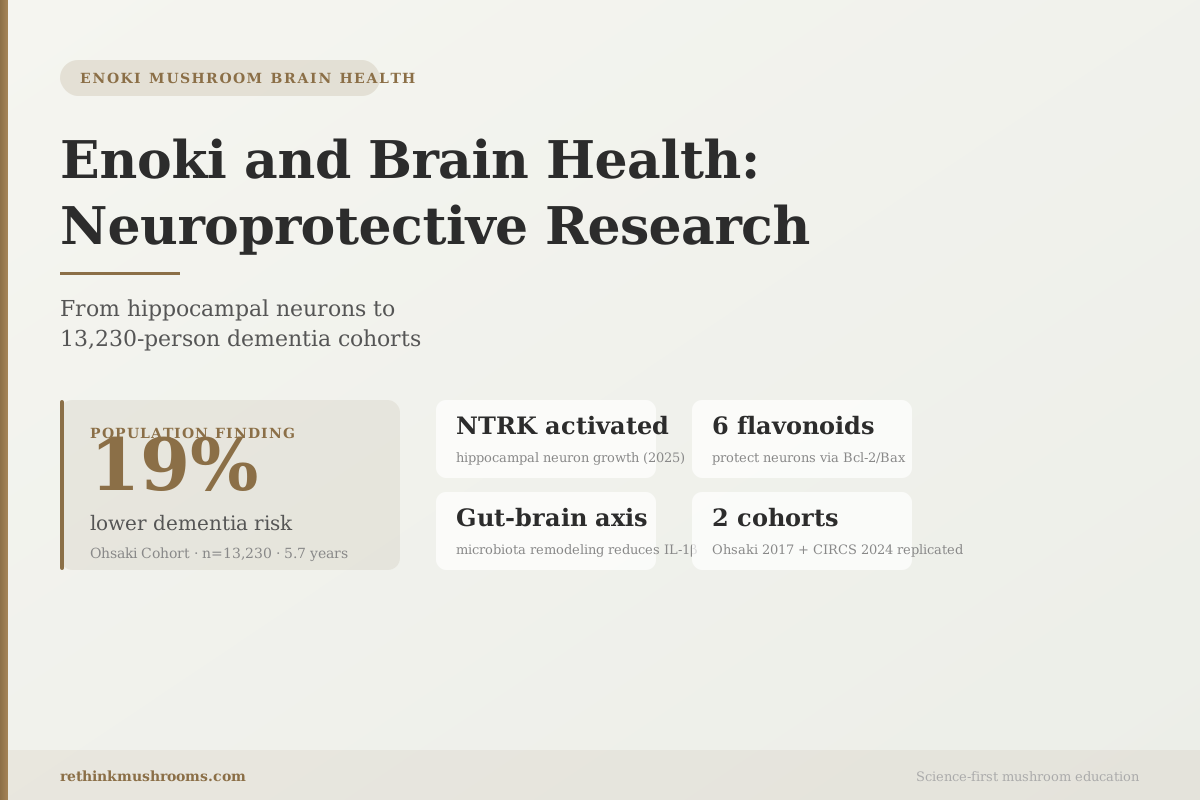
19% lower dementia risk
In a 13,230-person Japanese cohort followed over 5.7 years, eating mushrooms three or more times per week was associated with a 19% lower risk of dementia compared to eating them less than once per week.
Zhang et al., Journal of the American Geriatrics Society, 2017
NTRK activated
enoki extract promoted hippocampal neuron growth via nerve growth receptors (Mitra et al., 2025)
Gut-brain link
enoki polysaccharides reduced brain inflammatory markers by remodeling gut microbiota (Su et al., 2018)
Preclinical + cohort
all mechanism data is lab or animal; population associations are not causal proof
Zhang et al., Journal of the American Geriatrics Society, 2017
 View as image ↗
In 2025, researchers in Malaysia placed primary hippocampal neurons in culture, treated them with enoki mushroom extract, and measured what happened to neurite growth, a term for the new branches neurons sprout when forming connections. The methanolic enoki extract significantly promoted neurite outgrowth and improved hippocampal neuronal survival under oxidative stress conditions, doing so through activation of NTRK receptors (tropomyosin receptor kinases, a family of surface proteins on neurons that respond to growth factors and trigger cell survival and growth programs).[1]
That 2025 study is the most recent piece in a research trail on enoki mushroom brain health that runs back decades. The trail covers multiple compound classes working through distinct mechanisms: flavonoids protecting individual neurons from oxidative death, polysaccharides reducing neuroinflammation through an unexpected gut-microbiota route, and whole extract compounds that activate the growth machinery of hippocampal neurons directly.
This article covers the enoki brain health research across all those mechanisms, along with what large population studies in Japan show about mushroom consumption and dementia risk. The full species context, including enoki's complete bioactive compound profile, is covered in what is enoki mushroom.
Key Takeaways
- A 2025 study found enoki extract significantly promoted hippocampal neuron survival and neurite outgrowth in lab conditions through NTRK receptor activation (Mitra et al., Nutrients)
- Six specific flavonoids identified in enoki protected PC12 neural cells from hydrogen peroxide-induced death via the Bcl-2/Bax apoptosis pathway (Hu et al., 2016)
- Enoki polysaccharides improved memory in scopolamine-impaired mice by remodeling gut microbiota, reducing brain inflammatory cytokines IL-1β, TNF-α, and IL-6; the fecal transplant from treated mice reproduced memory benefits in untreated mice (Su et al., 2018)
- Enoki polysaccharides combined with ginsenosides improved spatial learning in an Alzheimer's disease rat model via reduced hippocampal apoptosis markers (Zhang et al., 2018)
- Eating mushrooms three or more times per week was associated with a 19% lower dementia risk in 13,230 elderly Japanese over 5.7 years (Ohsaki Cohort 2017); a second independent Japanese cohort (CIRCS 2024) replicated the direction of association
- All mechanism data is preclinical (lab and animal); population studies show association not causation; no human intervention trials on enoki and cognition exist
The 2025 Finding: Hippocampal Neurons and the NTRK Growth Signal
Mitra and colleagues used primary hippocampal neurons for their 2025 study, which is methodologically more meaningful than typical neural cell lines for brain research, because primary hippocampal neurons are isolated directly from brain tissue and retain more of the biological properties relevant to learning and memory than immortalized cell lines do.[1]
The enoki methanolic extract produced two measurable effects: it promoted neurite outgrowth (the growth of new axon branches and dendrites that form neural connections) and improved neuronal survival when cells were placed under oxidative stress conditions that would otherwise kill them. The mechanism appeared to run through NTRK receptors. NTRK proteins sit on the surface of neurons and, when activated by nerve growth factors, trigger internal programs that cause the neuron to grow new connections and resist apoptosis (programmed cell death).
The finding places enoki alongside lion's mane (which contains hericenones and erinacines known to stimulate nerve growth factor production) as a culinary mushroom with documented neurotrophic activity in a laboratory setting. The mechanism differs: lion's mane compounds appear to stimulate NGF synthesis upstream, while enoki extract appears to activate the downstream receptor that NGF normally binds to. Whether the enoki compounds responsible are polysaccharides, flavonoids, peptides, or something else was not fully resolved in the Mitra study.
The Tang 2016 systematic review of all F. velutipes biological activities established that neuroprotection is among the most consistently documented activities across the enoki research base.[2] The Mitra 2025 data adds the most specific mechanistic detail yet recorded for this effect.
Six Enoki Flavonoids That Prevented Neural Cell Death in Lab Tests
Hu and colleagues identified six specific flavonoids in F. velutipes and tested each one against oxidative stress in PC12 cells, a neural cell line derived from rat adrenal tissue that is widely used as a model for studying neuronal behavior.[3]
The six flavonoids were: arbutin, epicatechin, phillyrin, apigenin, kaempferol, and formononetin. Each was tested for its ability to protect the cells against hydrogen peroxide-induced death. Five of the six (all except apigenin) inhibited cell death by modulating the Bcl-2/Bax pathway, the molecular switch inside cells that decides whether a stressed cell survives or undergoes programmed death. The Bcl-2 protein promotes survival; the Bax protein promotes apoptosis. The enoki flavonoids shifted the balance toward survival by increasing Bcl-2 expression while reducing Bax and cytochrome C (a protein that, when released from mitochondria, signals the cell to die).
This compound-level data answers a more specific question than general antioxidant assays: it shows that flavonoids from enoki don't just neutralize radicals in a test tube but actively engage the survival/death decision-making machinery inside individual neurons. The six flavonoids tested are the same ones identified in the species and may be present in culinary quantities, though the concentrations required to produce these effects in eating situations have not been measured against the concentrations used in the cell study.
The Gut-Brain Route: Memory Recovery Through Microbiome Remodeling
The most surprising finding in the enoki brain health research is not about a compound directly entering brain tissue. It is about the gut.
Su and colleagues administered enoki polysaccharides (FVP) to mice whose memory had been chemically impaired using scopolamine, a drug that blocks acetylcholine receptors and produces temporary amnesia similar to the cholinergic deficits seen in Alzheimer's disease.[4] The enoki polysaccharides improved learning and memory in the impaired mice, but the mechanism that Su's team documented was not direct: the improvement was traced to gut microbiota changes.
FVP significantly altered the microbial composition in the gut of treated mice, increasing populations of Bacteroidia and Erysipelotrichia and reducing Clostridia and Bacilli. Alongside this, inflammatory signaling proteins in the brain (the cytokines IL-1β, tumor necrosis factor-alpha, and IL-6) decreased, while the anti-inflammatory cytokine IL-10 increased. The researchers then transferred fecal matter from FVP-treated mice to untreated impaired mice. The memory benefits partially reproduced in the recipient mice, which is strong evidence that the gut microbiota changes, not some other effect of FVP, were driving the neurological improvement.
This gut-brain axis mechanism is distinct from the direct neuronal protection in the Hu 2016 and Mitra 2025 research. It suggests enoki polysaccharides function in part as prebiotics that reshape the microbial community, which then reduces systemic neuroinflammation through signals that reach the brain. The mechanism is the same general pathway increasingly studied in the context of gut-brain research broadly, now documented specifically with enoki polysaccharides as the input.
For a more detailed look at enoki's neuroinflammation mechanisms, see enoki and neuroinflammation: brain protection research.
What Happened in the Alzheimer's Disease Rat Model
Zhang and colleagues used a different animal model for their 2018 study: D-galactose-induced neurodegeneration in rats, a model that mimics age-related oxidative damage and cognitive decline more broadly than the scopolamine impairment model.[5] They tested enoki polysaccharides (FVP) alone, ginsenosides (compounds from ginseng) alone, and the two combined.
All three groups showed improved cognitive performance in the Morris water maze (a behavioral test measuring spatial memory and learning where rats must locate a submerged platform) compared to the disease-model control group. The combination of FVP plus ginsenosides showed greater improvement than either compound alone. Mechanistically, the combination reduced hippocampal apoptosis markers (Bax, cytochrome C, caspase-3 and caspase-9, all of which signal cell death) and increased the survival protein Bcl-2, which is the same molecular pathway Hu 2016 identified in the flavonoid work.
This study suggests the polysaccharide fraction of enoki may have synergistic interaction with other plant-derived compounds for cognitive outcomes, which has implications for how enoki might function as part of a varied diet. It also demonstrates that two different research groups, using different animal models and different enoki fractions, converged on the same Bcl-2/Bax pathway as a central mechanism, which adds independent support for that specific mechanism.
For detailed coverage of the memory-specific cognitive studies in animal models, see Flammulina velutipes and memory: cognitive studies.
The Population Evidence: Japanese Cohorts and Dementia Risk
The laboratory and animal research establishes mechanisms. The population data asks whether the same associations appear in real people eating mushrooms in their ordinary diets.
Zhang and colleagues followed 13,230 elderly Japanese participants in the Ohsaki Cohort over 5.7 years.[6] Participants who ate mushrooms three or more times per week showed a 19% lower risk of incident dementia (hazard ratio 0.81, meaning their risk was 19% lower) compared to those who ate mushrooms less than once per week. The dose-dependent trend was statistically significant. The inverse association persisted after researchers removed participants with lower baseline cognitive scores or early-onset dementia from the analysis, which reduced the possibility that the finding was explained by reverse causation (people with better brain health also eating more mushrooms).
Aoki and colleagues published a second independent replication from the CIRCS (Circulatory Risk in Communities Study) Japanese cohort in 2024, confirming the direction of the association: higher mushroom intake was associated with lower risk of incident disabling dementia.[7]
Neither study isolated enoki specifically. Both measured total mushroom consumption across all species. Japan has a culinary culture where enoki is among the most commonly consumed mushroom species, particularly in soups and hot pot preparations, but the specific contribution of enoki versus shiitake, maitake, or other species consumed by these cohort participants cannot be separated from the data.
The population data therefore supports a general conclusion that regular mushroom consumption in the diet tracks with lower dementia risk at the population level. It does not establish that enoki specifically prevents dementia, nor does it prove causation, since mushroom consumption in these cohorts may correlate with other aspects of diet and lifestyle that also affect cognitive aging.
For the broader context of mushroom and dementia population research, see dietary mushroom intake and Alzheimer's risk: population studies.
The Bottom Line
The enoki brain health research base covers multiple mechanisms: direct neurotrophic activity through NTRK receptor activation (Mitra 2025), flavonoid-mediated neuronal apoptosis prevention via Bcl-2/Bax (Hu 2016), and an indirect gut-brain route where polysaccharides remodel microbiota to reduce neuroinflammatory cytokines (Su 2018). Animal disease models show cognitive improvements alongside reduced hippocampal apoptosis markers. Two large Japanese population cohorts link regular mushroom consumption to 19% lower dementia risk in elderly adults. All mechanism data is preclinical; the population studies show association not causation; no human clinical trials exist on enoki and brain outcomes.
Frequently Asked Questions
Sources & References
- 1RTHM-02150·Mitra, Sarmistha et al. (2025). “Neuroprotective and Neurotrophic Potential of Flammulina velutipes Extracts in Primary Hippocampal Neuronal Culture..” Nutrients.Study breakdown →PubMed →↩
- 2RTHM-00831·Tang, Calyn et al. (2016). “Golden Needle Mushroom: A Culinary Medicine with Evidenced-Based Biological Activities and Health Promoting Properties..” Frontiers in pharmacology.Study breakdown →PubMed →↩
- 3RTHM-00786·Hu, Qiuhui et al. (2016). “Identification of flavonoids from Flammulina velutipes and its neuroprotective effect on pheochromocytoma-12 cells..” Food chemistry.Study breakdown →PubMed →↩
- 4RTHM-01010·Su, Anxiang et al. (2018). “Flammulina velutipes polysaccharides improve scopolamine-induced learning and memory impairment in mice by modulating gut microbiota composition..” Food & function.Study breakdown →PubMed →↩
- 5RTHM-01023·Zhang, Yan et al. (2018). “Cognitive-enhancing effect of polysaccharides from Flammulina velutipes on Alzheimer's disease by compatibilizing with ginsenosides..” International journal of biological macromolecules.Study breakdown →PubMed →↩
- 6RTHM-00935·Zhang, Shu et al. (2017). “Mushroom Consumption and Incident Dementia in Elderly Japanese: The Ohsaki Cohort 2006 Study..” Journal of the American Geriatrics Society.Study breakdown →PubMed →↩
- 7RTHM-01849·Aoki, Shoko et al. (2024). “Mushroom intake and risk of incident disabling dementia: the Circulatory Risk in Communities Study (CIRCS)..” The British journal of nutrition.Study breakdown →PubMed →↩