Mushrooms & Alzheimer's Disease
44% lower dementia incidence
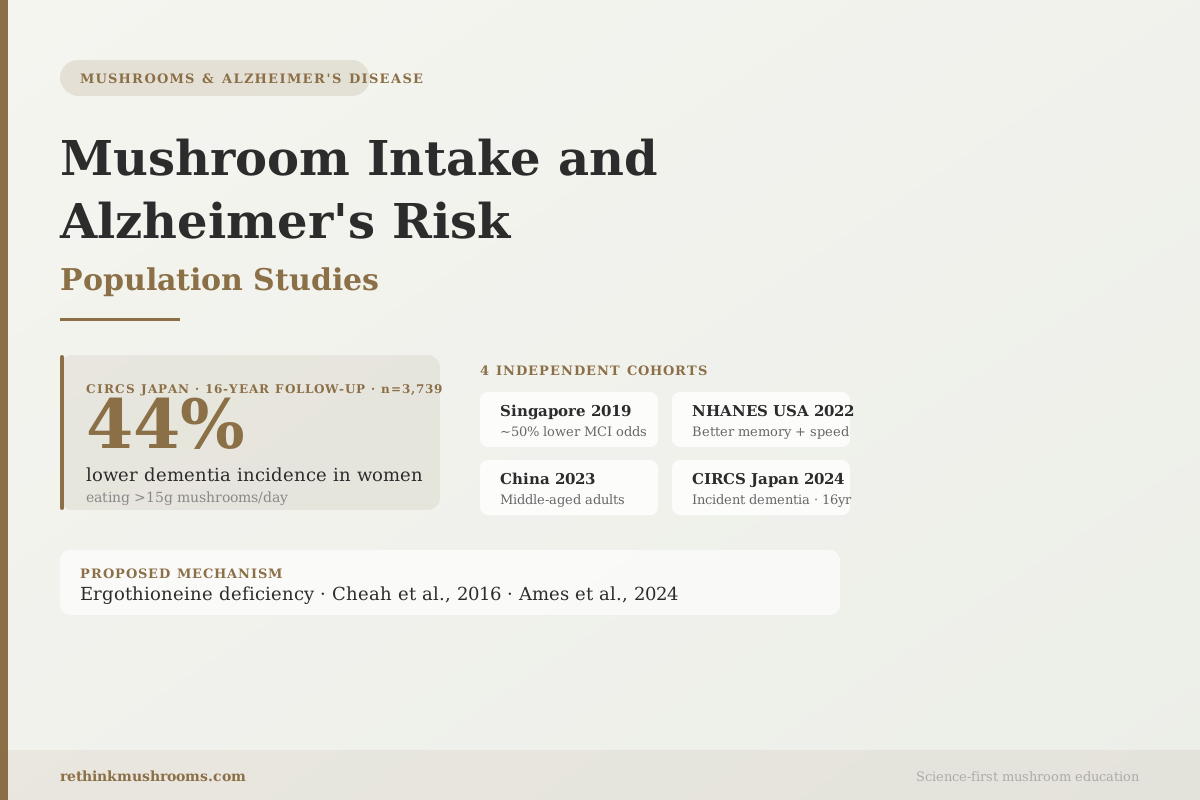
In a 16-year prospective study of 3,739 Japanese adults, women who ate more than 15g of mushrooms daily had 44% lower incidence of disabling dementia. Men in the same study showed no significant effect.
Aoki et al., British Journal of Nutrition, 2024
4 cohorts
Singapore, US, China, and Japan all show consistent inverse associations
~50% lower
MCI odds in Singapore adults eating ≥2 mushroom portions per week (Feng 2019)
16 years
prospective follow-up in the CIRCS Japan dementia incidence study
Aoki et al., British Journal of Nutrition, 2024
 View as image ↗
A 16-year prospective study of 3,739 Japanese adults tracked which participants developed disabling dementia, not just how they scored on cognitive tests. Women who ate more than 15 grams of mushrooms per day had a 44% lower incidence of disabling dementia over those 16 years. Men in the same study showed no statistically significant association.[1]
That finding, from Aoki and colleagues in the CIRCS (Circulatory Risk in Communities Study) cohort, is the strongest population-level evidence available that dietary mushroom consumption tracks with lower dementia risk. It also raises a question that the epidemiological literature hasn't resolved: why women and not men?
This article covers the four major population cohorts that have examined mushroom intake and cognitive outcomes, what they found, the gender difference from CIRCS, and the most likely mechanism linking mushroom consumption to lower dementia incidence.
For the broader context of how mushrooms affect cognitive aging across multiple dimensions, see Mushrooms and Cognitive Aging: Can They Protect Your Brain?.
Key Takeaways
- In a 16-year prospective cohort (n=3,739), Japanese women eating more than 15g of mushrooms daily had 44% lower incidence of disabling dementia; men showed no significant association (Aoki et al., 2024)
- A Singapore cross-sectional study (n=663) found that adults over 60 who ate two or more mushroom portions per week had roughly 50% lower odds of mild cognitive impairment (Feng et al., 2019)
- The US NHANES dataset confirmed similar associations: greater mushroom intake correlated with better processing speed and word learning in adults over 60 (Ba et al., 2022)
- A 2023 Chinese cross-sectional study extended the pattern to middle-aged and older adults in a Chinese population (Yan et al., 2023)
- A 2024 systematic review synthesizing all four cohorts concluded that the inverse association between mushroom consumption and cognitive decline is consistent across populations (2024 epidemiological review)
- The most studied mechanism is ergothioneine: elderly adults with mild cognitive impairment have significantly lower blood ergothioneine than cognitively normal peers, and mushrooms are the primary dietary source (Cheah et al., 2016)
The Strongest Evidence: The CIRCS Japan Cohort and 16 Years of Dementia Follow-Up
Most studies linking food intake to dementia use cognitive test scores as the outcome. A higher score means better function; a lower score suggests decline. These outcomes are useful but they aren't the same as tracking who actually develops dementia.
The CIRCS study used an outcome that's clinically more meaningful: incident disabling dementia, defined as dementia severe enough to require assistance with daily functioning. Aoki and colleagues followed 3,739 middle-aged Japanese adults for 16 years, tracking actual dementia diagnoses against dietary mushroom consumption data.[1]
For women, the finding was striking. Those consuming more than 15 grams of mushrooms per day had 44% lower risk of developing disabling dementia over the follow-up period, compared to women eating less. This association held after adjusting for other dietary and lifestyle variables.
For men, no statistically significant association appeared.
The CIRCS study is methodologically stronger than the cross-sectional designs that dominate mushroom-cognition research. Cross-sectional studies measure diet and cognition at a single point, making it impossible to establish which came first. A prospective design with 16 years of follow-up captures the time dimension: mushroom consumption was measured before dementia developed, which is the right causal direction for a dietary exposure study.
The Gender Finding: Why Women Benefit and Men Don't
The gender difference in the CIRCS cohort is the most interesting unanswered question in mushroom-dementia epidemiology. The study's authors noted the finding but couldn't establish a mechanism from the data alone.
Several hypotheses are plausible. Ergothioneine, the antioxidant found almost exclusively in mushrooms, has been proposed as the primary mediating compound between mushroom intake and cognitive protection. Sex differences in ergothioneine absorption, metabolism, or tissue distribution could explain differential benefit. Hormonal factors are another candidate: estrogen modulates oxidative stress pathways that ergothioneine targets, potentially amplifying the protective effect in women. Confounding is also possible: women and men who eat mushrooms regularly may differ in other dietary and lifestyle patterns in ways that the statistical adjustment didn't fully capture.
None of these hypotheses has been tested directly. What the CIRCS finding establishes is that the association between mushroom intake and dementia risk is not uniform across the population. Understanding who benefits most from higher mushroom intake requires studies designed to test that specific question, and none yet has.
Four Populations, One Signal: Singapore, the US, China, and Japan
The CIRCS cohort is the most rigorous data point, but it sits within a consistent pattern across four different research groups using different populations and methodologies.
Feng and colleagues conducted a cross-sectional study of 663 Singaporean adults aged 60 and older, assessing mushroom consumption and cognitive status.[2] Those who ate two or more portions of mushrooms per week had roughly 50% lower odds of mild cognitive impairment compared to those eating less than one portion per week. The association was independent of other dietary factors, physical activity, and educational background. The researchers attributed the pattern partly to ergothioneine content and partly to other bioactive compounds in the mushroom species commonly consumed in Singapore.
For a deeper look at the Singapore study specifically, see The Singapore Mushroom Study: Mushroom Intake and Cognitive Decline.
Ba and colleagues analyzed data from the US National Health and Nutrition Examination Survey (NHANES) to examine the relationship between mushroom intake and cognitive performance in adults aged 60 and older.[3] Greater mushroom consumption was associated with better performance on the Digit Symbol Substitution Test (DSST), which measures processing speed and attention, and on CERAD word learning, which measures memory encoding. The dose-response pattern was consistent: people who ate more mushrooms performed better on both tests. This US-based replication matters because it uses a nationally representative sample with dietary data collected through structured 24-hour recalls rather than food frequency questionnaires.
Yan and colleagues extended the pattern to a Chinese population using a cross-sectional design with middle-aged and older adults.[4] Higher mushroom consumption was significantly associated with better cognitive performance. This finding is important because it extends the signal beyond the elderly populations used in Singapore and the US studies, and into a different cultural dietary context where different mushroom species are consumed.
Together, the four cohorts cover Singapore, the United States, China, and Japan. They use different designs, different populations, different age ranges, and different cognitive outcome measures. The consistent direction of association across all four is the epidemiological case for mushroom intake and cognitive protection.
What the 2024 Systematic Review Concluded
A 2024 epidemiological review synthesized the available population studies on mushroom intake and cognitive performance.[5] The conclusion: the inverse association between mushroom consumption and cognitive decline is consistent across populations and study designs. Ergothioneine was identified as the primary candidate mediating mechanism across the cohort data.
The review also identified the limitations shared by the existing evidence: most studies are cross-sectional, which prevents causal inference; dietary recall methods introduce measurement error; and the specific mushroom species consumed vary enough across populations that attributing effects to particular compounds is difficult. The CIRCS prospective data partially addresses the cross-sectional limitation, but the other constraints apply across all cohorts.
The honest interpretation of the 2024 synthesis: the epidemiological pattern is robust enough to qualify as a meaningful association, not a coincidence. It isn't yet sufficient to conclude that eating mushrooms causes a reduction in Alzheimer's risk, because causation requires either experimental evidence or prospective data with very rigorous confounding control.
The Mechanism: Why Ergothioneine Is the Leading Explanation
The most compelling mechanistic link between mushroom consumption and cognitive protection comes from ergothioneine, a sulfur-containing amino acid derivative that humans cannot synthesize and must obtain from food. Mushrooms are the primary dietary source, providing far more ergothioneine per serving than any other commonly eaten food.
Cheah and colleagues measured blood ergothioneine levels in elderly adults with and without cognitive impairment and found that individuals with mild cognitive impairment had significantly lower ergothioneine than cognitively normal controls.[6] The lower the ergothioneine, the greater the cognitive decline. This correlation is consistent with ergothioneine as either a cause or a consequence of declining cognitive function, or both.
Bruce Ames and colleagues published a hypothesis paper in 2024 proposing that ergothioneine deficiency may be a causal factor in age-related neurodegeneration, not just a marker of it.[7] The reasoning: ergothioneine accumulates in mitochondria, the energy-producing organelles in neurons that are particularly vulnerable to oxidative stress. As humans age, dietary ergothioneine absorption declines and tissue reserves fall. Brain cells that depend on mitochondrial function for energy production and signaling become more vulnerable. This hypothesis connects the population-level mushroom data to a cellular-level mechanism.
Supporting the hypothesis, Zou and colleagues showed that ergothioneine supplementation extended lifespan in male mice and preserved both cognitive and physical performance as the mice aged, relative to controls.[8] Animal evidence for lifespan extension doesn't translate directly to human outcomes, but it provides a preclinical proof of concept for the Ames hypothesis.
From Association to Intervention: Bridging Population Data and Clinical Trials
Population studies show an association. Clinical trials can test whether the association reflects a causal relationship. The bridge between the two is still being built for mushroom intake and dementia.
Tan and colleagues are conducting a clinical trial specifically testing whether ergothioneine supplementation slows cognitive decline in patients with mild cognitive impairment, the preclinical stage before Alzheimer's disease diagnosis.[9] This trial targets the compound most likely responsible for the population-level associations rather than whole-food mushroom consumption, which allows cleaner attribution of any effect. Results from this trial will determine whether the epidemiological signal holds up under experimental conditions.
The existing clinical trial with the most directly relevant design is Mori and colleagues' 16-week double-blind RCT, which tested Hericium erinaceus (Lion's Mane) supplementation in 30 adults with mild cognitive impairment.[10] Cognitive scores improved significantly during the supplementation period compared to placebo, and declined after supplementation ended, suggesting the effect was compound-dependent. This trial used Lion's Mane at 4 times 250mg daily rather than dietary mushroom intake, but it provides direct human evidence that mushroom bioactives can shift cognitive outcomes in impaired populations.
The population studies don't tell you which species to eat. The clinical trial literature points toward Lion's Mane as the most studied species with human RCT evidence, while the ergothioneine data implicates the broader category of edible mushrooms as a dietary protective factor. For practical guidance on what dosage the dietary evidence suggests, see How Much Mushroom Do You Need to Protect Cognition? Dietary Evidence.
For a species-level comparison of Lion's Mane, Reishi, and Cordyceps research on Alzheimer's pathology, see Cross-Species Mushroom Research in Alzheimer's: Lion's Mane, Reishi, and Cordyceps.
What Population Studies Can and Cannot Tell Us
Population studies are the right starting point for understanding whether diet affects disease risk. They capture real-world dietary patterns at realistic quantities over meaningful time periods. They're also the study design most vulnerable to confounding: people who eat more mushrooms may exercise more, have higher income, eat more vegetables overall, or share other characteristics that independently reduce dementia risk.
The four cohorts reviewed here adjusted for a range of potential confounders, but adjustment can only control for variables that were measured. Unknown or unmeasured confounders remain. This is why the consistent directionality across four independently conducted studies in four different populations matters more than any single study. Confounding that operates the same way in Singapore, the US, China, and Japan would need to be an unusually universal phenomenon.
The cohort studies also don't tell us which mushroom species drive the association, which compounds are responsible, or at what dose the association becomes detectable. The Singapore study found an association at two or more portions per week. The CIRCS found a significant association in women at more than 15 grams per day. Different methodologies and different outcomes make it difficult to draw a single clear dose threshold from the population data.
What the population evidence establishes with reasonable confidence: habitual mushroom consumption is associated with lower rates of cognitive impairment and dementia in older adults across multiple populations, with the strongest prospective data pointing toward a particularly robust association in women. The biological mechanism most consistent with this pattern is ergothioneine's role in protecting neurons from oxidative stress and mitochondrial dysfunction.
For a mechanistic deep-dive into how mushroom compounds interact with Alzheimer's-specific pathology including tau tangles and amyloid plaques, see Mushroom Compounds and Tau Protein: Alzheimer's Mechanisms.
The Bottom Line
Four population cohorts across Singapore, the US, China, and Japan consistently link higher mushroom consumption to lower rates of cognitive impairment and dementia in older adults. The strongest evidence is a 16-year prospective study (n=3,739) in Japan, where women eating more than 15g of mushrooms daily had 44% lower incidence of disabling dementia; men showed no significant effect. The leading mechanism is ergothioneine deficiency, with lower blood levels found in cognitively impaired adults and a 2024 clinical trial directly testing ergothioneine supplementation in mild cognitive impairment underway.
Frequently Asked Questions
Sources & References
- 1. Source details for this reference are not yet available.
- 2. Source details for this reference are not yet available.
- 3. Source details for this reference are not yet available.
- 4. Source details for this reference are not yet available.
- 5. Source details for this reference are not yet available.
- 6. Source details for this reference are not yet available.
- 7. Source details for this reference are not yet available.
- 8. Source details for this reference are not yet available.
- 9. Source details for this reference are not yet available.
- 10. Source details for this reference are not yet available.