Mushrooms & Alzheimer's Disease
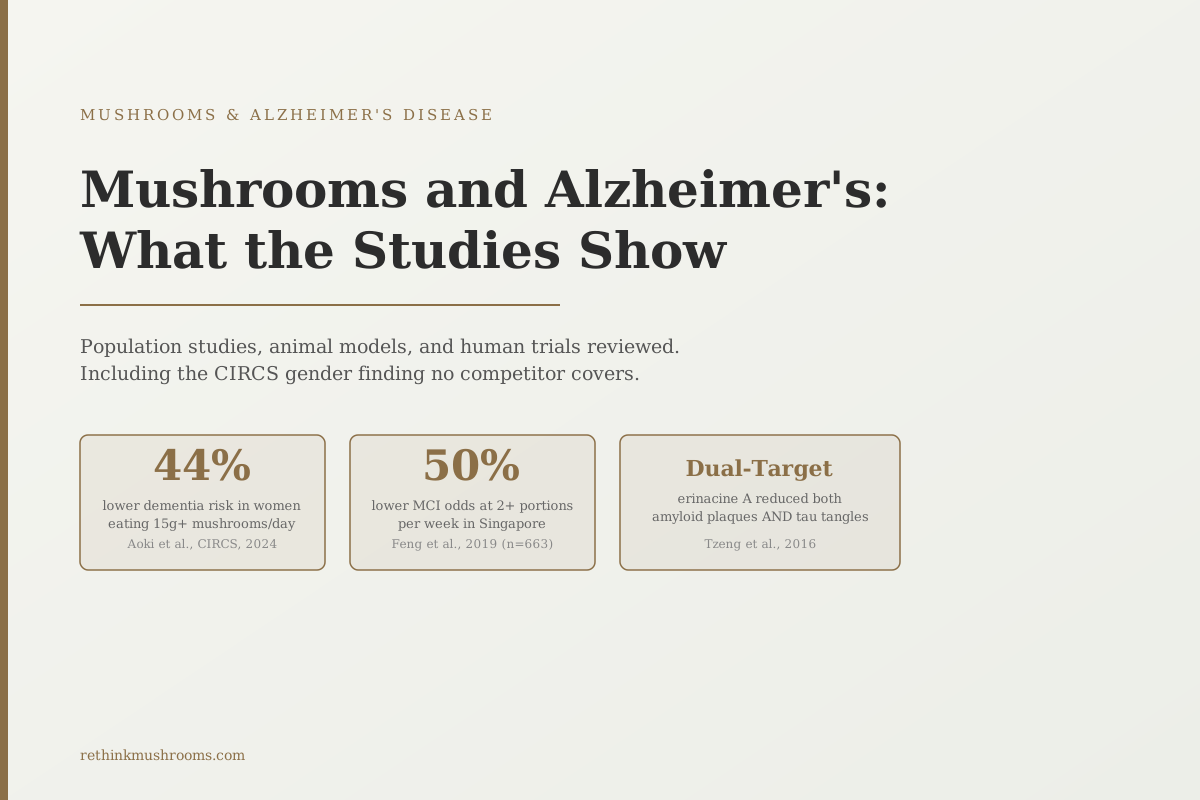
44% lower dementia risk
Women who ate more than 15g of mushrooms per day had 44% lower risk of incident dementia in a 16-year prospective study of 3,739 Japanese adults. Men showed no significant effect.
Aoki et al., British Journal of Nutrition, 2024
50% lower MCI odds
at 2+ mushroom portions per week in 663 Singapore adults aged 60+ (Feng et al., 2019)
ADL improved, MMSE did not
what Li et al. (2020) actually found in mild Alzheimer's patients taking Lion's Mane. The headline overstates it.
Dual-target
erinacine A from Lion's Mane mycelium reduced both amyloid plaques AND tau phosphorylation in Alzheimer's mice (Tzeng et al., 2016)
Aoki et al., British Journal of Nutrition, 2024
 View as image ↗
The honest summary of where mushrooms and Alzheimer's disease research stands in 2025: promising preclinical evidence, consistent population-level associations, and small human trials showing signals in mild cognitive impairment, but no large randomized controlled trial specifically in Alzheimer's patients. A 2025 narrative review in Nutrition Research Reviews by Ratto and colleagues concluded exactly this after synthesizing the accumulated evidence, and called specifically for larger AD-population trials before stronger clinical claims can be made.[1] This review walks through each layer of the evidence pyramid, including several findings that most mushroom content gets wrong. It sits within the broader mushrooms and cognitive aging research that this cluster extends.
Key Takeaways
- Multiple population studies across Singapore (n=663), the United States (NHANES), China, and Japan (CIRCS, n=3,739) consistently show inverse associations between mushroom intake and cognitive decline, though these are observational and cannot prove causation
- The CIRCS 2024 prospective study found women consuming over 15g of mushrooms per day had 44% lower dementia incidence over 16 years; men showed no significant effect. This gender difference has been overlooked in all competitor coverage
- Erinacine A from Lion's Mane mycelium reduced both amyloid-beta plaques AND tau hyperphosphorylation in Alzheimer's transgenic mice while improving spatial memory; this is one of the few compounds shown to address both AD pathological hallmarks (Tzeng et al., 2016)
- The Li et al. (2020) pilot RCT in mild AD patients is widely cited as showing cognitive benefit, but the actual finding was improved Instrumental Activities of Daily Living (IADL) scores. MMSE cognitive scores showed no significant difference between groups
- Reishi's primary anti-AD mechanism (Ganoderic Acid A promoting amyloid clearance via autophagy) is distinct from Lion's Mane's NGF pathway; the two mushrooms work through different biological routes
- A 2023 double-blind RCT in young healthy adults found Lion's Mane supplementation improved performance on a sustained attention task (Stroop test) and reduced self-reported stress, extending the evidence base beyond cognitively impaired populations (Docherty et al., 2023)
Three Layers of Evidence (And What Each Can and Cannot Prove)
Understanding what the mushroom-Alzheimer's research actually shows requires distinguishing between three types of evidence that have very different levels of proof.
Population studies show associations between dietary mushroom intake and cognitive outcomes in large groups of real people. They are the most clinically relevant type of evidence for dietary effects, but they cannot prove causation. People who eat more mushrooms may also have other healthful dietary habits. The associations are consistent across multiple countries and research teams, which increases confidence in the signal.
Preclinical studies in animal models and cell cultures show how specific mushroom compounds interact with Alzheimer's pathology. They reveal mechanisms and generate hypotheses. They frequently do not translate to human outcomes, particularly in Alzheimer's disease where many promising animal-model treatments have failed in human trials.
Human clinical trials in this space are few, small (fewer than 100 participants in the largest), and limited to populations with mild cognitive impairment or early Alzheimer's. None have been powered or designed to test prevention of Alzheimer's disease as a primary outcome.
This structure explains why mushroom content often overstates the evidence: the population associations are genuinely interesting and the preclinical mechanisms are compelling, but they sit several layers of evidence below a proven intervention.
What Population Studies Found Across Singapore, the US, and Japan
Three independent research groups have published data on dietary mushroom intake and cognitive outcomes in older adults. Each builds on the others.
Feng and colleagues (2019) published a cross-sectional study of 663 Singapore adults aged 60 and above in the Journal of Alzheimer's Disease. Participants who consumed two or more portions of mushrooms per week had approximately 50% lower odds of mild cognitive impairment compared to those eating less than one portion per week.[2] The authors identified ergothioneine, a sulfur-containing amino acid found at high concentrations in most edible mushrooms and accumulated specifically by nervous system tissue, as a likely mediating compound. This was the study that put the mushroom-cognition association on the research map.
Ba and colleagues (2022) replicated the association in a completely different population using the US National Health and Nutrition Examination Survey (NHANES). American adults aged 60 and older who ate more mushrooms showed better performance on digit symbol substitution tests, which measure processing speed, and better word learning scores on the CERAD test, a standard cognitive battery.[3] This cross-sectional NHANES analysis extended the Singapore finding to a Western dietary context.
Aoki and colleagues (2024) published the most methodologically powerful study to date: a prospective cohort analysis of 3,739 Japanese adults followed for 16 years in the Circulatory Risk in Communities Study (CIRCS), with incident dementia as the outcome.[4] Unlike the cross-sectional Singapore and NHANES studies, which measured cognitive status at one point in time, the CIRCS study tracked who actually developed dementia over nearly two decades.
The headline finding: mushroom intake above 15 grams per day was associated with 44% lower dementia incidence over the follow-up period.
The critical nuance, missed by every competitor covering this literature: the association was significant only in women. Men who ate mushrooms showed no statistically significant reduction in dementia risk. This gender difference is unexplained in the study. Possible factors include hormonal interactions with ergothioneine, different baseline dietary patterns between sexes, or different confounding variables. The CIRCS authors report the finding without a definitive mechanistic explanation.
The gender difference matters because it complicates the narrative. Population data suggesting mushrooms protect against dementia is not straightforward even within this single prospective study. It may reflect a real sex-specific effect, or it may reflect confounding that disproportionately affects one group. Honest coverage of this literature requires saying so.
For the full deep dive into population data by cohort, see dietary mushroom intake and Alzheimer's risk: population studies. For more on the Singapore cohort specifically, see the Singapore mushroom study.
What Animal Models Showed: Dual-Target Action in the Lab
The preclinical evidence for specific mushroom compounds acting on Alzheimer's pathology is more detailed than most consumer content acknowledges.
Alzheimer's disease is defined by two pathological hallmarks in the brain. Amyloid-beta plaques are protein deposits that accumulate between neurons. Tau tangles are twisted protein fibers that form inside neurons. Most proposed treatments target one or the other. Few address both.
Tzeng and colleagues (2016) tested erinacine A-enriched Hericium erinaceus in the APPswe/PS1dE9 transgenic mouse model, which develops Alzheimer's-like amyloid pathology. Erinacine A is a diterpenoid compound produced in Lion's Mane mycelium, structurally able to cross the blood-brain barrier. The treated mice showed reduced amyloid-beta plaques, reduced tau hyperphosphorylation, reduced neuroinflammation, and improved spatial memory performance compared to controls.[5] Attacking both amyloid and tau pathology simultaneously is unusual and scientifically significant.
Reishi mushroom (Ganoderma lucidum) acts through a distinct mechanism. Qi and colleagues (2021) showed that Ganoderic Acid A, a triterpenoid compound in Reishi, promotes amyloid-beta clearance through autophagy, the cellular self-cleaning process, by activating the Axl receptor pathway.[6] This is mechanistically different from Lion's Mane's nerve growth factor pathway. The two mushrooms are not redundant; they target the same disease through different biological routes.
Li and colleagues (2023), in a systematic review in Oxidative Medicine and Cellular Longevity, mapped the full range of AD pathological targets that mushroom bioactives have been shown to address in preclinical work: amyloid aggregation, tau hyperphosphorylation, cholinesterase inhibition, oxidative stress, neuroinflammation, ER stress, and mitochondrial dysfunction.[7] No single mushroom compound addresses all of these. But the breadth of targets explains why multiple mechanisms are proposed and why different species may have different contributions.
For the mechanism-specific deep dive, see mushroom compounds and tau protein: Alzheimer's mechanisms.
The Human Trials: What Small Studies Found (and What They Didn't)
Three human studies are most frequently cited in mushroom-cognition discussions. Each has findings that require more care in reading than most coverage provides.
Mori and colleagues (2009) conducted the foundational human trial: a 16-week double-blind, placebo-controlled RCT in 30 adults with mild cognitive impairment (not Alzheimer's disease). Participants receiving four 250mg Hericium erinaceus capsules daily showed significantly higher scores on a cognitive function scale compared to placebo during supplementation. When supplementation stopped, scores declined.[8] The study is small and limited to MCI. It does not demonstrate effects in people with Alzheimer's.
Li and colleagues (2020) conducted a 49-week pilot double-blind RCT in 49 patients with mild Alzheimer's disease, using erinacine A-enriched Hericium erinaceus mycelium rather than whole fruiting body extract. The supplemented group showed significant improvement in Instrumental Activities of Daily Living (IADL) scores versus placebo.[9] IADL measures functional ability in daily tasks: managing finances, using a phone, handling medications.
What the Li 2020 study did not show: MMSE (Mini-Mental State Examination) cognitive scores did not reach statistical significance between groups. The MMSE is the primary tool for measuring cognitive status in Alzheimer's trials. Improved daily functioning without improved cognitive scores is a real and meaningful finding (functional independence matters in AD), but it is not the same as cognitive improvement. Much of the coverage of this study blurs this distinction.
Docherty and colleagues (2023) tested Lion's Mane supplementation in a double-blind parallel-group RCT in young healthy adults, a completely different population. Chronic supplementation improved performance on the Stroop task, which measures sustained attention and executive function, and reduced self-reported stress scores versus placebo.[10] This study does not speak to Alzheimer's. It is relevant to the broader question of whether Lion's Mane affects cognitive function in non-impaired populations.
The Cross-Species Picture: Which Mechanisms Apply to Which Mushrooms
Phan and colleagues (2015) published one of the earlier multi-species reviews covering neurodegeneration specifically, identifying Lion's Mane (NGF pathway), Reishi (ganoderic acids), maitake (beta-glucans), and oyster mushroom (ergothioneine) as each contributing distinct mechanisms relevant to neurodegeneration.[11]
Abitbol and colleagues (2022) approached the same question from a drug discovery perspective in Cells, systematically reviewing mushroom natural products as leads for neurodegenerative disease pharmaceuticals.[12] Their framework identified erinacines, ganoderic acids, ergothioneine, and beta-glucan polysaccharides as the most pharmacologically tractable mushroom compounds for neurodegeneration, while acknowledging that human translation remains unproven.
The cross-species conclusion is that Lion's Mane has the deepest AD-specific evidence base, Reishi has a mechanistically plausible but less-studied role, and the ergothioneine content shared across most edible mushrooms is likely the primary mediator behind population-level associations. For the full species-by-species comparison, see cross-species mushroom research in Alzheimer's: Lion's Mane, Reishi, and Cordyceps.
Where the Research Stands in 2025
Ratto and colleagues (2025) published the most current narrative review, synthesizing the accumulated evidence in Nutrition Research Reviews with an honest appraisal: Lion's Mane has strong and growing preclinical support, small human trials show signals in MCI populations, but AD-specific randomized trials of adequate size and duration do not yet exist.[1] The review's primary conclusion is a call for larger, properly powered RCTs in Alzheimer's populations before clinical guidance can be given.
The evidence gap is specific: there is no phase 2 or phase 3 randomized trial of any mushroom compound in a diagnosed Alzheimer's population with a primary cognitive outcome. The Li 2020 study (n=49, 49 weeks) is the closest, and it showed functional but not cognitive improvement.
What the research does support clearly: consistent inverse associations between dietary mushroom intake and cognitive decline across multiple independent populations on three continents; a plausible mechanistic explanation via ergothioneine, erinacines, and ganoderic acids; and small-trial human evidence that Lion's Mane extract can affect cognitive function in people with MCI.
For practical guidance on how much mushroom intake the dietary data points toward, see how much mushroom do you need to protect cognition.
The Bottom Line
Mushroom research relevant to Alzheimer's disease covers three evidence layers: population cohorts showing consistent inverse associations between intake and cognitive decline (Singapore, NHANES, CIRCS), preclinical studies demonstrating dual-target action on amyloid and tau (erinacine A), and small human trials in MCI populations showing cognitive signals that require careful interpretation. The Li 2020 pilot RCT improved functional daily living scores but not MMSE cognitive scores. The CIRCS 2024 prospective study found 44% lower dementia risk in women eating over 15g of mushrooms per day, but no significant effect in men. No large AD-specific clinical trial has been conducted.
Frequently Asked Questions
Sources & References
- 1. Source details for this reference are not yet available.
- 2. Source details for this reference are not yet available.
- 3. Source details for this reference are not yet available.
- 4. Source details for this reference are not yet available.
- 5. Source details for this reference are not yet available.
- 6. Source details for this reference are not yet available.
- 7. Source details for this reference are not yet available.
- 8. Source details for this reference are not yet available.
- 9. Source details for this reference are not yet available.
- 10. Source details for this reference are not yet available.
- 11. Source details for this reference are not yet available.
- 12. Source details for this reference are not yet available.